
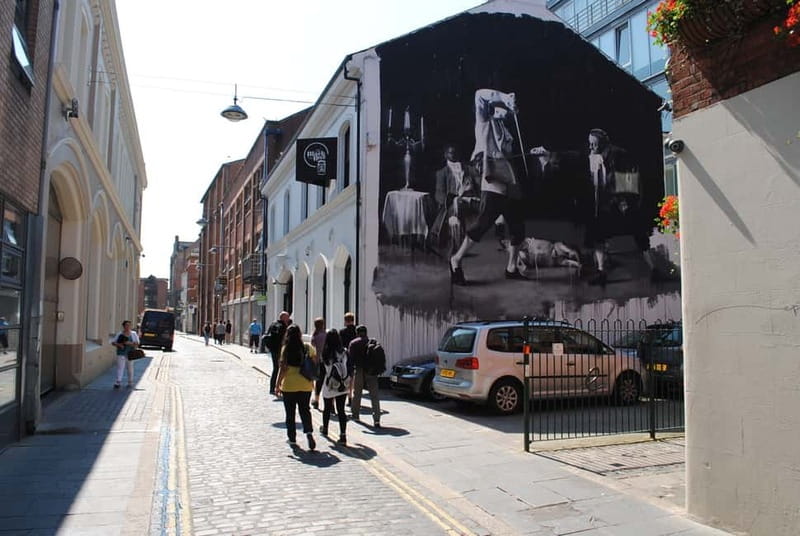
Review · UK
Belfast: A History of Terror Walking Tour
Belfast’s city centre can look calm and polished today, but this 2.5-hour walk shows you where fear, violence, and daily life once met. Starting at City Hall, you follow a local guide through places tied to the Troubles, with the streets themselves providing the classroom.
I like the personal local perspective, especially when guides such as Anne, Steve, James, and Mylie explain what it was like to grow up in Belfast during the conflict. I also like the balanced tone: the tour covers political divisions, paramilitary groups, the British Army, police, civilians, and the peace process without turning the past into a simple good-versus-bad story.
The main consideration is the subject matter. Bombings, deaths, fear, and community division are treated with care, but this is not light sightseeing. The tour is also English-only and packed with information, so you need a good standard of English to get the most from it.
Key points to know before you book
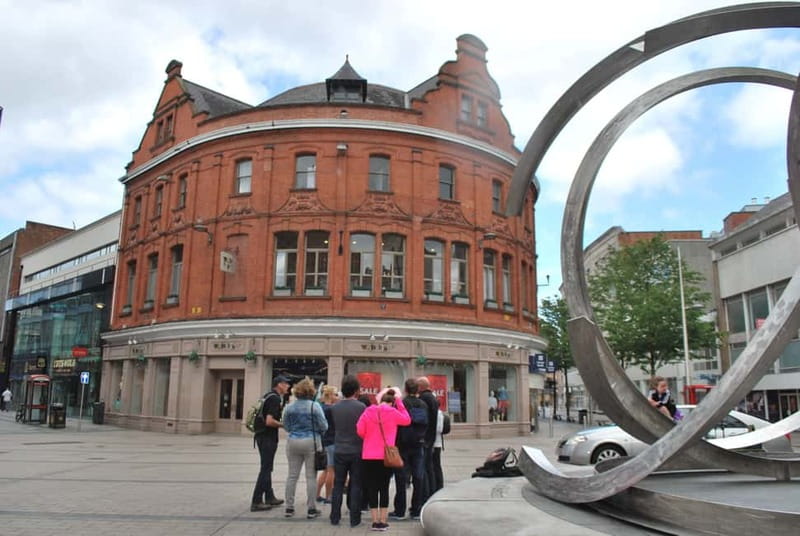
- The route begins at Belfast City Hall: This gives you a clear starting point for understanding Belfast’s political and civic story.
- You walk about 1.5 miles: The route is flat, with no hills or steps, but comfortable shoes still matter.
- The focus is the Troubles and their causes: You learn how centuries of division shaped the violence that began in the late 1960s.
- Local guides add personal context: Guides including James, Mylie, Anne, Steve, Chris, and others have explained the period through local experience and careful storytelling.
- The tour reaches beyond the violence: You hear how peace was achieved, how Belfast changed, and what challenges remain.
- Audio headsets are included: They help you hear the guide clearly, even when the group is moving through the city centre.
Starting at City Hall with 800 years of context
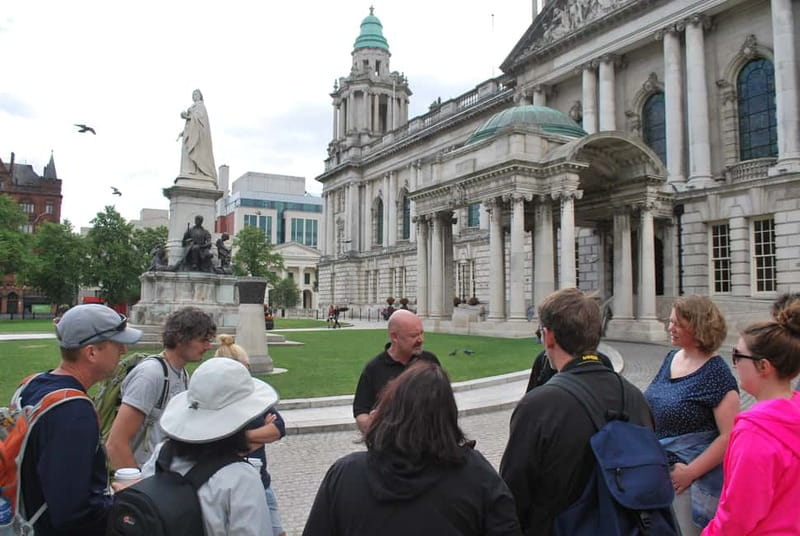
Meet at the front gates of Belfast City Hall in Donegall Square North. Look for a guide wearing a black jacket or T-shirt with the DC Tours logo on the left breast, and arrive about 10 minutes early.
The opening matters because the Troubles did not appear out of nowhere in the 1960s. Your guide first lays out the long story of Ireland’s division, British rule, religious identity, political power, and social inequality. You need that groundwork to understand why Belfast became the centre of the conflict.
This is one of the tour’s strongest choices. A short walk focused only on bomb sites can leave you with a grim list of dates and attacks. Here, you first get the political and social frame. Guides have been praised for making hundreds of years of history understandable in a limited time, without losing sight of ordinary people.
City Hall is also a practical place to begin. It is central, easy to find, and close to many of the locations used later in the walk. You are not spending the first part of the tour hunting for a meeting point in an unfamiliar district.
More History Walking Tours in the UK
- A History of Terror – Belfast City Centre Walking Tour
★ 5.0 · 2,883 reviews - Edinburgh: Old Town History and Tales Walking Tour
★ 4.8 · 2,361 reviews - Old Town Walking Tour History and Tales in Edinburgh
★ 5.0 · 2,168 reviews
Belfast city centre as the classroom
The route covers about 1.5 miles, all on flat city streets. The distance is modest, but the tour is information-heavy. You stop at around 10 locations, and each one adds another piece to the story.
At the sites of major bombings and attacks, your guide explains what happened and how the violence affected civilians, shops, workers, and public spaces. The point is not simply to show you where something terrible occurred. It is to help you picture how people continued shopping, commuting, working, and meeting friends while living with the possibility of an attack.
That contrast between routine and danger gives the tour much of its power. Belfast during the Troubles was not a city that stopped functioning completely. People still had jobs, families, errands, and social lives. But daily movement was shaped by fear, security checks, closures, warnings, and sudden violence.
You will hear about the effect on businesses and the city centre itself. A familiar street can carry a very different meaning once you learn what happened there. The guide’s role is important because many signs of the conflict are not obvious from the pavement today.
Former security cordons and the feeling of a divided city
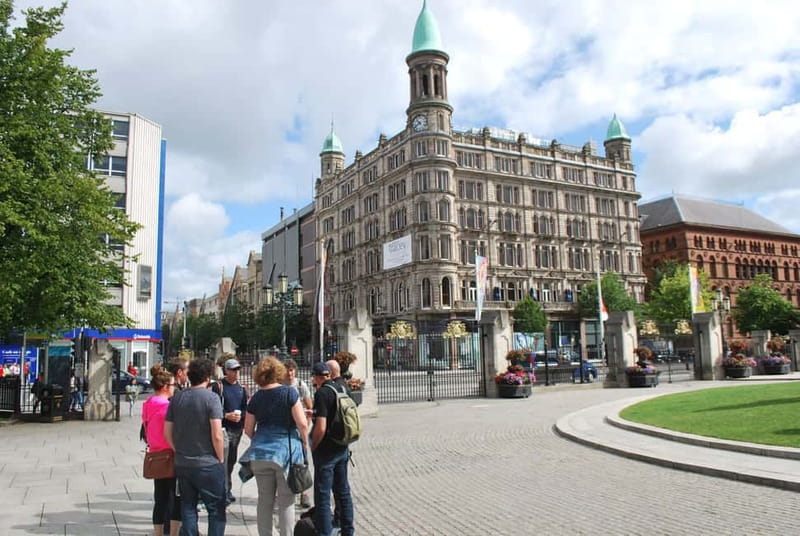
Former security cordon locations show how the conflict changed movement through Belfast. Barriers and controlled access points affected the way people entered, crossed, and used the city.
This part helps explain that the Troubles were not only a series of isolated attacks. They also shaped the physical experience of the city. Public space became linked to security, suspicion, and risk. A normal journey could involve delays, checks, or a changed route.
The tour also looks at the roles played by the British Army, police, and paramilitary organisations. That balance is important. The subject is politically charged, and the guide must explain several competing views without pretending that every action or consequence was the same.
Guides such as James, Steve, and Chris have been praised for presenting the subject in a clear and impartial way. That does not mean the stories are emotionally flat. You will hear about suffering and loss, but the presentation aims to give you enough context to understand why different groups acted as they did and how their actions affected people who had little control over the conflict.
Personal stories make the dates human
The strongest sections are often the personal ones. Local guides describe life in Belfast during the Troubles, sometimes drawing on their own experience of growing up there.
Anne, who was born and raised in Belfast, has explained the division of Ireland and the conflict through personal memories as well as historical facts. Steve has also spoken from the perspective of someone who lived through those years. Guides such as Mylie and Chris have been praised for combining personal experience with careful explanation.
That approach gives the tour a human scale. Instead of hearing only about organisations and political decisions, you begin to think about children, parents, workers, shopkeepers, and neighbours. You get a better sense of how fear and normality could exist at the same time.
The guides also use humour, but it is measured. James, Jim, Chris, and others have been noted for using light humour at suitable moments, helping the group stay focused during a long and serious walk. It is not comedy for its own sake. A small release can make difficult material easier to absorb.
The subject can be moving. You might find yourself needing a quiet moment, especially when the guide describes the impact on local people. The tour treats that response as part of understanding the past, not as something to play up for effect.
Same city, a different century:
- London Small Group Tour of Historical Pubs
★ 5.0 · 10,422 reviews - Edinburgh: Edinburgh Castle Guided History Tour with Tickets
★ 4.8 · 9,933 reviews - Edinburgh: Whisky Tasting with History and Storytelling
★ 4.9 · 2,451 reviews - Soho Music & Historic Pubs Tour
★ 5.0 · 1,993 reviews
The Forgotten Troubles Memorial and the unfinished story
The Forgotten Troubles Memorial provides a point for reflection. Its place in the route signals that the tour is not only about famous incidents or well-known political figures.
Here, the emphasis shifts toward people and experiences that can be overlooked. The memorial also helps bring the story into the present. Belfast has made major progress since the peace process, but peace does not erase grief, disagreement, or the memories carried by families and communities.
The guide explains the challenges that remain. You learn that post-conflict Belfast is a city still working through its past, rather than a place where every division has simply disappeared. That is a more useful picture than treating peace as a neat final chapter.
This part also gives the walk a more hopeful direction. The tour does not leave you among attack sites and old security barriers. It asks you to consider how reconciliation happens, what regeneration means, and how a city moves forward while remembering what came before.
Why the audio headsets are worth having
Every participant receives an audio headset. That may sound like a small detail, but it makes a real difference on a city walk.
You can hear the guide while standing near traffic, pedestrians, and other city noise. This is especially helpful if you have hearing difficulties, and it means the guide does not need to shout. The headsets also let you stay slightly spread out at stops instead of crowding tightly around the speaker.
The equipment supports the storytelling without getting in the way. You still walk beside the guide and see the streets directly, but you are less likely to miss a date, name, or explanation. With so much material covered in 2.5 hours, clear sound is part of the tour’s value.
A serious subject handled at a manageable pace
The tour lasts 2.5 hours, which is long enough to build a proper explanation but short enough to fit into a day of sightseeing. The route is not physically demanding. The flat streets and lack of steps make it suitable for wheelchair users, although weather and pavement conditions are still worth considering.
The pace has been described as comfortable, with stops spaced through the city centre. You are not rushing from one location to the next. Guides check that the group is following the story and, in some cases, make sure everyone is comfortable before continuing.
That said, you should expect sustained concentration. This is not a walk where you can tune in and out while taking photographs. The story moves from long-term causes to specific attacks, security measures, daily life, peace, and present-day challenges.
Children under 12 are not permitted. For older teenagers, the tour may be worthwhile if they have an interest in modern history and are ready for difficult topics. Parents should know that the content includes political violence and civilian suffering.
What the $35 price gets you
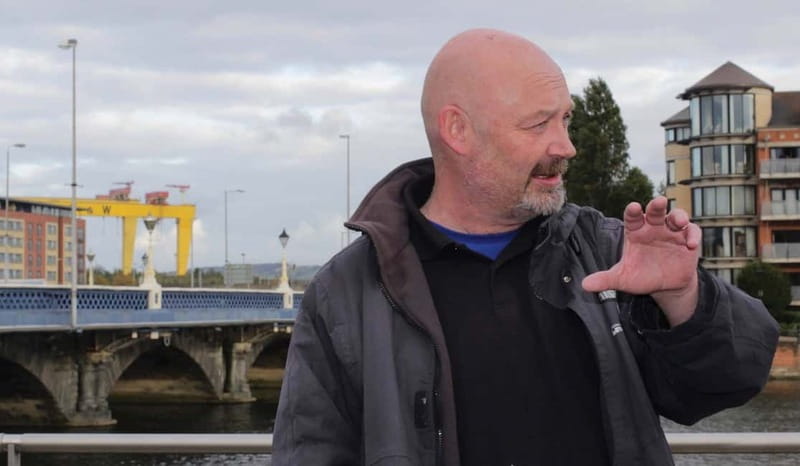
At $35 per person, the tour is priced above a simple orientation walk, but it offers much more than a general introduction to Belfast. You are paying for 2.5 hours of focused interpretation, a local guide, audio equipment, and access to a carefully connected story spread across the city centre.
I see the best value in the context. You could walk past many of these streets alone and see little evidence of what happened. The guide explains why particular sites matter, how events connected, and how the conflict shaped ordinary life.
The price is easier to justify if you are new to the Troubles or want a clear framework before visiting other Belfast sites. It also works well early in your stay, since the background can make later visits to museums, murals, memorials, or political districts more meaningful.
If you already have a strong academic understanding of Northern Ireland’s modern history, some of the early background may feel familiar. Even then, the local memories and city-centre locations may offer something different from reading about the conflict elsewhere.
Free cancellation up to 24 hours before the start and the reserve-now, pay-later option reduce the risk of fitting it into a changeable itinerary. The tour runs in all weather, so the price does not remove the need to prepare properly.
Rain, clothing, and practical comfort
Belfast weather can change quickly, and this tour goes ahead in rain. Wear comfortable shoes, bring weather-appropriate layers, and pack a waterproof jacket. Warm clothing is especially important in winter.
The route is short enough that you do not need specialist walking gear. The flat streets help, but you will still be outside for 2.5 hours, often standing while the guide speaks. A waterproof jacket is more useful than an umbrella because you need your hands free and must keep close enough to hear.
The meeting point at City Hall is central, and no transport is needed during the tour. The route stays within the city centre, making it easy to continue to another Belfast sight afterward.
Who will get the most from this walk
I would choose this tour if you want more than a quick look at Belfast’s attractive centre. It suits you if you are interested in modern Irish history, political conflict, peacebuilding, or the everyday lives of people caught in large events.
It is also a good choice if you prefer human stories to a museum label. The local guides explain the subject in person, answer the mood of the group, and add memories that a printed timeline cannot provide.
The tour may be less suitable if you want a relaxed sightseeing walk with only a little history. The name is accurate: the subject is terror, and the route deals with deaths, bombings, intimidation, and division. It is respectful, but it is not carefree.
You also need to be comfortable with an English-only tour. The information comes quickly, and understanding the details matters. If English is not your first language, a good command of English will help you follow the political terms and historical connections.
Should you book Belfast: A History of Terror?
Book it if you want to understand how Belfast became the centre of the Troubles and how the city is still working through that past. The best reasons are the local guides, the real city-centre locations, the personal stories, and the refusal to reduce the conflict to a simple political slogan.
I would try to take it near the start of your Belfast visit. You will see familiar streets differently afterward, and other historical sites will make more sense.
Skip it only if the subject is too heavy for your trip, or if you want a brief, scenic introduction rather than a serious history lesson. For most adults and older teens seeking context, $35 is fair value for a well-paced, thoughtful walk that connects Belfast’s past with its present.
FAQ
Where does the tour meet?
Meet at the front gates of Belfast City Hall on Donegall Square North in Belfast. The guide wears a black jacket or T-shirt with the DC Tours logo on the left breast.
How long does Belfast: A History of Terror last?
The tour lasts 2.5 hours.
How far do you walk?
The route is about 1.5 miles through Belfast city centre.
Is the route difficult?
The city centre is completely flat, with no hills or steps. Comfortable shoes are still recommended because you will be walking and standing outdoors.
Is the tour wheelchair accessible?
Yes, the tour is wheelchair accessible.
What language is the tour in?
The tour is available in English only. A good standard of English is needed to fully understand the information.
Is the tour suitable for children?
Children under 12 are not permitted. The subject includes political violence, bombings, deaths, and the human impact of the Troubles.
What should you bring?
Bring comfortable shoes and clothing suited to the weather. A waterproof jacket is recommended for rain, and warm clothing is advised during winter.
Can you cancel the booking?
Yes. You can cancel up to 24 hours before the tour for a full refund. You can also reserve now and pay later.
Just added around the UK
- Private tour of the stunning Cotswolds with an expert local guide★ 5.0 · 45 reviews
- Medieval Walking Tour of Chester★ 5.0 · 155 reviews
- Curious Cambridge – The History Tour that’s FUN!!!★ 5.0 · 80 reviews
- Birmingham Gangs Nighttime Historical Walking Tour with Pub Stops★ 5.0 · 53 reviews
- 2.5-Hours Walking Tour of Birmingham into Black Heritage Madiba★ 5.0 · 49 reviews
- Award Winning Private 2 Hour Belfast Political Black Taxi Tour★ 5.0 · 53 reviews
- Private Political History & Murals Tour Belfast★ 5.0 · 182 reviews
- Belfast Walking Tour: City Centre History, Troubles & Stories★ 5.0 · 39 reviews
UK History Tours, compared.
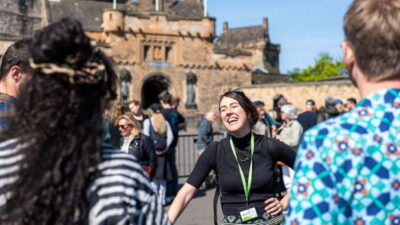
Edinburgh: Edinburgh Castle Guided History Tour with Tickets
Read our review →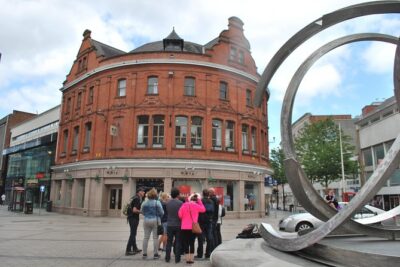
A History of Terror – Belfast City Centre Walking Tour
Read our review →
Edinburgh: Whisky Tasting with History and Storytelling
Read our review →
Edinburgh: Old Town History and Tales Walking Tour
Read our review →
Old Town Walking Tour History and Tales in Edinburgh
Read our review →
Edinburgh: Old Town and Underground Historical Tour
Read our review →Browse the lists this tour appears in