

Review · AMSTERDAM
Amsterdam: Private Pedicab Historical Sightseeing Tour
Amsterdam’s story unfolds quickly from the back of a pedicab. In two hours, you move from Dam Square and the oldest streets to the Amstel, Jewish Quarter, canal ring, and Museumplein, with local guide Bram de Haan explaining what you are seeing as you go. I like the private format, since you can ask questions and set a preferred finish. I also like the easy access to streets where cars cannot go.
The main drawback is the compact schedule. You see many districts, but most stops are brief, and this is not a museum tour or a long walking exploration. Check the weight limit carefully: the combined passenger weight is 200 kilograms, and the activity is not suitable for anyone over 100 kilograms.
Key points to know
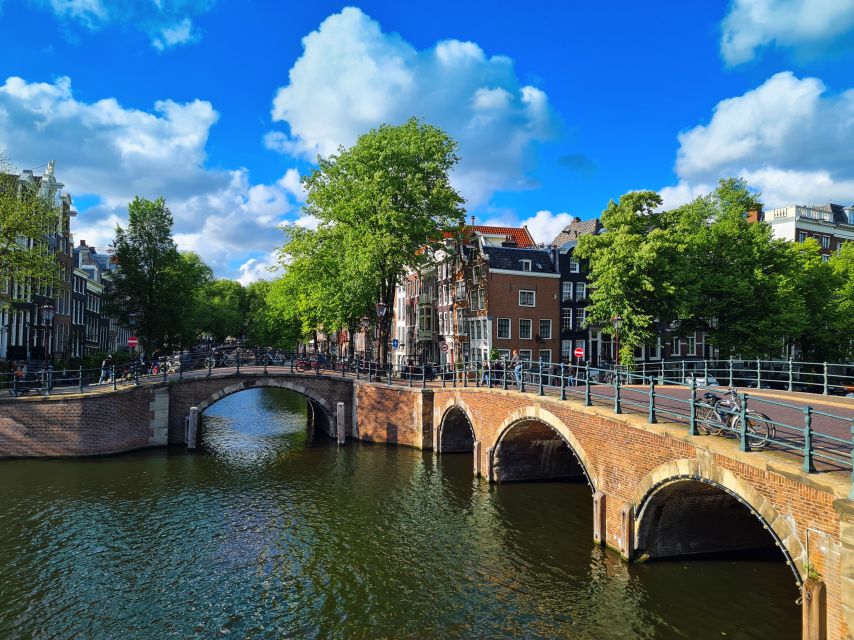
- Dam Square to Museumplein: Cover Amsterdam’s central sights in a logical route from the city’s birthplace to its major museum square.
- A local guide named Bram: Expect detailed explanations, old photographs, and maps that help show how Amsterdam changed over time.
- Private pedicab comfort: Hotel pickup and drop-off are included, with a blanket available in cold weather.
- Seven bridges and the Amstel: The ride includes some of the city’s best photo views, including the Skinny Bridge.
- Good for limited walking: You can see a lot while seated, although the pedicab is not suitable for passengers over 100 kilograms.
- Best for two people: At $230 per group, the cost is strongest when shared by a couple or two companions.
Why a pedicab works well in central Amsterdam
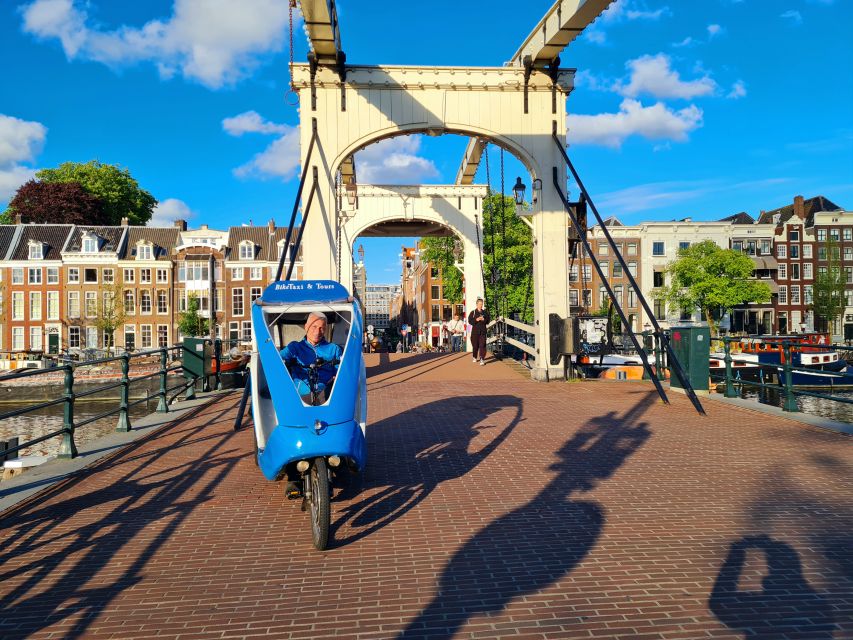
Amsterdam is easy to walk, but its center can ask a lot of your feet. The old streets, bridges, and canal paths make for a pleasant stroll, yet fitting every major district into one outing would take much longer than two hours.
A pedicab gives you a useful middle ground. You are outside, close to the streets, and able to look up at the canal houses instead of watching the road from inside a car. At the same time, you are not spending the whole tour keeping pace with a group on foot.
The small vehicle also matters in Amsterdam’s central streets. The route includes areas that are inaccessible to cars, so you can reach parts of the old center without dealing with a large vehicle. You remain seated while Bram handles the riding and points out details along the way.
This is a private tour for up to two people. That makes it a good choice for a couple, friends, or a parent and adult child who want one guide and an unrushed conversation. It is less suited to a larger family or a group looking for a lower per-person price.
The tour costs $230 per group, or $115 per person when two people share it. That is more than a standard group walking tour, but the price includes hotel pickup, drop-off, a private guide, and a route that covers several parts of Amsterdam. The value is strongest if you care about comfort, personal attention, and seeing a lot without a long walk.
More Private History Tours in Amsterdam
- Anne Frank and the Jewish History of Amsterdam Private Tour
★ 5.0 · 307 reviews - Private Boat Tour Amsterdam – 90 Min incl. welcome drink on historic saloon boat
★ 5.0 · 82 reviews - Amsterdam Private Historical Walking Tour
★ 5.0 · 75 reviews
Dam Square begins the city story
The ride starts at Dam Square, the main square in the old center. This is the natural place to begin because it marks the core from which Amsterdam grew.
You will see the Royal Palace, the New Church, and the National Monument. Bram uses the square to explain how the city developed, giving you a basic timeline before the route moves into older streets and neighborhoods.
Dam Square can feel busy, but the important point is not simply to take a picture and move on. It gives you a sense of Amsterdam’s political and civic center. The square connects royal power, religious buildings, public memory, and the city’s commercial past in one compact space.
The stop also helps you get your bearings. From here, the route moves into the old center, where the street plan is less formal and the canals begin to reveal how Amsterdam was built.
Zeedijk and the edge of Chinatown

Next comes Zeedijk, a street that once formed part of the dikes protecting Amsterdam. The name itself points to the city’s long struggle with water, a theme you will see again in the canals and along the Amstel.
One of the highlights here is the oldest cafe still standing with its original interior. The tour does not include food or drinks, so this is a look at the building and its setting rather than a tasting stop. That is worth knowing if you are hoping for a cafe break during the two-hour ride.
A little farther along, you get a glimpse of Chinatown. This is a short stop in a district known for its Asian businesses and street life, but the larger value is the way Zeedijk shows Amsterdam’s layers. An old defensive street, a historic cafe, and Chinatown sit close together, making the area a good example of how the center has changed without losing its older bones.
New Market and the old city gate
The route continues to New Market Square, where a 15th-century city gate occupies the middle of the square. It is one of the clearest places to see Amsterdam’s medieval past in built form.
Bram explains the role of the gate and the history of the square. This kind of context is useful because the building is easy to treat as a handsome old structure without understanding why it mattered. Here, the city’s defensive and commercial functions come together.
The stop is also a reminder that Amsterdam was not created all at once as a postcard of canals and narrow houses. It grew in stages. The older core, defensive works, waterways, and later merchant homes all fit into the same urban story.
More Private History Tours in the Netherlands
- Historic Amsterdam 2-Hour Private Tour with Local Guide
★ 4.9 · 53 reviews - Amsterdam: Private Anne Frank and Jewish History Tour
★ 5.0 · 26 reviews
Montelbaanstoren and the houseboats along Oude Waal
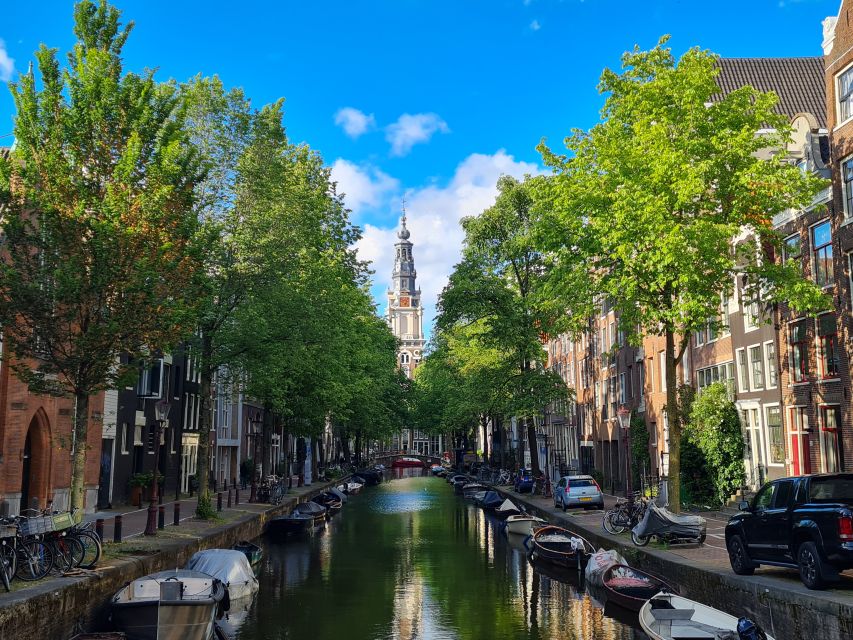
A few minutes later, you stop at Montelbaanstoren, an old watch and defense tower linked to Amsterdam’s expanded defenses in the early 16th century. Its location gives you more than a close look at the tower.
From here, you can look over the Oude Waal, where houseboats line the water with 17th-century canal houses behind them. This is one of the stronger viewpoints on the route because it combines living Amsterdam with older architecture.
The view also helps explain the city’s relationship with water. The canals are not empty decorative channels. They are part of the way Amsterdam was organized, defended, supplied, and inhabited. The houseboats add a modern layer, showing that the waterways still serve as homes as well as public spaces.
If photography matters to you, this is a worthwhile camera stop. The pedicab allows you to reach the viewpoint without turning the outing into a long walk.
The Jewish Quarter and Amsterdam’s wartime memory
The Jewish Quarter brings a more serious tone to the tour. You will see the Great Synagogue, described as the first synagogue Jewish people were allowed to build in Western Europe more than 350 years ago, along with the Portuguese Synagogue across the street.
Nearby, the Holocaust Names Monument carries the names of 102,000 Dutch Jewish victims of the Second World War on its bricks. The site needs time and attention. It is not just another quick landmark, and you may want a quiet moment to take in the scale of what it records.
Across from the monument is a row of 17th-century canal houses once inhabited by successful Sephardic Jewish immigrants involved in the diamond trade. This gives the neighborhood a fuller context. You see religious life, economic success, persecution, and remembrance in a small area.
Bram’s use of photographs and maps is especially useful here. A visual aid can show how a street or neighborhood changed over time in a way that a short spoken explanation cannot. The tour includes an in-depth explanation of the sights, but the pace still means you should ask if you want more time at a particular site.
The Hermitage and the Amstel
The ride then reaches the Hermitage, housed in a large 17th-century widowhouse. The building adds another kind of story to the route, showing how Amsterdam’s wealth shaped substantial homes and institutions along the water.
From there, you see the Skinny Bridge, one of Amsterdam’s best-known bridges. Its narrow white structure is especially attractive when lit at night, though a daytime tour gives you a broad view of the bridge and the Amstel.
This is also a prime photo location. The Amstel is the city’s main and widest canalized river, and the view opens up more than many of the tight canal streets. You get water, bridge, house fronts, and a wider sense of the city in one frame.
The tour does not promise a night departure, so do not book this outing expecting to see the bridge illuminated. Its nighttime lights are a useful fact about the landmark, not a guaranteed part of this daytime sightseeing route.
The 17th-century canal ring
The central part of the ride passes through Amsterdam’s canal district, the broad neighborhood of semicircular waterways around the old center. This is where you see many of the canal houses most people picture when they think of Amsterdam.
These homes were built for successful merchants, and their narrow fronts reflect the old city’s limited space. The houses are not identical, but they share features that can reveal when and how they were built. Bram explains those similarities, helping you read the buildings instead of simply passing them.
I like this part of the tour because it turns a pretty ride into a lesson in city design. You learn to notice the differences between houses, the curve of the canals, and the way the district wraps around the oldest center.
A practical note: the canal district is beautiful, but a two-hour route cannot stop at every bridge or street. If you have a particular canal house, church, or photo spot in mind, mention it to Bram early. The private format gives you some room to shape the experience, but the tour still has a planned route and a final stop.
Museumplein and the Rijksmuseum tunnel
The last major stop is Museumplein, a large green square from the 19th century and home to the Rijksmuseum and Van Gogh Museum. You do not enter either museum during this experience, so plan separate tickets and time if you want to see the collections.
The pedicab drives through the Rijksmuseum tunnel, an unusual way to approach the square. You then stop in the middle of Museumplein, where you can take in the open space and the museum facades.
This ending works well because it gives you a change of scale. The old center is tight, crowded with canals and narrow streets. Museumplein is broad and open, with major cultural institutions gathered around a lawn. It is a good place to finish a first look at Amsterdam before returning to your hotel or continuing on your own.
You can arrange a desired finish location in advance. That is useful if you would rather end near a museum, restaurant, or another part of central Amsterdam, though the exact arrangement should be made before the ride.
Guide style, comfort, and mobility
Bram de Haan is the named guide and provider of the experience. His approach combines spoken history with photographs and maps. That is valuable in Amsterdam, where the same canal or street may look very different when you see how it developed.
The strongest part of the guiding is the connection between places. You are not just told that a tower is old or that a canal house belonged to a merchant. You get a wider explanation of how Amsterdam grew, how Jewish communities shaped the city, and how the Second World War affected Dutch Jewish life.
The pedicab is also a practical choice if you have limited walking ability. Several people with reduced mobility found this format especially helpful because they could see major areas without walking between every stop. Still, you should not treat it as a fully accessible vehicle without checking your own needs. The supplied limits are clear: the combined passenger weight must not exceed 200 kilograms, and anyone over 100 kilograms should not book.
Cold weather is another consideration. A blanket is provided if conditions are chilly, but you should bring warm clothing. You are outside for the full ride, and the vehicle does not turn the experience into an indoor sightseeing tour.
The tour is offered in English, Dutch, and German. Food and drinks are not included, so plan a cafe stop before or after the ride rather than expecting one during the route.
Who should book this Amsterdam pedicab tour
I would choose this tour if I wanted a broad introduction to Amsterdam in one sitting. It is particularly useful on a first visit, when you want to understand how the old center, canal ring, Jewish Quarter, Amstel, and Museumplein fit together.
It suits couples and pairs who value privacy. It also works well for older adults or anyone who wants to limit walking while still seeing historic streets and open viewpoints.
I would not choose it if your main goal is extended time inside the Rijksmuseum, Van Gogh Museum, or synagogues. None of those admissions is part of the ride, and the tour focuses on exterior sights and street-level explanation.
I would also think twice if you want a slow photography tour. There are good photo stops, especially at Montelbaanstoren, the Amstel, Skinny Bridge, and Museumplein, but the route covers a lot of ground. Ask Bram when you want to stop, rather than waiting for him to guess.
Should you book it?
Book this private Amsterdam pedicab tour if you want history, comfort, and a wide route without committing to a long walk. Bram’s use of maps and photographs adds useful context, and the ride covers more than the standard canal-ring view.
The $230 price is fair for two people who want a private guide, hotel pickup, and a tailored finish. It is harder to justify for one person, unless avoiding walking and having a private guide are especially important to you.
Check the weight restriction before booking, wear warm clothes, and be realistic about the pace. If those points work for you, this is a pleasant and efficient way to get your first sense of Amsterdam.
FAQ
How long is the Amsterdam pedicab tour?
The tour lasts two hours.
How many people can join the private pedicab?
The price covers a private group of up to two people.
What is the price of the tour?
The listed price is $230 per group of up to two people.
Is hotel pickup included?
Yes. Pickup and drop-off are included, and you should wait outside in front of your hotel.
Where does the tour begin?
The route starts at Dam Square.
Where does the tour finish?
The standard route returns toward your hotel, but you can set a desired finish location in advance.
Which languages are available?
The live guide is available in English, Dutch, and German.
Is food or drink included?
No. Food and drinks are not included.
Is the tour suitable for someone with limited walking ability?
The seated pedicab format can help people with limited walking ability see Amsterdam with less walking. The combined passenger weight must not exceed 200 kilograms, and the activity is not suitable for anyone over 100 kilograms.
What should I bring?
Bring warm clothing. A blanket is available in cold weather.
Just added around Amsterdam
- Amsterdam Walking Tour: Urban Legends & History with local guide★ 5.0 · 39 reviews
- Amsterdam: Luxury Canal Cruise with Historic VR Experience★ 5.0 · 305 reviews
- Amsterdam: Anne Frank and World War II Walking Tour (TOP RATED)★ 4.5 · 72 reviews
- Small Group Tour to Nazi WWII concentration camp from Amsterdam★ 5.0 · 112 reviews
- Amsterdam 3 hrs Bike Tour – live guide En/Fr/De/Nl/Sp★ 4.5 · 138 reviews
- Amsterdam Haunted History and Ghost Walking Tour★ 5.0 · 47 reviews
- Guided Walking Tour Amsterdam – Legends, History & Ghost Stories★ 5.0 · 28 reviews
- LGBTQI+ History Tour of Amsterdam★ 5.0 · 123 reviews
Amsterdam History Tours, compared.

Amsterdam: Life of Anne Frank and World War II Walking Tour
Read our review →
Amsterdam: Dutch WWII Resistance Museum Entry Ticket
Read our review →
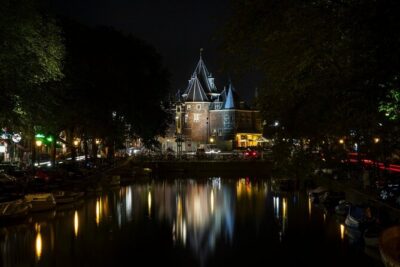
Amsterdam: Haunted History and Ghost Walking Tour
Read our review →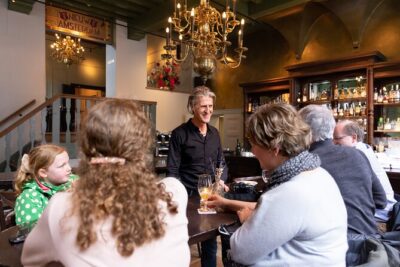
Amsterdam High-End Dutch Food & History Tour – Up to 8 guests
Read our review →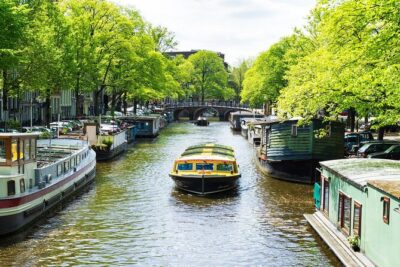
Amsterdam: Historic City Sightseeing Canal Cruise
Read our review →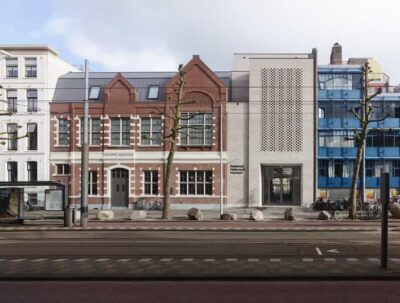
Amsterdam: National Holocaust Museum Entry Ticket
Read our review →
Anne Frank and the Jewish History of Amsterdam Private Tour
Read our review →Browse the lists this tour appears in