
Review · ATHENS
Ancient Athens tour: Acropolis, Parthenon and Acropolis Museum
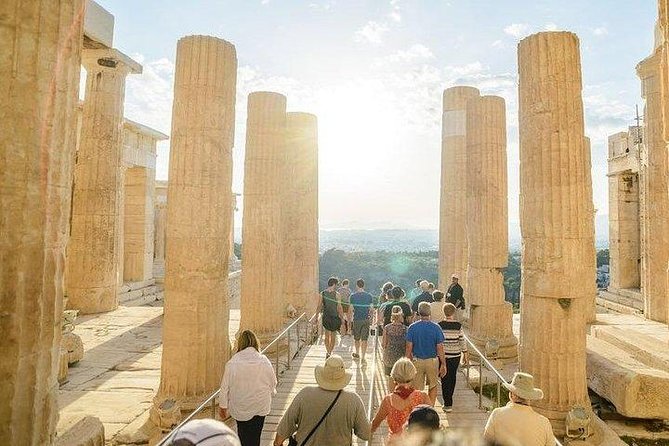
The best part of this Athens tour is the link between the Acropolis monuments and the Acropolis Museum. You see the Parthenon, Caryatids, ancient theater, and ceremonial gateway on the hill, then examine surviving sculpture and decoration in a cool, well-designed museum.
I like the small maximum group of 20 and the use of a licensed guide, with past guides such as Alexia, Lydia, Giannas, and John earning especially warm praise for clear explanations and good pacing. I also like the early 9 a.m. start, bottled water, and the chance to shape your time around the monuments.
The main catch is the ticket wording. The advertised price is $72.59 per person, but Acropolis and museum admission may cost extra unless you choose the ticket-inclusive option. The uphill paths can also be hot and slippery, so good shoes, sunscreen, and water matter.
Key points before you book
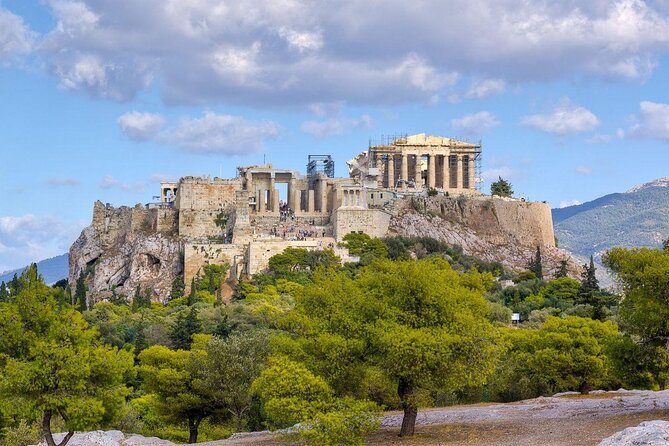
- The museum completes the Acropolis visit: You can connect the ruins on the hill with original sculptures and archaeological finds below.
- A licensed English-speaking guide leads the walk: Guides use stories, mythology, and local history to explain details that are easy to miss alone.
- The 9 a.m. start helps with heat and crowds: Earlier visits can be more comfortable, especially during sunny months.
- Admission may not be included: Check your selected option carefully. The Acropolis ticket is listed at €30 and the museum ticket at €20 when purchased separately.
- Expect a moderate physical outing: Ancient stone paths, steps, sun, and uneven surfaces call for sensible footwear and steady mobility.
- The group is capped at 20 people: That is large enough to keep the price reasonable but small enough for a guide to manage the group.
Why the Acropolis and museum belong together
Athens can tempt you into a quick photo at the Parthenon and a hurried walk away. That would miss much of what makes this site worth your time. The Acropolis is powerful in person, but the broken columns and weathered marble do not explain themselves.
A good guide gives the hill a human shape. You hear why the buildings were created, how mythology appears in the decoration, and how the monuments fit into the story of ancient Athens. Guides praised during this tour include archaeologists, teachers, and long-time specialists. Alexia, Lydia, Giannas, Efie, and John are among the names associated with clear, lively explanations.
The Acropolis Museum provides the second half of the lesson. Its displays hold objects found on the Acropolis and its surrounding slopes, covering periods from the Greek Bronze Age through Roman and Byzantine Athens. The building also sits over archaeological remains from Roman and early Byzantine Athens, adding another layer beneath your feet.
I especially like this pairing because the hill gives you scale and setting, while the museum lets you study the art at close range. You can look at the architecture outdoors, then see preserved decoration and sculpture indoors rather than trying to understand every fragment under the bright Greek sun.
More Ancient History Tours in Athens
- Athens: Acropolis & up to 5 Archaeological Sites Combo Pass
★ 4.2 · 13,904 reviews - Athens: Ancient Greek Theater Performance
★ 4.7 · 2,481 reviews - Historical Delphi One Day Tour with Arachova Stop & Expert Guide
★ 4.5 · 1,247 reviews
Starting at Porinou Street at 9 a.m.
The meeting point is Porinou 5, Athens 117 42, with a 9 a.m. start. The activity returns to this same meeting point, so you are not left wondering where the walk finishes.
The location is near public transportation, which helps if you are staying elsewhere in Athens. You will need to arrive ready for a walking tour, not a coach excursion. There is no hotel pickup listed, and the experience is conducted in English.
The group can reach a maximum of 20 people. That size is worth noting. You will not receive the same quiet, one-to-one attention as on a private tour, but the guide can still gather the group at selected points and explain the monuments without the cost of a private booking.
Communication is helped by listening devices on some tours. Several guides used microphones or earpieces so the group could hear in crowded areas. One practical warning is useful here: bring wired headphones if the tour company permits or requests them, since one participant found the audio difficult in some places. The supplied information does not guarantee a particular audio setup, so do not rely on being able to hear every word from the back of a group.
Walking up the Acropolis
The Acropolis portion lasts about two hours. This is the part where you should expect sun, stone, slopes, and a steady stream of people.
The climb is not described as extreme, but a moderate fitness level is required. The path can include smooth or slippery rock, especially where thousands of feet have polished the surface. Wear shoes with a firm grip. Sandals with slick soles are a poor choice, even if they look appealing in hot weather.
The Greek sun can be fierce. Bottled drinking water is provided, but you should still arrive hydrated and use sunscreen. A hat, sunglasses, and a small handheld fan can also be useful on a hot day. The early start is one of the tour’s practical strengths because heat and crowd levels generally become harder to manage later in the day.
Your guide will look for places where the group can stop without blocking the flow of people. Expect explanations in short sections rather than one long lecture. That works well at the Acropolis, where the best view may last only a minute before another group passes through.
You will have opportunities for photographs, but this is not a free-roaming two-hour visit. The guide needs to keep the group together and cover the major structures. One useful expectation to set is that you will gain much more context than on a self-guided walk, but you may have less uninterrupted time to wander alone.
The Parthenon and Athena’s hilltop temple
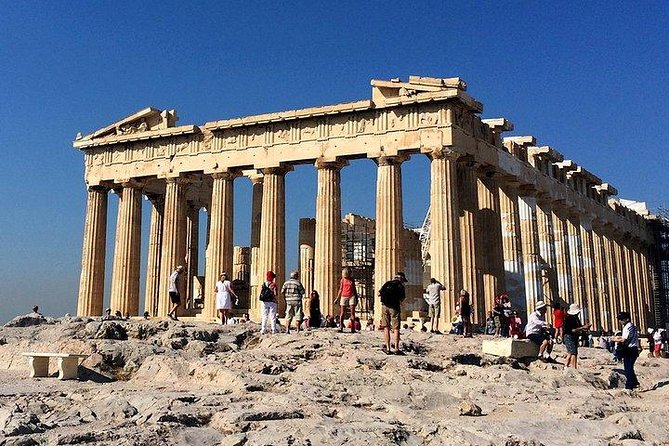
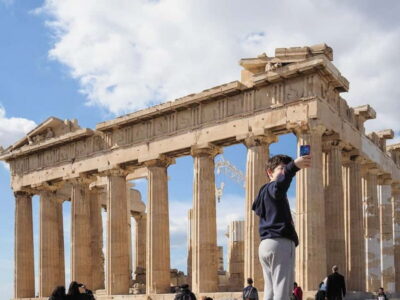
The Parthenon is the visual center of the visit. Built for Athena, the city’s patron goddess, it is more than a famous background for photographs. Its proportions, columns, sculpture, and position on the hill reflect the political and religious importance Athens gave itself in the ancient world.
The formal stop here is short, listed at about 10 minutes, but the guide’s explanation can turn that short pause into one of the strongest parts of the outing. You will likely discuss the temple’s purpose, its decoration, and what has survived or disappeared over time.
Do not expect to walk through the Parthenon interior. The value is in seeing the structure from the outside, understanding its setting, and learning how its design worked. Your guide may also point out surrounding views and other archaeological remains that would look like unrelated stones without explanation.
The hilltop can be crowded, even outside the main summer months. A capable guide matters here because the best gathering points change with the flow of people. Guides such as Alexia and Lydia were praised for keeping groups comfortable, finding shade, and allowing time for photographs while still moving the tour along.
More Ancient History Tours in Greece
- From Athens: Ancient Corinth Day Trip with Canal & VR Guide
★ 4.6 · 1,073 reviews - Acropolis, Parthenon & Athens Old City Heritage Walking Tour
★ 4.5 · 876 reviews - Private Biblical Tour Ancient Corinth & Isthmus Canal from Athens
★ 5.0 · 762 reviews - Athens: Ancient Corinth & Nafplio Full Day Trip with Swim
★ 4.8 · 531 reviews
Theater of Dionysus and the ancient performance world
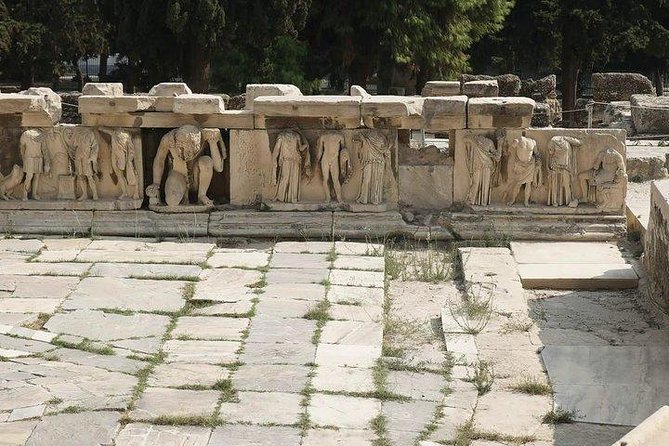
The Theater of Dionysus is one of the world’s important ancient theaters and receives a short stop of about 10 minutes. It sits on the southern slope of the Acropolis and helps you picture Athens as a place of public performance, not simply a collection of temples.
Theater in ancient Athens was tied to civic life, religious festivals, and the work of major playwrights. A guide can explain why the setting mattered and how the audience experienced performances. Without that context, the surviving stone seats can be easy to overlook.
The itinerary lists the Theater of Dionysus twice, each with a 10-minute stop. In practical terms, you should expect attention to this site during the Acropolis walk rather than two separate theater visits. The exact order can change as the guide manages crowds and the group’s pace.
This stop is useful for anyone who wants more than the standard Parthenon photograph. It gives the Acropolis a social side and helps explain how religion, drama, and public life were connected.
Herod Atticus Odeon and the Propylaea
The Herod Atticus Odeon is another 10-minute stop. This Roman-era theater is still used for performances, which makes it easier to connect the ancient structure with present-day Athens. The curved seating area and stage setting are impressive even when you see them from above rather than entering for a show.
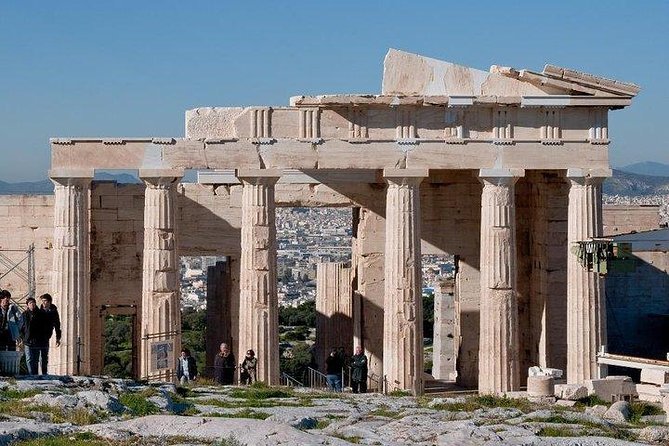
The Propylaea, the monumental gateway to the Acropolis, also receives about 10 minutes. It is the entrance that framed the approach to the sacred hill, and its scale helps explain how carefully visitors were led into this important area.
These brief stops work best when the guide explains what you are seeing before you move on. The stonework can look fragmentary, but the placement of the buildings tells you how the Acropolis was organized. You will also have chances to look outward across Athens, although the amount of free viewing time depends on crowd movement and the guide’s schedule.
The Caryatids at the Erechtheion
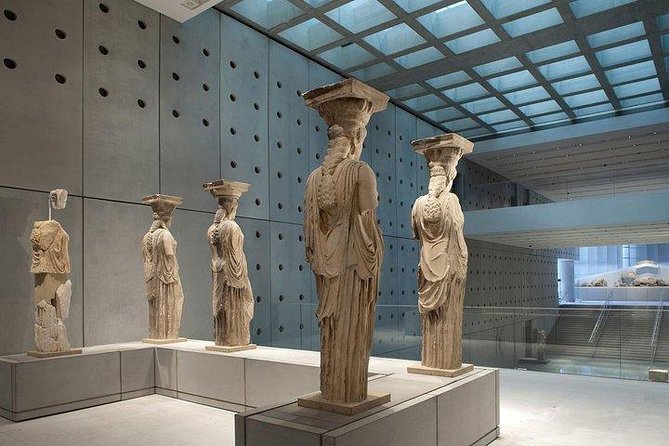
The Erechtheion is best known for its Caryatids, the sculpted female figures that serve as architectural supports on the porch. This is one of the easiest places to pause for a close look at the relationship between sculpture and building design.
The women you see on the Acropolis are replicas. Several original Caryatids are preserved in the Acropolis Museum, with another held in the British Museum. That is one reason the museum visit matters: outdoor monuments often show you the setting, while indoor displays preserve the finer details.
The stop is listed at about 10 minutes. Your guide can explain the religious importance of the building and the meaning attached to the figures. You will want photographs, but take time to notice the folds of the clothing, the posture, and the way the figures carry architectural weight.
One hour inside the Acropolis Museum
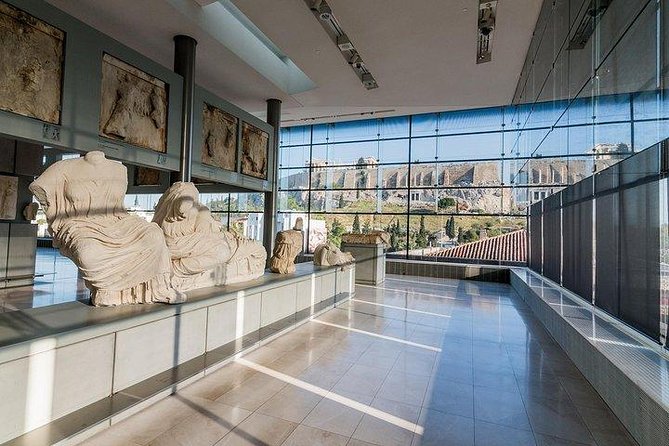
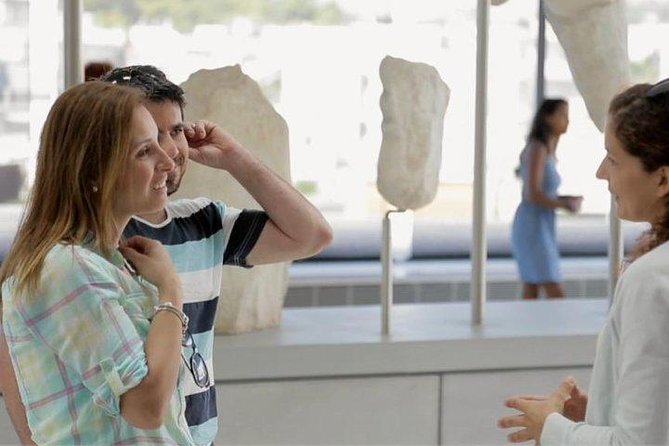
The museum portion lasts about an hour with the guide. Afterward, you may be encouraged to remain longer on your own, which is a useful arrangement if you want extra time with a favorite gallery.
The museum focuses on objects found on the Acropolis and nearby slopes. Its collection reaches from the Bronze Age through later Greek, Roman, and Byzantine periods. That range helps you see the Acropolis as a site with a long life, not a single moment frozen in the fifth century BC.
The building’s design is also part of the experience. It lies over archaeological remains from Roman and early Byzantine Athens, so the museum visit adds a second archaeological site beneath the galleries. You get a change from the exposed stone of the hill, with a more controlled setting for looking closely at sculpture and architectural fragments.
Several guides have been praised for helping visitors connect the museum to what they had just seen outdoors. That connection is the key. When you see a missing sculptural detail or preserved decorative element inside, the Parthenon and Erechtheion become easier to read.
The hour goes quickly. If you want a long, quiet museum visit, plan to stay after the guided portion if your schedule allows. The tour gives you a strong introduction, but the museum can support much more time than the basic itinerary provides.
What the $72.59 price really covers
At $72.59 per person, this is not the cheapest way to see the Acropolis. The value depends heavily on the ticket option you select.
The tour includes a licensed guide. Acropolis admission is listed separately at €30 per person, and museum admission at €20 per person unless you choose an option that includes the tickets. If you arrive without tickets, the information provided says you may be able to buy them in cash from your guide at the meeting point. I would still check the exact booking choice before paying, since the difference between a guide-only package and a ticket-inclusive package can change the final cost and reduce uncertainty on the morning.
The price makes more sense for you if you want clear explanations, crowd management, and a planned route through both the hill and museum. It makes less sense if you prefer to move alone, read at your own pace, and spend several hours in the museum.
A licensed guide is particularly useful at the Acropolis because the stones do not come with labels at every turn. The strongest guides on this experience use mythology, architecture, humor, and stories about daily life rather than reciting dates. That human touch is where the tour earns its fee.
Who will enjoy this tour most
I would recommend this experience to first-time visitors who want the major Acropolis sights in one morning. It also suits anyone who prefers a guide at archaeological sites and wants the museum included rather than left as a separate decision.
Families and mixed-age groups may appreciate the breaks, water, and clear structure. The guides are described as patient and attentive to shade, comfort, restroom timing, and group pace. Still, the uneven uphill surfaces mean that every participant should be comfortable with moderate walking.
This is also a good choice for visitors with only part of a day in Athens. The four-hour format covers the essential monuments without requiring a full day. If you are visiting from a cruise port, allow extra time for transportation to the Porinou Street meeting point and avoid booking a tight departure afterward.
You may prefer another format if you want a private guide, a slower archaeological study, or extensive time alone at each monument. The group cap of 20 is reasonable, but it remains a group tour.
Practical advice for a smoother morning
Arrive ready to walk. Wear shoes with grip, apply sunscreen before meeting the guide, and bring a hat and sunglasses. Water is provided, but do not wait until you feel thirsty to drink.
Choose the earliest available start when possible. The 9 a.m. departure helps, and several guides have been praised for taking groups out before the worst heat and crowd levels. Athens can remain busy even in September, so an early visit is not a guarantee of empty paths.
Keep your expectations flexible. The guide may change the order of stops to find a usable place to speak or to avoid a thick knot of people. That is a benefit, not a flaw, as long as you understand that the schedule is a guided route rather than unlimited personal exploration.
Under-25 visitors should carry a physical passport or identity card if they want to confirm eligibility for a reduced price. A digital copy may not be enough, so bring the original document.
Free cancellation is available up to 24 hours before the start time for a full refund. Changes or cancellations made inside that 24-hour window are not accepted for a refund.
Should you book it?
Book this tour if you want the Acropolis, Parthenon, major hilltop monuments, and museum in one organized morning, with a licensed English-speaking guide to explain what you are seeing. The museum is not an optional afterthought here. It is the part that helps you understand the missing sculpture and decoration on the hill.
Before booking, confirm if your selected price includes both the €30 Acropolis ticket and the €20 museum ticket. Then prepare for heat, slippery stone, and a moderate walk. If those conditions suit you, this is a strong way to make Athens’ most famous site feel like a connected story rather than a list of ancient ruins.
FAQ
How long does the Ancient Athens tour last?
The experience lasts approximately four hours, including about two hours at the Acropolis and about one hour at the Acropolis Museum.
What time does the tour start?
The listed start time is 9 a.m.
Where does the tour meet?
The meeting point is Porinou 5, Athina 117 42, Greece.
Where does the tour finish?
The activity ends back at the meeting point.
Is the tour offered in English?
Yes. The tour is offered in English.
Is an entrance ticket included?
It depends on the option you select when booking. Acropolis and museum admission are excluded unless you book the ticket-inclusive option.
How much are the listed entrance fees?
The Acropolis entry fee is listed as €30 per person, and the Acropolis Museum entry fee is listed as €20 per person.
What is included in the tour price?
A licensed tour guide and bottled drinking water are included. Mobile ticketing is also listed as a feature.
How large is the group?
The activity has a maximum of 20 travelers.
What should visitors under 25 bring for a reduced price?
People under 25 should bring their physical passport or identity card to confirm eligibility for a reduced price.
Is the tour physically demanding?
A moderate fitness level is recommended. The route includes an uphill walk and potentially slippery stone surfaces.
Can I cancel for a full refund?
Yes. You can cancel at least 24 hours before the experience start time for a full refund. Cancellations or changes made less than 24 hours before the start time are not accepted for a refund.
Just added around Athens
- Small-Group Women History in Ancient Greece Walking Tour★ 5.0 · 38 reviews
- The original Christian tour on Paul’s footsteps in Athens and ancient Corinth★ 4.5 · 25 reviews
- Ancient Athens Segway Tour with Agora and Kerameikos★ 5.0 · 94 reviews
- Ancient Sparta & Mystras Private Day Tour from Athens★ 5.0 · 52 reviews
- Athens National Archaeological Museum E-Ticket with Audio Guide★ 3.0 · 57 reviews
- Ancient Corinth, Sanctuary of Hera, Blue Lake & Canal from Athens★ 5.0 · 26 reviews
- Half Day Historical Athens City Private Taxi Service Tour★ 5.0 · 79 reviews
- Biblical Corinth Taste Faith & History with wine & Oil Tasting★ 5.0 · 28 reviews
Athens History Tours, compared.
Athens: Acropolis & up to 5 Archaeological Sites Combo Pass
Read our review →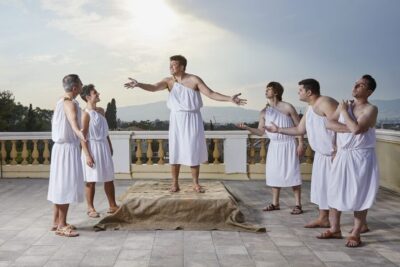

Historical Delphi One Day Tour with Arachova Stop & Expert Guide
Read our review →
From Athens: Ancient Corinth Day Trip with Canal & VR Guide
Read our review →
Historic Athens: Small Group Electric Bike Tour
Read our review →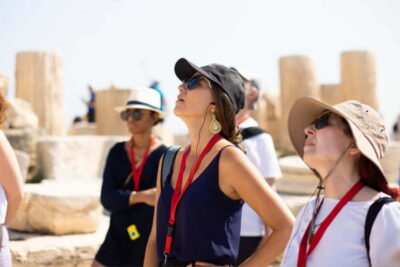
Acropolis, Parthenon & Athens Old City Heritage Walking Tour
Read our review →
Private Biblical Tour Ancient Corinth & Isthmus Canal from Athens
Read our review →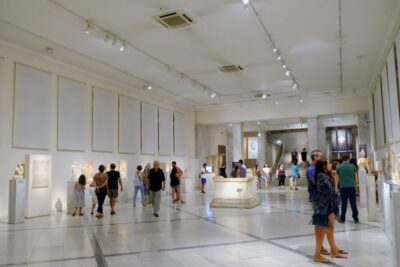
Athens: National Archaeological Museum Ticket w/ Opt. Audio
Read our review →Browse the lists this tour appears in