Review · ATHENS
Athens: Ancient Agora E-Ticket and Audio Tour
The Ancient Agora is where Athens’ democracy took shape, and this self-guided tour gives that idea a clear storyline. I like the offline audio commentary, which works without data inside the site, and the freedom to pause for photos, museum exhibits, or a shady rest. The Agora Museum, Pnyx, Mars Hill, and the prison associated with Socrates give the visit more range than a simple walk among ruins.
The main drawback is navigation. Some paths run side by side, and the directions can feel vague, especially if you are trying to listen, take pictures, and find the next stop at once. Bring a charged phone and headphones, download everything before arrival, and allow closer to two hours if you want the visit to feel unhurried.
Ancient Agora highlights at a glance
- Follow democracy from Solon to the popular assembly: The audio tour explains how legal reforms and civic institutions helped shape early Athenian government.
- See the Bouleuterion and Tholos area: These ruins connect the stones beneath your feet with the daily work of drafting laws and proposals.
- Visit the Agora Museum: Exhibits explain both the ideals and the harsher defenses of Athenian democracy.
- Look across Athens from Pnyx and Mars Hill: These hills provide some of the tour’s best Acropolis views.
- Add Socrates and ancient theater to the story: The route includes the prison associated with Socrates and ends near the Theatre of Dionysus.
- Use your phone offline: The ticket and audio tour must be downloaded before you enter because there is no internet access in the archaeological site.
Why the Ancient Agora deserves time
Most first-time visits to Athens focus on the Acropolis. That makes sense, but the Ancient Agora explains how the city worked below the hilltop temples. This was not only a field of broken columns. It was a civic center where people met, traded, debated, worshipped, passed laws, and took part in public life.
I like this tour because it gives the ruins a question to answer: how did Athens move from rule by a few powerful families toward a system in which citizens helped govern the city? The answer is not simple, and the audio commentary takes you through the chain of changes rather than treating democracy as something that appeared overnight.
The tour lasts about 90 minutes to two hours. You can move at your own pace, which matters here. Some remains are easy to miss when you are walking alone, while other stops deserve a pause to look at the ground plan and imagine the activity that once filled the space.
The Ancient Agora is also less tightly programmed than a guided group excursion. You are not following a guide’s flag or waiting for a whole group to finish at each stop. That freedom is useful if you want to spend extra time in the museum or stop often for photographs.
More Ancient History Tours in Athens
- Athens: Acropolis & up to 5 Archaeological Sites Combo Pass
★ 4.2 · 13,904 reviews - Athens: Ancient Greek Theater Performance
★ 4.7 · 2,481 reviews - Historical Delphi One Day Tour with Arachova Stop & Expert Guide
★ 4.5 · 1,247 reviews
From Hephaestus to the first civic reforms
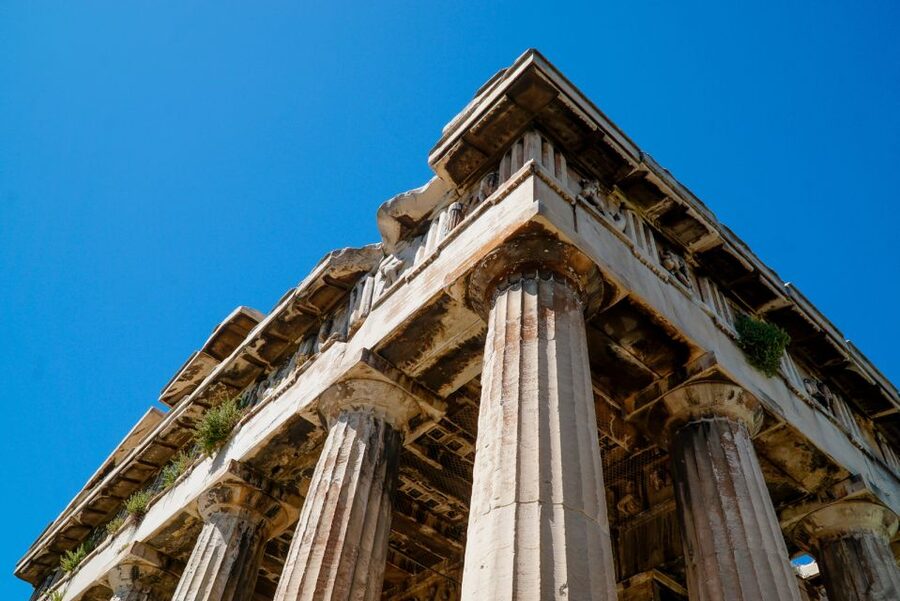
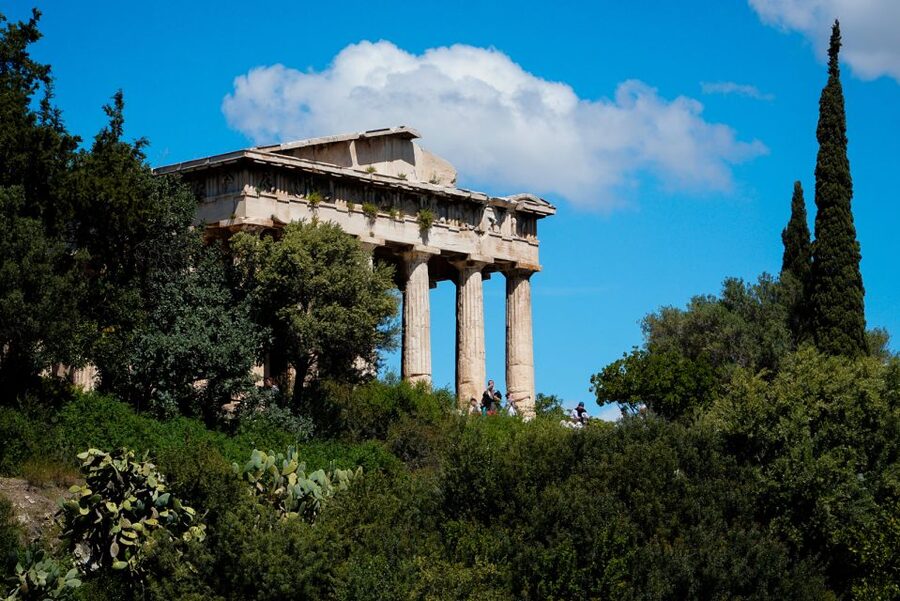
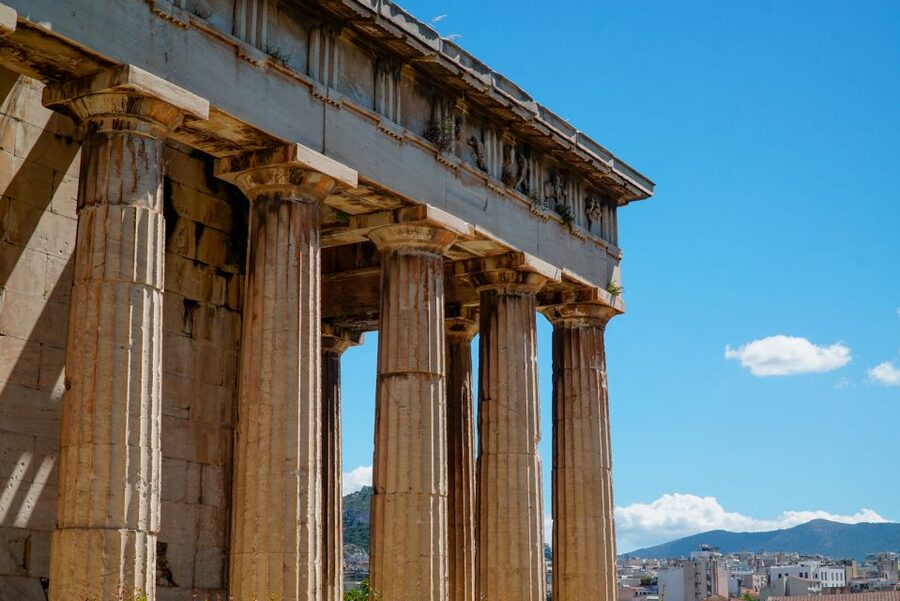
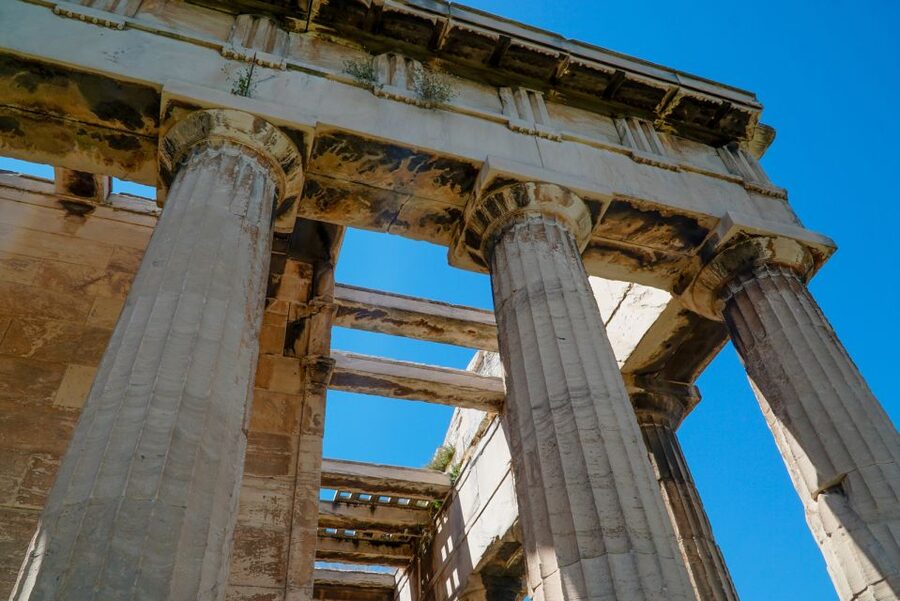
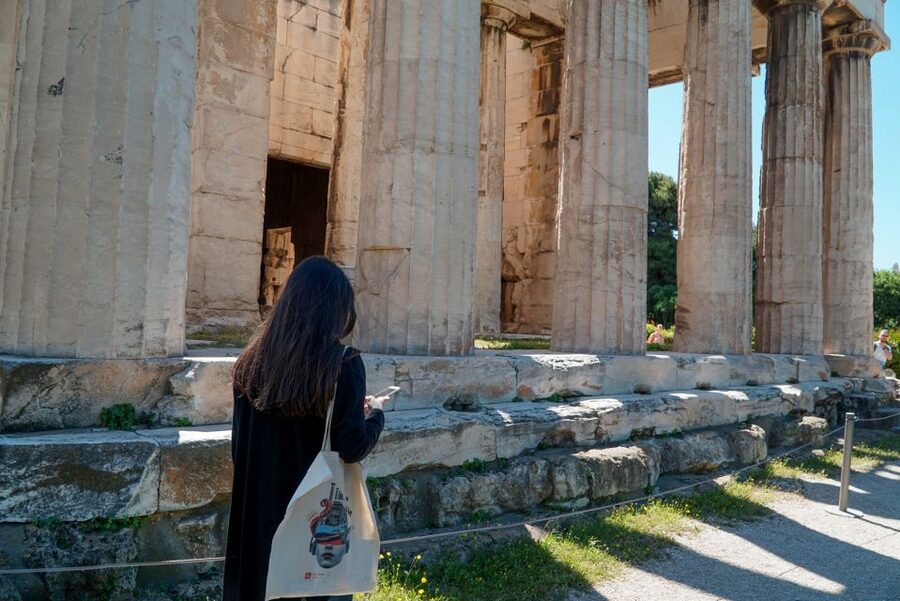
Your introduction begins near the Temple of Hephaestus, one of the best-preserved ancient temples in Athens. Its position above the Agora makes it an immediate landmark, and the audio sets up the political story before you begin examining the smaller ruins.
The opening focuses on Solon and his legal reforms. You do not need to arrive with a detailed grasp of Athenian political history. The commentary explains how changes in law helped create the conditions for an early form of civil society.
This is a strong starting point because it keeps the visit from becoming a parade of names and stones. You hear why the Agora mattered, then begin connecting individual buildings to the wider political system. If you prefer a quick sightseeing stop, this section may feel more academic than expected. If you want context, it gives the entire route a useful backbone.
The audio is available in English, Italian, Greek, German, Spanish, and French. Its tone is designed for independent listening, with anecdotes about figures such as Aristides the Just and Pericles alongside explanations of the institutions around you.
The Tholos and Bouleuterion: democracy at work
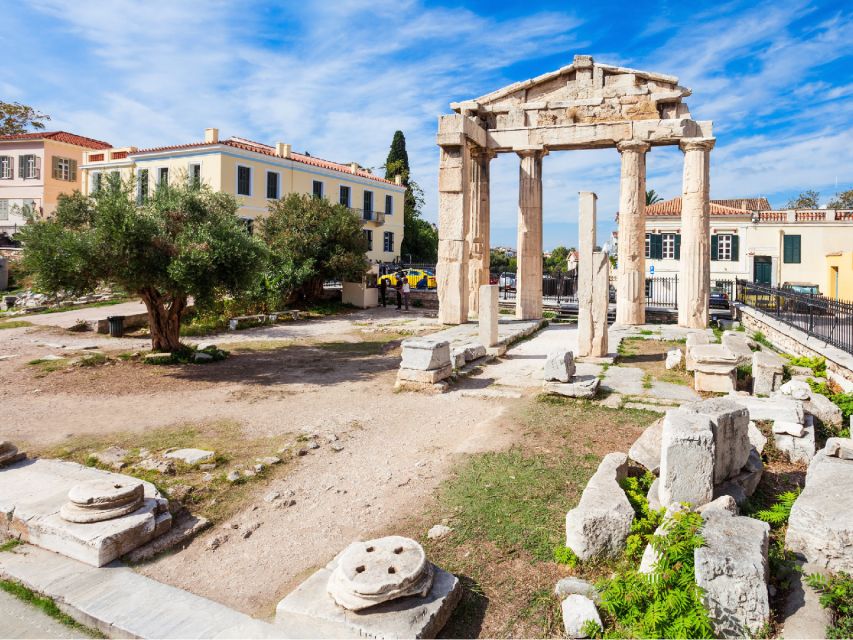
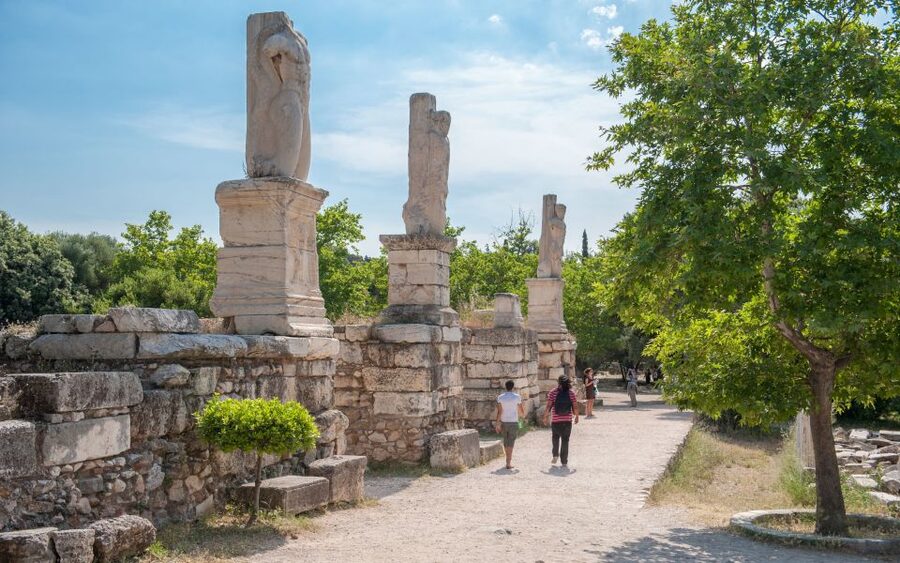
Near the Tholos, you come to the remains of the Bouleuterion, where 500 Athenians met to prepare laws and proposals for presentation to the popular assembly. The ruins are not visually grand in the way the Parthenon is, but the political idea behind them is enormous.
This is one of the places where an audio guide earns its price. Without explanation, the Bouleuterion can look like another low arrangement of foundations. With the story, you begin to picture the routine work behind public decisions: meetings, proposals, administration, and the handling of city business.
The tour also introduces the safeguards and punishments used to protect Athenian democracy from perceived threats. Some methods were ingenious. Others were severe. The museum later adds more detail, so listen closely here and keep the political ideals in balance with the system’s limits and cruelty.
The route’s directions are not always perfectly clear. Parallel paths and lightly marked ruins can make it hard to tell exactly where a stop begins. I recommend pausing the audio when you reach a confusing junction rather than walking while trying to solve the map. The offline map helps, but it does not remove every bit of guesswork.
The Agora Museum and its overlooked upper floor
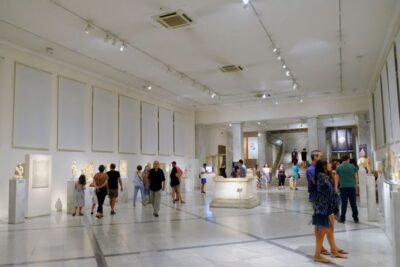
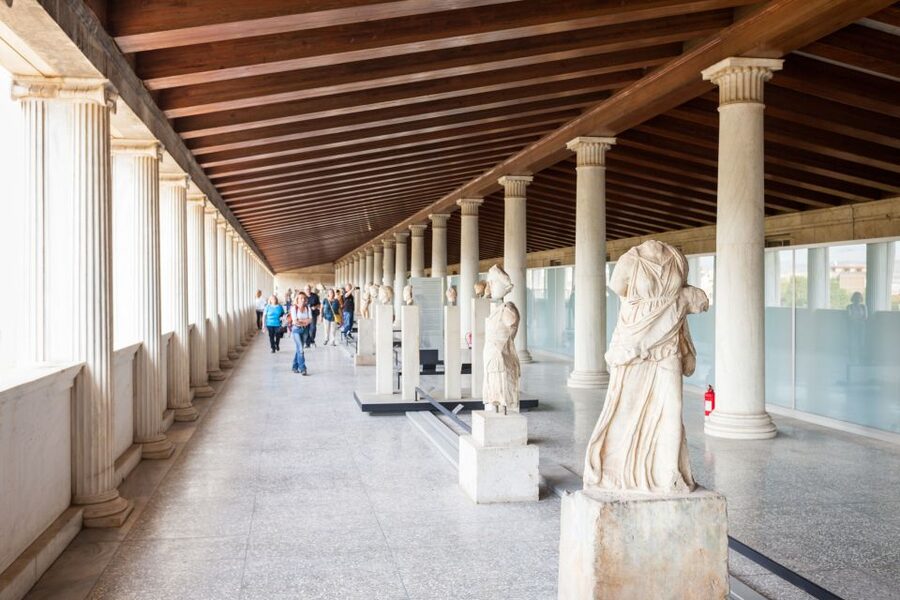
The Museum of the Ancient Agora is housed in the reconstructed Stoa of Attalos. It provides a welcome change from the open archaeological ground, especially in hot weather, and offers objects that explain how the Agora functioned.
The exhibits show the practical side of Athenian public life. You will encounter material connected with civic institutions and with the ways Athenians attempted to defend their political system. The museum makes clear that democracy was not only speeches and ideals. It depended on rules, records, procedures, and sometimes harsh decisions.
Give the museum more time than a quick pass through the lower galleries. The second floor is especially easy to overlook, yet it offers an unusual view down toward the Panathenaic Way. That higher angle helps you read the site as a connected urban center instead of a collection of isolated ruins.
The museum also gives you a break from full sun. That practical detail matters in Athens, where a slow walk over exposed archaeological paths can become tiring. The audio tour continues to guide the visit, but you can stop the recording as needed. One useful caution: the app may stop playing if you zoom in to take a photo, so check that the commentary has resumed before walking on.
More Ancient History Tours in Greece
- From Athens: Ancient Corinth Day Trip with Canal & VR Guide
★ 4.6 · 1,073 reviews - Acropolis, Parthenon & Athens Old City Heritage Walking Tour
★ 4.5 · 876 reviews - Private Biblical Tour Ancient Corinth & Isthmus Canal from Athens
★ 5.0 · 762 reviews - Athens: Ancient Corinth & Nafplio Full Day Trip with Swim
★ 4.8 · 531 reviews
Pnyx and Mars Hill for the best views
The route takes you toward the Pnyx and the Rock of Ares, also called Mars Hill. These locations add scenery to the political story. From the higher ground, you get postcard-style views toward the Acropolis and a better sense of how the ancient city was arranged around its central civic spaces.
The Pnyx is especially important to the theme of the tour because it is tied to the popular assembly. The Agora explains the preparation of public business, while the Pnyx helps you think about the public gathering itself.
Mars Hill brings another layer to the walk. The view is the immediate reward, but the setting also helps explain why hills and open meeting places mattered in ancient Athens. I would plan to pause here rather than treating it as a quick audio stop. It is one of the places where the connection between geography and public life becomes easier to grasp.
The route is not suited to everyone. Some points are not wheelchair accessible, and the activity is specifically not suitable for wheelchair users. Comfortable shoes are important for all visitors, since the walk crosses archaeological paths and includes uphill sections.
The prison of Socrates and the human side of the story

The tour continues toward the prison associated with Socrates on the hill of Philopappos. The stop offers a change of mood. Instead of focusing only on institutions and famous statesmen, the audio turns toward the life and death of a philosopher whose ideas remain tied to Athens.
You will hear more about Socrates and the circumstances around his final days. The prison is not a grand monument, and the significance depends heavily on the explanation. This is where the audio format helps, provided you take time to listen rather than simply photographing the entrance and moving on.
One particularly memorable thread concerns Samuel the Cobbler and his relationship with Socrates. It is the sort of personal anecdote that gives the political story a human scale. Rather than seeing ancient Athens only through temples and major leaders, you get a glimpse of ordinary connections and the city’s intellectual life.
The route toward this area may feel less direct than the first part of the Agora. Keep the offline map open and pay attention to the stop names. If you are already tired, this is the point where the two-hour version of the visit becomes more realistic than the 90-minute version.
Ending near the Theatre of Dionysus
The tour ends within easy reach of the Acropolis archaeological area, in front of the Theatre of Dionysus. This makes the experience useful as part of a larger day in central Athens. You finish with ancient theater, not another political building.
The theater is connected with Aeschylus, Sophocles, and Euripides, whose tragedies were performed there. Seeing the place where those works were staged gives the final stop a satisfying connection to the civic story. Athens’ democracy was not only assemblies and laws. It also created a public culture of drama, argument, performance, and shared ideas.
Do not assume the ending means you have completed an Acropolis visit. The Ancient Agora ticket covers the Agora site, while the surrounding attractions have their own entry arrangements unless you have a separate combination ticket. If you plan to visit both the Agora and the Acropolis, check the ticket options carefully before booking.
Is $30 a fair price?
At $30 per person, this is not the cheapest way to enter the Agora. The value depends on how much you want from the visit. If you only need admission and are happy reading signs or using a guidebook, a standalone ticket may suit you better.
For many people, the audio element makes the cost reasonable. You receive the entrance ticket, a self-guided tour, and offline map content in one purchase. A live guide would offer more immediate help with directions and questions, but this option lets you stop, replay, and move on without waiting for a group.
The price also makes more sense if you use the full route. Spend time in the museum, climb toward the viewpoints, and follow the story to Socrates and the Theatre of Dionysus. If you rush through the main ruins and leave after 45 minutes, you are not getting the full benefit.
A combination ticket covering the Agora and Acropolis may be worth checking for your plans. The attraction itself is worth visiting, and pairing it with the Acropolis can make better financial sense than buying separate admissions, depending on the available ticket rules at the time of your visit.
What to do before you arrive
The most important preparation takes place before you reach the entrance. You receive the Ancient Agora e-ticket and audio-tour instructions in a separate email from the local partner. Check your spam folder if the message is not visible.
Download the ticket and the entire audio tour while you have internet access. There is no internet access inside the archaeological site, so do not assume you can sort out the app at the gate.
Bring:
- A charged Android or iOS smartphone
- Headphones
- Comfortable shoes
- Your downloaded e-ticket
The app does not work with Windows phones, iPhone 5 or 5C and older models, older iPod Touch devices, or older iPads listed in the activity information. Large bags and luggage are not allowed, so pack lightly.
At the entrance, use the ticket validating machines. The GetYourGuide voucher itself is not accepted as the admission ticket. You need the separate e-ticket, printed or downloaded on your phone.
The entry rules for reduced or free admission also matter. EU students and minors can enter free with the required identification, but they must queue for a zero-value pass. Non-EU students and people over 65 may qualify for reduced admission, though they need to queue at the ticket office. If one of those categories applies to you, the $30 adult ticket may not be the best choice.
Who will enjoy this audio tour?
I would recommend it to independent visitors who want more context than a sign provides but do not want to join a fixed-time group. It suits history fans, first-time Athens visitors, and anyone interested in the origins of democracy, civic life, and classical theater.
It is also a good choice if you like taking your time. You can linger in the museum, pause for views, or replay a section without holding up a group.
You may want another option if you need a fully accessible route, personal help with navigation, or the chance to ask questions throughout the visit. The directions can be vague in places, and there is no live guide. Families with young children should also consider whether a political and historical audio tour lasting up to two hours matches their interests.
Should you book the Ancient Agora audio tour?
Book it if you want the Ancient Agora to make sense as a working city rather than a field of ruins. The strongest parts are the democracy storyline, the Bouleuterion, the museum, the Pnyx views, and the personal story connected with Socrates.
I would book early in the morning or late in the afternoon, especially during hot weather. The museum offers an air-conditioned pause, but much of the route is outdoors and includes uphill walking.
Skip it if you only want a fast entrance, need wheelchair access, or dislike navigating with a phone. For everyone else, the $30 price is reasonable when you download the material properly and allow the full two hours. Bring headphones, keep the map handy, and do not miss the museum’s second floor.
FAQ
How long does the Ancient Agora audio tour take?
The activity lasts about 90 minutes to two hours. Allow closer to two hours if you want time for the museum, photographs, viewpoints, and the Socrates stop.
Is a live guide included?
No. This is a self-guided audio tour for an Android or iOS smartphone.
Which languages are available?
The audio guide is available in English, Italian, Greek, German, Spanish, and French.
Can I use the audio tour without internet access?
Yes. You must download the audio tour and offline interactive map before your visit because there is no internet access inside the archaeological site.
What should I bring?
Bring a charged smartphone, headphones, and comfortable shoes. Large bags and luggage are not allowed.
Is the GetYourGuide voucher accepted at the entrance?
No. You need the separate Ancient Agora e-ticket sent by the local partner. Download it to your phone or print it before arrival.
Is the tour wheelchair accessible?
No. Some points of interest are not wheelchair accessible, and the activity is not suitable for wheelchair users.
Can eligible students or older visitors use reduced admission?
EU students and minors can enter free with identification, but they must queue for a zero-value pass. Non-EU students and people over 65 may receive reduced tickets, but they need to queue at the ticket office.
More Audio Tours in Athens
- Athens National Archaeological Museum E-Ticket with Audio Guide
★ 3.0 · 57 reviews - Taormina: Ancient Theater Skip-the-Line Ticket & Audio Guide
★ 4.5 · 2,412 reviews - Athens: National Archaeological Museum Ticket & Audio Guide
★ 4.3 · 1,330 reviews - Medieval Torture Museum Ticket with Audio Guide and Ghost Hunting
★ 5.0 · 962 reviews
More Self-Guided Tours in Athens
- Athens: National Archaeological Museum Ticket w/ Opt. Audio
★ 4.4 · 713 reviews - Athens: Roman Agora & Ancient Agora E-ticket & 2 Audio Tours
★ 4.1 · 107 reviews - Half Day Ancient Corinth and Canal VR Audio Guided Tour
★ 5.0 · 104 reviews - Ancient Agora Self-Guided Tour with 3D & Audio (No Ticket)
★ 3.9 · 59 reviews
Just added around Athens
- Small-Group Women History in Ancient Greece Walking Tour★ 5.0 · 38 reviews
- The original Christian tour on Paul’s footsteps in Athens and ancient Corinth★ 4.5 · 25 reviews
- Ancient Athens tour: Acropolis, Parthenon and Acropolis Museum★ 5.0 · 256 reviews
- Ancient Athens Segway Tour with Agora and Kerameikos★ 5.0 · 94 reviews
- Ancient Sparta & Mystras Private Day Tour from Athens★ 5.0 · 52 reviews
- Athens National Archaeological Museum E-Ticket with Audio Guide★ 3.0 · 57 reviews
- Biblical Corinth Taste Faith & History with wine & Oil Tasting★ 5.0 · 28 reviews
- Ancient Corinth, Sanctuary of Hera, Blue Lake & Canal from Athens★ 5.0 · 26 reviews
Athens History Tours, compared.
Athens: Acropolis & up to 5 Archaeological Sites Combo Pass
Read our review →

Historical Delphi One Day Tour with Arachova Stop & Expert Guide
Read our review →
From Athens: Ancient Corinth Day Trip with Canal & VR Guide
Read our review →
Historic Athens: Small Group Electric Bike Tour
Read our review →
Acropolis, Parthenon & Athens Old City Heritage Walking Tour
Read our review →
Private Biblical Tour Ancient Corinth & Isthmus Canal from Athens
Read our review →