
Review · AMSTERDAM
Amsterdam History Walking Tour
Amsterdam’s story unfolds in a compact two-hour walk, from a small settlement near the Amstel to a global trading power. Along the way, you’ll see canal houses, quiet lanes, old prisons, a former convent area, the Anne Frank House, and the famous crooked houses beside the Amstel.
I like the small maximum group of 10, which should make it easier to hear the guide and ask questions. I also like the wide range of subjects, from Dutch last names and hidden religious communities to the Golden Age, organized crime, marijuana, and the city’s modern idea of freedom. The main drawback is that most stops receive only about 10 minutes, so this is a brisk introduction rather than a detailed study of each site.
Key points before you book

- Samuel is a memorable guide: He is praised for clear storytelling, energy, and his willingness to answer questions.
- The walk covers more than postcard views: Expect Amsterdam’s origins, trade wealth, social freedoms, prison history, flowers, and architecture.
- The Anne Frank House is an exterior stop: Entry is not included, so you will not visit the interior as part of this walk.
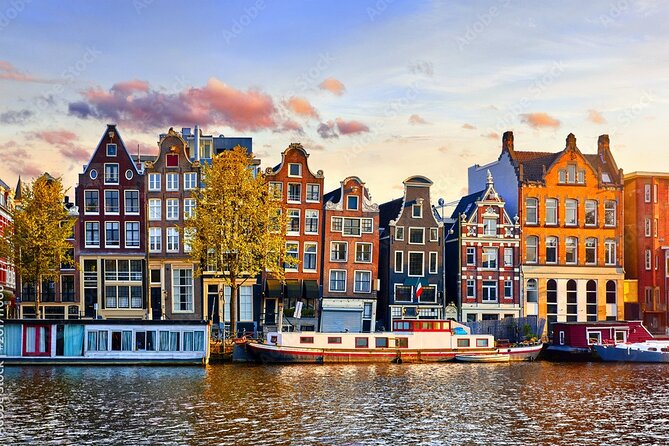
- You finish at the Dancing Houses: The route ends at one of Amsterdam’s most photographed views beside the Amstel.
- The price is unusually low: At $6.05 per person, the tour offers strong value if you want a short orientation walk.
- Plan for outdoor walking: The tour lasts about two hours, requires good weather, and is offered in English.
Amsterdam’s story begins near Dam Square
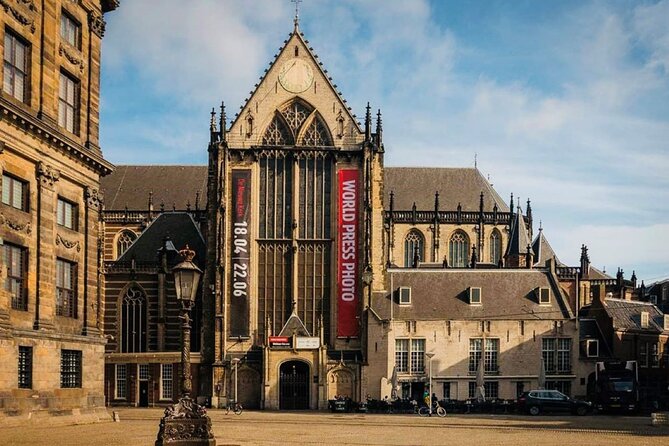
The meeting point is by the New Church at Dam Square, in the center of Amsterdam. This makes the opening easy to reach by public transport and places you close to the city’s symbolic heart before the walk even starts.
At Kattengat, the guide explains how Amsterdam began and how its first years shaped the city. This opening matters because Amsterdam can look like a carefully planned canal city, but its early growth was tied to water, trade, and settlement along the Amstel.
You spend about 10 minutes here, enough for a clear introduction without getting stuck in dates. I like this approach for a first morning or afternoon in the city. You get a framework that helps later sights make sense, rather than seeing attractive buildings with no idea why they are there.
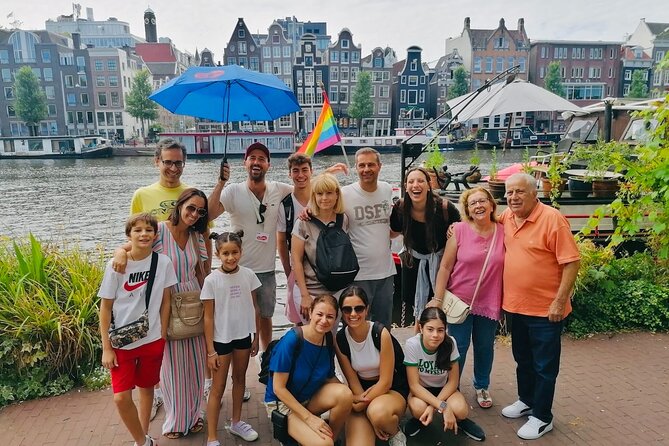
From the start, the guide also sets the tone for the walk: history mixed with social customs and local culture. Feedback about Samuel repeatedly points to his ability to explain the city in an easy, lively way. He is also praised for speaking with everyone in the group and handling questions well, a useful quality on a small walking tour.
More History Walking Tours in Amsterdam
- Amsterdam: Life of Anne Frank and World War II Walking Tour
★ 4.8 · 10,467 reviews - Amsterdam: Haunted History and Ghost Walking Tour
★ 4.5 · 488 reviews - Amsterdam: Highlights & History Walking Tour
★ 4.8 · 266 reviews
Oude Nieuwstraat and Amsterdam’s less obvious red-light history
The route then moves to Oude Nieuwstraat, described as one of the city’s most beautiful and lesser-known streets. The subject here is the other Red Light District, which gives you a different angle on a part of Amsterdam often reduced to a few famous windows and neon signs.
This stop should appeal to you if you prefer context to spectacle. The point is not simply to pass through a notorious area, but to understand how Amsterdam’s streets, business, religion, and social rules have overlapped over time.
The 10-minute format keeps the stop focused. You should not expect a full history of prostitution or a lengthy discussion of the area’s present-day rules. Instead, it works as one chapter in a larger story about how Amsterdam has handled behavior that other cities tried to hide.
That balance is one of the tour’s strengths. It touches subjects that can be awkward or sensational, but the stated focus is on the city’s development and culture. You will get the most from it if you come ready to listen and ask questions rather than expecting a theatrical presentation.
Leliegracht and the Dutch Golden Age
At Leliegracht, the subject shifts to the Dutch Golden Age, the period when Amsterdam held major influence in world trade. The canal setting gives the explanation a fitting backdrop. Rather than discussing wealth only in a museum, you are standing among the waterways and buildings that helped make Amsterdam’s commercial power possible.
This is one of the stops where the city’s elegant appearance gains extra meaning. Canal houses are not just pretty facades. They point to trade, finance, shipping, and the wealth that flowed through Amsterdam.
The guide’s role matters here. A list of dates would be easy to forget, but a good explanation can connect the buildings, the canals, and the city’s place in international commerce. Samuel is often praised for giving historical facts a clear cultural setting, including the Dutch mindset and local customs.
Again, 10 minutes is enough for a concise explanation, but not enough for every detail. If the Golden Age is your main interest, you may want to add a museum or a longer history visit elsewhere in Amsterdam. For a first walk, this stop gives you a useful foundation without taking over the whole afternoon.
The Anne Frank House, seen from the outside

The walk continues to the Anne Frank House, one of Amsterdam’s most important modern landmarks. The tour allows about 10 minutes here, and admission is not included.
That distinction is important. You should expect an exterior explanation and historical context, not entry into the house. If you want to visit the interior, you will need a separate ticket and arrangement. The tour itself does not bundle that experience into the $6.05 price.
Even from outside, this is a meaningful stop. The site connects Amsterdam’s streets with the history of Jewish persecution, hiding, and war. A guide can help place the building within the city rather than leaving you with only a famous name and a photograph.
The short visit also keeps the walking route moving. Some people will appreciate that the tour does not spend most of its time at one landmark. Others may find 10 minutes too brief, especially if Anne Frank House is the main reason they came to Amsterdam. Know what you are booking: this is a city history walk with a stop at the house, not an Anne Frank House visit.
More History Walking Tours in the Netherlands
- Anne Frank and Amsterdam Jewish History Walking Tour
★ 5.0 · 259 reviews - Amsterdam: Ghost Walking Tour and Dark History
★ 4.8 · 118 reviews - Amsterdam: Iconic Canals & Historic Sights Walking Tour
★ 4.5 · 90 reviews - Amsterdam: Anna Frank and World War II History Walking Tour
★ 4.8 · 86 reviews
Dam Square, Amsterdam’s public stage
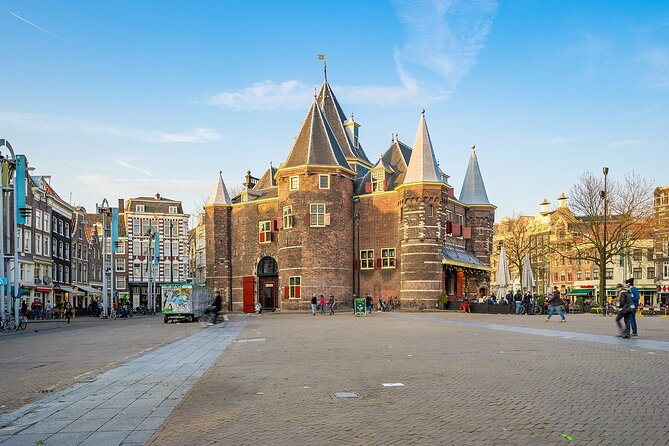
At Dam Square, the group returns to the center of the city for a closer look at its main public space. The square is treated as Amsterdam’s heart, and that is a useful way to understand its role.
You will likely already have passed through Dam Square if you arrive at the meeting point, but the guide’s explanation gives it more weight. A central square can look like a place for photographs, shopping, and passing crowds. With historical context, it becomes a place where the city’s public life, power, and identity meet.
The 10-minute stop also helps organize the route. After hearing about the city’s origins, trade, and major landmarks, you return to the point from which Amsterdam’s central districts make sense. This is a practical benefit of the tour: you are not only collecting facts, you are learning how the central streets relate to one another.
Amsterdam Gallery and the mystery of facade plaques

The next stop heads south to Amsterdam Gallery, where the guide explains the origin of the decorative plates seen on many facades. These small details are easy to miss when you walk alone, especially when the city’s canals and leaning houses compete for attention.
This is the kind of subject I value on a walking tour. It trains you to look up and notice clues in the architecture. Once you understand why the plates are there and what they represent, the facades become more readable.
Admission is not included at this stop. The provided details do not specify an entrance arrangement, so you should treat it as a brief point of interest within the walk rather than assume that a separate indoor visit is part of the price.
The stop also shows the tour’s broad range. It moves from major events to small architectural features, helping you see Amsterdam as a lived-in city rather than a collection of famous sights.
Spui, freedom, and Amsterdam’s social character
Through the city streets, the route reaches Spui, a square linked in the tour to the freedoms that made Amsterdam famous. This section looks beyond buildings and into the city’s social character.
Amsterdam’s reputation for tolerance did not appear from nowhere. The tour uses Spui to discuss how ideas about personal freedom and public life took shape. The subject should interest you if you want to understand why the city became associated with open attitudes toward religion, behavior, and expression.
One especially useful detail from the guide’s stories concerns secluded places for nuns. That subject adds a needed layer to the usual picture of Amsterdam as simply permissive. The city’s history also includes private religious life, restrictions, and communities that operated quietly within a changing society.
You may also hear about Dutch last names and other cultural details. These smaller facts can be surprisingly helpful because they show how history reaches into ordinary life. Samuel is praised for answering questions on these topics instead of sticking rigidly to a script.
Kalverpassage and an old prison’s darker side
At Kalverpassage, the tour turns toward an old prison and the history of the Dutch prison system and organized crime. This is one of the more unexpected subjects on a central Amsterdam walk.
The stop adds contrast. After canals, trade, architecture, and social freedoms, you get a look at control, punishment, and criminal networks. It reminds you that Amsterdam’s history is not only a polished story of commerce and tolerance.
You should keep your expectations realistic. The stop lasts about 10 minutes, so it will introduce the subject rather than provide a full account of Dutch criminal justice. Still, the change of focus can make the walk more memorable, especially if you like history that includes uncomfortable or less celebrated chapters.
The fact that this history is tied to an old prison also gives the explanation a physical setting. You are not hearing about crime in the abstract. You are looking at a place connected to the city’s systems of law and punishment.
Bloemenmarkt, tulip fever, and marijuana
At Bloemenmarkt, one of Amsterdam’s best-known spots, the guide discusses tulip fever and another famous local product, marijuana. The pairing gives you two different ways to think about Amsterdam’s relationship with commerce, fashion, and controlled substances.
Tulip fever refers to the intense enthusiasm and speculation surrounding tulips in Dutch history. The subject fits naturally in a city where flowers remain part of the public image. The stop helps separate the real history from the simplified postcard version.
The marijuana discussion returns to the theme of Amsterdam’s social rules and public reputation. Placing it beside tulip history makes the point that the city’s famous freedoms and commercial instincts have long carried complications.
Bloemenmarkt can be busy, so this may be one of the less quiet stops. You are in a famous central location, not a secluded garden. The advantage is atmosphere and recognition. The disadvantage is that you may need to concentrate to hear every detail, particularly if the surrounding area is crowded.
The Dancing Houses and the final view
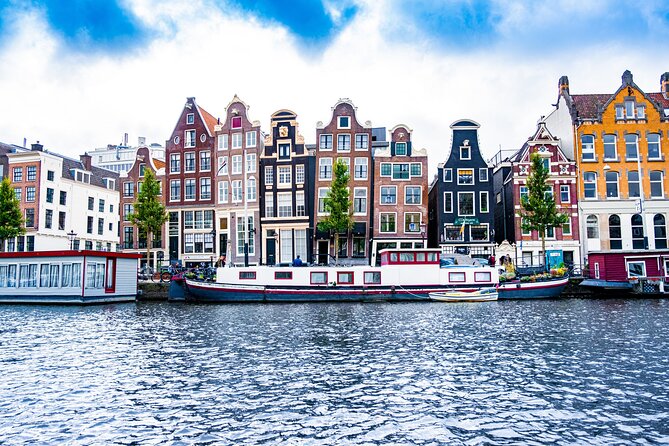
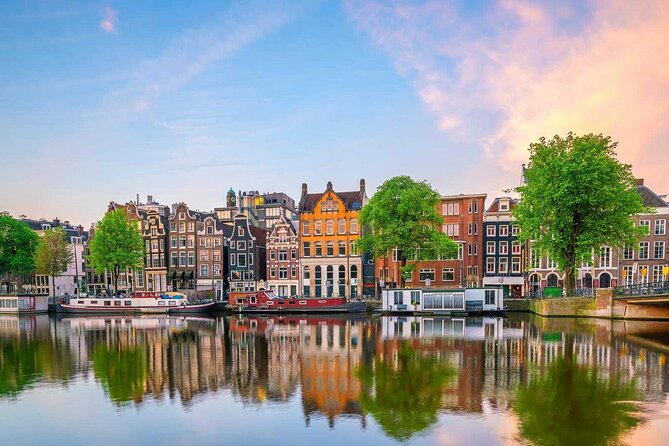
The tour ends at the Dancing Houses on Amstel 102II, beside the Amstel. These sloping buildings are among Amsterdam’s most photographed views, and they make a strong finish.
Here, the guide explains the country’s distinctive architecture and why the houses lean. The subject is practical and visual. You can look directly at the buildings while hearing how their shape developed, rather than trying to remember an explanation after leaving.
Ending here also gives the route a clear sense of movement. You begin near Dam Square and finish by the water, passing through old streets, canals, famous landmarks, and central squares along the way. The final stop is well suited to photographs, but the explanation keeps it from being just another pretty view.
The finish point is also useful for planning the rest of your day. The tour does not return to the New Church, so you should be ready to continue from Amstel 102II. The supplied details do not state a specific onward transport recommendation, but the walk is near central Amsterdam and public transport is available in the surrounding area.
What the $6.05 price really gives you
At $6.05 per person, this is an inexpensive way to get two hours of guided orientation in central Amsterdam. All fees and taxes are included, and there is no admission charge built into the walk. You should still plan for a tip, which is not included.
The value is strongest if you are new to Amsterdam and want a clear introduction before exploring alone. The route covers ten subjects in roughly two hours, so you receive a broad city portrait for very little money.
The price does not buy extended time inside major attractions. Anne Frank House admission is excluded, and the tour is not designed as a museum visit. If you want long stops, private attention, or a detailed study of one period, you should look for a different format.
The group limit of 10 improves the value. A small group generally makes it easier to follow the guide, ask about local customs, and hear explanations in busy streets. Samuel’s energy and willingness to answer questions are particularly useful here.
Who should book this Amsterdam walk?
I would choose this tour for a first visit, a short stay, or the first full day when you want to understand the central city before setting off on your own. It suits people who enjoy stories about culture and daily life as much as major historical events.
It is also a good fit if you like an active guide. Samuel is described as dynamic, friendly, and open to questions, with a strong grasp of Amsterdam’s history and culture. The experience seems best when you take part rather than simply follow silently.
Families and mixed-age groups may find the wide subject range helpful, though the tour data does not specify a minimum age. Most people can participate, and service animals are allowed. You should be comfortable walking outdoors for about two hours.
I would hesitate if you want guaranteed indoor access, long visits at landmarks, or a slow architectural survey. The pace is brisk, and several stops receive only 10 minutes. Good weather is required, so a rainy forecast can affect your plans.
The tour is offered in English and is booked an average of 32 days ahead. That suggests you should reserve early if your dates are fixed, especially since the group is capped at 10 people. Confirmation arrives when you book, and cancellation is free up to 24 hours before the start time. Late cancellations and late changes are not refunded.
Should you book the Amsterdam History Walking Tour?
Book it if you want an affordable, lively introduction to Amsterdam that mixes major landmarks with odd details and difficult subjects. The route gives you the city’s beginnings, Golden Age, freedom culture, prison history, tulip fever, and architecture in one compact outing.
Skip it if you mainly want to enter the Anne Frank House or spend a long time at each sight. For most first-time visitors, though, the combination of a $6.05 price, a 10-person limit, and a guide such as Samuel makes this a sensible way to get your bearings.
FAQ
How long does the Amsterdam History Walking Tour last?
The tour lasts approximately two hours.
How much does the tour cost?
The listed price is $6.05 per person.
In what language is the tour offered?
The tour is offered in English.
Where does the tour begin?
It begins at the New Church by Dam Square, 1012 NP Amsterdam, Netherlands.
Where does the tour finish?
It finishes at the Dancing Houses at Amstel 102II, 1017 AD Amsterdam, Netherlands.
Is admission to the Anne Frank House included?
No. Admission to the Anne Frank House is not included.
Are entrance fees included?
All fees and taxes are included, but admission to the Anne Frank House and Amsterdam Gallery is not included where applicable.
Is a tip included?
No. A tip is not included in the tour price.
How many people can join the tour?
The tour has a maximum of 10 participants.
What happens if the weather is poor?
The experience requires good weather. If it is canceled because of poor weather, you will be offered another date or a full refund.
Just added around Amsterdam
- Amsterdam Walking Tour: Urban Legends & History with local guide★ 5.0 · 39 reviews
- Amsterdam: Luxury Canal Cruise with Historic VR Experience★ 5.0 · 305 reviews
- Amsterdam: Anne Frank and World War II Walking Tour (TOP RATED)★ 4.5 · 72 reviews
- Small Group Tour to Nazi WWII concentration camp from Amsterdam★ 5.0 · 112 reviews
- Amsterdam 3 hrs Bike Tour – live guide En/Fr/De/Nl/Sp★ 4.5 · 138 reviews
- Guided Walking Tour Amsterdam – Legends, History & Ghost Stories★ 5.0 · 28 reviews
- LGBTQI+ History Tour of Amsterdam★ 5.0 · 123 reviews
- Amsterdam Haunted History and Ghost Walking Tour★ 5.0 · 47 reviews
Amsterdam History Tours, compared.

Amsterdam: Life of Anne Frank and World War II Walking Tour
Read our review →
Amsterdam: Dutch WWII Resistance Museum Entry Ticket
Read our review →
Amsterdam: Haunted History and Ghost Walking Tour
Read our review →
Amsterdam High-End Dutch Food & History Tour – Up to 8 guests
Read our review →
Amsterdam: Historic City Sightseeing Canal Cruise
Read our review →
Amsterdam: National Holocaust Museum Entry Ticket
Read our review →
Anne Frank and the Jewish History of Amsterdam Private Tour
Read our review →Browse the lists this tour appears in