
Review · MOROCCO
Discovery of Moroccan Culinary Heritage, History and Secrets
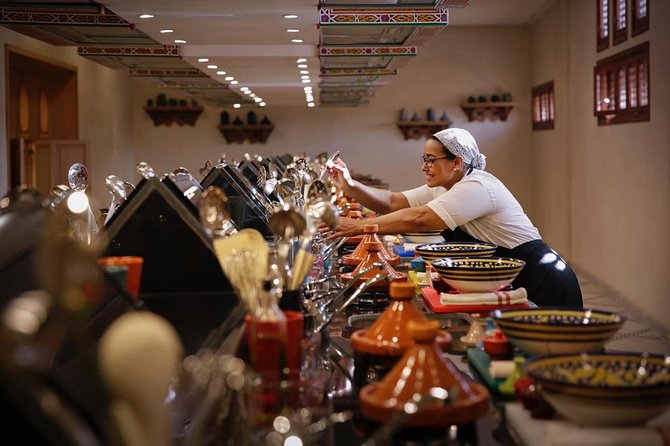
The best part of this Marrakech experience is that it puts hands-on cooking inside a restored riad. You do not simply look at photographs of Moroccan food. You measure spices, shape bread, cook traditional dishes, visit a neighborhood bread oven and herbalist, and eat what you prepare.
I like the clear teaching kitchen and the link between food and daily life. The museum adds useful context, while the Dada shows how Moroccan cooks actually use herbs, spice blends, bread ovens, and slow cooking. The main consideration is timing: the experience is listed at about two hours, so the cooking portion may feel brisk, and language arrangements should be confirmed if you specifically need English.
Key points to know before booking
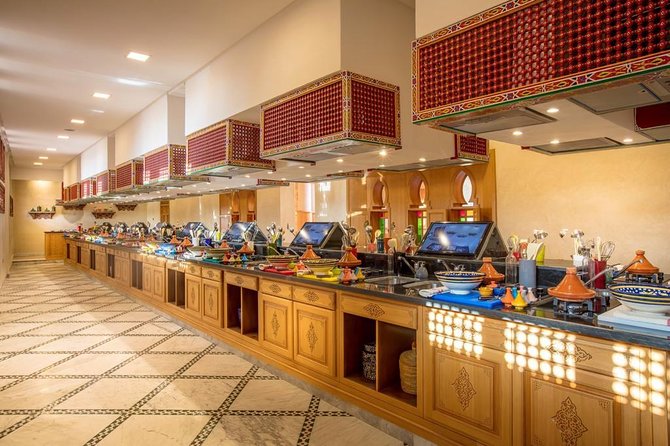
- Cook in a 34-station teaching kitchen: The professional setup gives each participant room to work, rather than watching from the edge of a demonstration.
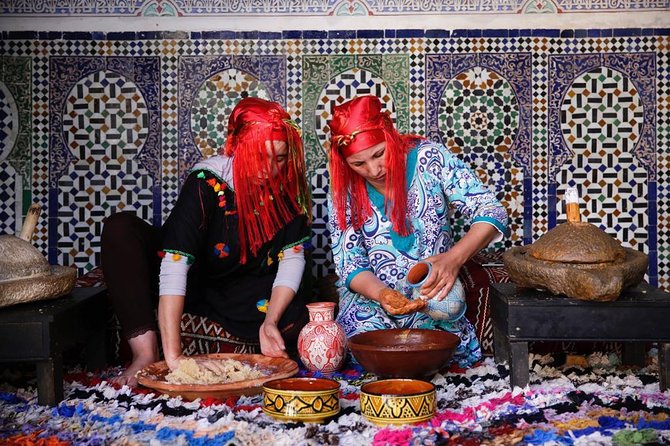
- Learn from a traditional Dada: A Moroccan cook explains spice quantities, baking methods, and the small techniques behind familiar dishes.
- See food in its neighborhood setting: The route includes a bread oven and an herbalist where local spices come from.
- Eat the food you prepare: Lunch, bottled water, and coffee or tea are listed as included, with Moroccan wine offered as an optional extra.
- Visit a restored riad and museum: The building itself is a major part of the outing, with courtyards, displays, videos, utensils, and cooking stations.
- Plan for a small-to-medium group: The maximum is 34 people, though the teaching kitchen is designed to give each person a station.
Cooking Moroccan food in a restored Marrakech riad
The Moroccan Culinary Arts Museum sits on Rue Riad Zitoun el Jdid, near the Bahia Palace area of Marrakech. You begin and end at the museum, which makes this a simple addition to a day in the southern medina.
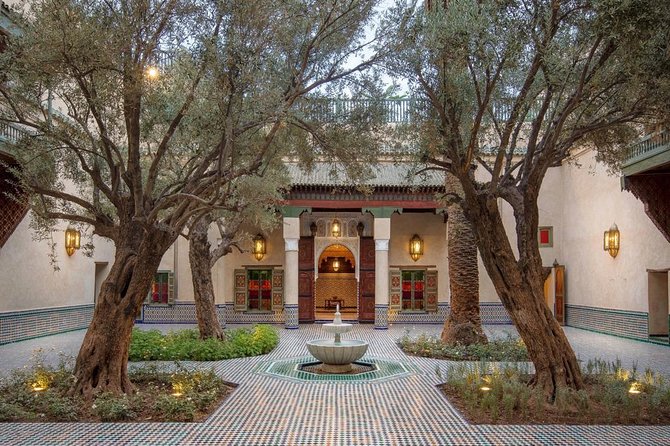
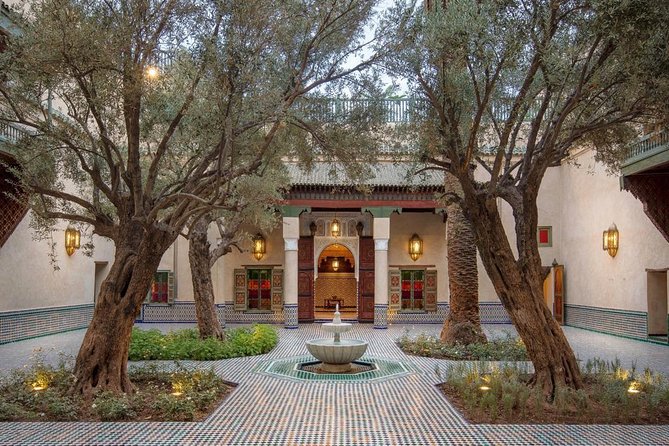
The setting does much of the work before the cooking begins. This is a restored riad with a courtyard, traditional rooms, a Moroccan living room, and a terrace. Parts of the building have the feel of a palace residence, and the quiet interior offers a welcome change from the noise outside.
I would allow a few extra minutes to find the entrance. The meeting point is specific, the Moroccan Culinary Arts Museum, rather than a broad neighborhood landmark. It is close to public transportation, and the activity ends at the same place where it starts.
On arrival, you receive an introduction from a French or English interpreter. Younes has welcomed visitors at reception, and Yasmina is identified as the museum’s general manager. The exact staff member and teaching language may vary, so an English speaker should confirm the language at booking, particularly since one participant received the class in French despite booking in English.
More Food and History Tours in Morocco:
- Sevilla Food Tour: Tapas, Wine, History & Traditions
★ 5.0 · 3,468 reviews - Victoria Guided Food and History Tour
★ 5.0 · 2,015 reviews - Gastown Historic Walking Food Tour
★ 5.0 · 1,863 reviews
What the museum adds to the cooking lesson
The museum is not just a waiting room for the kitchen. It explains the ingredients, serving customs, cooking methods, and food traditions that shape Moroccan meals.
You may see photographs, videos, utensils, table settings, and displays about dishes such as pastilla, couscous, tajine, and tangia. One useful distinction is between tajine, the slow-cooked dish usually prepared in a conical clay pot, and tangia, a different Marrakech specialty with its own cooking method.
The displays are modern and clearly arranged. Some visitors find the museum itself more engaging than the written information, while others find the exhibits modest compared with the beauty of the building. That is a fair expectation. Come for the combination of museum, cooking, and meal rather than for a large national collection.
The building is one of the strongest reasons to include the museum. Courtyards, carved details, traditional furnishings, and the terrace give the food displays a fitting home. If you have already visited several palaces and riads, the exhibits may feel familiar. If this is your first close look at Moroccan domestic design, the setting adds real value.
Bread, spices, and the food behind the meal
The experience begins with a demonstration of Moroccan bread making. Bread is not treated as a side detail here. It is part of the rhythm of Moroccan meals and an important way to understand how food is prepared and shared.
You also visit a bread oven and a neighborhood herbalist. These stops connect the polished museum kitchen to the working food culture of Marrakech. You see where bread is baked and where herbs and spices are sourced, instead of learning about them only from labels.
The herbalist visit can be especially useful if you have been buying spice mixtures in the souks and want a clearer sense of what you are looking at. Moroccan cooking depends on balance more than brute force. The Dada explains how to dose spices, and that practical point matters. A dish can be transformed by too much cumin, paprika, saffron, or preserved lemon.
The published description does not specify the name of the Dada, but the role is central. This is a traditional cook who demonstrates baking and cooking methods and provides hands-on help. The teaching is supported by additional staff, which is useful when several people need help at once.
Inside the 34-station teaching kitchen
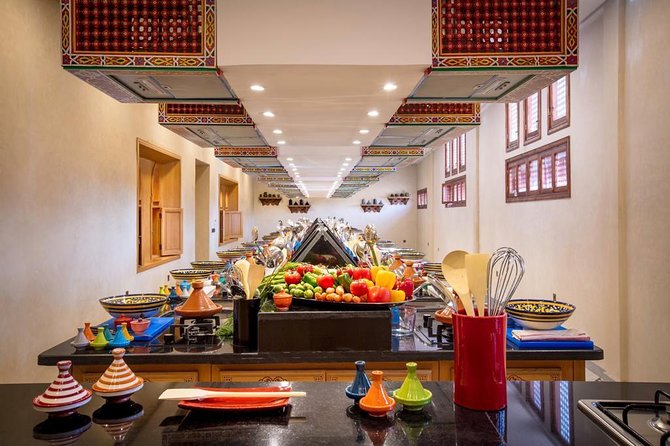
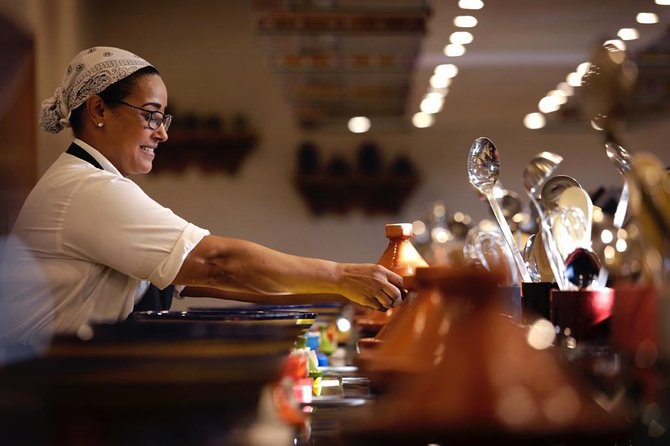
The kitchen is built for instruction. It has 34 stations, giving the class a more organized feel than a casual demonstration in a restaurant kitchen.
You should expect to take part rather than simply watch. The dishes named in the material include tajine, couscous, Moroccan salads, and dessert. One class prepared two salads, a tajine, and a dessert. Another session included chicken tajine and a typical Moroccan dish. The exact menu can vary, but the purpose is consistent: teach several parts of a traditional meal.
This format suits beginners. You receive verbal instruction, then practical help as you work. The kitchen is described as professional grade and designed for teaching, so the space should be easier to follow than a crowded home kitchen.
There is one important limit. A group of up to 34 people is allowed, and that is a sizeable class. The individual workstations help, but the amount of personal attention can depend on the day’s attendance and the number of assistants. If you want a quiet, private lesson with long one-to-one coaching, this is not the safest choice.
For most people, the group format is part of the fun. You can compare results, work alongside couples or families, and see how other people handle the same ingredients. Children can take part, too. A 12-year-old joined the class with a grandparent, which suggests that the lesson can work well for older children who enjoy practical activities.
More History Tours in Morocco:
- Fes: Volubilis Roman Ruins, Mouly Idriss, & Meknes Day Trip
★ 4.6 · 2,375 reviews - Marrakech Historical and Cultural Tour – Half Day City Tour
★ 4.5 · 1,180 reviews - Atlas Mountains – Ancient Ait Ben Haddou Day Tour from Marrakech
★ 5.0 · 411 reviews - Fez: Guided Walking Tour of the Historic Medina
★ 5.0 · 359 reviews
The dishes you make and eat
The reward comes at the table. After cooking, you eat the prepared dishes, generally on the terrace or in the Moroccan living room. The meal gives you a chance to notice how the spice balance, texture, and cooking time came together.
Tajine is the natural centerpiece. It teaches patience, layering, and the value of gentle heat. Couscous shows a different side of Moroccan cooking, with attention to grains and accompaniments. Salads provide contrast, since Moroccan salads can be cooked, seasoned, chilled, or served at room temperature rather than resembling a simple bowl of raw greens.
Dessert rounds out the lesson. The specific sweet is not fixed in the details provided, so do not book expecting one named pastry. You should think of the meal as a sample of Moroccan home cooking rather than a restaurant tasting menu.
Lunch is listed as included, along with bottled water and coffee or tea. Alcoholic drinks are not included. Moroccan wines may be available as an optional discovery with the meal, but you should treat that as an extra rather than part of the base price.
There has been some inconsistency in how refreshments were handled, with one participant reporting that bottled water and tea or coffee were not offered as expected. I would confirm the current inclusions when you arrive and check any added charge before ordering wine. That small step avoids confusion at the table.
The Moroccan tea ceremony
Tea is more than a hot drink in this setting. The ceremony offers a short lesson in hospitality and presentation.
You can expect Moroccan tea to be prepared and served after the cooking portion. The ceremony helps explain why meals in Morocco often feel social and unhurried, even when the kitchen work itself is carefully organized.
The tea service is also a useful pause. Cooking classes can become busy once several dishes are underway, and the ceremony gives you time to sit, taste, and talk about what you have made.
Coffee and tea are included in the stated package, while wine is separate. If the tea ceremony is important to you, mention it when checking in, since the timing of the service may depend on the day’s schedule.
A close look at the value of $69.79
At $69.79 per person, this is not the cheapest way to eat in Marrakech. A simple local meal costs far less, and museum admission alone has historically been priced much lower than the full cooking experience.
The value comes from the combination. You are paying for an interpreter, a cooking instructor, ingredients, use of the teaching kitchen, the museum visit, the neighborhood food stops, and the prepared lunch. If you would otherwise book a museum visit, a cooking class, and a meal separately, the package makes practical sense.
I especially like that the class does not isolate food from place. The bread oven and herbalist help explain the ingredients before you sit down to eat. That makes the price easier to justify for someone who wants more than a recipe demonstration.
The value is weaker if you mainly want to browse the museum. The exhibits can be seen in a shorter visit, and some displays may feel underwhelming if you are expecting a large, object-heavy institution. In that case, pay for the museum alone rather than the cooking package.
The optional wine also affects the final cost. The base price should be judged without assuming alcohol is covered.
Timing, language, and practical details
The experience is listed as approximately two hours, although the description also uses the phrase half-day. I would plan around the stated two-hour duration, then allow extra time for the meal, tea, museum viewing, and any delays in a group class.
The meeting point and end point are the same: the Moroccan Culinary Arts Museum, Rue Riad Zitoun el Jdid, Marrakesh 40000, Morocco. You do not need to arrange a separate ride back after the meal.
The activity is near public transportation, and service animals are allowed. Confirmation is normally sent at booking. If you book within one day of the start time, confirmation arrives as soon as possible and depends on availability.
Free cancellation is available up to 24 hours before the local start time. Within 24 hours, the payment is not refunded, and changes are not accepted. That rule matters if your Marrakech schedule is still moving around.
The maximum group size is 34. The kitchen’s many stations make that number workable, but a full session will feel more social and less personal than a small private class.
Who will enjoy this experience most
I would choose this for food-focused visitors who want to understand Moroccan cooking through action. It suits beginners, couples, families with older children, and anyone who wants a structured activity near the Bahia Palace district.
It is also a smart choice for people who have already sampled tajine and couscous but want to know how the dishes are made. The lesson turns familiar menu items into something more understandable.
The experience is less suitable if you dislike group activities, need a guaranteed English-only class, or want a long, advanced culinary workshop. It is also not the right pick if your main interest is a major museum collection rather than cooking.
For the best experience, arrive ready to participate. Pay attention to the spice measurements, ask how the bread is baked, and notice which ingredients are treated as everyday staples. The useful lessons are often small ones, such as how much seasoning is enough or how a dish changes when cooked slowly.
Should you book this Moroccan cooking class?
I would book it if you want a practical introduction to Moroccan food in a beautiful Marrakech setting. The strongest features are the teaching kitchen, the traditional Dada, the bread and spice stops, and the chance to eat your own work.
I would hesitate only if you need a very small class or a guaranteed English lesson. Confirm the language and the current drink inclusions before paying, then use the two-hour session as a focused introduction rather than a full professional cooking course.
For most food-minded visitors, $69.79 is a reasonable price for a museum visit, guided food lesson, neighborhood context, and lunch in one stop. It gives you something useful to take home: not just a photograph of a tajine, but a better idea of how Moroccan cooks build flavor.
FAQ
Where does the Moroccan cooking experience start?
It starts at the Moroccan Culinary Arts Museum on Rue Riad Zitoun el Jdid, Marrakesh 40000, Morocco.
Where does the activity end?
The activity ends back at the Moroccan Culinary Arts Museum, the same place where it begins.
How long does the experience last?
The listed duration is approximately two hours.
How much does the experience cost?
The listed price is $69.79 per person.
What food and drinks are included?
Bottled water, lunch, and coffee or tea are listed as included. The lunch consists of dishes prepared during the class.
Is Moroccan wine included?
No. Alcoholic beverages are not included. Moroccan wine may be available as an optional discovery with the meal.
Is the class offered in English?
A French or English interpreter is provided according to the activity details. Since language arrangements may vary, confirm English availability when booking if it is essential to you.
How many people can join the activity?
The maximum group size is 34 people.
What is the cancellation policy?
You can cancel up to 24 hours before the local start time for a full refund. Cancellations or changes made within 24 hours are not accepted for a refund.
Just added around Morocco
- 6-Day Private Morocco Cultural Tour From Casablanca To Marrakech★ 5.0 · 24 reviews
- Marrakech The History and Culture Day Trip★ 4.5 · 45 reviews
- Marrakech: Historical Discovery Tour★ 4.1 · 87 reviews
- Marrakech: Day Trip to the Beautiful and Historic Essaouira★ 4.3 · 39 reviews
- From Marrakech: Essaouira Full day trip, beach and History★ 4.9 · 26 reviews
- Fez: Walking Tour in the Ancient City of Fez★ 4.8 · 73 reviews
- Casablanca to Fez: Scenic & Historical Day Trip with Lunch★ 4.7 · 111 reviews
- Discover the secrets of the Medina of Fez: guided cultural tour (private)★ 5.0 · 68 reviews
Morocco History Tours, compared.
Fes: Volubilis Roman Ruins, Mouly Idriss, & Meknes Day Trip
Read our review →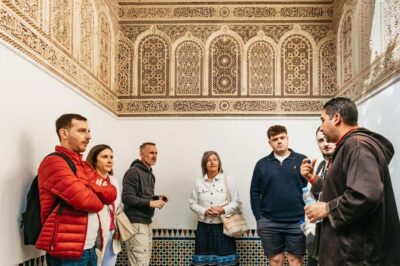
Marrakech: Saadian Tombs & Bahia Palace, Medina Guided Tour
Read our review →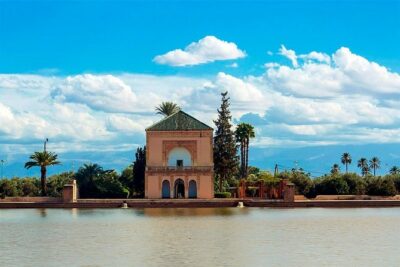
Marrakech Historical and Cultural Tour – Half Day City Tour
Read our review →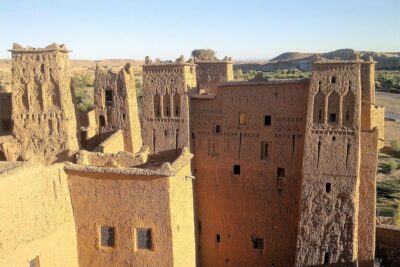
Atlas Mountains – Ancient Ait Ben Haddou Day Tour from Marrakech
Read our review →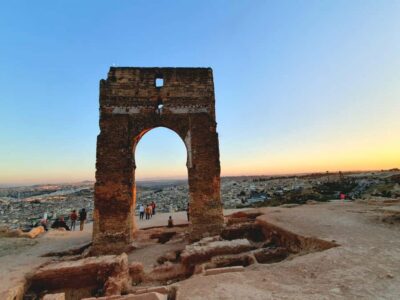
Fez: Guided Walking Tour of the Historic Medina
Read our review →
Casablanca Cultural Tour: Medina, Views & Local Delights
Read our review →
Casablanca to Fez: Scenic & Historical Day Trip with Lunch
Read our review →
Fes: A Guided Walking Tour Through the Historic Medina
Read our review →Browse the lists this tour appears in