
Review · USA
Baltimore Walking & Driving Self-Guided Audio Tour
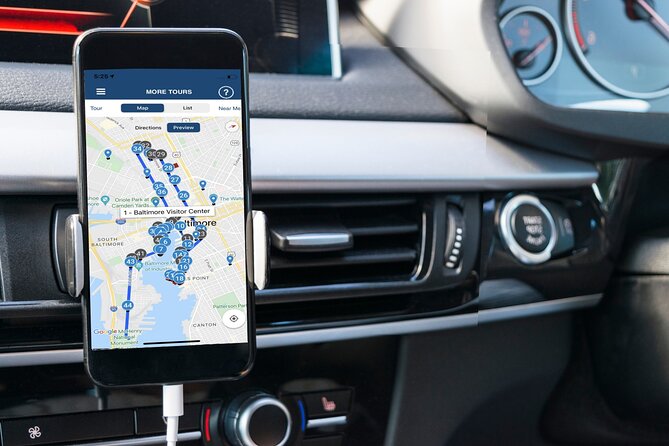
Baltimore’s story comes alive along a nine-mile route that links the Inner Harbor, Fells Point, Mount Vernon, Camden Yards, and Fort McHenry. Edgar Allan Poe, Frederick Douglass, and the Star-Spangled Banner all get their own chapters, and the app plays each story as you reach the right spot.
I like two things right away: one purchase covers up to four people in a car, and the tour never expires. You can pause for lunch, stop for a museum, or save part of it for another day. The price is hard to beat if you are sharing it.
The catch is navigation. The stories are usually the strongest part, but GPS can misfire, urban streets can be confusing, and the audio may cut off if you move too quickly. Treat this as a narrated route rather than a full substitute for a dedicated navigation app.
Key points to know before you go

- 42 audio stories across more than nine miles: You get far more than a quick list of landmarks, with history tied to the places outside your window.
- One $16.99 purchase covers four people: The value is especially good for a family or group sharing one car.
- Start at the Baltimore Visitor Center: The route moves through the harbor, historic neighborhoods, central Baltimore, and Fort McHenry.
- Lifetime access: Download it once, then use it again on a later Baltimore visit or listen in smaller sections.
- Driving with optional walking: Most of the route works from the car, but headphones and short walks improve the experience at several stops.
- Navigation needs attention: Download the tour on strong Wi-Fi or cellular service, and keep Google Maps available as a backup.
Baltimore history from the driver’s seat

This is not a traditional tour with a guide waiting at the meeting point. You begin at the Baltimore Visitor Center on Light Street, open Action’s separate Tour Guide app, and let your phone’s GPS trigger the narration.
The route covers roughly nine miles and usually takes one to two hours if you keep moving. The wider estimate of one to three hours makes sense once you add photo stops, museum visits, meals, walking, or a pause when the city traffic gets in the way.
You receive more than 42 stories, while the route highlights 27 major places. That means some stops receive more than one piece of narration, and some stories point you toward nearby sites rather than functioning as a formal admission stop.
I like this format for a first look at Baltimore. You can get your bearings without committing to a fixed departure time or a crowded bus. You also decide which places deserve a longer visit.
The tradeoff is that you must manage the experience yourself. No person is there to explain a missed turn, restart a story, or adjust the pace. If you are driving alone, the route demands extra care. Pull over before handling the phone, and do not rely on the app as your only source of road directions.
More History Walking Tours in the USA
- History and Hauntings of Salem Guided Walking Tour
★ 5.0 · 14,564 reviews - Boston: Freedom Trail History Small Group Walking Tour
★ 5.0 · 6,450 reviews - Historic Charleston Guided Sightseeing Walking Tour
★ 5.0 · 6,216 reviews
From the Inner Harbor to Fells Point
The tour begins at the Baltimore Visitor Center, a sensible starting point near the city’s most familiar sights. The opening audio introduces Baltimore as a city shaped by maritime trade, political conflict, immigration, literature, and civil rights.
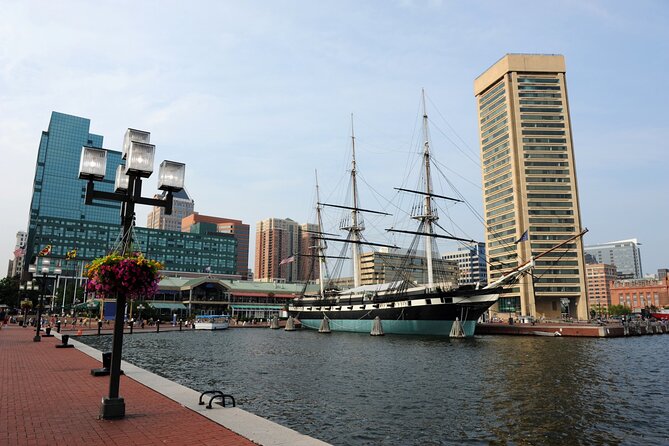
From there, you reach the Inner Harbor, the city’s main visitor district. The harbor makes a useful visual introduction, with water, historic ships, museums, and open public areas close together. The audio gives you context before you decide which attractions deserve an admission fee.
The USS Constellation is one of the route’s strongest harbor stops. This three-masted warship predates the Civil War and is tied to the history of naval enforcement against ships carrying enslaved people. You can hear the story from outside, but the ship’s interior requires a separate ticket.
The National Aquarium follows. It houses more than 20,000 sea and land animals and is one of Baltimore’s biggest family attractions. The audio tour does not include admission, so think of this as a useful orientation stop rather than a complete aquarium visit.
The route also points out the Seven Foot Knoll Lighthouse, one of the unusual sights in the harbor. Nearby, you hear about Mr. Trash Wheel, the colorful-looking device that collects floating rubbish before it spreads through the harbor. It is a good example of Baltimore mixing old harbor infrastructure with practical modern solutions.
Next comes the National Katyn Memorial, a serious monument with a history connected to Polish remembrance. This is the kind of stop that a standard city drive might pass without explanation. The audio gives it a reason to slow down and look.
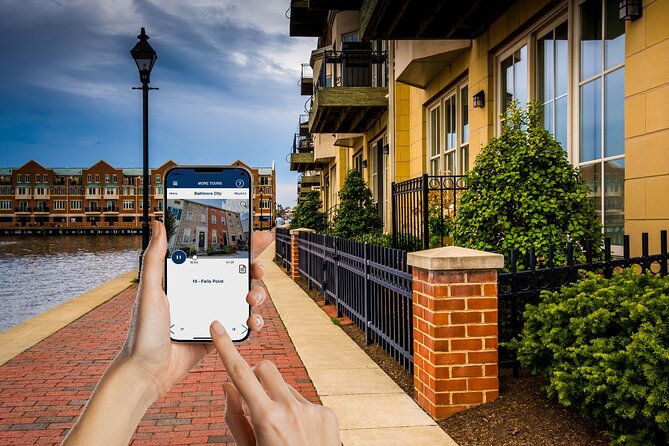
Fells Point adds a different mood. Founded as an independent town in 1763, it still has a strong historic character. The neighborhood’s port once employed many African Americans, including free and enslaved workers, and the modest housing reflected what working people could afford.
The Horse You Came In On Saloon is another memorable address. It occupies a Colonial-era building and offers drinks, pub food, and live music. The story also connects the saloon with Edgar Allan Poe, whose supposed ghost adds a little Baltimore theater to the route. Admission is not included, and you should confirm operating details if you plan to stop for food or music.
Frederick Douglass and Baltimore’s maritime past

The Frederick Douglass and Isaac Myers Maritime Park gives the tour some of its most important social history. The site honors two African American figures linked to Baltimore’s shipbuilding world.
Frederick Douglass worked as a shipwright before becoming one of the country’s major abolitionists, writers, and political voices. Isaac Myers was a pioneering labor organizer. Together, their stories show how Baltimore’s waterfront was also a workplace where Black workers built skills, organized, and challenged an unfair system.
The narration also connects Douglass to women’s rights. He attended the 1848 women’s rights convention in Seneca Falls and argued that voting rights should apply to Americans regardless of race or sex. That detail gives you a fuller picture of Douglass, rather than reducing him to one chapter of abolitionist history.
Douglass Place adds another personal connection. The site includes homes built by Douglass, and the audio follows his rise from enslaved shipwright to a major figure in American public life. If you have time, this is a good place to pause the route and explore on foot.
The tour’s treatment of Douglass is one of its most valuable features. Baltimore’s harbor can look like a collection of ships and restaurants at first glance. These stories help you see the people who worked there and the political struggles tied to the waterfront.
City Hall, Mount Vernon, and Poe

Baltimore City Hall is hard to miss. Its grand design makes it an easy visual marker, but the audio adds a strange local story: in 1883, two Baltimore politicians argued outside the building, fought, drew pistols, and exchanged gunfire. One of them died, and the other was arrested for murder.
It is a short, grim tale, but it fits the tour’s style. You get major civic architecture mixed with the kind of odd incident that makes a city feel less polished and more human.
The Washington Monument in Mount Vernon Place comes next. Baltimore’s monument was the first major monument honoring George Washington, and its architect, Robert Mills, later used the design for the much larger monument in Washington, D.C. The Baltimore structure is not simply a smaller copy. It came first.
Edgar Allan Poe’s grave is one of the tour’s most atmospheric stops. The story centers on the mysterious Poe Toaster, who appeared each January 19, Poe’s birthday, wearing black clothing and a wide-brimmed hat. The visitor left three roses and a bottle of cognac before slipping away.
The ritual lasted for decades, but the person’s identity was never confirmed. You can visit the grave without paying an admission charge, though the tour itself does not include any attraction tickets.
Nearby, the H. L. Mencken House points to another Baltimore writer. Mencken was a major American journalist and critic, and the stop broadens the literary side of the route beyond Poe.
The Walters Art Museum adds a cultural option in the Mount Vernon area. The audio can tell you why the building matters, but entry is separate. If art is a priority, plan enough time to pause the tour instead of trying to fit a museum visit into the moving route.
Same city, a different century:
- Charleston’s Old South Carriage Historic Horse & Carriage Tour
★ 5.0 · 10,023 reviews - Beneath The Streets Underground History Tour
★ 4.5 · 8,006 reviews - Big Island in a Day: Volcanoes Waterfalls Sightseeing and History
★ 5.0 · 6,569 reviews - Charleston Horse-Drawn Carriage Tour: Explore Historic Charleston
★ 5.0 · 3,561 reviews
Baseball, science, and Baltimore’s working city
The Babe Ruth Birthplace and Museum gives the route a strong sports connection. Ruth was born in Baltimore, and the museum preserves that part of his story. This is another paid attraction, so the audio stop works best as a decision point: stop for the museum, or continue with the city drive.
Oriole Park at Camden Yards provides a second baseball landmark. Even without a game, the ballpark is worth recognizing as a major part of modern Baltimore’s identity. The route lets you connect the neighborhood’s current character with the older port and industrial stories heard earlier.
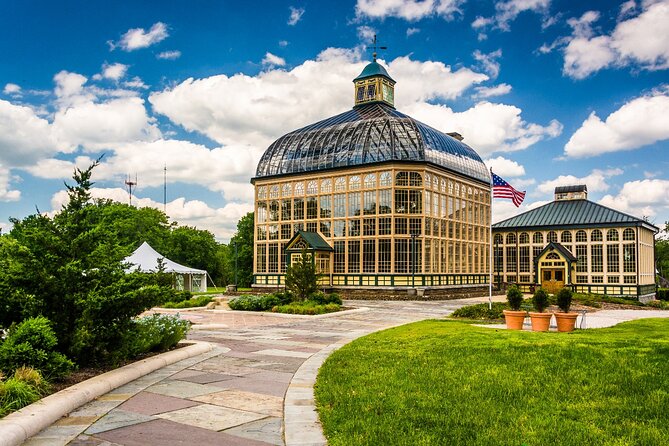
The Maryland Science Center offers a family-friendly stop near the harbor. It is one of the country’s older scientific institutions and gives families another option beyond the aquarium. Again, admission is not included, but the audio helps you understand where the attraction fits in the city.
Port Discovery Children’s Museum is another family stop. If you are traveling with children, you may want to pause the tour here rather than trying to hear stories while everyone is eager to get inside.
Mount Clare Museum House and the B&O Railroad Museum shift the focus toward transportation and industry. Baltimore’s history is not only about famous writers and waterfront monuments. Railroads, workers, shipping, and trade helped make the city what it is, and these stops point you toward that larger story.
Poe’s final days and Mother Seton

The route returns to Poe at the site of his death, connected with Church Home and Hospital. His final days remain uncertain. In 1849, he left Richmond intending to travel to Philadelphia, but he never reached the city. After disappearing for about a week, he was found in Baltimore and later died at the hospital.
The audio presents the known outline without turning the mystery into a false certainty. That is the right approach. Poe’s death has inspired endless theories, but the basic facts are already compelling.
The Mother Seton House introduces a very different figure. Elizabeth Ann Seton lived there temporarily and later became the first American-born person canonized as a saint. She was raised Episcopalian, discovered Catholicism while in Italy during her husband’s illness, and devoted her life to her new faith after his death.
This stop is easy to overlook if you only focus on the harbor and major monuments. The audio makes it part of a wider portrait of Baltimore, a city shaped by religious change as well as politics, literature, and trade.
Fort McHenry and the national anthem
Fort McHenry is the emotional finish of the route. Built to protect Baltimore’s harbor, the fort endured a major British attack in 1814. Nineteen British warships approached, and roughly 1,000 defenders prepared for the assault.
The bombardment did not destroy the fort. Its reinforced defenses held, and the American flag remained visible after the attack. Francis Scott Key saw that flag and wrote the poem that later became the national anthem.
The Star-Spangled Banner Flag House connects the poem to the physical flag and the people who made it. This section works best if you slow down and give the narration your full attention. It is not just a patriotic landmark. It is a story about war, endurance, writing, and the creation of a national symbol.
The stated endpoint is along the Star-Spangled Banner National Historic Trail near Fort McHenry. Fort McHenry itself requires a separate admission ticket, and its hours or access can affect your plans. Check current opening information before you set out, especially if the fort is the main reason for booking.
How the app works in real city traffic
After booking, you receive setup instructions and a password by email and text. Search for audio tour if the message is not immediately visible. Download the separate Action Tour Guide app while you have strong Wi-Fi or cellular service, then download the tour for offline use.
Once you reach the starting point, the first story should begin through location detection. The next stories play as you move along the route. You can pause, replay, skip, or return later because the access does not expire.
The app works best on an iPhone with iOS 15 or later, an Android device running version 9 or later, or an iPad or tablet with GPS and cellular connection. You can connect the sound to your car through Bluetooth, USB, or an AUX cable. Apple CarPlay is supported, while Android Auto support is still being developed.
The main weakness is GPS reliability. Tall buildings, poor service, road closures, and missed turns can leave you out of position. One practical solution is to use the tour for narration and Google Maps for road awareness. If the app cuts off a story as you approach the next checkpoint, slow down or pull over and replay it.
Do not let the app force you into a risky turn. Baltimore has one-way streets, busy areas, and changing road conditions. If a street is closed, follow legal signs and use your backup map to rejoin the route.
Price, timing, and who gets the best value
At $16.99 per group of up to four, this is inexpensive compared with a private guide or a bus tour. A family of four pays less than $5 per person, and you can use the tour again on another trip without paying again.
The value drops if you expect admission to be included. The aquarium, USS Constellation, Fort McHenry, museums, and other attractions charge separately. The tour is best understood as a narrated orientation that helps you choose where to spend extra time and money.
You can start any day during the stated operating window of 6 a.m. to 9 p.m. The experience is private, with only your group participating. Free cancellation is available up to 24 hours before the scheduled start time. Inside that window, changes and refunds are not accepted.
This tour suits families, couples, friends sharing a car, and independent visitors who dislike fixed schedules. It is less suitable if you want a polished, turn-by-turn driving guide or a person who can answer questions on the spot.
Should you book the Baltimore audio tour?
Book it if you want a low-cost introduction to Baltimore with strong stories about Frederick Douglass, Poe, Fort McHenry, the harbor, and the city’s unusual characters. The lifetime access and group pricing make it a sensible choice for a flexible visit.
Skip it if you need flawless navigation, plan to drive alone through busy streets, or want every attraction included in one ticket. Download the route before leaving, bring headphones for walking sections, connect the phone to your car stereo, and keep a separate navigation app ready.
Used that way, the tour does what it promises: it gives Baltimore a voice while leaving you in charge of the stops.
FAQ
How much does the Baltimore self-guided tour cost?
The tour costs $16.99 per group of up to four people.
How long does the tour take?
The route is about nine miles and usually takes one to two hours to drive. With stops, walking, meals, and attraction visits, you may spend up to three hours.
Where does the tour start?
It starts at the Baltimore Visitor Center on Light Street in Baltimore, Maryland.
Where does the tour end?
The stated endpoint is on the Star-Spangled Banner National Historic Trail near Fort McHenry.
Is the tour guided in person?
No. This is a private, self-guided audio experience. No guide meets you at the starting point.
Does the tour include attraction admission?
No. Entry tickets, attraction passes, and reservations are not included.
Does the audio tour expire?
No. The tour provides lifetime access and can be used on future trips or replayed at home.
Do I need cellular service during the tour?
You need strong Wi-Fi or cellular service to download the tour. After downloading, it is designed to work offline.
Can I connect the audio to my car?
Yes. You can use Bluetooth, USB, or AUX. Apple CarPlay is supported, while Android Auto support is still being developed.
Is cancellation available?
Yes. You can receive a full refund if you cancel at least 24 hours before the experience start time. Cancellations within 24 hours are not refunded.
More Audio Tours in the USA
- Historic Old Town Albuquerque smart phone App/Audio Walking Tour
★ 4.0 · 27 reviews - Taormina: Ancient Theater Skip-the-Line Ticket & Audio Guide
★ 4.5 · 2,412 reviews - Athens: National Archaeological Museum Ticket & Audio Guide
★ 4.3 · 1,330 reviews - Delphi: Archaeological Site & Museum Ticket with Audio Tours
★ 4.3 · 721 reviews
More Self-Guided Tours in the USA
- Medieval Torture Museum Ticket with Audio Guide and Ghost Hunting
★ 5.0 · 962 reviews - Gettysburg Battlefield Self-Guided Driving Audio Tour
★ 4.5 · 910 reviews - Salida History Audio Tour l A Self-Guided Wild West Experience
★ 5.0 · 41 reviews - Historic Bar Harbor Self-Guided Walking Audio Tour Guide
★ 4.5 · 38 reviews
Just added around the USA
- Red Rocks Amphitheatre Historical Walking Tour★ 5.0 · 74 reviews
- 1-Hour Segway Tour of Cheyenne Cañon Art, History and Nature★ 5.0 · 36 reviews
- Colorado Springs – Guided Walking Ghost / History Tour★ 5.0 · 168 reviews
- Ancient Landscapes Private Geology Hike at Garden of the Gods★ 5.0 · 31 reviews
- Village Food Tours Lunch & History Tour★ 5.0 · 80 reviews
- 2.5 Hour Kayaking with Manatee and History Tour in Tarpon Springs★ 5.0 · 24 reviews
- Safety Harbor Ghost Tour★ 5.0 · 60 reviews
- Historical Bicycle Tour of Dunedin★ 5.0 · 44 reviews
USA History Tours, compared.

History and Hauntings of Salem Guided Walking Tour
Read our review →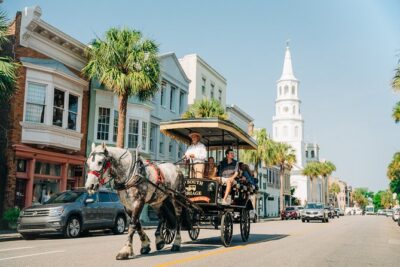
Charleston’s Old South Carriage Historic Horse & Carriage Tour
Read our review →
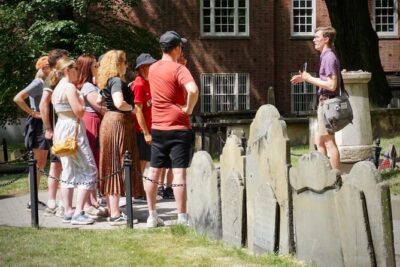
Boston: Freedom Trail History Small Group Walking Tour
Read our review →
Historic Charleston Guided Sightseeing Walking Tour
Read our review →
Savannah History and Haunts Candlelit Ghost Walking Tour
Read our review →
Tour of Historic Fenway Park, America’s Most Beloved Ballpark
Read our review →
Oahu: Mauka Warriors Luau Honoring Polynesia’s Forgotten History
Read our review →Browse the lists this tour appears in