
Review · BOSTON
Downtown Freedom Trail Walking Tour – History & Architecture
Boston’s Freedom Trail packs a remarkable amount of American history into a short downtown walk. This tour follows the section from Faneuil Hall to Boston Common, passing the Boston Massacre Site, Old State House, King’s Chapel, and the graves of Paul Revere and Samuel Adams.
I like the compact 70-minute format, which gives first-time visitors a useful introduction without taking over the day. I also like the mix of political history and architecture, from the gold-domed State House to the Federal and French Second Empire buildings along School Street.
The main caution is that guide quality can vary. Alan and Andrew have received especially warm praise for humor and clear storytelling, while some people found it hard to hear the guide or wanted more detail about the Revolution. A group of up to 20 can also make listening tricky on a noisy street.
Key points at a glance
- A focused Freedom Trail route: The walk covers the central downtown stretch between Faneuil Hall and Boston Common.
- History plus architecture: You’ll hear about colonial protests, Boston’s early institutions, famous residents, and the buildings that shaped the city.
- A short morning commitment: The tour begins at 10:00 a.m. and lasts about 70 minutes, leaving your afternoon open.
- Small-group setting: The maximum group size is 20, though street noise can still affect how clearly you hear.
- Good family potential: Children can take part, and several guides make a point of including younger members of the group.
- A useful value at $45: The tour offers a guided overview of many major downtown sites, though it is mainly an outdoor orientation rather than a series of interior visits.
Why this short Boston walk works
The Freedom Trail is easy to follow on your own, but a red-brick line and a list of names do not explain why the sites matter. A guide gives you the connections: protest leads to revolution, colonial government gives way to American government, and old churches, cemeteries, shops, and civic buildings reveal how Boston grew.
This tour concentrates on the downtown portion, rather than trying to cover every Freedom Trail site in one long outing. That makes the route manageable. You begin near State Street and Congress Street at 10:00 a.m., then finish at Brewer Fountain by Boston Common.
At $45 per person, the price is reasonable if you want a structured introduction to Boston. You are paying for a guide who handles the route, gives context, answers questions, and links the stops together. You are not paying for entry into a collection of museums or historic interiors. Most of the experience takes place outdoors, with buildings and landmarks viewed from the street.
The walk is also a practical first activity in Boston. It helps you understand where Faneuil Hall, the Common, Beacon Hill, School Street, and the older downtown core fit together. Afterward, you can decide which places deserve a longer visit.
More History Walking Tours in Boston
- Boston: Freedom Trail History Small Group Walking Tour
★ 5.0 · 6,450 reviews - Boston: Freedom Trail History Small Group Walking Tour
★ 4.9 · 1,590 reviews - Boston Pizza Lovers Food and History Walking Food Tour
★ 4.5 · 1,082 reviews
Faneuil Hall and Quincy Market: starting with protest
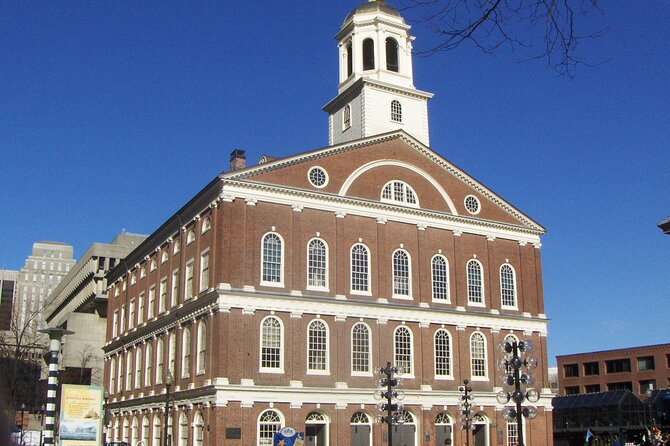
The route begins around Faneuil Hall and Quincy Market, one of the liveliest parts of central Boston. Faneuil Hall is often called the Cradle of Liberty because public meetings and forceful speeches here helped build opposition to British rule.
Look up for the grasshopper weathervane. It is a small detail, but the sort of detail that helps turn a quick stop into a memorable one. Your guide can also place the marketplace in the larger story of colonial Boston, where commerce, public debate, and protest shared the same crowded streets.
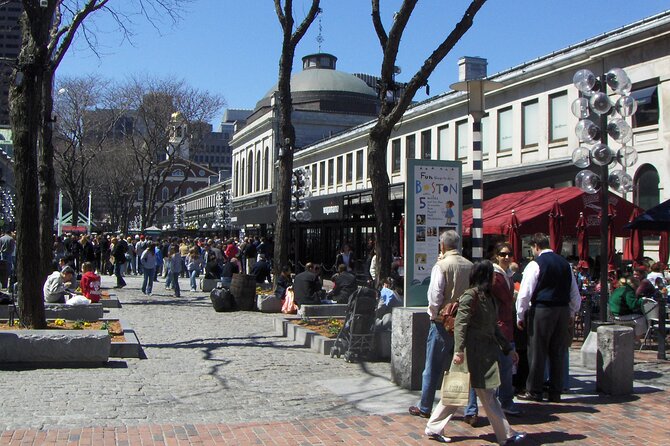
Quincy Market adds a different layer. It is a major food and shopping center today, while the nearby historic buildings point back to Boston’s commercial past. This is a busy starting area, so arrive ready to locate the guide and stay close to the group.
The first stop may receive extra time to allow late arrivals to catch up. That is considerate, but it can also make the opening feel slower if you are already there on time.
The Old State House and Boston Massacre Site
From Faneuil Hall, the walk moves toward the Old State House and the Boston Massacre Site. These two stops work well together because they show how British authority and colonial anger collided in a very small part of the city.
The Old State House, built in 1713, was the center of British colonial government in Massachusetts. Its balcony later became the place where the Declaration of Independence was first read to Bostonians. The building is not just an old facade. It represents the government the colonists challenged, and then the public space where a new political idea was announced.
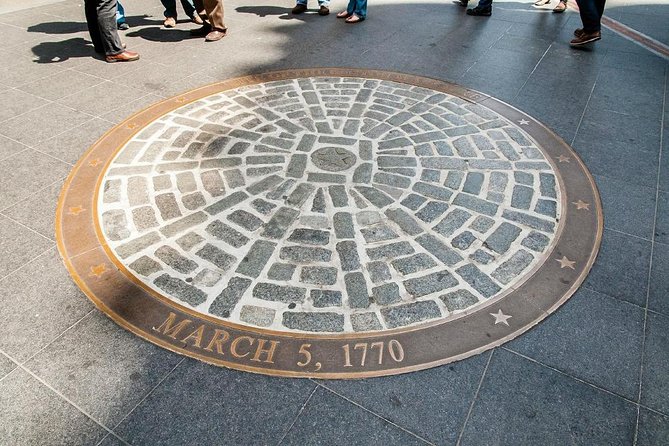
Nearby, the Boston Massacre Site is marked by a cobblestone ring in the pavement. The 1770 confrontation between British soldiers and colonists became powerful revolutionary propaganda. Your guide can help you separate the physical event from the way it was presented and remembered.
This is one of the strongest sections for anyone who wants a clear beginning-to-end story. The drawback is that the site is in a busy downtown setting. You are looking at a street-level marker, not entering a quiet historic room, and the guide’s voice matters a great deal.
Old South Meeting House and Old Corner Bookstore
The Old South Meeting House is tied to the events that led to the Boston Tea Party. The large brick church was the gathering place where colonists debated British taxation and made decisions that pushed the city closer to open revolt.
The guide also points out the Old Corner Bookstore at 283 Washington Street, built in 1718 as a residence and apothecary shop. It became a bookstore in 1828 and later connected with major American literary figures, including Ralph Waldo Emerson and Charles Dickens.
This pairing gives the walk useful range. The Old South Meeting House represents political action, while the bookshop reflects Boston’s long connection with publishing and public ideas. You get a sense that the city’s history was shaped not only in government buildings, but also in churches, stores, and meeting rooms.
You may have time to explore some places more closely, but the 70-minute schedule is primarily a guided walk past the landmarks. If your priority is going inside every historic building, plan additional time after the tour.
More History Walking Tours in the USA
- Boston History Tour: Scenic Walk Through Time & Landmarks
★ 5.0 · 627 reviews - Boston’s North End Food and History Walking Tour
★ 5.0 · 459 reviews - Walk the Historic Freedom Trail with Costumed Guide
★ 4.5 · 329 reviews - Boston Seafood Lovers Food and History Walking Tour
★ 5.0 · 208 reviews
School Street, Old City Hall, and the Irish Famine Memorial
School Street is one of the most interesting stretches of the route because several periods of Boston’s story appear within a short walk.
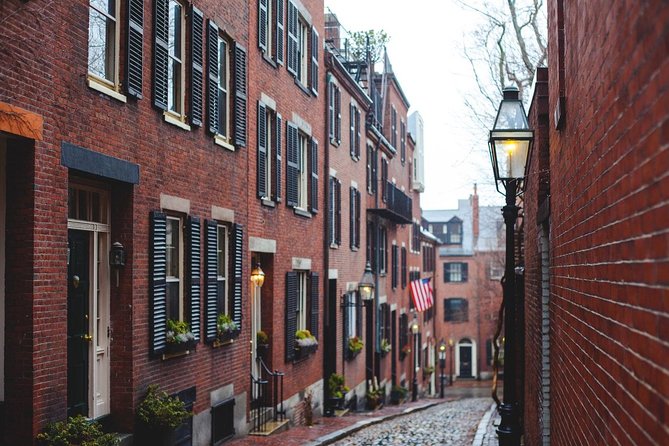
Old City Hall, at 45 School Street, housed Boston’s city government from 1865 to 1969. Its French Second Empire design was an early example of that style in the United States. Here, the focus shifts from colonial rebellion to the growth of a major American city in the 19th century.
Nearby, the original site of Boston Latin School is marked by a statue of Benjamin Franklin and a sidewalk mosaic. Founded in 1635, it was the first public school in America and offered free classical education to boys. The stop is brief, but it helps explain the city’s early emphasis on education and civic training.
The Boston Irish Famine Memorial adds a more difficult and more recent chapter. Two groups of statues contrast an Irish family suffering during the Great Famine of 1845 to 1852 with a prosperous family that had immigrated to America. This is a reminder that Boston’s story did not end with the Revolution. Immigration, hardship, ambition, and social change all shaped the city that followed.
The range of subjects is a strength, though it may not satisfy you if you want every minute devoted to Revolutionary War events. Some people prefer the tour’s broad sweep, while others want more detail about individual battles, political figures, and military events.
King’s Chapel and the Omni Parker House
King’s Chapel is one of the most important religious landmarks along this section of the Freedom Trail. Its history reaches back to 1686 and continues through the colonial period, the American Revolution, and the early years of the United States.
The church gives the guide a chance to discuss how religion, government, and social status shaped early Boston. It also adds an architectural pause to a route otherwise filled with civic and political landmarks.
The nearby Omni Parker House brings a more personal and hotel-centered story. Founded by Harvey D. Parker in 1855, it is described as the oldest continuously operating hotel in the United States. It has hosted every U.S. president since Ulysses S. Grant and is associated with Boston Cream Pie, Parker House Rolls, and the word scrod.
These details are useful because they make the city feel inhabited rather than frozen in 1775. You are not only looking at monuments to famous events. You are also seeing places connected with food, lodging, writing, politics, and everyday public life.
Tremont Temple and Boston’s changing society
Tremont Temple brings another strong social theme into the walk. The church began in 1839 as the Free Baptist Church and became associated with open attendance without charge. It is often identified as the first integrated church in America.
Its story includes Timothy Gilbert, who left another congregation after it objected to his inviting a Black family into his pew. Tremont Temple later hosted public events, including an Egyptian mummy display and speeches against slavery by figures such as Frederick Douglass and Sam Houston.
This stop broadens the tour beyond the familiar Revolution narrative. It gives you a way to think about race, religion, public speech, and civic life in 19th-century Boston.
The treatment of social history can vary with the guide. One guide may spend more time on Black history and reform movements, while another may focus more heavily on architecture or colonial politics. That variety can be a strength, but it also explains why the tour may feel different from one departure to another.
Granary Cemetery and the people behind the story
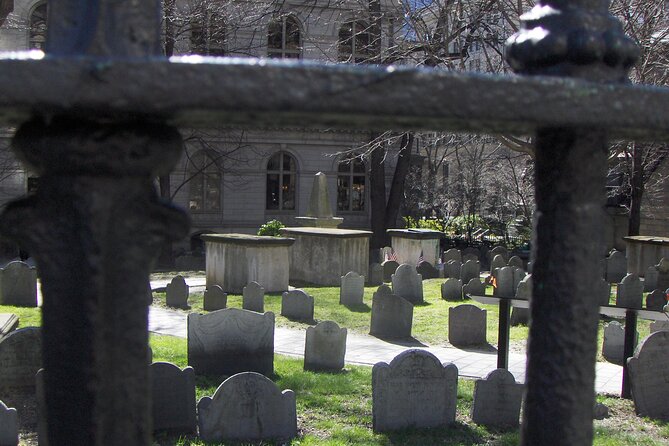
Old Granary Cemetery is one of the most visually striking stops. It is the final resting place of Paul Revere, Samuel Adams, and John Hancock, among other important figures from Boston’s early history.
A cemetery can provide a welcome change from the traffic and hard pavement of downtown. It also puts names from schoolbooks into a physical setting. You can see how close the burial ground is to the streets where Boston’s political life unfolded.
The cemetery stop works best when the guide explains the people rather than simply pointing out famous graves. The strongest guides use humor and human details to make the figures less remote. Alan has been praised for connecting historic facts to modern Boston, and Andrew for combining clear explanation with a light touch.
There is a practical limitation here. The cemetery can be crowded, and the group may need to move or gather closely so everyone can hear. Keep your phone away during the explanation and watch for the pace of the group when leaving.
Park Street Church, Boston Common, and the New State House
Park Street Church marks the final part of the route. The church is a familiar Boston landmark, and its position beside the Common makes it a natural transition from the dense historic core to the city’s oldest public park.
Boston Common covers 50 acres and is recognized as the oldest city park in the United States. It is bounded by Tremont Street, Beacon Street, Charles Street, and Boylston Street. The tour ends at Brewer Fountain, giving you a practical place to continue exploring.
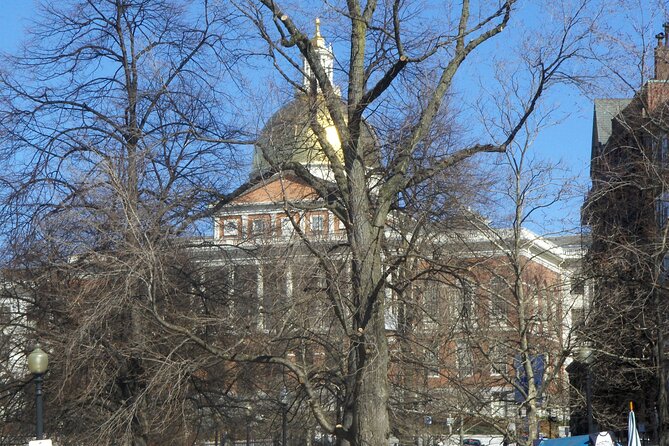
The New State House overlooks the Common and is recognizable by its 23-karat gold dome. Built in 1798, it remains the seat of Massachusetts government. Seeing the Old State House earlier in the walk and the New State House near the end creates a useful visual comparison: colonial authority, revolutionary change, and the government of the new state.
This final stretch is one of the best reasons to take the tour early in your Boston visit. Once you reach the Common, you are well placed to continue toward Beacon Hill, walk through the park, or follow another route into the city.
Guide style, group size, and hearing clearly
The experience depends heavily on the person leading it. Alan is associated with thorough explanations, humor, and a knack for connecting historic events with modern Boston. Andrew has also received strong praise for being funny, clear, and good with children.
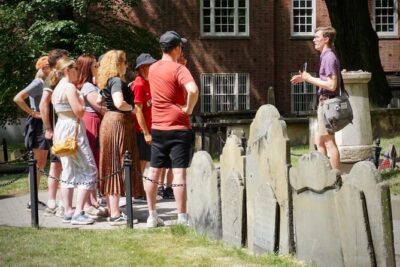
The provider limits the group to 20 people. That is smaller than many city walks, and it can make questions and personal attention easier. Still, some people have found the guide difficult to hear, especially on busy streets, and a microphone is not listed as part of the experience.
I would stand near the guide rather than drift to the back. This matters most at the Boston Massacre Site, School Street, and around the cemetery, where street noise and passing groups can compete with the explanation.
Children must be accompanied by an adult. The tour can work well for families because the route is short and some guides actively include younger members by asking questions. The subject matter is serious, though, and parents should expect discussion of violence, slavery, famine, and political conflict.
Weather, timing, and what to bring
The tour begins at 10:00 a.m. and operates in all weather conditions, so dress for the forecast. The cancellation terms also allow the experience to be canceled because of poor weather, with a different date or full refund offered in that case.
Wear comfortable shoes. This is a true walking tour, not a bus ride with short photo stops. Bring water and clothing that lets you stay outside for the full 70 minutes.
Free cancellation is available up to 24 hours before the start time. Within 24 hours, refunds are not provided, and changes are not accepted. That policy makes early booking sensible if your Boston schedule is firm, but check the weather before the deadline if conditions look uncertain.
The tour is offered in English and is near public transportation. Confirmation arrives at booking, and most people can participate.
Should you book the Downtown Freedom Trail Walking Tour?
Book it if you want a short, guided introduction to Boston’s central historic district, especially on your first morning in town. The route covers many major landmarks, the price is fair for a 70-minute guided walk, and the combination of people, politics, architecture, and public spaces gives you a useful framework for the rest of your visit.
It is a good fit for families, first-time visitors, solo sightseers, and anyone who wants more context than the painted trail line provides. Try to join a departure led by Alan or Andrew if those names are available, and stay near the guide so you can hear every explanation.
Skip it if you want long interior visits, a costumed performance, or a highly detailed account of every Revolutionary War event. For those priorities, you may prefer a longer tour or a self-guided day that lets you spend more time inside individual sites.
FAQ
Where does the tour begin?
The meeting point is at State Street and Congress Street in Boston, Massachusetts. The scheduled start time is 10:00 a.m.
Where does the tour end?
The walk ends at Brewer Fountain on the Freedom Trail near Boston Common.
How long does the tour last?
The tour lasts approximately 1 hour and 10 minutes, or 70 minutes.
What landmarks are included?
The route passes Faneuil Hall, Quincy Market, the Old State House, the Boston Massacre Site, Old South Meeting House, Old Corner Bookstore, Old City Hall, the Boston Latin School site, King’s Chapel, Tremont Temple, Old Granary Cemetery, Park Street Church, the New State House, and Boston Common.
Is the tour offered in English?
Yes. The tour is offered in English.
Can children join?
Yes. Children can participate, but they must be accompanied by an adult.
What happens if I need to cancel?
You can cancel at least 24 hours before the start time for a full refund. Cancellations or changes made within 24 hours are not accepted and are not refunded. If the experience is canceled because of poor weather or because the minimum number of participants is not reached, you will be offered another date or experience, or a full refund.
Just added around Boston
- Boston’s North End History + Photo Walking Tour (SMALL Group)★ 5.0 · 27 reviews
- Boston’s Architecture, History + Photo Walking Tour (SMALL Group)★ 5.0 · 91 reviews
- Freedom Trail Guided Walking Tour (SMALL GROUP)★ 4.5 · 98 reviews
- Haunted Boston’s Historic Streets Walking Guided Tour★ 4.5 · 184 reviews
- Boston: Underground Railroad History Tour of Beacon Hill★ 5.0 · 141 reviews
- Beacon Hill Boston History + Photo Walking Tour (SMALL Group)★ 5.0 · 163 reviews
- Beacon Hill + Back Bay History + Photo Walking Tour(SMALL Group)★ 5.0 · 60 reviews
- A Taste of the Freedom Trail: Boston’s Iconic Food & History Tour★ 5.0 · 32 reviews
Boston History Tours, compared.
Boston: Freedom Trail History Small Group Walking Tour
Read our review →
Tour of Historic Fenway Park, America’s Most Beloved Ballpark
Read our review →
Boston Food & History: Pizza, North End & Freedom Trail
Read our review →Boston: Freedom Trail History Small Group Walking Tour
Read our review →
City Cruises Boston Historic Sightseeing Harbor Cruise
Read our review →
Boston Pizza Lovers Food and History Walking Food Tour
Read our review →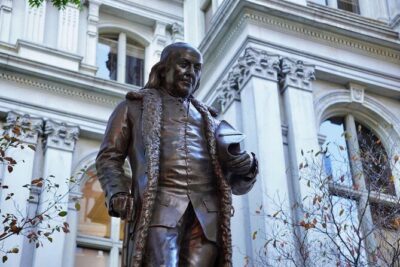
Boston Freedom Trail History Pub Crawl Small-Group Tour
Read our review →
Boston City View Bicycle Tour: History and Landmarks
Read our review →Browse the lists this tour appears in