
Review · BOSTON
Walk the Historic Freedom Trail with Costumed Guide
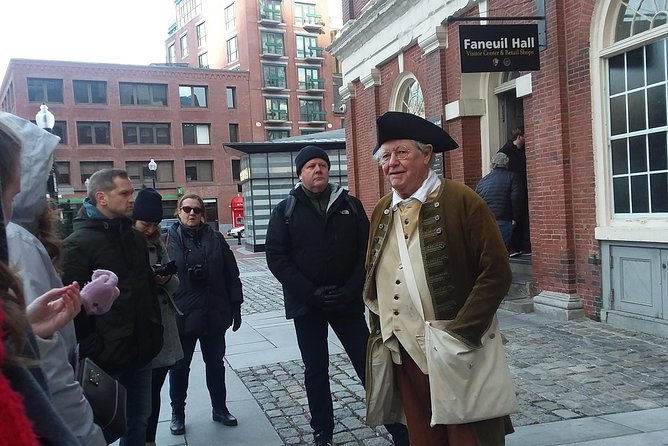
Boston’s Freedom Trail is easiest to understand when the streets become the classroom. This 90-minute walk links churches, burial grounds, meeting halls, and the site of the Boston Massacre, with a costumed guide turning dates and names into a connected story.
I like the short format, which gives you a useful introduction without taking half your day. I also like the character of the guides. Names such as James Otis, Thomas, Jeff, Steven, Adri, and Samuel Gray appear among the guides, and their styles range from witty and theatrical to calm and academic. The main consideration is sound: downtown traffic and a group of up to 45 people can make it hard to hear at times.
Key points at a glance
- A compact route through central Boston: Walk from Park Street Church to Faneuil Hall Marketplace in about 90 minutes.
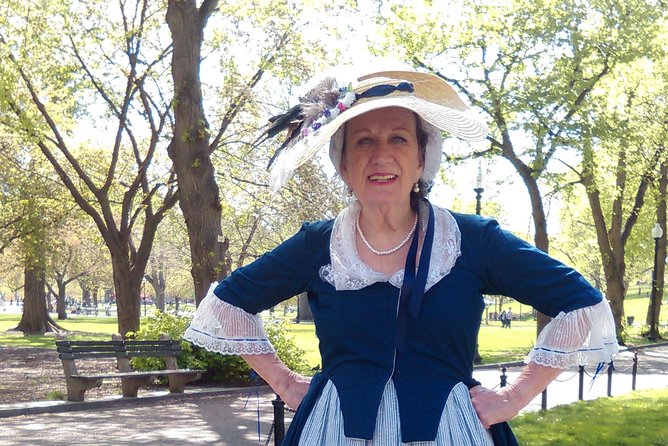
- Costumed storytelling: Guides such as James Otis and Thomas use period dress, humor, and historical detail to keep the walk lively.
- Ten listed stops with broad coverage: See Boston Common, the State House, Granary Burying Ground, Old South Meeting House, the Old State House, and more.
- A gentle but active outing: The route is less than a mile according to the tour information, yet includes plenty of standing and walking.
- Useful for a first look at Boston: Morning and afternoon departures leave room for a museum, meal, harbor visit, or North End wander.
- Good value at $30: You get a focused introduction to major landmarks without committing to a three-hour full-route walk.
Why this short Freedom Trail walk works
The Freedom Trail is marked by a red line through Boston, but following it on your own does not automatically explain why each building matters. You may see an old church, a brick government building, or a graveyard and move on without grasping the argument, conflict, or personal story behind it.
This tour gives you a framework. The guide connects Puritan Boston, British rule, colonial protest, the American Revolution, and the early republic as you move through downtown. That makes the route especially useful on your first day in Boston. You can return to places later with a better sense of what you are seeing.
The walk begins at 139 Tremont Street, close to Boston Common and Park Street Station. It finishes at Faneuil Hall Marketplace, a handy place to continue with lunch, shopping, or a walk toward the North End. The start and finish are not the same, so you should plan your day around that point-to-point route.
At $30 per person, the experience is priced fairly for a live, guided introduction. You are paying for interpretation rather than admission to a special interior exhibit. Most of the value comes from the guide’s ability to explain the places in front of you, answer questions, and keep the story moving.
The shorter format is the real selling point. A full Freedom Trail experience can take about three hours as a private tour, while this version gives you a central selection in roughly half the time. If you have only one day in Boston, that tradeoff matters.
More History Walking Tours in Boston
- Boston: Freedom Trail History Small Group Walking Tour
★ 5.0 · 6,450 reviews - Boston: Freedom Trail History Small Group Walking Tour
★ 4.9 · 1,590 reviews - Boston Pizza Lovers Food and History Walking Food Tour
★ 4.5 · 1,082 reviews
Park Street Church and Boston Common
Park Street Church is the first stop. The church is presented as a place where early Puritan ideas developed toward Protestant abolitionism. That is a compact description of a complicated religious and political shift, so listen closely as your guide explains the change rather than treating the building as a quick photo stop.
You then move into Boston Common for about ten minutes. This is where the guide lays out Boston’s early story and gives the city’s oldest central public space its proper context. The Common is a useful opening chapter because it helps you picture Boston before the later landmarks begin to crowd together.
The walking pace is meant to be gentle. You are not covering a long distance quickly, but you will be standing while the guide speaks. Wear shoes that can handle old sidewalks and dress for the weather. A light drizzle does not necessarily ruin the outing, but cold rain or poor conditions can lead to a cancellation, alternate date, or refund.
The Massachusetts State House and the argument over consent
The Massachusetts State House receives a short stop of about five minutes. Built in 1795, it represents a central idea in American political history: government is not legitimate without the consent of the people.
This is one of those places where a brief explanation can add more value than a long visit on your own. The gold-domed building is visually striking, but the important point is the political principle attached to it. The guide uses the building to connect Boston’s colonial disputes with the larger question of who has the right to govern.
The stop is outside-oriented, based on the supplied route. If you want an interior visit, you should treat that as a separate plan rather than assuming this walk includes a full State House tour.
Granary Burying Ground and Boston’s political family tree
Granary Burying Ground gets about fifteen minutes, the longest stop on the route. That extra time makes sense. This graveyard is more than 350 years old and contains the remains of important figures from Boston’s early political and religious life.
The tour points out that more signers of the U.S. Constitution are buried here than anywhere else in the country. The exact names and stories are where a good guide earns the fee. Instead of seeing rows of worn stones, you get a sense of how the people connected to Boston’s political upheaval fit together.
Some visitors may find fifteen minutes in a graveyard longer than expected, especially if they prefer a faster-moving walk. I see the pause as useful for history-minded visitors, but it is also the part of the route most likely to feel slow for younger children or anyone focused only on major buildings.
More History Walking Tours in the USA
- Boston History Tour: Scenic Walk Through Time & Landmarks
★ 5.0 · 627 reviews - Boston’s North End Food and History Walking Tour
★ 5.0 · 459 reviews - Boston Seafood Lovers Food and History Walking Tour
★ 5.0 · 208 reviews - Downtown Freedom Trail Walking Tour – History & Architecture
★ 4.5 · 194 reviews
King’s Chapel and Boston’s changing faiths
King’s Chapel follows, with about ten minutes devoted to the church and its setting. It began as a Church of England congregation and was originally built around 1688. That detail places the church firmly in the period when Boston’s religious identity was tied to English authority.
The stop helps balance the usual Revolution story. Boston was not created as a single-minded revolutionary town. Its people belonged to different churches, followed different political leaders, and disagreed about the Crown, trade, and local power. A costumed guide can make those divisions easier to picture than a plaque can.
You should expect commentary at the site rather than a lengthy private visit inside. The walk’s strength is the chain of places, not extended time in any single church.
Boston Latin School and the value of a short stop
The Boston Latin School site takes about five minutes. Founded in 1635, it is identified as the oldest public school in the United States.
This is a quick stop, but it adds an important piece to the story. Boston was not only a center of protest and commerce. It also placed early emphasis on education, civic life, and the training of future leaders. The guide can explain why that matters within the wider colonial setting.
For you, the practical benefit is variety. The tour does not spend the whole morning on churches or military events. It moves from religion to politics to burial customs to education, keeping the route from becoming a string of similar facades.
Old South Meeting House and the Tea Party connection
Old South Meeting House gets about ten minutes. This is one of the most important places on the route because major public gatherings happened here, including a meeting just before the Boston Tea Party in 1773.
The building lets you think about protest as a public act. People did not simply disagree in private. They gathered in large numbers, debated what to do, and made decisions that could put them at odds with British authority.
The guide’s storytelling style matters here. A list of dates will not tell you why a meeting became tense or why the Tea Party carried such political weight. Guides such as Thomas or James Otis are known for adding humor and theatrical energy, which can make this part easier to remember. Guide assignments vary, so you should not book around a particular person unless the operator confirms who is leading your departure.
Old State House and the transfer of power
The Old State House is one of the most visually rewarding stops. Built in 1713, it served as Boston’s original state house. It was first controlled by the British and then taken over by the Americans in 1775.
That change in ownership gives the building a clear role in the tour. You are not just looking at an old structure. You are looking at a place where authority changed hands during a political crisis.
The stop is listed at about five minutes, so you will not have time for a long interior visit. Still, the exterior and the guide’s explanation provide enough context to make the next stop, the Boston Massacre site, feel connected rather than random.
The Boston Massacre site and the power of an image
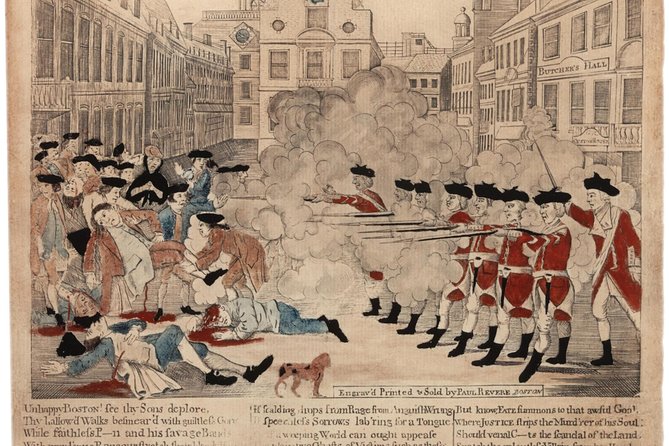
The Boston Massacre site receives about ten minutes. On March 5, 1770, British soldiers killed five Americans here. Paul Revere later made a famous engraving of the event.
This is a strong moment for understanding how public opinion is shaped. The event itself was tragic and chaotic, but Revere’s engraving helped present it in a way that supported the colonial cause. Your guide can help separate the event, the image, and the political use of both.
It is also one of the noisier parts of the walk. Downtown traffic, construction, and passing pedestrians can interfere with speech. The operator says guides use microphones, but people with hearing concerns should stay near the front. If hearing every detail is essential, position yourself carefully before the explanation begins.
Faneuil Hall Marketplace and the final stop
The tour ends at Faneuil Hall Marketplace after about five minutes at the final stop. Faneuil Hall is closely tied to Boston’s public debates, and the statue of Samuel Adams gives the conclusion a recognizable revolutionary figure.
Ending here is practical. You are close to food, shops, and routes into other parts of downtown. You can continue toward the North End, though the tour itself does not include a full North End walk. One guide has been praised for adding tips about lobster rolls and places to see in that neighborhood, but those suggestions depend on the person leading your group.
Faneuil Hall can be crowded and noisy, so do not expect a quiet ending. The advantage is that the tour leaves you in a useful part of town rather than returning you to the starting point.
Guide style, group size, and the sound problem
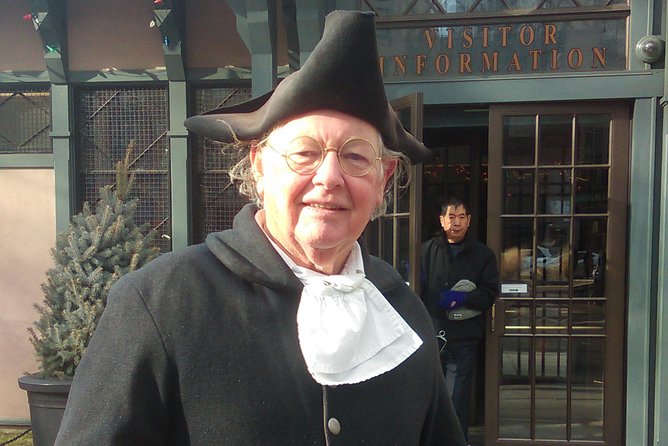
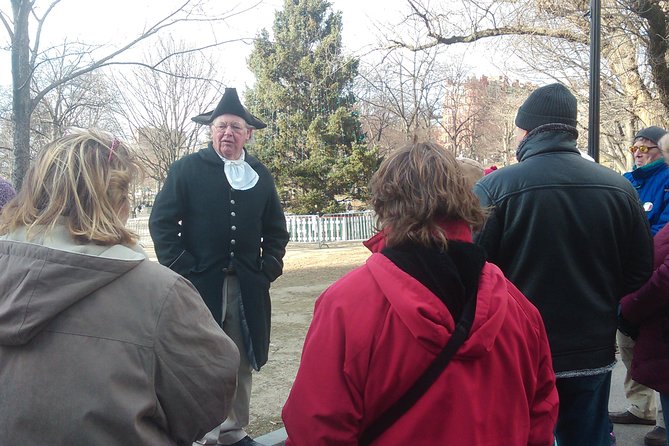
The guide is the heart of this experience. The company uses costumed presenters, and the strongest descriptions of the tour focus on humor, energy, historical detail, and an ability to answer questions. James Otis is known for his long experience and theatrical persona. Thomas has been singled out for wit and a lively delivery, while Jeff, Steven, Adri, and Samuel Gray are also named among guides who have led memorable walks.
That variety can be a strength. You may get a guide who performs the past with plenty of character, or one who takes a more measured classroom approach. The tour is designed for adults, but older children and teenagers with an interest in American history should get plenty from it.
The tradeoff is group size. The stated maximum is 45 people, and a large group can make narrow sidewalks and crowded sites less comfortable. Most of the time, the issue is not walking speed. It is hearing the guide and gathering around each stop.
The microphones help, but they do not erase city noise. Stay close to the guide, avoid lingering at the back, and tell the guide early if you have hearing trouble. This is a practical point, not a minor detail. One of the main benefits of paying for a guided walk is hearing the explanation clearly.
Who should book this 90-minute route
I would choose this tour if you want a first look at Boston’s major Revolutionary-era sites without spending three hours on foot. It suits couples, families, history buffs, and anyone with a morning or afternoon free before another activity.
It also works well for a first day in the city. Afterward, you can decide which places deserve a longer visit. The route is not strenuous, but it does involve walking and standing, so it is not a seated sightseeing experience.
The format can suit someone who benefits from a clear routine and a moderate pace. One family found the length and presentation workable for a child with high-functioning autism, though individual needs vary. Service animals are allowed, and the route is near public transportation.
You should think twice if you want a complete Freedom Trail experience, long interior visits, or a quiet small-group setting. The walk covers the central sites rather than every stop, and the group may be sizable.
Booking details worth knowing
The price is $30 per person. Confirmation arrives at booking, and the ticket is mobile, which keeps the arrival process simple. Departures are offered in the morning and afternoon, giving you room to fit the walk around a meal, museum, train connection, or flight.
The meeting point is 139 Tremont Street. The tour ends at Faneuil Hall Marketplace, Boston, Massachusetts 02109. It is smart to allow a little extra time to reach the start, since a late arrival could be difficult once the group has moved into Boston Common.
Cancel at least 24 hours before the start for a full refund. Changes made within 24 hours are not accepted and the payment is not refunded. Poor weather or failure to meet the minimum number of participants can lead to a new date, another experience, or a full refund.
Should you book it?
Book this walk if you want a lively, efficient introduction to Boston’s political past. The cost is reasonable, the route is manageable, and the end at Faneuil Hall makes it easy to continue exploring.
I would not choose it as your only Freedom Trail experience if you have several days and want to enter every major building. For most first-time visitors, though, the 90-minute route offers a useful balance: enough landmarks to orient you, enough stories to make them memorable, and enough free time left to explore Boston on your own.
FAQ
How long is the Freedom Trail walking tour?
The tour lasts approximately 1 hour and 30 minutes.
How much does the tour cost?
The listed price is $30 per person.
Where does the tour begin?
It begins at 139 Tremont Street, Boston, Massachusetts 02111.
Where does the tour end?
It ends at Faneuil Hall Marketplace in Boston, Massachusetts 02109.
Is the tour offered in English?
Yes. The tour is offered in English.
How much walking is involved?
The experience is described as a gentle 90-minute stroll with a lot of walking and standing. The route is listed as less than one mile.
What should I wear?
Dress for the weather and wear comfortable shoes.
Are service animals allowed?
Yes, service animals are allowed.
What is the cancellation policy?
You can cancel at least 24 hours before the start for a full refund. Cancellations or changes made less than 24 hours before the start are not accepted and are not refunded.
Just added around Boston
- Boston’s North End History + Photo Walking Tour (SMALL Group)★ 5.0 · 27 reviews
- Boston’s Architecture, History + Photo Walking Tour (SMALL Group)★ 5.0 · 91 reviews
- Freedom Trail Guided Walking Tour (SMALL GROUP)★ 4.5 · 98 reviews
- Haunted Boston’s Historic Streets Walking Guided Tour★ 4.5 · 184 reviews
- Boston: Underground Railroad History Tour of Beacon Hill★ 5.0 · 141 reviews
- Beacon Hill Boston History + Photo Walking Tour (SMALL Group)★ 5.0 · 163 reviews
- Boston: Food and History of The Freedom Trail Private Tour★ 5.0 · 159 reviews
- Beacon Hill + Back Bay History + Photo Walking Tour(SMALL Group)★ 5.0 · 60 reviews
Boston History Tours, compared.
Boston: Freedom Trail History Small Group Walking Tour
Read our review →
Tour of Historic Fenway Park, America’s Most Beloved Ballpark
Read our review →
Boston Food & History: Pizza, North End & Freedom Trail
Read our review →Boston: Freedom Trail History Small Group Walking Tour
Read our review →
City Cruises Boston Historic Sightseeing Harbor Cruise
Read our review →
Boston Pizza Lovers Food and History Walking Food Tour
Read our review →
Boston Freedom Trail History Pub Crawl Small-Group Tour
Read our review →
Boston City View Bicycle Tour: History and Landmarks
Read our review →Browse the lists this tour appears in