
Review · BOSTON
Boston: Freedom Trail History Small Group Walking Tour
Boston’s Freedom Trail is more than a red line through downtown. It is a compact lesson in how a colonial port moved from uneasy British rule to open revolt. This 2.5-hour small-group walk links all 16 official landmarks, with a historian explaining what happened between 1760 and 1775 and why the city became the spark for the American Revolution.
I like two things here. First, the route gives you a useful order to Boston’s story, from the Common to the North End. Second, the group is capped at 16, which makes it easier to ask questions and hear the guide. Guides including Jon, Maura, Mark, Alejandro, and Maz are praised for clear storytelling and strong command of the subject. The main drawback is just as clear: you stay outside most buildings, and the full route means standing and walking for much of the afternoon.
Key points to know before booking
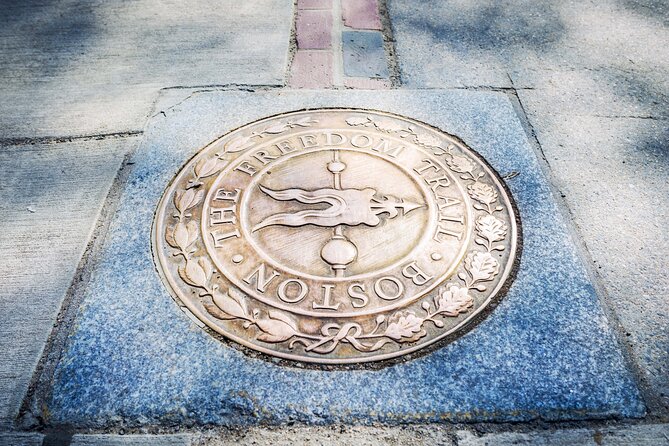
- All 16 official Freedom Trail landmarks: You follow the complete downtown and North End route rather than seeing only the most famous stops.
- A history-first walking tour: The main focus is Boston from 1760 to 1775, with political events, street-level conflict, and Revolutionary figures tied to each site.
- Small groups of up to 16: The size suits questions and conversation without the feel of a private tour.
- No museum admissions included: You see the exteriors and hear the stories, but entry inside churches and historic buildings costs extra.
- Ends in the North End: Copp’s Hill Terrace puts you near Hanover Street’s Italian restaurants, pastry shops, and pizza.
- Plan for weather and walking: The tour runs outdoors, requires moderate fitness, and is not a good fit if standing for long periods is difficult.
Why this Freedom Trail walk works so well
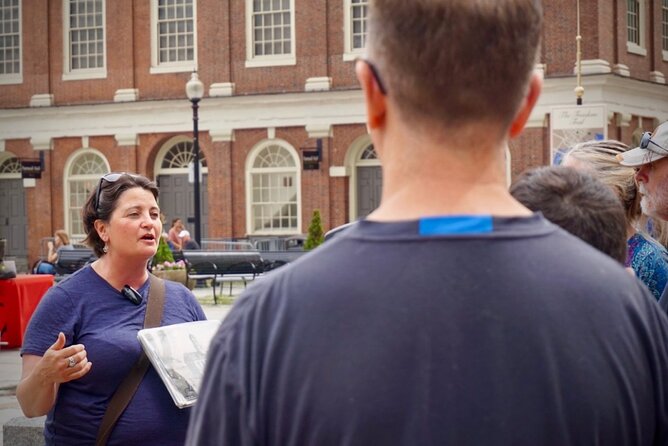
The Freedom Trail can be followed on your own, but the red-brick path does not explain itself. A church may look like an old church. A patch of pavement may look like an ordinary downtown corner. A good guide turns those places into scenes, arguments, warnings, and decisions.
That is the strength of this tour. The guide keeps the story centered on the years before the Revolution, when Boston was filled with competing loyalties. You hear about imperial power, local politics, taxation, protest, military occupation, and the choices that pushed neighbors toward conflict.
The group limit matters. Sixteen people is large enough to keep the cost at $35.10 reasonable, yet small enough that a guide can respond to questions. The experience is offered in English and uses a mobile ticket, so the practical setup is simple.
The 4.9 rating from 6,450 reviews and 98 percent recommendation rate point to a consistent experience, especially for the guides. Jon is praised for presenting the story in chronological order. Maura is praised for vivid storytelling. Mark brings a teacher’s command of the subject, while Alejandro is attentive to cold weather and uses indoor or covered spaces when possible. Maz has a gift for making a history lesson feel connected from one stop to the next.
More History Walking Tours in Boston
- Boston: Freedom Trail History Small Group Walking Tour
★ 4.9 · 1,590 reviews - Boston Pizza Lovers Food and History Walking Food Tour
★ 4.5 · 1,082 reviews - Boston History Tour: Scenic Walk Through Time & Landmarks
★ 5.0 · 627 reviews
Starting at Boston Common and the Boston Foundation Monument
Meet inside Boston Common at the Boston Foundation Monument, near the park’s northern edge opposite 50 Beacon Street. The granite monument has a bronze relief showing two men shaking hands, marking the arrival of the Puritans in 1630.
This is a sensible starting point because it puts you at the beginning of Boston’s civic story. Before the guide gets to muskets and midnight rides, you get a reminder that Boston’s origins involved settlement, religion, land, and competing ideas about government.
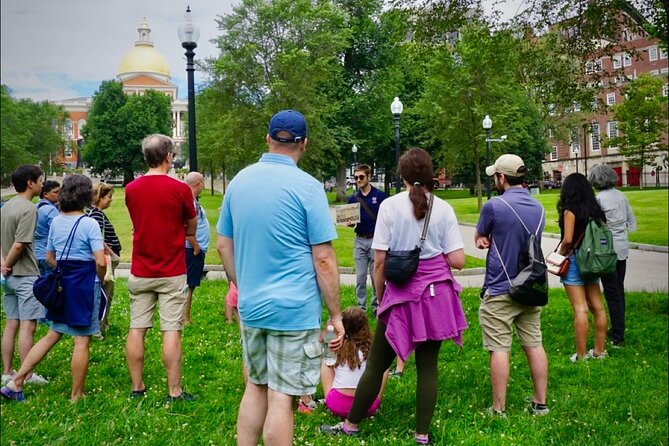
The first stop takes about 10 minutes. After that, the group moves into Boston Common, established as communal grazing land in 1634. It is described as the oldest public land in the Americas, and its broad open space gives the guide room to explain Boston’s early growth.
You also hear about the Massachusetts State Capitol, completed in 1798, and its nickname, the Hub of the Solar System. This section is not only about the Revolution. It shows how Boston’s public center changed as the city became a political and commercial force.
Granary Burying Ground and Boston’s Revolutionary names
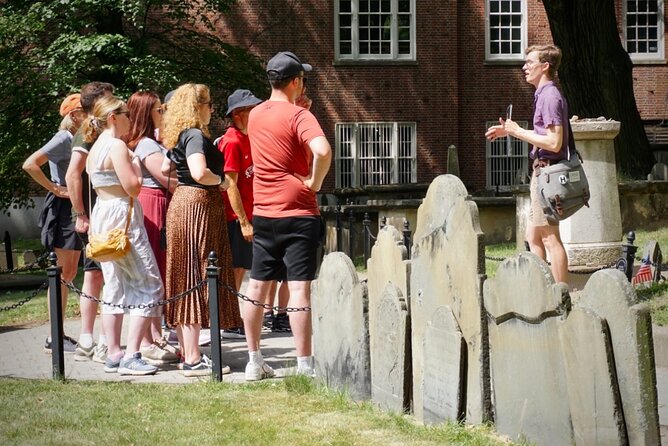
The walk continues to Granary Burying Ground, Boston’s third-oldest burial ground, founded in 1660. Allow about 20 minutes here.
This is one of the tour’s strongest stops because the names connected to the Revolution are not abstract. The burial ground is the final resting place of major figures from Revolutionary Boston, and the guide can connect those people to the arguments and events you will encounter later.
Along the route, you also pass several early religious sites. One is the first Church of England in Puritan Boston, dating to 1686 and 1754. Another is Boston’s oldest burying ground, founded in 1630. The tour also points out an active church that was the tallest building in 19th-century Boston, dating from 1809.
The route includes the site of Boston’s early political center, active for more than a century from 1865, as well as the former publishing house of Ticknor & Fields, housed in a building from 1718. These stops broaden the walk beyond 1770s conflict. You see how Boston remained a place of religion, government, publishing, and public debate long after the Revolution.
Benjamin Franklin, Boston Latin School, and the power of education
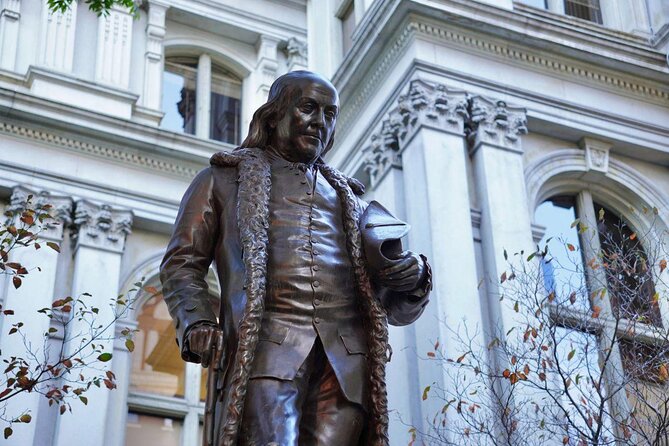
Near the statue of Benjamin Franklin, the guide explains the site of Boston Latin School, founded in 1635 and recognized as the oldest public school in the Americas.
The statue is a natural place to discuss Franklin, but the school site adds another layer. The story is not only about famous leaders. It is also about education, civic life, and who had access to the ideas shaping the city.
The stop lasts about 10 minutes. You should expect the guide to keep moving rather than pause for a long museum-style talk. That rhythm is useful on a 2.5-hour route, but it also means you need to listen closely and ask questions when there is a natural opening.
More History Walking Tours in the USA
- Boston’s North End Food and History Walking Tour
★ 5.0 · 459 reviews - Walk the Historic Freedom Trail with Costumed Guide
★ 4.5 · 329 reviews - Boston Seafood Lovers Food and History Walking Tour
★ 5.0 · 208 reviews - Downtown Freedom Trail Walking Tour – History & Architecture
★ 4.5 · 194 reviews
The meeting houses and the road to the Boston Tea Party
The walk passes a Congregationalist meeting house from 1729, identified as the origin site of the Boston Tea Party in 1773. It also reaches the colonial capitol of the Massachusetts Bay Colony, built in 1713 and described as Boston’s oldest public building.
These places help explain how protest became organized. Boston’s public buildings were not simply scenic old structures. They were places where residents met, argued, passed information, and challenged authority.
You also pass the former home of a renowned political leader associated with Boston’s Sons of Liberty. The guide’s role here is especially valuable because the sites are close together, while the events they represent were part of a larger chain. Complaints about imperial policy became public meetings. Public meetings became resistance. Resistance brought British troops into the city.
This is where a historian-led walk earns its price. You are not just collecting photographs of old buildings. You are following the machinery of political conflict through the streets where it unfolded.
The Boston Massacre Site and a city under pressure
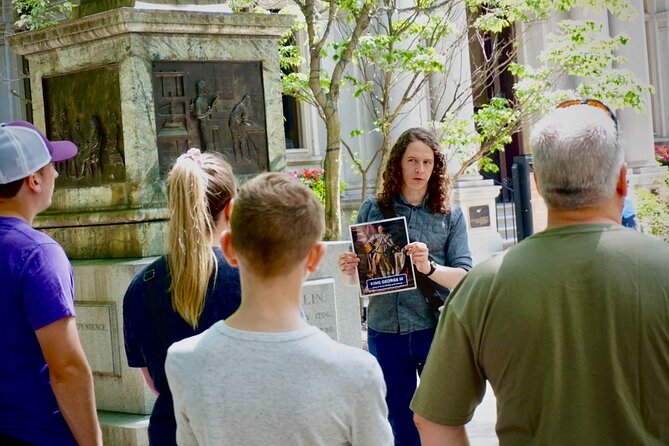
The Boston Massacre Site marks the killing of five Bostonians by British soldiers in 1770. The group spends about 20 minutes here.
This is one of the most important pauses on the route. The event became a powerful symbol for colonial resistance, but the guide can place it within the tense setting of military occupation, protest, and mutual distrust. The point is not to reduce the event to a slogan. It is to understand how violence on one street could fuel a much wider political crisis.
The site is located in the modern downtown, so the contrast between present-day city life and the colonial episode is sharp. You may find the stop more meaningful when the guide explains what the surrounding streets represented at the time, rather than simply pointing to the location.
Faneuil Hall, Quincy Market, and Boston’s public voice
Faneuil Hall takes about 10 minutes. It hosted Boston’s town meetings and became known as the Cradle of Liberty.
This is a good place to connect protest with public speech. Boston’s arguments were made in meeting halls, streets, churches, and burial grounds. The building’s importance comes from that civic role, not just its age.
The route also passes the oldest restaurant in the United States, located in a historic building dating to 1704. The restaurant itself dates from 1826, so this is another spot where the guide can separate the age of the building from the age of the business.
You will pass through a busy commercial section here. That can make it harder to hear if the group is spread out, so stay close to the guide. The payoff is a better sense of how the historic center now functions as part of a working city rather than a sealed museum district.
North Square and the Paul Revere House
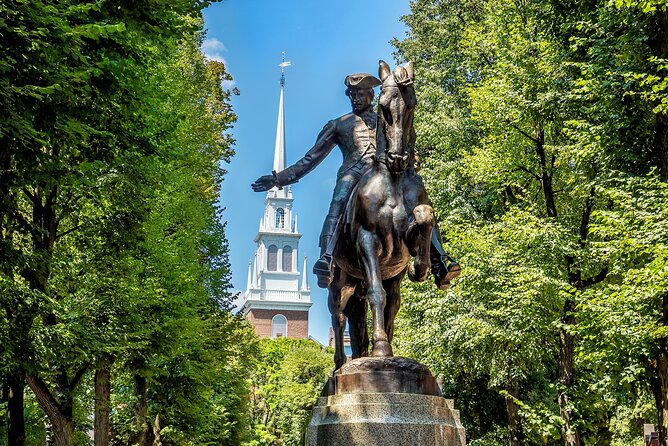
From Faneuil Hall, the route heads into North Square, a historic public square at the center of Boston’s North End. The group spends about 20 minutes in this area.
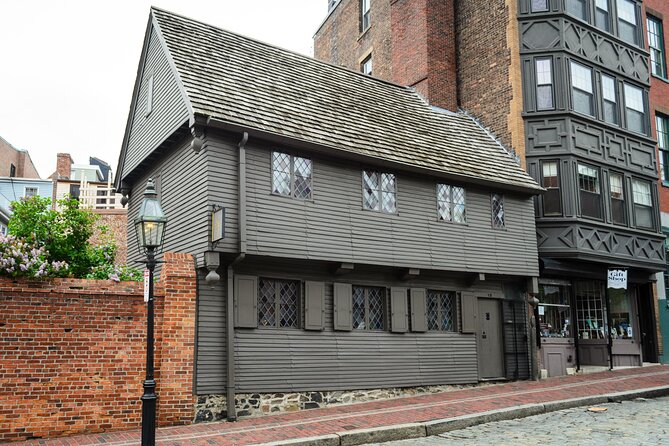
The North End changes the feel of the walk. Streets become narrower, the route feels more residential, and the Revolutionary story becomes tied to individual homes and neighborhoods. North Square is also near the Paul Revere House, built in 1680 and recognized as the oldest structure in downtown Boston.
You see the exterior and learn about Revere’s home, but admission inside is not included. That distinction matters. If you want to explore the house itself, plan to return separately and pay the admission charge.
The guide then brings you to the Paul Revere Statue, in a pedestrian-only area honoring the famous Midnight Ride of 1775. This stop takes about 20 minutes and gives the guide room to explain the ride within the wider network of warnings, messengers, and military movements.
The Midnight Ride is one of the most familiar stories on the Freedom Trail. A good guide can keep it from becoming a simple legend by showing how it fits the larger crisis. The experience is strongest when you listen for the connections between Revere, local communities, British troops, and the fear of open war.
Old North Church and Copp’s Hill Terrace
The route continues to Old North Church, Boston’s oldest church, where signal lanterns were held during the Midnight Ride. You also pass the second-oldest burying ground in Boston.
These stops bring the tour close to its Revolutionary climax. The church’s role in the warning system is famous, but its age and religious setting also show how many institutions were already in place before the crisis. The Revolution grew out of an established city with old churches, old cemeteries, schools, markets, and political traditions.
The tour finishes at Copp’s Hill Terrace after about 20 minutes at the final stop. From here, you look toward the Charles River and two major landmarks: the USS Constitution, launched in 1797, and the Bunker Hill Monument, linked to the 1775 battle.
This is an effective ending because it points beyond the downtown route. You do not visit Charlestown on this tour, and the Charlestown neighborhood is specifically excluded. Still, the final view lets the guide bring the story toward the wider military conflict.
The terrace is also practical. You finish close to Hanover Street, with Italian restaurants, pastry shops, and pizza nearby. I would plan to eat in the North End after the walk rather than rush back across town.
What $35.10 gets you
At $35.10 per person, this is a fair price for a 2.5-hour guided walk covering the complete Freedom Trail. You are paying for the guide’s preparation, the historical structure, and the ability to ask questions while moving through the city.
The value is strongest if you are visiting Boston for the first time or want context before exploring museums and interiors on your own. You cover a lot of ground without paying separate admission at every stop.
The price does not include entry inside museums or churches. That keeps the tour affordable, but it also means the experience is mainly outdoors. Old South Meeting House, Old North Church, and King’s Chapel may offer discounted admission with a Hub Town Tour ticket, according to the operator’s guidance. Check the current terms if entering those buildings is important to you.
Walking, weather, and accessibility
The tour is wheelchair and stroller accessible, and service animals are allowed. It is near public transportation, which makes the starting point convenient for a day of sightseeing.
Still, accessible does not mean effortless. You need moderate physical fitness and must be comfortable standing for extended periods. The route lasts roughly two and a half hours, with limited opportunity to sit.
Weather deserves real attention. Several winter accounts describe freezing temperatures, wind, and the need to bundle up. Guides may use indoor or covered spaces for short warm-up breaks, but this remains an outdoor walking tour. Comfortable shoes, warm layers, and a weather check on the morning of the tour are sensible.
The tour requires good weather and may be canceled if conditions are poor or if the minimum group size is not met. In those cases, you are offered another date or a full refund. You can cancel for a full refund up to 24 hours before the start time. Inside 24 hours, no refund is provided.
Who should book this tour
I would choose this walk if you want Boston’s history explained in order, with enough detail to make the buildings and street corners matter. It suits first-time visitors, history fans, families with older children, and anyone who prefers a guide’s voice to reading plaques at every stop.
It is also a strong first-day activity. The route cuts through central Boston and the North End, giving you a useful map of the city. You can return later to the sites that interest you most, especially the churches and historic houses that require admission.
I would hesitate if you dislike long outdoor walks, have trouble standing, or want to spend substantial time inside historic buildings. You should also think twice on a very cold or wet day, even though the guides work hard to make winter departures comfortable.
For most visitors, I would book it. The complete route, modest price, small group, and strong guide roster make this a practical introduction to Boston. Book it for the stories, not simply the landmarks, and leave time afterward to explore the North End at your own pace.
FAQ
How long is the Freedom Trail walking tour?
The tour lasts approximately 2 hours and 30 minutes.
How many people are in each group?
The group has a maximum of 16 travelers.
Does the tour visit all 16 Freedom Trail landmarks?
Yes. The experience includes all 16 official historic landmarks on the Freedom Trail.
Are museum and church admissions included?
No. Admission inside museums and historic buildings is not included.
Where does the tour start and finish?
It starts at the Boston Foundation Monument inside Boston Common, near 49 Beacon Street. It finishes at Copp’s Hill Terrace at 520 Commercial Street in the North End.
Can I cancel for a full refund?
Yes. You can cancel at least 24 hours before the start time for a full refund. Cancellations made less than 24 hours before the start time are not refunded.
More Small-Group History Tours in Boston
- Boston Freedom Trail History Pub Crawl Small-Group Tour
★ 5.0 · 996 reviews - Beacon Hill Boston History + Photo Walking Tour (SMALL Group)
★ 5.0 · 163 reviews - Freedom Trail Guided Walking Tour (SMALL GROUP)
★ 4.5 · 98 reviews - Boston’s Architecture, History + Photo Walking Tour (SMALL Group)
★ 5.0 · 91 reviews
Just added around Boston
- Freedom Trail Guided Walking Tour (SMALL GROUP)★ 4.5 · 98 reviews
- Boston’s North End History + Photo Walking Tour (SMALL Group)★ 5.0 · 27 reviews
- Boston’s Architecture, History + Photo Walking Tour (SMALL Group)★ 5.0 · 91 reviews
- Haunted Boston’s Historic Streets Walking Guided Tour★ 4.5 · 184 reviews
- Boston: Underground Railroad History Tour of Beacon Hill★ 5.0 · 141 reviews
- Beacon Hill Boston History + Photo Walking Tour (SMALL Group)★ 5.0 · 163 reviews
- A Taste of the Freedom Trail: Boston’s Iconic Food & History Tour★ 5.0 · 32 reviews
- Boston: Food and History of The Freedom Trail Private Tour★ 5.0 · 159 reviews
Boston History Tours, compared.

Tour of Historic Fenway Park, America’s Most Beloved Ballpark
Read our review →
Boston Food & History: Pizza, North End & Freedom Trail
Read our review →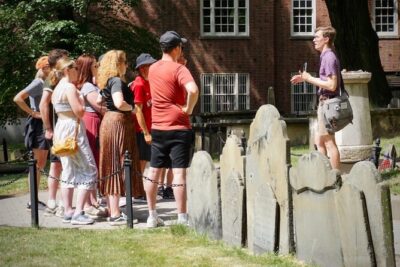
Boston: Freedom Trail History Small Group Walking Tour
Read our review →
City Cruises Boston Historic Sightseeing Harbor Cruise
Read our review →
Boston Pizza Lovers Food and History Walking Food Tour
Read our review →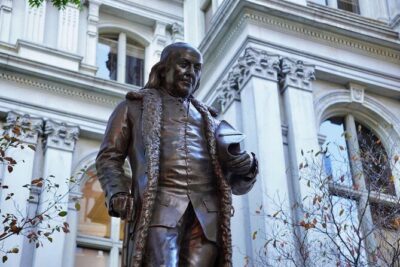
Boston Freedom Trail History Pub Crawl Small-Group Tour
Read our review →
Boston City View Bicycle Tour: History and Landmarks
Read our review →
Boston History Tour: Scenic Walk Through Time & Landmarks
Read our review →Browse the lists this tour appears in