
Review · BOSTON
Boston: Votes for Women History Tour of Back Bay
Boston’s Back Bay looks polished and familiar, but its streets hold a less obvious story: the long fight for women’s voting rights. This 2.5-hour walking tour links grand homes, clubs, libraries, churches, and public spaces to the Boston women who organized, funded, opposed, and reshaped that fight.
I like the small maximum of 15 people, which gives you a better chance to hear the guide and ask questions. I also like the route’s focus on real places, including Pauline A. Shaw’s home, the Boston Public Library, and the former offices of suffrage groups. The main drawback is that you will spend much of the tour standing outdoors, so this is not a good choice if long periods on your feet are difficult.
Key points about Boston’s Votes for Women tour
- Pauline A. Shaw’s home at 6 Marlborough Street reveals how money and organization helped drive the suffrage campaign.
- The route includes both pro-suffrage and anti-suffrage women, giving you a more complete picture than a simple list of movement heroes.
- Boston Public Library and Copley Square show how civic buildings and public spaces supported the campaign.
- Blanche Ames appears in an unusual role, as a pro-suffrage cartoonist and early advocate for birth control.
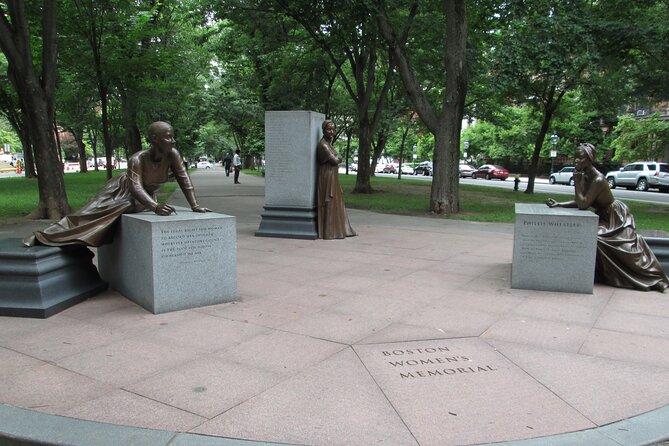
- The tour ends at the Boston Women’s Memorial, featuring Abigail Adams, Phillis Wheatley, and Lucy Stone.
- The $35 price is reasonable for a small-group, 2.5-hour tour, though museum admission and gratuity are not included.
Why Back Bay tells a different suffrage story
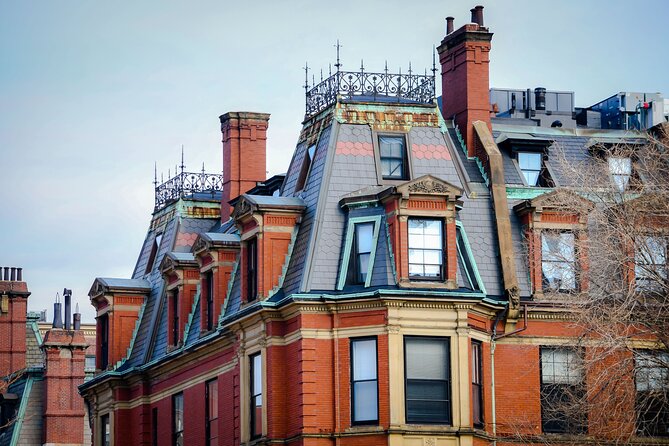
Boston’s women’s rights story is not confined to one monument or meeting hall. It is spread across elegant residential streets and civic buildings that you might otherwise pass without a second thought.
That is the useful idea behind this walk. Instead of treating suffrage as a distant national campaign led only by famous names, the tour shows how Boston women worked through homes, clubs, newspapers, religious groups, libraries, and political organizations.
You will also see disagreement within the movement. Some women campaigned for the vote, while others organized against extending suffrage to women. That contrast gives the tour more balance and helps explain that women were not one unified political bloc.
The route stays in and around Back Bay, one of Boston’s most walkable areas. The streets are attractive, but the focus is not architecture alone. Buildings become evidence of who had influence, who had money, who could speak in public, and who tried to shape the future of American democracy.
More History Tours in Boston:
- Boston: Freedom Trail History Small Group Walking Tour
★ 5.0 · 6,450 reviews - Tour of Historic Fenway Park, America’s Most Beloved Ballpark
★ 4.5 · 3,013 reviews - Boston Food & History: Pizza, North End & Freedom Trail
★ 5.0 · 1,772 reviews
Starting with Make Way for Ducklings and the Public Garden
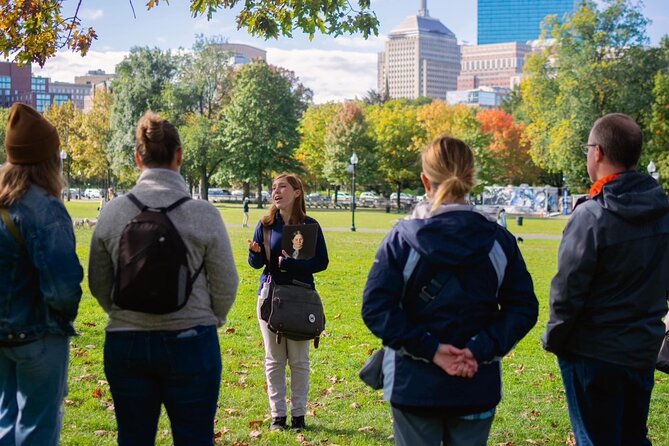
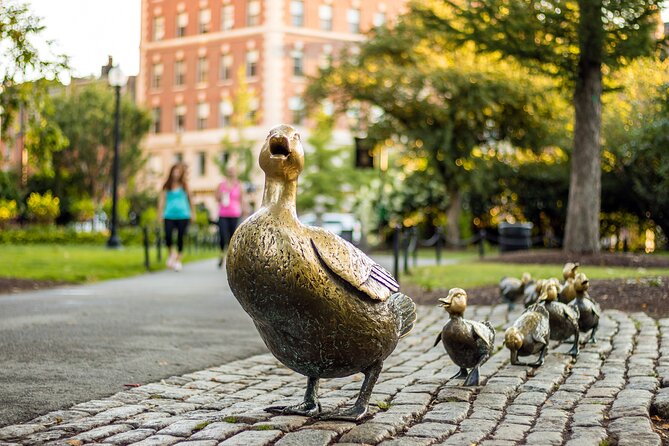
The meeting point is the Nancy Schön sculpture based on Robert McCloskey’s Make Way for Ducklings, at 4 Charles Street. It is an easy-to-recognize place beside the Boston Public Garden and gives you a pleasant start in one of central Boston’s best-known green spaces.
The Public Garden was established in 1837 as the first public botanical garden in the United States. You will spend about 10 minutes here, with no admission charge.
The opening stop helps place the tour in Boston’s public realm. You are not beginning in a conference room or a museum display. You are walking through a civic space that has long been part of everyday city life.
The route also takes in the equestrian statue of George Washington by Thomas Ball. It was commissioned in 1859. This is a useful visual contrast: a grand monument to a male political leader set within a tour that asks where women fit into the public story of American government.
Do not expect an indoor visit at this point. The value is in the guide’s explanation and the way the surroundings frame the discussion. Wear shoes suited to city sidewalks, and arrive ready to stand while listening.
Pauline A. Shaw and the money behind the movement
At 6 Marlborough Street, the tour reaches the former home of Pauline A. Shaw. She financed Boston’s women’s suffrage movement and founded the Boston Equal Suffrage Association for Good Government.
You will spend about five minutes at this stop, but its importance is greater than the short time suggests. Political movements need speeches and idealism, but they also need funding, offices, printing, organizers, and sustained public work. Shaw’s role helps you see the practical side of reform.
This is one of the tour’s strongest details because it moves beyond the familiar story of marches and famous speeches. You learn how a wealthy and organized supporter could help keep a campaign going.
The stop also introduces a theme that returns throughout the walk: Boston’s suffrage story involved women with very different backgrounds and strategies. Some worked through associations and publications. Others used art, public meetings, or social networks to make their case.
Churches, homes, and competing political views
The route passes a church established in 1630 that later became a center of the Transcendentalist movement. The building connects the suffrage discussion to Boston’s long tradition of religious and philosophical debate.
The tour then points out the home of Elizabeth Putnam, an anti-suffragist who was the first woman to preside over a state electoral college. That detail complicates the usual assumption that every prominent woman involved in public life supported the vote.
You will also see the former homes of Julia Ward Howe and Blanche Ames. Howe is a major figure in nineteenth-century American reform circles, while Ames brings a different kind of public voice. She was a pro-suffrage cartoonist and an early advocate for birth control.
Blanche Ames is particularly memorable because her work shows that political persuasion did not depend only on formal speeches or committee meetings. Cartoons could make an argument quickly, reach a wider public, and poke fun at the opposition.
The route also discusses the Ames Mansion, which represented the family’s wealth and political involvement. The family story includes both the anti-suffragist Mary Shreve Ames and the suffragist Blanche Ames.
That family contrast is worth your attention. It shows that political arguments were not always divided neatly between unrelated groups. They could exist under the same family name, within the same social circles, and even in the same household network.
Same city, a different century:
- Boston: Freedom Trail History Small Group Walking Tour
★ 4.9 · 1,590 reviews - City Cruises Boston Historic Sightseeing Harbor Cruise
★ 4.5 · 1,388 reviews - Boston Pizza Lovers Food and History Walking Food Tour
★ 4.5 · 1,082 reviews - Boston Freedom Trail History Pub Crawl Small-Group Tour
★ 5.0 · 996 reviews
Commonwealth Avenue and the politics of public space
Commonwealth Avenue provides one of the prettiest portions of the walk. This long avenue includes trees, grassy areas, benches, and statues, giving you a break from tightly packed city blocks.
The tour points out the home of Mary Shreve Ames, president of the Massachusetts Anti-Suffrage Association. Her presence keeps the story from becoming one-sided. If you are interested in how opposition campaigns worked, this stop adds needed context.
Public space matters here. Women seeking political rights had to find ways to speak, organize, publish, and hold meetings in a society that often limited women’s formal authority. A broad avenue, a civic square, or a public hall could become part of that struggle.
This section should appeal to anyone who likes social history tied to real places. You are not simply memorizing names. You are seeing how homes and streets reflected the political power of Boston’s upper and middle classes.
The College Club and women building institutions
The College Club of Boston is another important stop. Founded as the first women’s college club in the United States, it represents the growing educational and professional networks available to women.
You will spend about 10 minutes here, with no admission charge. The building’s significance is less about a dramatic event and more about the institutions women created for themselves.
A club like this helped connect educated women who wanted a public role. It also points to a broader change in American life: women were entering colleges and professional circles, then using those networks to press for social and political reform.
This stop may be especially useful if you are interested in the relationship between education and activism. The tour helps you see that the suffrage movement did not appear out of nowhere. It grew through organizations, friendships, publications, and shared work.
From a natural history museum to political organizing
The route continues to RH Boston, The Gallery at the Historic Museum of Natural History. The building housed the Museum of Natural History from 1864 to 1951, and you will spend about 10 minutes here.
The stop adds architectural and institutional context to the walk. Back Bay was not only a residential district. It also contained major cultural institutions that shaped the city’s public life.
The tour then identifies the former site of an MIT laboratory where Katherine McCormick protested against popular fashion as part of the suffrage movement. This is one of the walk’s more unexpected details.
It gives you a glimpse of the creative tactics used by activists. The campaign was not limited to formal petitions or conventional political gatherings. Protest could also take aim at the expectations placed on women’s clothing and behavior.
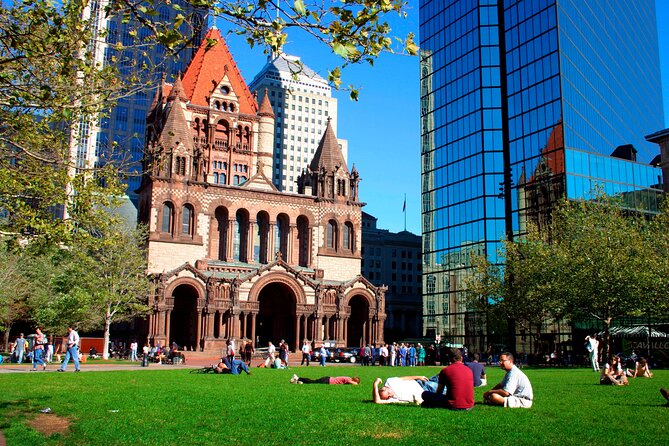
You will also see a building constructed in 1877 that members of the American Association of Architects considered one of the country’s top 10 buildings. The architectural note adds visual interest, but it also shows how the tour moves between design, science, culture, and politics without leaving the neighborhood.
Copley Square and the Boston Public Library
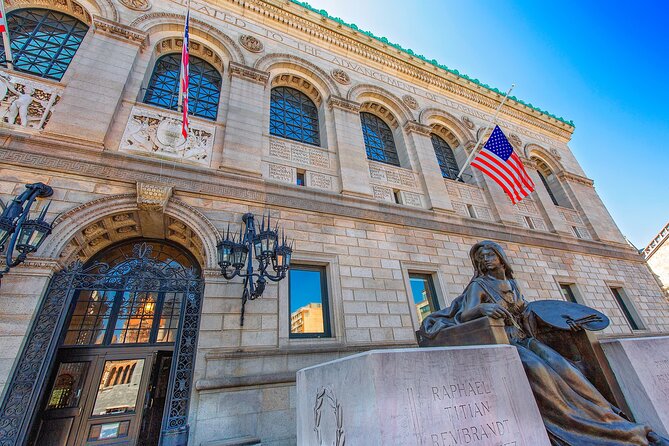
Copley Square was designed as a cultural center of Boston. It is one of the route’s major public spaces and a natural place to pause and consider how reform movements used the city itself.
You will spend about 10 minutes here. The square’s open setting contrasts with the private homes seen earlier, reminding you that political arguments eventually had to reach a wider audience.
The Boston Public Library is another key stop. Founded in 1848, it is now the third-largest public library in the United States. You will spend about 10 minutes here, and the tour helps connect the library to access to information, education, and public debate.
For me, this is one of the most valuable parts of the route. Libraries are easy to treat as quiet background scenery, but they are central to any movement that depends on research, newspapers, speeches, pamphlets, and self-education.
You should not assume the tour includes admission inside museums or extended indoor visits. The listed stops are primarily exterior landmarks, and the activity is built around walking and interpretation.
The offices where the campaign did its daily work
The route reaches the former Chauncy Hall, where several pro-suffrage organizations had offices. These included the Massachusetts Woman Suffrage Association and The Women’s Journal.
This stop brings the campaign down to its working level. Behind every public speech was an office handling correspondence, publishing, planning, and fundraising. The presence of a newspaper also shows how important print was in shaping public opinion.
The tour then identifies the former location of the Kensington Building, demolished in 1967. It housed the offices of the Massachusetts Association Opposed to Further Extension of Suffrage to Women.
This is a useful pairing. You see the physical proximity of competing political organizations and are reminded that opposition was organized, funded, and deliberate. The campaign for women’s voting rights faced a real political counterforce.
The route also passes the finish line of the Boston Marathon and a popular shopping street lined with dining, retail, and luxury brands. These modern reference points help you stay oriented in the present-day city while the guide explains what occupied these blocks in earlier decades.
Public speaking, spiritualism, and the final memorial
The tour passes a former Spiritualist Temple, a place where women were allowed to lead public meetings. That detail points to one of the practical barriers women faced: being permitted to speak publicly was itself politically meaningful.
A venue that allowed women to lead meetings could become an important training ground. It offered a platform, an audience, and a chance to build confidence in public argument.
The walk ends at the Boston Women’s Memorial on Commonwealth Avenue Mall, about 0.8 miles from the starting point. The memorial depicts Abigail Adams, Phillis Wheatley, and Lucy Stone.
Ending here gives the tour a clear visual finish. These three women represent different parts of Boston and American women’s history: political thought, literary achievement, and organized activism.
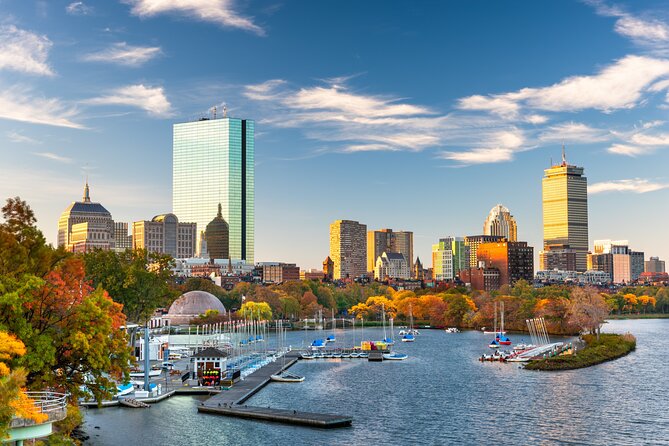
The memorial is also a good place to continue your own exploration. You finish in the center of Back Bay, within walking distance of Downtown Boston to the east and the Fenway area to the west.
What $35 gets you
At $35 per person, this tour offers solid value if you want interpretation rather than a simple walk through attractive streets. The experience lasts about 2.5 hours, includes a small group capped at 15 people, and connects a large number of landmarks through one theme.
The price does not include museum admission, and there are no guides in period costume. That is worth knowing before you book. This is an outdoor history walk led through explanation, not a theatrical performance or a ticketed museum program.
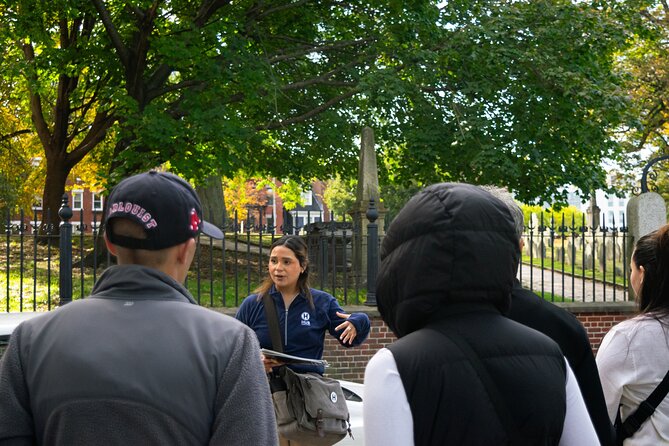
The strongest value comes from the guide’s ability to connect ordinary-looking buildings to a larger story. Maura, one guide associated with the experience, has been especially praised for telling the stories with energy, encouraging questions, and inspiring further reading.
You should also plan for an optional gratuity. The experience is offered in English, uses a mobile ticket, and is often booked about 30 days ahead, so reserving early may be sensible if your dates are fixed.
Who will enjoy this walk most
I would recommend this tour to anyone who has already seen Boston’s better-known Revolutionary landmarks and wants a different angle on the city. It also suits people who enjoy social history, women’s studies, political movements, architecture, and the stories behind familiar streets.
It is a good choice for younger visitors who can stay engaged with a walking discussion. The guide’s use of homes, cartoons, newspapers, clubs, and public buildings gives the subject several entry points.
You need moderate physical fitness. The activity is not recommended if standing for extended periods is difficult, and the experience requires good weather. Service animals are allowed, and the route is near public transportation.
The small group is a real advantage. With no more than 15 people, you have a better chance of hearing the explanations and asking about a particular person or building. Still, this is not a private tour, so the amount of individual attention depends on the group and the guide.
Should you book Boston’s Votes for Women tour?
Book it if you want Boston history that reaches beyond the Freedom Trail and the standard list of male political figures. The route gives you specific addresses, competing viewpoints, and a clearer sense of how women organized in daily life.
I especially recommend it if you like tours that leave you with ideas for further reading. The stories of Pauline A. Shaw, Blanche Ames, Mary Shreve Ames, Julia Ward Howe, and the women connected to the College Club give the walk plenty of substance.
Skip it if you want a fast-paced sightseeing route, extensive indoor access, or a performance with costumes. This is a thoughtful outdoor walk, and its rewards come from listening, asking questions, and noticing the buildings around you.
FAQ
How long is the Votes for Women History Tour of Back Bay?
The tour lasts approximately 2 hours and 30 minutes.
How much does the tour cost?
The price is $35 per person.
What is the group size?
The tour has a maximum of 15 participants.
Where does the tour begin?
It begins at the Make Way for Ducklings sculpture by Nancy Schön, at 4 Charles Street, Boston, Massachusetts 02116.
Where does the tour end?
It ends at the Boston Women’s Memorial at 256 Commonwealth Avenue, on the Commonwealth Avenue Mall.
What time does the tour start?
The stated start time is 10:00 a.m.
Is museum admission included?
No. Admission inside museums is not included.
Is the tour suitable for people who have trouble standing?
The tour is not recommended for people who have trouble standing for extended periods. Participants should have a moderate level of physical fitness.
Just added around Boston
- Boston’s Architecture, History + Photo Walking Tour (SMALL Group)★ 5.0 · 91 reviews
- Freedom Trail Guided Walking Tour (SMALL GROUP)★ 4.5 · 98 reviews
- Boston’s North End History + Photo Walking Tour (SMALL Group)★ 5.0 · 27 reviews
- Haunted Boston’s Historic Streets Walking Guided Tour★ 4.5 · 184 reviews
- Boston: Underground Railroad History Tour of Beacon Hill★ 5.0 · 141 reviews
- Beacon Hill Boston History + Photo Walking Tour (SMALL Group)★ 5.0 · 163 reviews
- A Taste of the Freedom Trail: Boston’s Iconic Food & History Tour★ 5.0 · 32 reviews
- Boston: Food and History of The Freedom Trail Private Tour★ 5.0 · 159 reviews
Boston History Tours, compared.
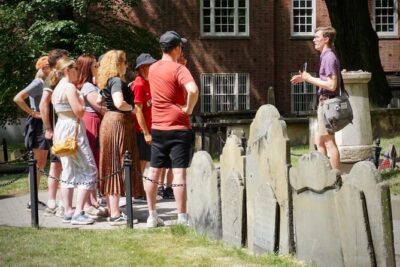
Boston: Freedom Trail History Small Group Walking Tour
Read our review →
Tour of Historic Fenway Park, America’s Most Beloved Ballpark
Read our review →
Boston Food & History: Pizza, North End & Freedom Trail
Read our review →Boston: Freedom Trail History Small Group Walking Tour
Read our review →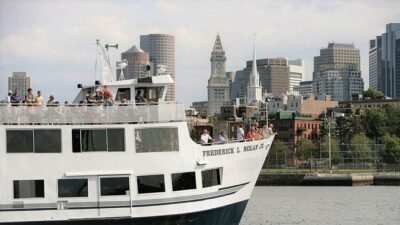
City Cruises Boston Historic Sightseeing Harbor Cruise
Read our review →
Boston Pizza Lovers Food and History Walking Food Tour
Read our review →
Boston Freedom Trail History Pub Crawl Small-Group Tour
Read our review →
Boston City View Bicycle Tour: History and Landmarks
Read our review →Browse the lists this tour appears in