
Review · SPAIN
Visita Guiada Por El Casco Histórico De Cuenca Y Su Catedral
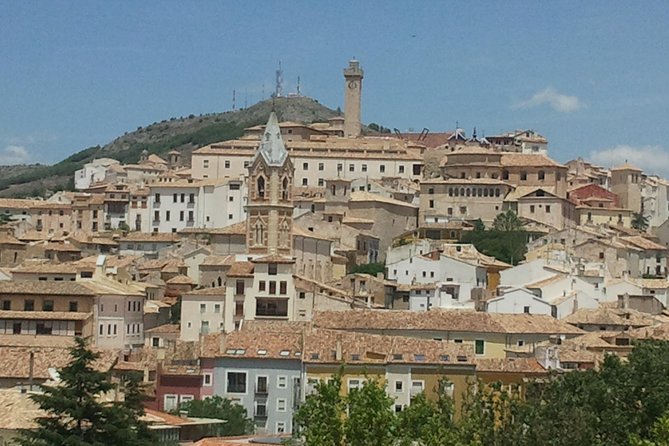
Cuenca’s strangest sight is not its cathedral. It is the city’s San Martín skyscrapers, tall sixteenth-century homes that rise as high as 12 floors above the Huécar Gorge. This tour takes you inside them, then links them to the cathedral, hanging houses, towers, convents, and viewpoints that make the old town a UNESCO World Heritage Site.
I like the tour’s mix of major sights and less obvious corners. The cathedral visit gives you 35 minutes indoors, while the San Martín stop adds a rare look at ordinary historic housing. I also like that the route is led by official local guides, including Guillermo, whose clear and playful style earned special praise.
The main consideration is the group size, which can reach 50 people. That is large for narrow medieval streets and may make it harder to hear or move freely at some stops. Still, at $18.58 for about two hours and fifteen minutes, the price is strong if the cathedral and interior skyscraper visit are your priorities.
Key points at a glance
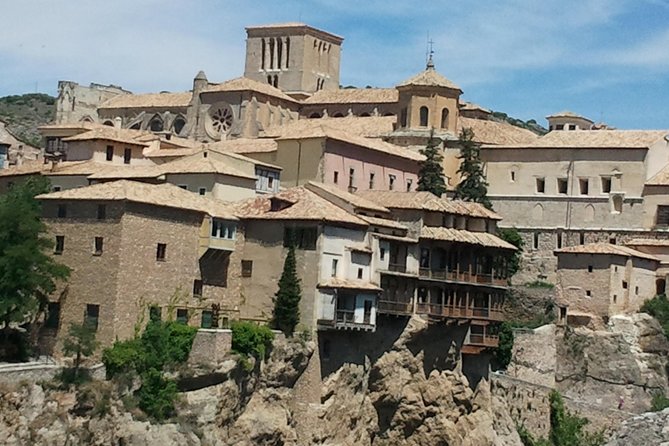
- Inside Cuenca’s San Martín skyscrapers: See the tallest European homes of the sixteenth century, with as many as 12 levels.
- A 35-minute cathedral visit: Enter Spain’s first Gothic cathedral and spend real time looking beyond the exterior.
- A route through the old town: Visit Plaza Mayor, Plaza de la Merced, Mangana Tower, the Jewish quarter, Casas Colgadas, and San Pablo Bridge.
- A guide-led history lesson: Guides explain the city’s buildings, people, churches, and changing neighborhoods in an entertaining way.
- A useful daytime companion to a night tour: The route covers different old-town streets, so it can add another layer to an evening visit.
- Simple cancellation terms: You receive a full refund if you cancel at least 24 hours before the start time.
Starting at Plaza Mayor and the cathedral quarter
The tour begins at 11:30 a.m. at C. Alfonso VIII, 1, in Cuenca’s upper historic center. That start time works well for a morning visit, though you should arrive with enough time to find the meeting point in the old town. The tour ends at Cuenca Cathedral in Plaza Mayor, so you finish in a useful central location rather than being left on the edge of town.
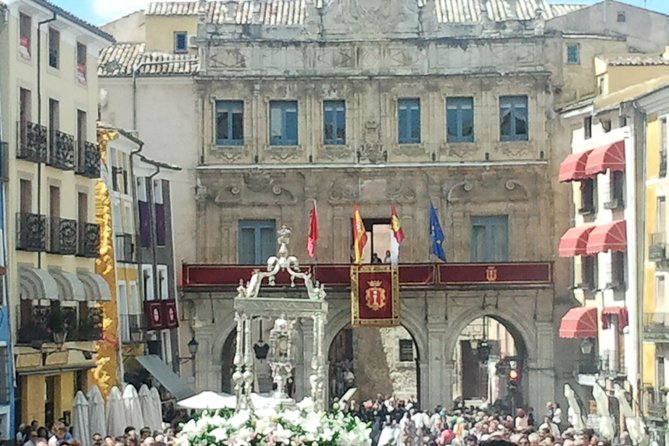
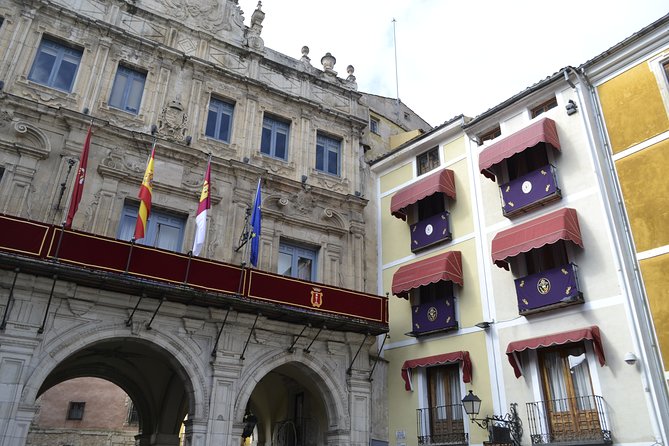
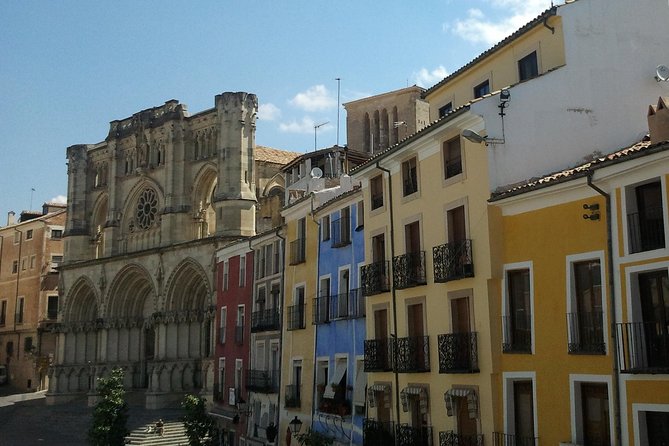
The first stop is Plaza Mayor, Cuenca’s main square. Its colored façades are mostly from the sixteenth century, giving the square a friendly, irregular look rather than the grand symmetry found in many Spanish cities. The Baroque town hall provides one side of the scene, while the huge Convento de las Petras adds scale.
I would pay attention here to how tightly packed the buildings are. Cuenca’s old center is not a collection of isolated monuments. The buildings press together along the high ground, and the square gives you an early sense of how the city developed around steep ravines and limited flat land.
The tour then moves to Plaza de la Merced, a smaller and more intimate square. Three Baroque façades face one another: the seminary, a church, and a cloistered convent. This is a good place to hear how religious institutions shaped Cuenca’s historic center.
The stop is free, but the value comes from the explanation. Without a guide, you might simply see attractive old façades. With context, the square becomes a compact lesson in religious architecture and urban life.
Other history tours people book around Spain:
- Madrid Essential: Historic Center, Plaza Mayor & Royal Palace
★ 5.0 · 6,416 reviews - Montserrat with Black Madonna & Medieval Winery with Tapas/Lunch
★ 5.0 · 5,209 reviews - Barcelona: Tapas Walking Tour with Food, Wine, and History
★ 4.8 · 4,261 reviews
Mangana Tower and Cuenca’s high viewpoints
Mangana Tower is a sixteenth-century tower with two clocks near the top. It offers broad views across the city, making it one of the tour’s best orientation points.
I like this stop because it helps you understand Cuenca as a place built above dramatic drops. The city’s old center occupies a narrow high ridge between the Huécar and Júcar gorges. From the tower area, the views connect the streets you are walking with the ravines and lower parts of the city.
The tower also adds a practical sense of direction. Cuenca’s old center can feel confusing, with lanes that rise, bend, and suddenly open onto a viewpoint. Seeing the city from above helps you understand why the route moves through such a compact but uneven area.
The tour description does not give a separate admission charge for Mangana Tower, and the stop is listed as free. The amount of time spent there may depend on the guide and group, so do not expect a long tower climb or an extended viewing session unless the day’s conditions allow it.
Entering the San Martín skyscrapers
The San Martín neighborhood is the tour’s most distinctive stop. Here, you see both the outside and inside of homes that were among Europe’s tallest residential buildings in the sixteenth century. Some reached 12 floors.
The word skyscraper sounds modern, but Cuenca’s version comes from medieval and early modern building traditions. The homes rise dramatically because they are built along steep ground. From one side, a building may look modest. From the gorge side, the same structure can stretch many levels downward.
The interior visit matters. Cuenca’s hanging houses are famous, but it is easy to see them only as a postcard view. Entering the San Martín homes gives you a better sense of how people actually occupied these narrow, tall buildings.
Only about five minutes is specifically assigned to this stop, so keep your expectations realistic. You will not receive a long architectural tour of every room. Instead, this is a short but unusual access point that many standard walking routes do not include.
I would consider this a major reason to book. The cathedral is the city’s best-known interior sight, but the San Martín homes provide the tour’s most original detail. They also help explain why Cuenca’s architecture looks so vertical and surprising.
San Pablo Convent and the bridge over the gorge
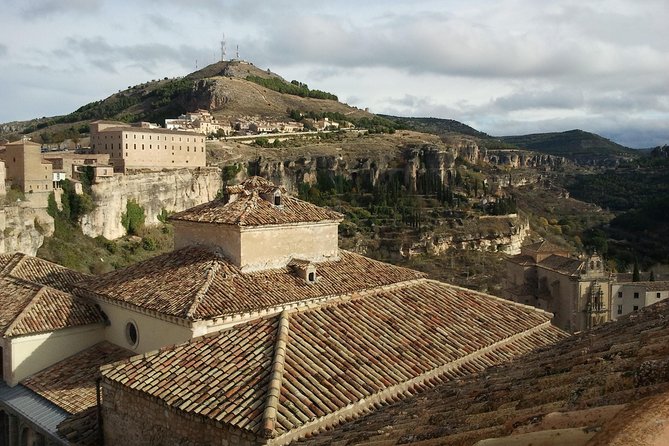
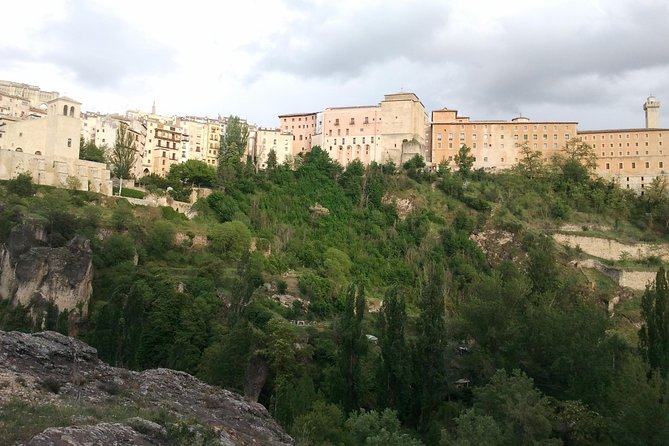
The route continues to the Convento de San Pablo, now home to a Parador hotel. Its setting is the main attraction: the former convent sits at the edge of a drop, facing the rugged gorge and the old city.
You do not need to stay at the Parador to appreciate the location. The guide can explain how a religious building came to occupy such a striking site, while you take in the relationship between the convent, the gorge, and the old town.
From there, the tour reaches San Pablo Bridge. The present bridge is an iron structure built in 1903. It replaced an earlier stone bridge, and fragments of that older crossing can still be seen.
The bridge is practical as well as scenic. It links the old center with the former convent and gives you a clear view toward the Casas Colgadas. It can also feel exposed because of its height, so anyone uneasy with high crossings should be prepared for a dramatic walk.
This section is one of the best examples of how the tour combines architecture and setting. You are not simply moving from one monument to the next. The route shows why each building was placed where it is and how the gorge shaped Cuenca’s growth.
Same city, a different century:
- Sevilla Food Tour: Tapas, Wine, History & Traditions
★ 5.0 · 3,468 reviews - Valencia Old Town Tour with Wine & Tapas in 11th Century Historic Monument
★ 5.0 · 3,234 reviews - Madrid Tapas & Taverns Small Group Food & History Tour
★ 5.0 · 2,664 reviews - Barcelona Tapas Walking Tour: Food, Wine & History
★ 4.5 · 1,928 reviews
Seeing the Casas Colgadas from the right angle
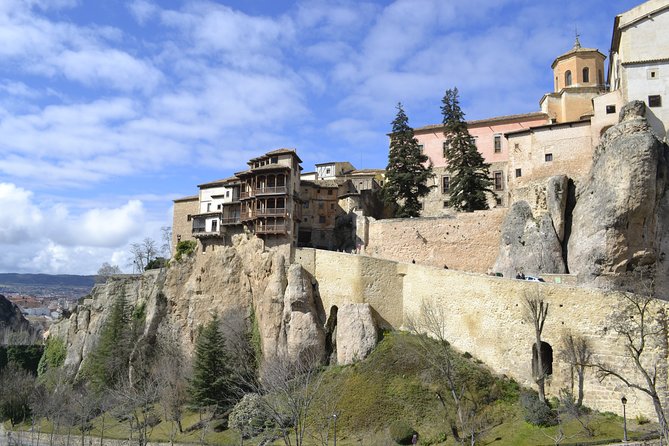
Cuenca’s Casas Colgadas are noble homes from the fourteenth century, suspended above the Huécar Gorge. Their wooden balconies project over the drop, creating one of Spain’s most recognizable old-town views.
The buildings are more impressive when you notice their construction rather than treating them as a photo stop. Their balconies, height, and position show how the city used every possible piece of high ground.
From San Pablo Bridge, you get a useful perspective on the façades. The view makes the houses appear to hang over empty space, while the route through the old center lets you see how they connect to the surrounding streets.
The stop is free, but the real benefit is the guide’s interpretation. A photograph tells you that the houses are dramatic. An explanation can show how noble residences, gorge-side construction, and the city’s defensive position fit together.
The area is likely to be one of the busiest parts of the route because the Casas Colgadas are Cuenca’s signature sight. In a group of up to 50 people, stay close enough to hear and allow room for other people taking photographs.
Alfonso VIII and the story of medieval Cuenca
Near the cathedral, the route pauses at a bronze statue of Alfonso VIII. He ruled Castile for 44 years and is remembered for his victory at the Battle of Las Navas de Tolosa, an event that changed the course of Spanish history.
This stop adds political context to the buildings around you. Cuenca’s monuments can seem like a series of beautiful structures, but the city also reflects royal power, military conflict, and the reshaping of Christian Spain.
The statue itself may take only a few minutes to see. Its importance lies in the story attached to it. I like stops such as this because they keep the tour from becoming a list of architectural dates.
The route also passes through what was once Cuenca’s Jewish quarter. No separate admission is required, and the tour description does not specify a single surviving building for a full interior visit there. Instead, the value is in recognizing the old neighborhood as part of the city’s layered past.
Spending 35 minutes inside Cuenca Cathedral
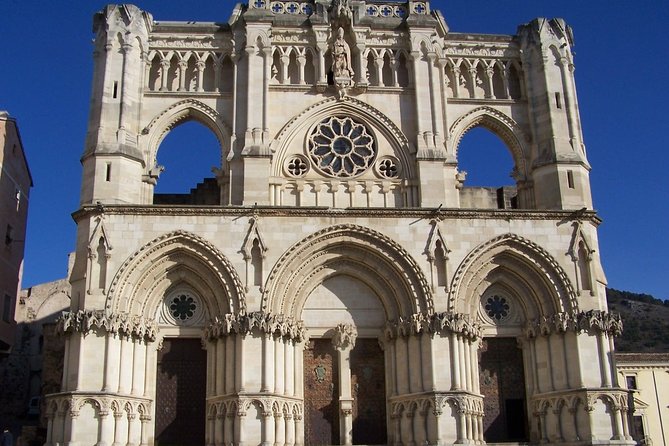
The tour ends at Cuenca Cathedral, and the interior visit lasts about 35 minutes. That is enough time for a focused introduction rather than a rushed glance through the doorway.
Cuenca Cathedral is described as Spain’s first Gothic cathedral and one of the country’s most surprising. Its importance is not only its age. The building helps explain the city’s religious power and the scale of construction that took place in the old center.
I would save your attention for the parts the guide points out. A guided visit is especially useful in a cathedral because the details can blur together: chapels, stonework, changes in style, religious art, and structural features. A well-paced explanation gives you a way to sort what you are seeing.
The tour’s strongest praised qualities are its teaching style and its energy. Guillermo is specifically named as a guide who made the visit both instructive and fun, while also helping people learn a great deal in a short time. That matters here. A cathedral tour can become dry if it turns into a string of dates, but the advertised approach aims for clear facts with humor.
The end point in Plaza Mayor is convenient. You can continue exploring the old center, stop for food, or visit nearby sights after the guide finishes. Since the tour does not return you to the starting point, note the route before booking if you need to meet transport elsewhere.
Price, group size, and who gets the most value
At $18.58 per person, this is a good-value introduction to Cuenca. You receive about 2 hours and 15 minutes of guiding, entry to the cathedral, and access to the San Martín skyscrapers. Most of the outdoor stops have no extra admission cost, but the guide’s interpretation is what ties them together.
The price makes particular sense if you would otherwise visit the cathedral on your own. You also gain access to the interior of the San Martín homes, a detail that is not part of every old-town walk.
The maximum group size is 50 people. That is the main tradeoff. A large group can keep the price low, but narrow streets, small squares, and cathedral interiors are easier to enjoy with fewer people. If Guillermo is leading, his friendly teaching style may help, but the exact guide is not guaranteed.
The tour suits you best if:
- You want a first look at Cuenca’s UNESCO-listed old town.
- You care about the cathedral interior, not just an exterior photograph.
- You enjoy unusual residential architecture.
- You prefer historical explanation to wandering without context.
- You want a daytime route that differs from a night tour.
- You can manage a walking route through an old center with uneven, steep streets.
You may prefer a smaller or more specialized experience if you dislike groups of up to 50 people or want extended time at each building. The five-minute skyscraper stop is memorable, but brief. The cathedral receives more attention, with 35 minutes inside.
Confirmation arrives at booking. Service animals are allowed, public transportation is nearby, and most people can participate. You can cancel for a full refund up to 24 hours before the start time. Any later cancellation or change is not accepted, so keep that deadline in mind.
Should you book this Cuenca walking tour?
I would book it if this is your first visit to Cuenca and you want the main old-town story in one efficient morning. The combination of the cathedral, San Martín skyscrapers, Casas Colgadas, Mangana Tower, San Pablo Bridge, and former Jewish quarter gives you both famous sights and less familiar details.
The strongest reason to choose it is the interior access to the San Martín homes. The cathedral is essential, but those tall gorge-side residences give the tour its unusual character. The guides also seem to place real weight on making the history lively, with Guillermo singled out for being both informative and entertaining.
I would hesitate only if you need a small group or a slow photographic walk. With up to 50 people and a tight schedule, this is an efficient introduction rather than a long, quiet study of every monument. For $18.58, though, it offers a lot of Cuenca in a manageable 2 hours and 15 minutes.
FAQ
How long does the Cuenca historic center tour last?
The tour lasts approximately 2 hours and 15 minutes.
What time does the tour begin?
It starts at 11:30 a.m.
Where does the tour begin?
The meeting point is C. Alfonso VIII, 1, 16001 Cuenca, Spain.
Where does the tour end?
The tour ends at Cuenca Cathedral in Plaza Mayor.
Is cathedral admission included?
Yes. Admission to Cuenca Cathedral is included, and the visit lasts about 35 minutes.
How far in advance can I cancel for a full refund?
You can cancel at least 24 hours before the experience start time for a full refund. Changes or cancellations made less than 24 hours before the start are not accepted.
Just added around Spain
- Night Walking Tour of Medieval Cuenca★ 5.0 · 64 reviews
- Mosque of Cordoba History Tour in English Tickets included★ 5.0 · 257 reviews
- 2 Hours Tour around Cádiz: History, anecdotes and curiosities★ 5.0 · 89 reviews
- Jerez de la Frontera History and Art Walking Tour★ 4.5 · 49 reviews
- Bilbao Historical Small Group Tour★ 4.5 · 159 reviews
- The Authentic Bilbao Pintxos, Food & Wine Tour with a Local★ 5.0 · 360 reviews
- Girona, Costa Brava and Medieval Village from Barcelona★ 5.0 · 149 reviews
- Tarragona and Sitges Small Group Tour – Roman History & Culture★ 4.5 · 339 reviews
Spain History Tours, compared.
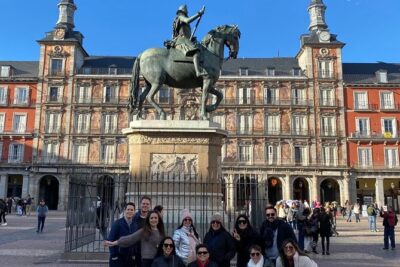
Madrid Essential: Historic Center, Plaza Mayor & Royal Palace
Read our review →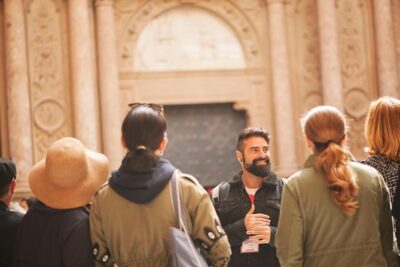
Montserrat with Black Madonna & Medieval Winery with Tapas/Lunch
Read our review →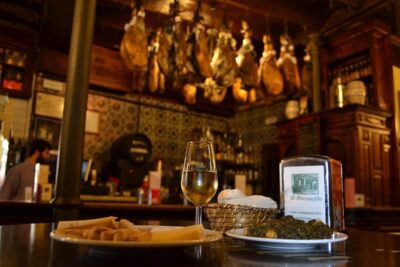
Sevilla Food Tour: Tapas, Wine, History & Traditions
Read our review →
Valencia Old Town Tour with Wine & Tapas in 11th Century Historic Monument
Read our review →
Madrid Tapas & Taverns Small Group Food & History Tour
Read our review →
Barcelona Tapas Walking Tour: Food, Wine & History
Read our review →
Ultimate Seville Tapas, Wine & History Small Group Tour
Read our review →
Córdoba: Skip-the-Line Great Mosque-Cathedral History Tour
Read our review →Browse the lists this tour appears in