
Review · GETTYSBURG
Gettysburg Battlefield Self-Guided Driving Audio Tour
Gettysburg’s battlefield is much easier to understand when the ground, monuments, and battle story arrive together. This 19-mile self-guided route uses GPS-triggered narration to guide you from the first day’s fighting at McPherson’s Ridge to Pickett’s Charge and Lincoln’s Gettysburg Address.
I like the freedom to stop for photos, walk around monuments, or pause for lunch without waiting for a bus. I also like the price: $16.99 per car for up to four people is a strong value. The main catch is the app. A few users had trouble with GPS timing or getting started, so download the tour on strong Wi-Fi and practice before setting off.
Gettysburg Battlefield Audio Tour at a Glance
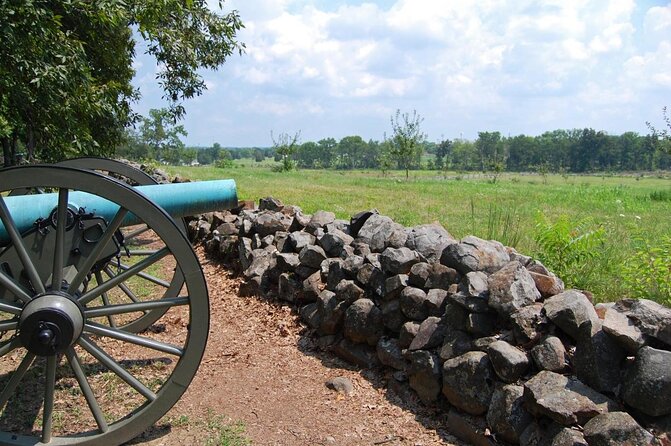
- Follow the official Auto Tour route: Cover key sites across more than 19 miles, including Seminary Ridge, Little Round Top, the Wheatfield, Culp’s Hill, and the National Cemetery.
- Hear more than 60 stories: The narration covers battle movements, commanders, soldiers, monuments, farms, and smaller human details.
- Pay once for the car: One purchase covers a group of up to four people, making this far cheaper than paying for several seats on a guided tour.
- Use it at your own speed: Pause the audio, stop at monuments, take breaks, or return another day with lifetime access and no expiration.
- Download before arriving: The route works offline, but you need a strong phone connection to download the app and tour files first.
- Plan on two to four hours: The basic drive can take less time, but stopping at the major sites makes this a half-day outing.
Why a Driving Audio Tour Works Well at Gettysburg
Gettysburg is too large to understand from one museum room or a quick drive past a few monuments. The fighting spread across roads, fields, ridges, farms, woods, and hills. An audio guide can connect those places while you are actually looking at them.
This tour follows the official battlefield driving route, so you are not trying to piece together a random collection of historic spots. The narration begins with the battle’s first day and moves forward through the second and third days. That order matters. You can follow the changing battle instead of jumping from one famous site to another without context.
I also like the private format. You stay in your own car, choose your stops, and control the pace. A family with a tired child can keep moving. A history fan can pause at a monument and use the extra stories in the app. A couple can stop for photographs without holding up a group.
The tradeoff is that no guide is physically beside you. If you miss a turn, have trouble with GPS, or want to ask a question on the spot, you must solve it through the app or support team. The tour is simple once it is running, but the first few minutes deserve care.
More Battlefield and Military History Tours in the USA:
- 2-Hour Gettysburg Battlefield Guided History Bus Tour with a National Park Guide
★ 4.5 · 2,201 reviews - Gettysburg: Horse-Drawn Carriage Battlefield Tour
★ 4.8 · 896 reviews - Guided Savannah Civil War History Walking Tour
★ 5.0 · 492 reviews
Starting at the Heritage Center or Visitor Center
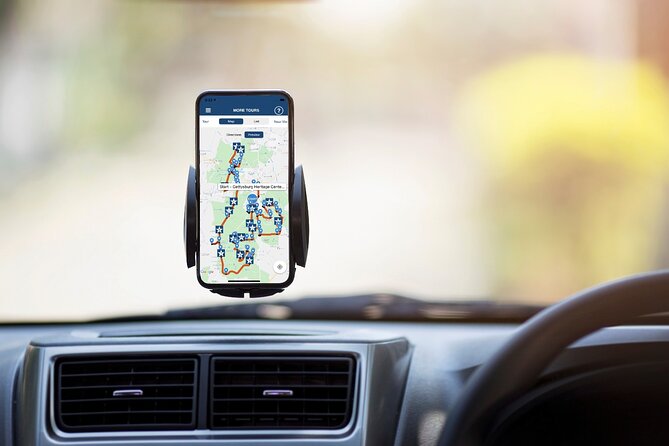
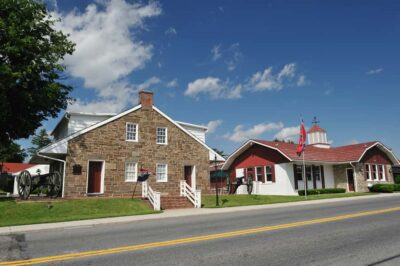
The tour can begin at the Gettysburg Heritage Center or the National Park Visitor Center. The stated meeting point is the Heritage Center parking lot at 297 Steinwehr Avenue, though the tour instructions also identify the National Park Visitor Center as an available starting location.
The Heritage Center Museum is worth considering before the drive. Admission is not included, so treat it as an optional extra rather than part of the $16.99 price. The museum can help you get your bearings before the battlefield route begins, but you can also start the audio tour directly if you prefer to keep costs down.
Download the separate Action Tour Guide app before you arrive. After booking, you receive setup instructions and a password by email and text. Search your messages for audio tour if you need to find them quickly.
Once the tour is downloaded, it works without cellular service or Wi-Fi. Connect your phone to the car stereo with Bluetooth, USB, or AUX. Apple CarPlay supports audio playback, while the map display is not yet available through CarPlay. Android Auto support is still being developed.
The app uses your phone’s GPS to trigger each story. Go to the starting point, launch the correct tour, and allow the app to access your location. The first story should begin when you reach its marked point, followed by the next story as you drive.
First Day: McPherson’s Ridge and the Railroad Cut
The first battlefield stops introduce the battle as dawn breaks on July 1, 1863. At McPherson’s Ridge, the narration explains how Union and Confederate forces collided and how officers placed their regiments around the ridge.
This is a good opening because you begin with movement and uncertainty. You are not just hearing dates and names. You are looking across ground where both armies tried to organize while the fight grew larger.
The Railroad Cut follows. This unusual depression became the site of a serious clash on the first day. The audio focuses on tactics and the people involved, giving you a reason to look closely at the terrain instead of simply passing through it.
Next comes the Eternal Light Peace Memorial. Its materials carry a deliberate message: Maine granite forms the base and Alabama limestone forms the pillar. The memorial represents reunification, so it provides a useful pause from troop movements and battlefield mechanics.
At Oak Ridge Observation Tower, you can look over the fields from above. The stop returns to the first day, now in the afternoon, as Union soldiers try to hold back the Confederate advance. The tower offers one of the better chances to connect the narration with the shape of the ground.
The 11th Pennsylvania Volunteer Infantry Monument adds a smaller personal detail. A dog named Battlefield Sallie is carved into the monument base. Sallie served as the regiment’s mascot for much of the Civil War, and the story also touches on the role of drummers and military music.
These early stops are relatively short, often around five to ten minutes of suggested listening. You can remain in the car, but getting out at selected points makes the route more memorable.
North Carolina, Pickett’s Charge, and the Second Day

As evening closes over the first day, the route passes the North Carolina Memorial and Virginia Monument. The narration explains how Union forces lost ground and how both armies prepared for what came next.
At Gettysburg Auto Tour Stop 5, the story shifts to the second day. This location is also connected to Pickett’s Charge, but the tour saves that account for later, after you have followed the second day’s action. That choice keeps the battle in order instead of jumping ahead to its most famous moment.
The Longstreet Observation Tower provides another high view. The tower overlooks areas connected with the second day, giving you a chance to see why ridges and open fields mattered so much to commanders.
The optional detour to Eisenhower National Historic Site is useful if you have extra time. The site overlooks the battlefield and was often used by President Eisenhower. It is not necessary to complete the driving route, so you can decide based on your schedule.
At Warfield Ridge, Confederate troops prepare to attack a Union position defended by trained marksmen. The story helps explain how the second day developed into a series of attacks against strong Union positions.
Little Round Top is one of the most important stops. Union troops barely held the hill against Confederate forces, protecting a key position. The route passes around the hill and through the Valley of Death, a name that reflects the heavy fighting there.
The tour also covers Devil’s Den, where Confederate sharpshooters used the volcanic rocks for cover. This is a place where the physical setting tells part of the story. You can see how rocks and elevation shaped the fighting, even before the narration fills in the details.
More Self-Guided Tours in the USA:
- Medieval Torture Museum Ticket with Audio Guide and Ghost Hunting
★ 5.0 · 962 reviews - Salida History Audio Tour l A Self-Guided Wild West Experience
★ 5.0 · 41 reviews - Historic Bar Harbor Self-Guided Walking Audio Tour Guide
★ 4.5 · 38 reviews - Baltimore Walking & Driving Self-Guided Audio Tour
★ 3.5 · 30 reviews
The Wheatfield, Peach Orchard, and Trostle Farm
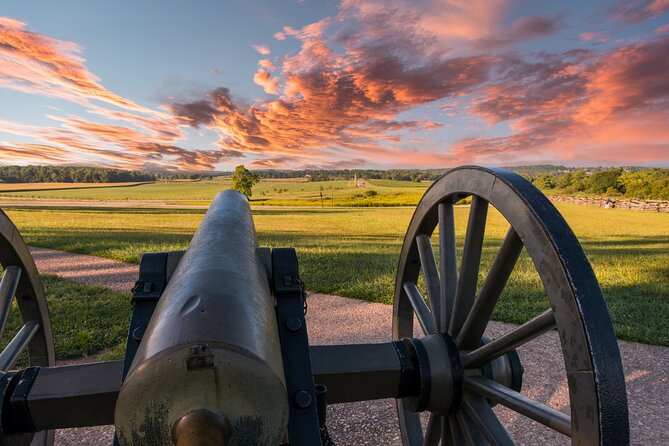
The second day continues at the Wheatfield, another major fighting site. The audio places you alongside Union troops trying to defend against Confederate attacks and includes the unusual story of Union soldier J. J. Purman.
The Peach Orchard follows. Here the narration traces the battle’s shifting fortunes and explains which plans worked and which failed. The orchard is one of the places where the broad movement of the battle can feel confusing without a guide, so the location-triggered audio is especially useful.
At the Abraham Trostle Farm, the human cost becomes more immediate. The Trostle family fled so quickly that dinner remained on the table. Details like this help you picture Gettysburg as a lived-in community, not an empty stage prepared for a battle.
The route then reaches Plum Run, where the audio follows soldiers escaping the fighting near the Peach Orchard. At the George Weikert Farm, the story turns to medical care. The Weikert family returned to find their farm converted into a battlefield hospital.
These farm stops are among the most useful parts of the route for anyone who wants more than commander names and battlefield arrows. You hear about families, food, farm buildings, wounded soldiers, and military doctors. That ground-level detail gives the larger battle a human scale.
Pennsylvania Memorial, Spangler’s Spring, and Culp’s Hill
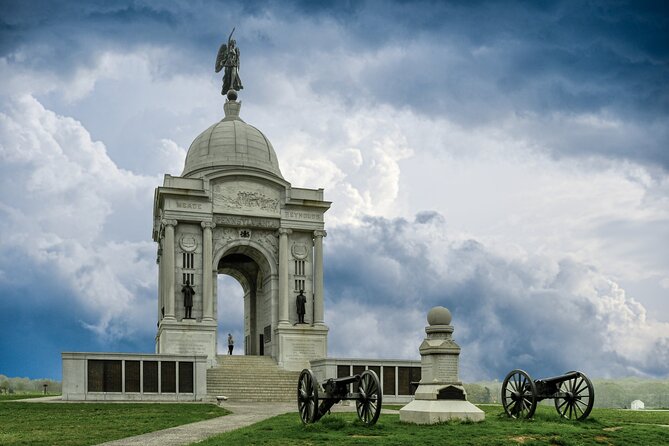
The Pennsylvania State Memorial honors nearly 35,000 Pennsylvanian soldiers who fought at Gettysburg. The narration connects the monument to a powerful idea: for these men, the battle was not only about an abstract national cause. Their own state was nearby, and its defense was personal.
Spangler’s Spring takes you into a wooded section of the battlefield. The tour explains why this small water source mattered, then carries the story toward Culp’s Hill.
At Culp’s Hill Tower, Union and Confederate troops fought for control of a strategic position. The Union held the hill through the evening, an important result after the pressure of the second day.
East Cemetery Hill brings the second day to a tense close. Confederate forces attempted a night attack after failing to capture Culp’s Hill fully. The Union came close to losing, but persistence, skill, and luck helped preserve the position.
The sequence works well because it shows that the second day was not one single clash. It was a long chain of attacks, defenses, retreats, and narrow escapes. You should allow time to get out of the car at a few of these locations. The audio may be short, but the monuments and terrain deserve more than a drive-by glance.
Pickett’s Charge and the National Cemetery

The third day begins at Gettysburg National Military Park with the battle’s wider meaning. Lee’s second invasion of the North ended here, and the battle became known as the high water mark of the Confederacy.
At Auto Tour Stop 15, the tour finally covers Pickett’s Charge. From the high ground, you look across the open distance Confederate soldiers had to cross toward Union defenses. The audio follows the charge and identifies the farthest point reached by the Confederacy.
This is the moment when the earlier stops pay off. You have already followed both armies through the first two days, seen the ridges and fields, and heard how Union positions survived repeated attacks. Pickett’s Charge is easier to grasp because you know what the armies were trying to achieve.
The final stop is the National Cemetery. This is also where Abraham Lincoln delivered the Gettysburg Address. The narration explains why the speech was brief despite the enormous expectations surrounding it. Lincoln believed the soldiers who died there deserved the attention more than he did.
The tour officially ends at the cemetery, a fitting place to stop rather than rush back to town. Admission to the battlefield sites is free, but any museum admission, attraction pass, or reservation is separate.
Price, Timing, and Overall Value
At $16.99 per group of up to four, this is one of the less expensive ways to get organized commentary at Gettysburg. A family of four pays less than $4.25 per person, assuming everyone rides in one car. Even a couple gets a private route for less than the cost of many paid guided options.
The value is strongest if you plan to stop and listen to the stories. The tour includes more than 60 audio segments, but the stated drive time can be as little as one to two hours if you keep moving. For a fuller visit, plan on two to four hours.
You can use the tour again on another visit. Current tour details provide lifetime access with no expiration, so you can split the route across multiple days or return to favorite sections. The ability to pause is especially useful at Gettysburg, where a monument or viewpoint may deserve more time than the audio itself.
The main risk is technical rather than financial. Some people have needed several attempts to start the tour, and GPS timing can slip if you leave the marked route or drive faster than recommended. Keep the app open, follow the official route, observe the speed limit, and download everything before arriving.
Who Should Choose This Tour?
I would choose this tour for independent visitors who want structure without a fixed schedule. It suits families, couples, and small groups traveling together in one car.
It also works well for visitors who have already driven the battlefield but felt they missed the meaning of the sites. The narration ties monuments and roads to the battle, so you are less likely to pass a place without knowing why it matters.
This may not be the best choice if you want a live historian, a question-and-answer conversation, or someone to handle navigation for you. It also requires a little patience with the app during setup.
The audio is offered in English only. Most people can take part, but the experience depends on having a suitable GPS-enabled phone or tablet. An iPhone running iOS 15 or later, an Android device running version 9 or later, or an iPad or tablet with cellular and GPS capability is recommended.
Free cancellation is available up to 24 hours before the scheduled start time. Cancellations within 24 hours are not refunded.
Should You Book the Gettysburg Self-Guided Driving Tour?
I would book it if you want a low-cost, private way to cover the major Gettysburg sites in the correct order. The strong points are the price, flexible pacing, offline access, and the way the narration connects the battlefield’s famous places with smaller stories about soldiers and local families.
Prepare the app before you arrive. Start at the Heritage Center or Visitor Center, keep your phone connected to the car stereo, and give the GPS a moment to catch up. If you want a live guide or dislike troubleshooting technology, choose another format. For everyone else, this is a practical way to turn a large and complicated battlefield into a clear, self-paced half-day visit.
FAQ
How much does the Gettysburg Battlefield Self-Guided Driving Audio Tour cost?
The tour costs $16.99 per group of up to four people. One purchase covers everyone in the same car.
How long does the tour take?
The full experience generally takes two to four hours. The driving route itself is more than 19 miles and can take about one to two hours without extended stops.
Where does the tour start?
You can begin at the Gettysburg Heritage Center or the National Park Visitor Center. The listed meeting point is the Heritage Center parking lot at 297 Steinwehr Avenue.
Where does the tour end?
The tour ends at the National Cemetery at 125 Taneytown Road, Gettysburg, Pennsylvania.
Does the tour include admission to museums or attractions?
No. Attraction passes, entry tickets, and reservations are not included. The battlefield stops listed on the route have free admission.
Does the tour work without cell service?
Yes. You must download the tour while you have strong Wi-Fi or cellular service. After that, the audio and offline maps work without a connection.
How do I access the audio tour?
After booking, you receive setup instructions and a password by email and text. Download the separate Action Tour Guide app, enter the password, and launch the tour at the designated starting point.
Does the narration play automatically?
Yes. The app uses GPS to begin stories at the correct locations and trigger the next audio sections as you follow the route.
Can I pause the tour or return another day?
Yes. You can pause the tour, take breaks, skip sections, and resume later. The current access terms provide lifetime use with no expiration.
Is the tour available in languages other than English?
No. The tour is offered in English only.
More Audio Tours in the USA
- Historic Old Town Albuquerque smart phone App/Audio Walking Tour
★ 4.0 · 27 reviews - Taormina: Ancient Theater Skip-the-Line Ticket & Audio Guide
★ 4.5 · 2,412 reviews - Athens: National Archaeological Museum Ticket & Audio Guide
★ 4.3 · 1,330 reviews - Delphi: Archaeological Site & Museum Ticket with Audio Tours
★ 4.3 · 721 reviews
Just added around the USA
- Red Rocks Amphitheatre Historical Walking Tour★ 5.0 · 74 reviews
- 1-Hour Segway Tour of Cheyenne Cañon Art, History and Nature★ 5.0 · 36 reviews
- Colorado Springs – Guided Walking Ghost / History Tour★ 5.0 · 168 reviews
- Ancient Landscapes Private Geology Hike at Garden of the Gods★ 5.0 · 31 reviews
- Village Food Tours Lunch & History Tour★ 5.0 · 80 reviews
- 2.5 Hour Kayaking with Manatee and History Tour in Tarpon Springs★ 5.0 · 24 reviews
- Safety Harbor Ghost Tour★ 5.0 · 60 reviews
- Historical Bicycle Tour of Dunedin★ 5.0 · 44 reviews
Gettysburg History Tours, compared.
2-Hour Gettysburg Battlefield Guided History Bus Tour with a National Park Guide
Read our review →
Gettysburg: Horse-Drawn Carriage Battlefield Tour
Read our review →
Ghost Tour: History and Haunts – Family Friendly – Best in Gettysburg
Read our review →
Gettysburg: 1863 Historic Downtown Walking Tour
Read our review →
Gettysburg: “History and Haunts” Family Friendly Ghost Tour
Read our review →
Gettysburg: Beer, Wine, and History Guided Walking Tour
Read our review →Browse the lists this tour appears in