
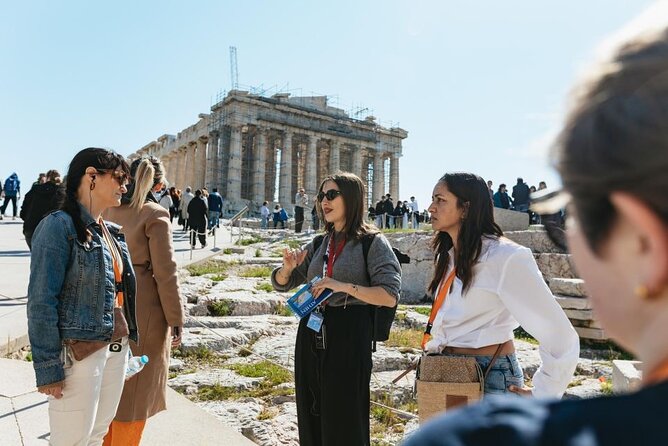
Review · ATHENS
Acropolis, Parthenon and Ancient Agora Guided Tour with entrances
The best part of this Athens tour is the combination of the Acropolis and Ancient Agora in one morning. You see the city’s most famous monument, then move into the public heart of ancient Athens, where people once met, traded, debated, and worshipped.
I like the included entrance fees and the small maximum group of 20. I also like the hearing devices, since a clear guide’s voice matters when you are standing among crowds and wind on the Acropolis. The main drawback is the uphill walking, heat, and uneven ground. This is not a hard athletic outing for most fit adults, but it can feel tiring, especially in summer.
Key points to know before booking
- Acropolis and Agora together: You get two major ancient sites instead of seeing the Acropolis alone.
- About three and a half hours: The pace is full but still allows time for photos, questions, and short rests.
- English-speaking licensed guide: Guides such as Angeliki, Laura, Hermes, Elaina, Elena, Demos, and Stevie have led sessions praised for clear explanations and humor.
- Headsets included: You can hear the guide without standing shoulder to shoulder with the group.
- Morning start at 9:00: The early timing can help you avoid some heat and, on quieter days, some crowds.
- No hotel pickup: You make your own way to Porinou Street and finish at the Ancient Agora.
Why this Athens walking tour works

Athens has two ways to see its ancient monuments. You can walk in alone, take a few photos, read scattered signs, and leave with a general sense that the place is important. Or you can go with a guide who explains how the sites fit together.
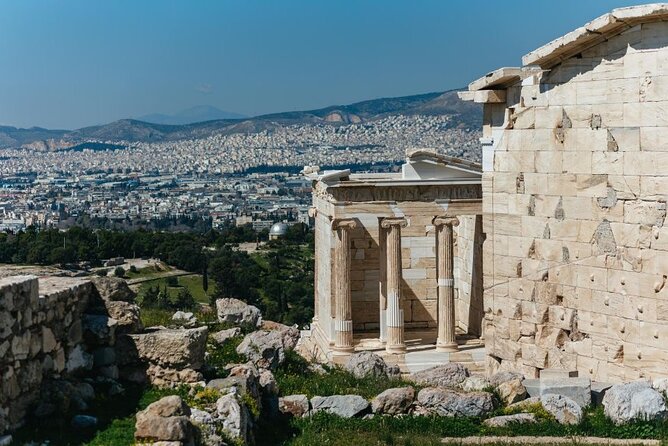
This tour is built around the second approach. It begins at the Acropolis, the rocky citadel above Athens, and finishes at the Ancient Agora below it. That order makes sense. You first see the symbols of Athenian power and religion, then the civic center where daily public life took place.
The price is $129.75 per person. That is not a budget walk, but admission to both archaeological areas is included, along with a licensed guide and listening equipment. For you, the value depends on how much explanation you want. If you already know Greek architecture and prefer to move alone, the price may feel high. If you want the monuments explained in plain language, the guide adds real value.
The group can include up to 20 people. That is not a private tour, but it is small enough to keep the group moving together. The headsets are especially useful at the Parthenon, where wind, other guides, and general site noise can make spoken commentary hard to follow.
More Ancient History Tours in Athens
- Athens: Acropolis & up to 5 Archaeological Sites Combo Pass
★ 4.2 · 13,904 reviews - Athens: Ancient Greek Theater Performance
★ 4.7 · 2,481 reviews - Historical Delphi One Day Tour with Arachova Stop & Expert Guide
★ 4.5 · 1,247 reviews
Starting at the Acropolis at 9:00
The meeting point is on Porinou Street, near the Acropolis. There is no hotel pickup or drop-off, so allow time to reach the starting point on your own. The tour begins at 9:00 in the morning and ends at the Ancient Agora, not back at the starting point.
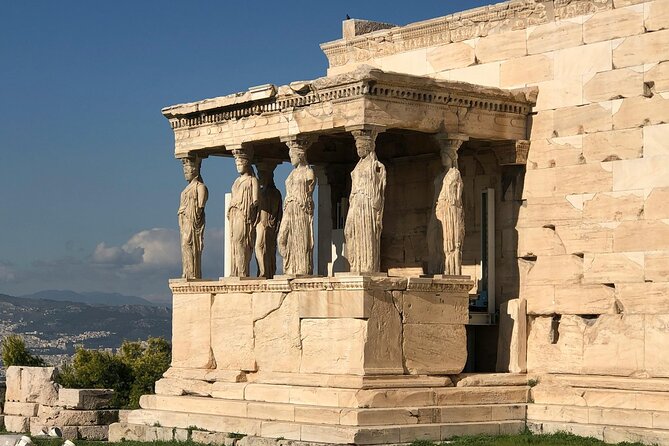
The first Acropolis visit is listed as about 30 minutes. That does not mean you see the whole hill in a rushed dash. It is a focused introduction to the citadel and its major remains, with the guide setting the story before you reach the Parthenon.
The Acropolis sits above Athens, so you should expect an uphill approach, stone surfaces, and exposed sun. Several people found the climb steeper than expected, while others considered it manageable with a moderate level of fitness. I would bring water, wear sturdy shoes, and avoid treating this as a gentle city stroll.
The guide’s job here is more than naming buildings. You need context to understand why this hill mattered, how its monuments were used, and why the site became such a strong symbol of Athens. Guides including Laura, Angeliki, Hermes, Elaina, Demos, and Stevie have been praised for clear explanations, patience, and a good pace.
Herod Atticus Odeon and the Theatre of Dionysus
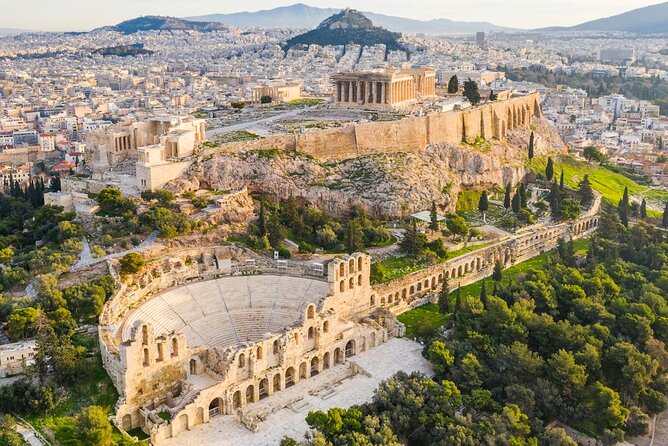
The route continues to the Herod Atticus Odeon, with about 10 minutes set aside. This stone theater sits on the southwest slope of the Acropolis. Herodes Atticus built it in 161 AD in memory of his wife, and it originally had a wooden roof and room for about 5,000 spectators.
The theater is still used for performances, which gives it an unusual link between ancient construction and modern Athens. Your time here is brief, so think of it as a guided stop for orientation, photos, and an explanation of how Roman-era Athens added to the older Greek setting.
Next comes the Theatre of Dionysus, with about 15 minutes. Built on the southern slope, it formed part of the sanctuary of Dionysus Eleuthereus. This is an important stop because theater was not a side hobby in ancient Athens. It was tied to religious festivals and public life.
The short time at each theater is a tradeoff. You get a useful overview without turning the morning into a specialist archaeology seminar. If theaters are your main interest, you may wish for more time. For most first-time visitors, the balance keeps the tour moving toward the Acropolis summit.
The Parthenon, Athens’s essential stop

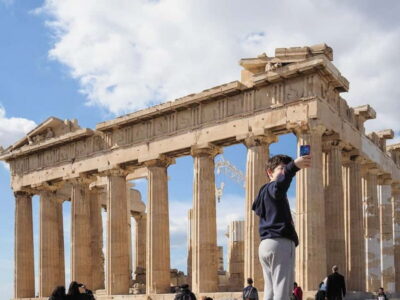
The Parthenon receives about 30 minutes, and this is the emotional center of the tour. Dedicated to Athena, it was built as a temple and later passed through very different chapters of use and damage. Its sculptures are among the finest achievements of classical Greek art, and the building remains a powerful symbol of ancient Greece, democracy, and Western civilization.
A guide helps you look past the familiar outline. The Parthenon is not simply a large old temple. Its proportions, decoration, religious purpose, and place within the Acropolis all matter. The guide can also help you separate what you are actually seeing from the idealized image many people carry in their heads.
Thirty minutes is enough to hear the main explanation, admire the columns and sculptural details, and take photographs. It is not enough for every architectural question or a slow study of each visible feature. The tour aims to give you a strong first understanding, not exhaustive site research.
Morning is a smart choice here. The heat can build quickly on the exposed hill, and one person noted that a hot day made the full outing tiring. On a cool day, wind can be a factor too. One guide, Laura, kept the experience worthwhile even in cold, windy weather, but you should dress for changing conditions rather than assuming Athens will always feel warm.
More Ancient History Tours in Greece
- From Athens: Ancient Corinth Day Trip with Canal & VR Guide
★ 4.6 · 1,073 reviews - Acropolis, Parthenon & Athens Old City Heritage Walking Tour
★ 4.5 · 876 reviews - Private Biblical Tour Ancient Corinth & Isthmus Canal from Athens
★ 5.0 · 762 reviews - Athens: Ancient Corinth & Nafplio Full Day Trip with Swim
★ 4.8 · 531 reviews
Walking down to the Ancient Agora
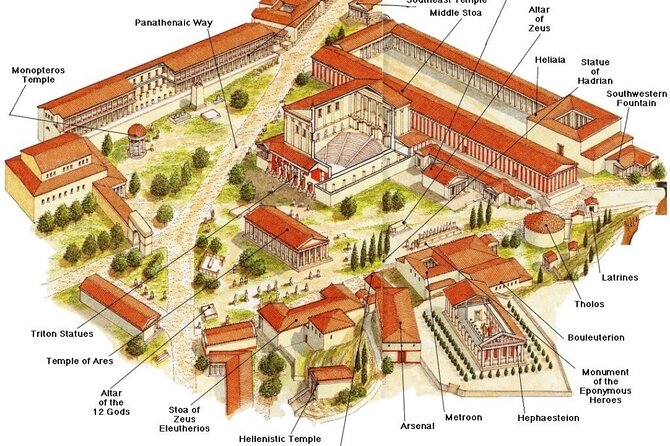
The second half shifts from sacred hilltop monuments to the Ancient Agora. This is where the tour becomes especially useful. The Acropolis can feel like a place of grand symbols. The Agora helps you picture the ordinary machinery of the city.
The Ancient Agora was used for commerce, assemblies, residences, and public gathering. It lies northwest of the Acropolis, bordered by the Areopagus to the south and the hill called Agoraios Kolonos, or Market Hill, to the west.
The allotted time is about 1 hour and 15 minutes, making it the longest stop. That extra time matters. The Agora is spread out, and its meaning is not always obvious if you only walk among foundations and broken columns. A good guide connects the remains to the people who used this space and to the political life of Athens.
You may find this portion less instantly dramatic than the Parthenon. It has fewer single-image moments. But I consider it one of the tour’s strongest features because it adds daily life and civic activity to the grand religious monuments above.
The walk between the Acropolis and Agora also makes the city’s layout easier to understand. You are not just visiting disconnected ruins. You are following the relationship between the hilltop sanctuary and the public center below.
Temple of Hephaestus and the Stoa of Attalos
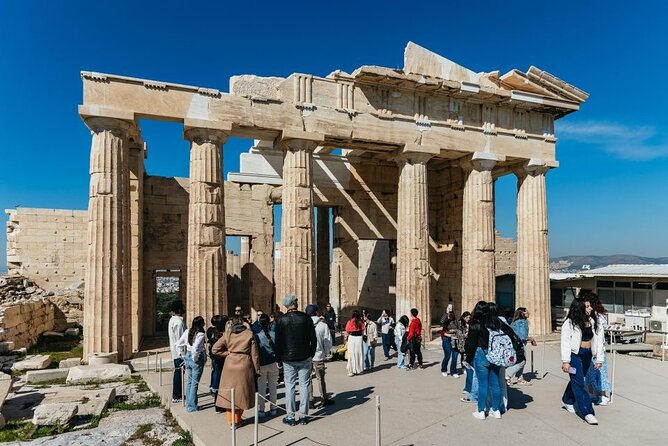
The stop described as the Temple of Aries is actually the Temple of Hephaestus. It receives about 15 minutes. Dedicated to Hephaestus, god of fire and craftsmanship, the temple was built around 449 BC during the height of the Athenian Empire.
It is one of the best-preserved ancient Greek temples, with clear Doric features. Compared with the Parthenon, it is smaller and less famous, but its condition can make it easier to understand. You can read the basic shape of a classical temple without as much visual confusion from missing sections and long restoration work.
The Stoa of Attalos receives another 15 minutes. King Attalos II of Pergamon built the original two-story colonnaded structure in the second century BC. It functioned as a covered walkway and shopping area, a useful reminder that the Agora was a working public place, not only a ceremonial site.
The restored building now houses the Museum of the Ancient Agora. This is where small objects and architectural pieces can give shape to the open-air ruins. The museum portion adds welcome detail, though 15 minutes is a quick visit. If you enjoy museums, note what catches your eye and consider returning later if your schedule allows.
Guide quality and the small-group setup
The strongest part of this experience is the guiding. The guide names associated with different departures include Hermes, Angeliki, Laura, Elaina, Elena, Demos, and Stevie. You cannot select a particular person from the information provided, but the consistent pattern is clear: guides explain the sites, answer questions, use humor when appropriate, and adjust the pace when needed.
That last point matters more than it may sound. One guide paused for rest stops on the uphill climb, and another kept slower walkers from being left behind. The pace was also described as measured rather than rushed. This makes the tour a better fit for mixed-age groups than a hard-driving march through the monuments.
The headsets connect to the guide’s microphone. I like this practical touch. You can step back to look at a column or take a photograph while still following the explanation. In a busy archaeological area, that is far better than trying to stay within arm’s reach of the guide.
The maximum group size is 20. You should not expect the intimacy of a private walk, and you may have to wait briefly when the group regathers. Still, the size is manageable, especially with headsets and a guide who checks that everyone is together.
Fitness, weather, and what to bring
The tour requires moderate physical fitness. The main challenges are the climb to the Acropolis, stone paths, heat, and the total amount of walking over three and a half hours. One person described the uphill sections as more demanding than expected, while another found the walk reasonable for an able-bodied person.
Bring water. A bottle is not included, and extra water options are not listed. Wear shoes with a secure grip, since ancient stone surfaces are not the place for flimsy sandals. A hat and sun protection make sense in warm weather, while a light layer can help on a cool or windy morning.
The tour requires good weather. If poor weather causes cancellation, you are offered another date or a full refund. You can cancel for a full refund up to 24 hours before the start time, but changes or cancellations inside that window are not accepted.
Mobility needs deserve honest attention. The guide can be accommodating to slower walkers and people with some mobility issues, but the uphill route and uneven archaeological ground remain real factors. If you use a mobility aid or have trouble with climbs, contact the provider before booking rather than assuming the route will be easy.
Who gets the most from this tour
I would choose this tour for a first visit to Athens, especially if you want the major ancient sites explained in one organized morning. It suits history fans, families with older children, and anyone who would rather ask questions than read every plaque alone.
It also works well as an early trip activity. Several people found the morning timing useful for avoiding the worst heat and some crowds. Afterward, you finish at the Ancient Agora, giving you a practical starting point for continuing through central Athens.
You may want a different option if you dislike guided groups, prefer a slow photographic visit, or already have a strong background in classical architecture. The schedule is purposeful, so you will not have unlimited time at the Parthenon or museum.
Is the $129.75 price fair?
At $129.75, this is a mid-to-high priced guided visit, but the comparison should include what you receive. Admission to the Acropolis monuments and Ancient Agora is included, as are the licensed guide and audio devices. You also avoid the work of planning a route through several major sites.
The real value is the explanation. Without a guide, you can see the Parthenon and Agora, but you may miss how religion, theater, government, trade, and public life fit together. The tour gives you that framework in a single morning.
I would book it if you want an efficient first look and useful historical context. I would skip it if your main goal is independence and long stretches of quiet time. The price is easiest to justify when you treat the outing as both admission and instruction, not simply a walk among ruins.
Should you book this Acropolis and Agora tour?
Yes, if you want Athens’s essential ancient sites in one well-paced morning and you value a guide who can explain what you are seeing. The Acropolis, Parthenon, theaters, Temple of Hephaestus, Stoa of Attalos, and Ancient Agora create a strong sequence, moving from monumental religion to everyday civic life.
Book with realistic expectations. You will climb, walk on uneven ground, face the weather, and share the experience with as many as 19 other people. Bring water, start ready at 9:00, and choose this tour for its structure and explanations. For a first visit to Athens, that is a fair exchange for the $129.75 cost.
FAQ
How long does the tour last?
The tour lasts approximately 3 hours and 30 minutes.
What time does the tour begin?
It begins at 9:00 am.
Where does the tour start?
The meeting point is on Porinou Street in Athens, Greece.
Where does the tour end?
The tour ends at the Ancient Agora of Athens.
Is admission included?
Yes. Entrance fees for the Acropolis monuments and Ancient Agora are included.
Is a guide included?
Yes. A licensed English-speaking guide leads the tour.
Are audio devices provided?
Yes. Hearing devices connected to the guide’s microphone are included.
Is hotel pickup or drop-off included?
No. Pickup and drop-off are not included.
What happens if I need to cancel?
You can cancel up to 24 hours before the start time for a full refund. Cancellations or changes made less than 24 hours before the start are not accepted. If poor weather causes the tour to be canceled, you are offered another date or a full refund.
Just added around Athens
- Small-Group Women History in Ancient Greece Walking Tour★ 5.0 · 38 reviews
- The original Christian tour on Paul’s footsteps in Athens and ancient Corinth★ 4.5 · 25 reviews
- Ancient Athens tour: Acropolis, Parthenon and Acropolis Museum★ 5.0 · 256 reviews
- Ancient Athens Segway Tour with Agora and Kerameikos★ 5.0 · 94 reviews
- Ancient Sparta & Mystras Private Day Tour from Athens★ 5.0 · 52 reviews
- Athens National Archaeological Museum E-Ticket with Audio Guide★ 3.0 · 57 reviews
- Biblical Corinth Taste Faith & History with wine & Oil Tasting★ 5.0 · 28 reviews
- Ancient Corinth, Sanctuary of Hera, Blue Lake & Canal from Athens★ 5.0 · 26 reviews
Athens History Tours, compared.
Athens: Acropolis & up to 5 Archaeological Sites Combo Pass
Read our review →
Historical Delphi One Day Tour with Arachova Stop & Expert Guide
Read our review →
From Athens: Ancient Corinth Day Trip with Canal & VR Guide
Read our review →
Historic Athens: Small Group Electric Bike Tour
Read our review →
Acropolis, Parthenon & Athens Old City Heritage Walking Tour
Read our review →
Private Biblical Tour Ancient Corinth & Isthmus Canal from Athens
Read our review →
Athens: National Archaeological Museum Ticket w/ Opt. Audio
Read our review →Browse the lists this tour appears in