
Review · ATHENS
Athens: Women in Ancient Greece
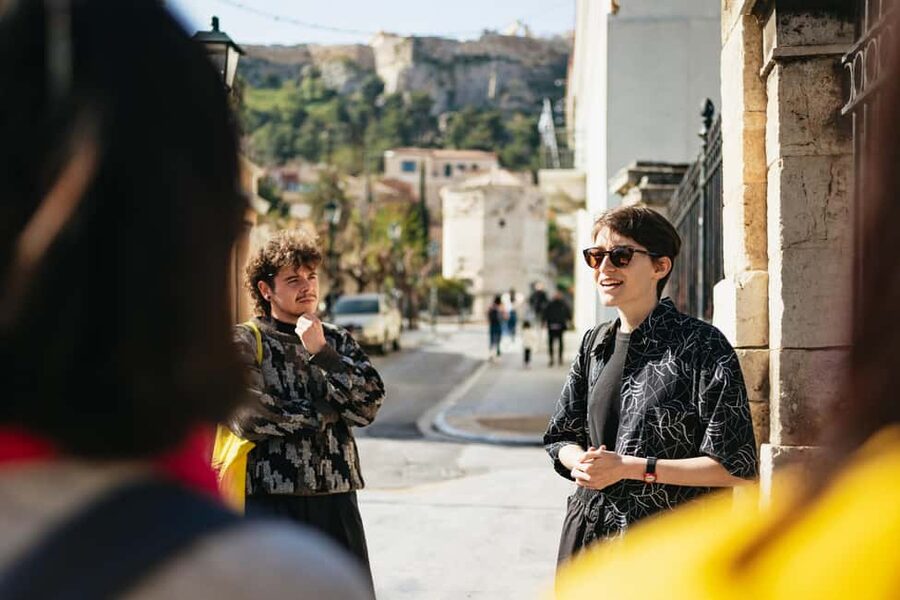
Athens is usually told through its philosophers, generals, and politicians. This two-hour walk asks a sharper question: Where were the women? Guide Maelle connects daily life, mythology, and famous figures such as Sappho, Aspasia, and Agnodice to the monuments around you.
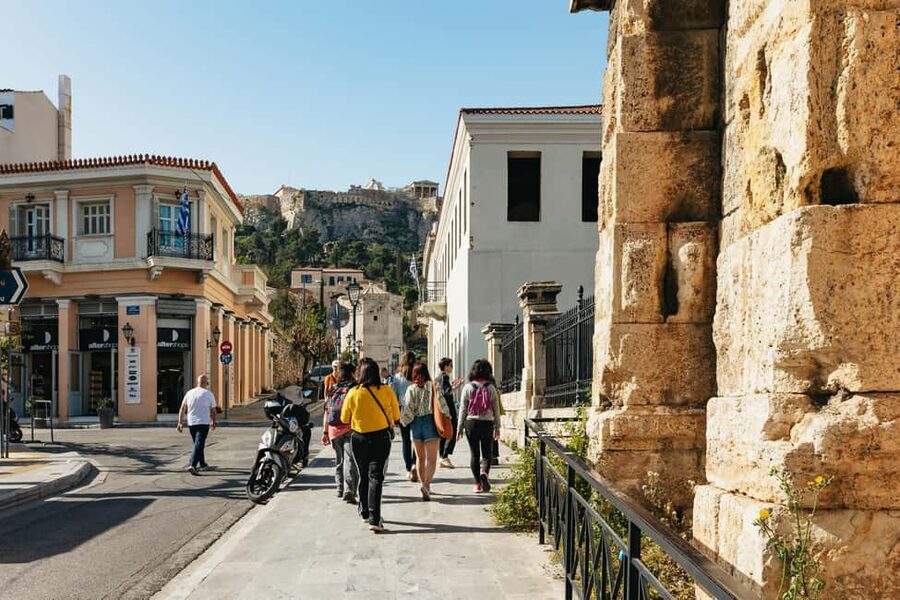
I like the fresh point of view and the conversational style. You do not simply hear dates beside old stones. You discuss marriage, work, religion, social class, and the limits placed on women. I also like the route from Monastiraki toward Filopappou Hill, which mixes major sights with quieter corners and fine Acropolis views.
The main drawback is practical: this is a walking tour with steps and uneven historic streets. The archaeological sites are viewed from outside, and the price does not include entry tickets. If you want a full interior visit to the Acropolis or Agora, book that separately.
Key points at a glance
- A female view of famous Athens: Connect Hadrian’s Library, the Agora, Pnyx, and the Acropolis to the lives of women who are often left out of standard tours.
- Stories beyond Athens: Hear about women in Sparta and Thebes, as well as Athenian figures such as Aspasia, Sappho, and Agnodice.
- Mythology with a social purpose: Athena, Penelope, Demeter, and Pandora help explain how Greek stories shaped ideas about women.
- A conversation, not a lecture: Maelle encourages questions and discussion, making the walk feel personal and thoughtful.
- A manageable two-hour route: The walk ends on Filopappou Hill, with scenic views and a natural place to continue exploring Athens.
- Plan for stairs and sun: Bring water, sunscreen, and a hat. This outing is not suitable for wheelchair users or people with serious mobility or heart concerns.
Why this Athens walk feels different
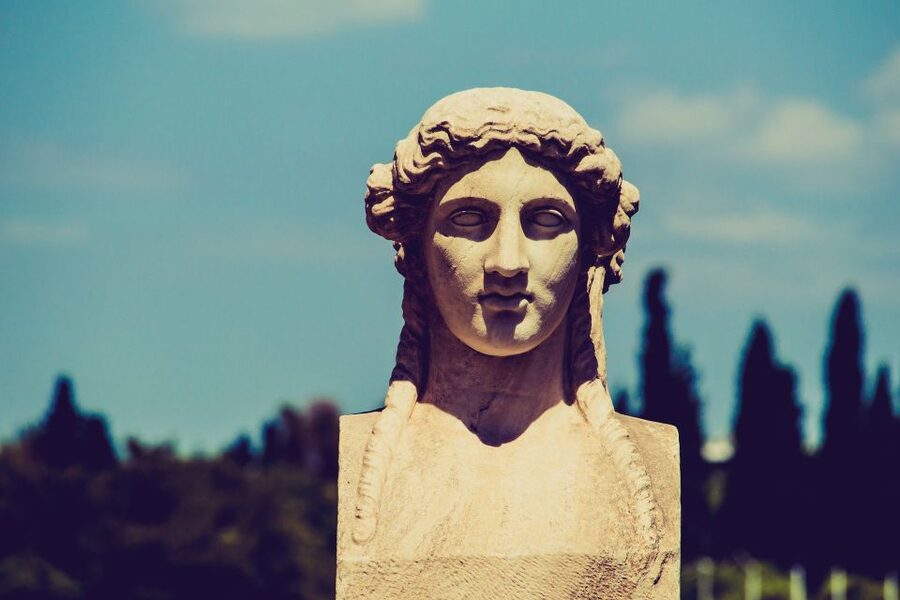
The best reason to choose this tour is its subject. Ancient Athens is often presented as the birthplace of democracy and philosophy, yet the women who lived beside that public world are easy to overlook. This walk brings them into the picture without pretending that ancient society was fair or modern in its outlook.
You hear about the duties and restrictions placed on women, but also about the different lives available to wealthy women, poor women, enslaved women, foreigners, priestesses, artists, and women from other Greek cities. That range matters. There was no single female experience in ancient Greece.
The discussion also separates myth from history. Stories about goddesses and heroines reveal what society admired, feared, or expected from women, but they are not simple records of daily life. Maelle’s approach connects the two without treating every legend as fact.
The tone is thoughtful, but not heavy. You can ask questions, compare ancient customs with modern life, and follow an idea that catches your interest. Several people who took the walk with Maelle describe her humor, warmth, and ability to turn a difficult subject into an engaging conversation. That style is especially useful if you know little about ancient Greece.
More Ancient History Tours in Athens
- Athens: Acropolis & up to 5 Archaeological Sites Combo Pass
★ 4.2 · 13,904 reviews - Athens: Ancient Greek Theater Performance
★ 4.7 · 2,481 reviews - Historical Delphi One Day Tour with Arachova Stop & Expert Guide
★ 4.5 · 1,247 reviews
Meeting at Monastiraki and setting the theme
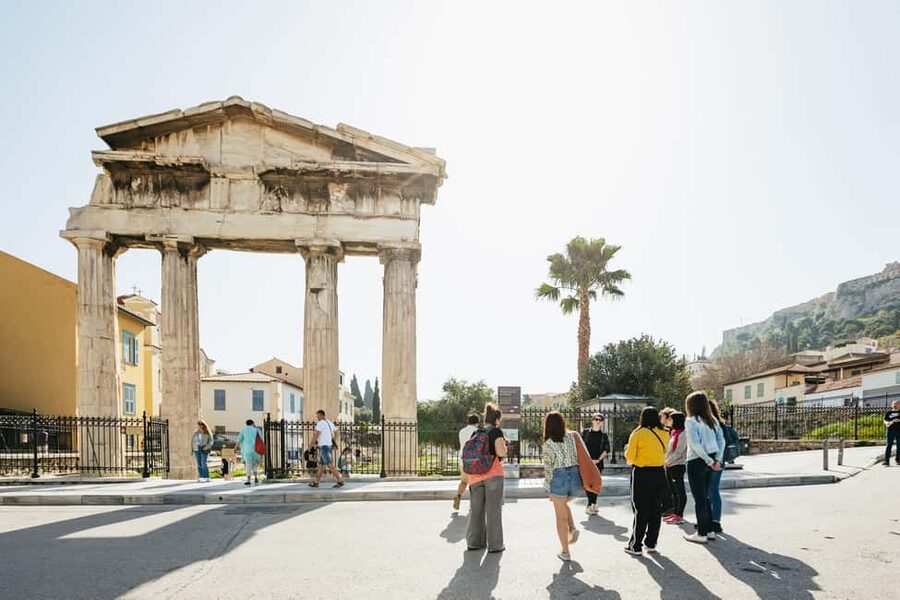
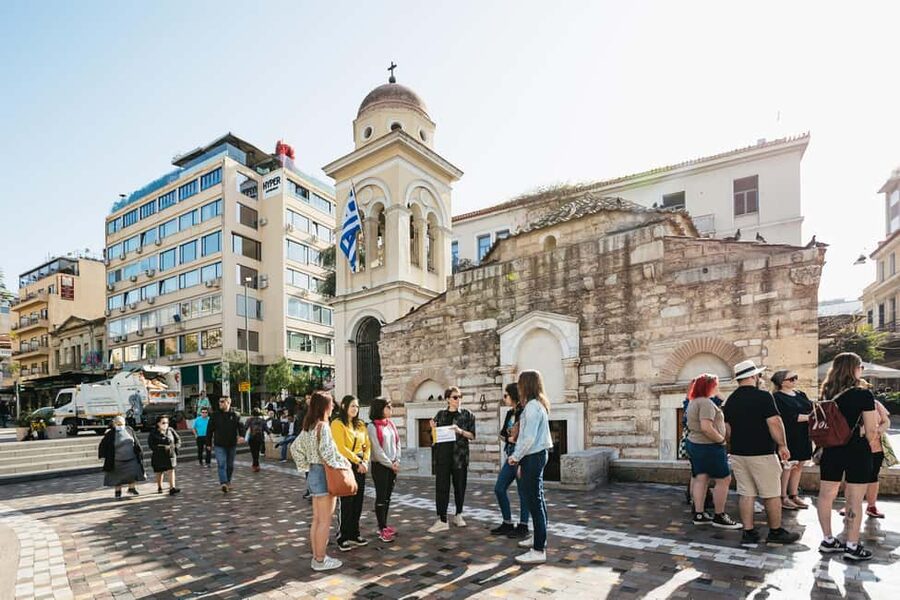
Meet your guide in Monastiraki Square, in front of the Church of the Virgin Mary Pantanassa. Look for the sign reading Women in Ancient Greece. This is a central and easy-to-reach starting point, but the square can be busy, so give yourself enough time to find the church and guide.
The opening section helps you understand the purpose of the walk. You are not just touring old buildings with a female name attached to them. You are looking at the political, religious, and domestic world around those buildings and asking who had access to it.
That distinction makes the experience useful alongside a standard Acropolis tour. A conventional route may explain temples and civic institutions. This walk asks who cooked, traded, worshipped, raised children, attended festivals, or remained excluded from public decision-making.
Monastiraki and Hadrian’s Library
The first stops are Monastiraki and Hadrian’s Library. The Monastiraki area gives you a lively modern setting before the route moves into ancient Athens. It is a good place to begin thinking about how cities are layered, with present-day streets crossing old political and commercial ground.
At Hadrian’s Library, the focus shifts toward education, public culture, and who could take part in intellectual life. The building is viewed from the exterior, so do not expect an archaeological-site visit here. The value comes from the setting and the explanation rather than from entering the monument.
This is also where the tour can challenge the familiar idea that ancient Greece was equally open to everyone. Athens produced celebrated male philosophers, yet women had far fewer formal paths into education and public debate. Stories of women who did gain influence become more striking when you understand how unusual their position was.
Plaka and the Gate of Athena Archegetis
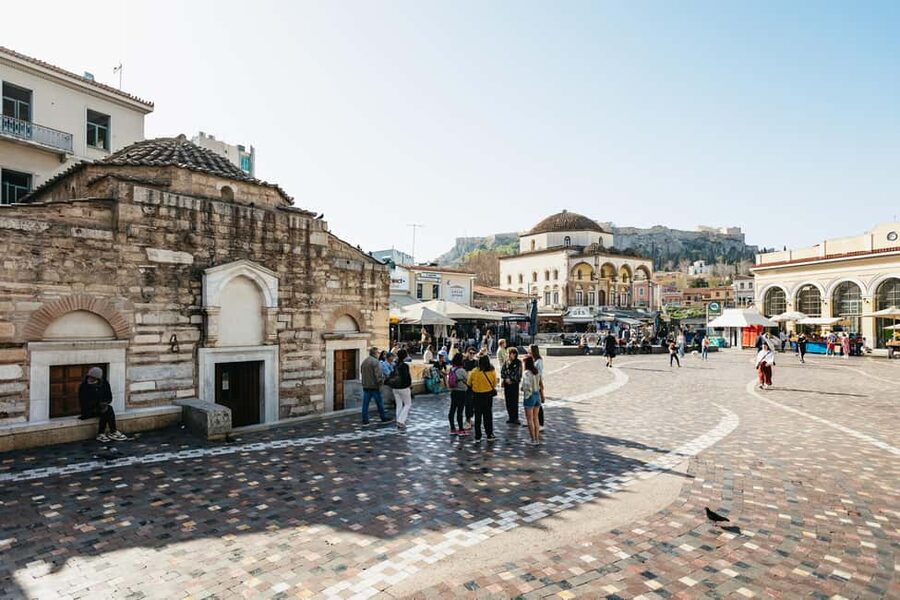
The route continues through Plaka, where ancient remains, later buildings, shops, and narrow streets sit close together. You will hear about women in daily life while moving through one of the most atmospheric parts of central Athens.
Expect roughly ten minutes of guided attention in this area, though the pace is shaped by questions and the group. The walk is not built around long stops at every monument. Instead, each place acts as a prompt for a wider subject.
At the Gate of Athena Archegetis, the conversation turns toward religion and public identity. Greek women’s lives were tied closely to household rituals, religious festivals, family duties, and the worship of gods and goddesses. Religion could reinforce social rules, but it also gave some women important roles as priestesses or participants in ceremonies.
The myths of Athena, Penelope, Demeter, and Pandora add another layer. Athena represents power and wisdom, but she is also a goddess created within a male-centered civic system. Penelope is praised for loyalty and patience. Demeter’s story speaks to motherhood, loss, fertility, and the food supply. Pandora reflects ancient anxieties about women and blame.
The useful point is not simply remembering each myth. You are encouraged to ask what these stories taught people about female behavior and what they concealed about real women.
More Ancient History Tours in Greece
- From Athens: Ancient Corinth Day Trip with Canal & VR Guide
★ 4.6 · 1,073 reviews - Acropolis, Parthenon & Athens Old City Heritage Walking Tour
★ 4.5 · 876 reviews - Private Biblical Tour Ancient Corinth & Isthmus Canal from Athens
★ 5.0 · 762 reviews - Athens: Ancient Corinth & Nafplio Full Day Trip with Swim
★ 4.8 · 531 reviews
The secret stop and stories beyond Athens

A stop described as secret adds a little variety to the route, but the important feature is not mystery for its own sake. It gives the guide room to discuss material that does not fit neatly beside one famous monument.
This is where you may hear stories such as the account of kidnapped Spartan girls or the mysterious women’s festival in Athens. These tales are memorable because they show women as participants in social and religious life, not just as wives, daughters, or prizes in someone else’s story.
The route also reaches beyond Athens. Sparta and Thebes had different customs and reputations, so comparing them helps prevent a common mistake: treating all ancient Greek communities as if they worked the same way. The lives of women varied by city, class, family position, and legal status.
You may also hear about women who crossed expected boundaries. Sappho represents poetry and intellectual achievement. Aspasia raises questions about foreign women, public influence, and the way later writers described women close to powerful men. Agnodice is linked to medicine and the challenge of entering a profession controlled by male authority.
These accounts are not presented as a simple list of heroines. Their value lies in the questions they raise. Who recorded their achievements? What evidence survives? How much of a later story may be legend? That critical approach gives the walk more substance than a parade of inspirational names.
The Ancient Agora from a woman’s point of view
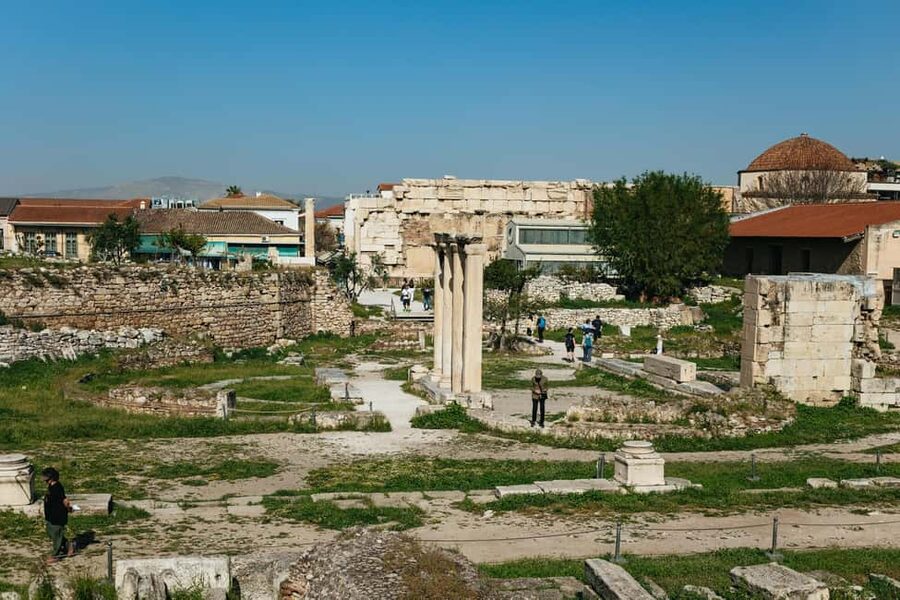
The Ancient Agora is one of the route’s most important settings. It was a center of political, commercial, legal, and social life, yet women did not share equally in the public rights associated with Athens.
The tour views the area from outside, and the stop lasts about ten minutes. That is enough to place the Agora in context, but not enough for a full archaeological visit. If the Agora is high on your list, set aside another part of your trip for its entrance and interior paths.
Here, you can think about the contrast between the celebrated democratic system and the people excluded from it. The first democratic votes at Athens are a major part of the city’s story, but women were not full political citizens in the modern sense. Enslaved people and foreigners were also left outside the central political community.
That does not mean women had no influence. Their work sustained households and religious practice, and family connections could affect public life. The tour helps you see how a society can create important institutions while limiting participation in them.
I find this one of the strongest parts of the experience because it avoids easy praise. Athens can be both historically important and deeply unequal. You can admire its political experiments while asking who benefited from them.
Pnyx and the limits of democracy
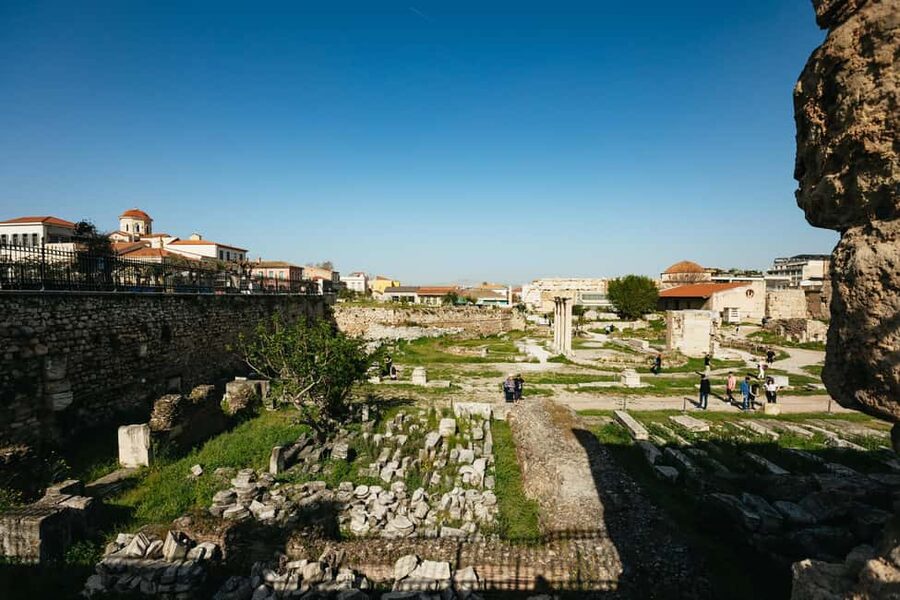
The walk then reaches the Pnyx, the hillside associated with public meetings and democratic voting. This is one of the clearest places to consider the gap between the ideal of democracy and the actual population allowed to exercise political power.
The stop is scheduled for about fifteen minutes, giving the guide more time to explain the setting and invite discussion. You may stand where political decisions were debated while considering who could speak, vote, or shape the rules.
That physical setting makes the subject easier to grasp. Democracy is not an abstract idea here. It took place on a particular hillside, among particular citizens, within a society that assigned women a different place.
The conversation also connects the ancient world with present-day questions. That does not turn the tour into a modern political lecture. Instead, it encourages you to notice how old assumptions about gender, citizenship, and public authority can survive in new forms.
This stop may be especially rewarding if you are interested in the origins of democracy. It gives you a more honest version of the story than the usual quick claim that Athens simply invented freedom.
Acropolis views and the walk to Filopappou Hill

As you continue, the route offers a viewpoint toward the Acropolis. You do not enter the Acropolis on this tour, but the sightline gives the walk a strong visual finish. The temples above Athens become a backdrop for the stories you have been hearing about women, gods, and civic life.
The final destination is Filopappou Hill. The guided portion here lasts about ten minutes, and the hill provides a scenic end to the route. It also gives you a chance to pause after the denser historical discussions.
The ending works well because the tour moves from the center of public Athens to a broader view over the city. You leave with monuments in mind, but also with a different sense of the people who lived around them.
The stated drop-off point is near Rovertou Galli 69, at a kiosk. From there, you can continue on foot or make your own plans, though no onward transport is included.
What the two-hour format gives you
Two hours is long enough to build an argument and short enough to fit into a busy Athens schedule. You cover many locations, so the tour is a focused introduction rather than an exhaustive study of women in ancient Greece.
The pace includes short guided stops of about five to fifteen minutes. Much of the value comes from listening while walking between sites. If you prefer a slow archaeological visit with time for photographs at every ruin, this may feel quick.
The private-group format can make a real difference. The activity is offered as a private tour when that option is selected, and the group format is listed as private. Confirm the exact option when booking if having a private guide is important to you.
Maelle is the guide most often associated with this experience. Her style is described as friendly, humorous, and conversational, with regular questions for the group. She also gives practical Athens suggestions, which can be useful if this is early in your stay.
The tour is offered in English and French. A small gift is included, and food, drinks, and archaeological entrance tickets are not.
Price, comfort, and practical value
At $88 per person, this is not the cheapest way to see central Athens. You are paying for a specialist subject, a live guide, and a carefully connected route rather than simply being led from monument to monument.
The value is strongest if you have already seen, or plan to see, the standard Acropolis sights and want more context. It also suits a first visit if you prefer to begin with social history rather than architecture alone.
There are limits. Exterior views mean you will need separate tickets for the archaeological sites. The tour includes stairs and walking on historic streets, so wear sensible shoes and bring water, sunscreen, and a sun hat. It is not suitable for wheelchair users or people with mobility impairments, heart problems, or difficulty with steps.
Athens can be hot, and one useful feature of Maelle’s approach is that she looks for shade during stops when needed. Still, choose a cooler time of day when possible and do not treat the two-hour duration as a guarantee of an easy stroll.
Who should book this experience
I would choose this tour if you want:
- A social and cultural view of ancient Athens
- Stories about women across different classes and Greek cities
- A guide who welcomes questions and discussion
- A thoughtful companion to an Acropolis or Agora visit
- A short experience that can fit into a two or three-day Athens stay
- A history tour suitable for friends, couples, parents with older children, or anyone curious about overlooked voices
I would choose something else if you mainly want interior access to ruins, a general introduction to every major ancient monument, or a fully accessible route without steps.
This is also a good pick for families with daughters or young adults who may find the usual sequence of male rulers and philosophers narrow. The subject is serious, but the storytelling and conversation keep it approachable.
Should you book Women in Ancient Greece?
Book it if you want Athens to become more than a collection of famous stones. The route gives you the Agora, Pnyx, Plaka, Hadrian’s Library, Acropolis views, and Filopappou Hill, but its real purpose is to ask who lived within this society and who was shut out.
The strongest reasons to go are Maelle’s engaged teaching style, the attention to women from different social groups, and the clear links between mythology and everyday expectations. The main cautions are the outdoor-only monument views, the steps, and the additional cost of archaeological tickets.
For a standard sightseeing checklist, this is not enough on its own. For a more complete and honest understanding of Athens, it is a smart two-hour addition.
FAQ
Where does the Women in Ancient Greece tour begin?
Meet your guide on Monastiraki Square, in front of the Church of the Virgin Mary Pantanassa. Your guide will hold a sign reading Women in Ancient Greece.
How long does the walking tour last?
The tour lasts two hours. Starting times vary, so check availability when choosing your date.
Which languages are available?
The tour is offered in English and French.
Does the tour enter the Acropolis or archaeological sites?
No. The historic sites are viewed from outside, and archaeological entry tickets are not included.
What sights are included along the route?
The route includes Monastiraki, Hadrian’s Library, Plaka, the Gate of Athena Archegetis, a secret stop, the Ancient Agora, Pnyx, an Acropolis viewpoint, and Filopappou Hill.
Is the tour suitable for wheelchair users or people with mobility difficulties?
No. The route includes steps and is not suitable for wheelchair users or people with mobility impairments. It is also not suitable for people with heart problems.
What should I bring?
Bring water, sunscreen, and a sun hat. Food and drinks are not included.
Just added around Athens
- Small-Group Women History in Ancient Greece Walking Tour★ 5.0 · 38 reviews
- The original Christian tour on Paul’s footsteps in Athens and ancient Corinth★ 4.5 · 25 reviews
- Ancient Athens tour: Acropolis, Parthenon and Acropolis Museum★ 5.0 · 256 reviews
- Ancient Athens Segway Tour with Agora and Kerameikos★ 5.0 · 94 reviews
- Ancient Sparta & Mystras Private Day Tour from Athens★ 5.0 · 52 reviews
- Athens National Archaeological Museum E-Ticket with Audio Guide★ 3.0 · 57 reviews
- Biblical Corinth Taste Faith & History with wine & Oil Tasting★ 5.0 · 28 reviews
- Ancient Corinth, Sanctuary of Hera, Blue Lake & Canal from Athens★ 5.0 · 26 reviews
Athens History Tours, compared.
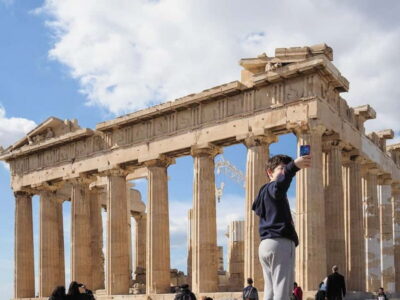
Athens: Acropolis & up to 5 Archaeological Sites Combo Pass
Read our review →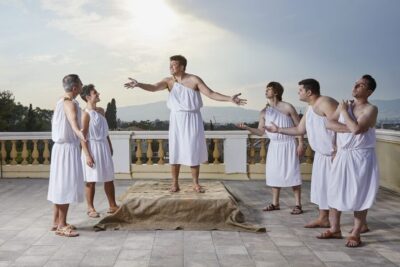
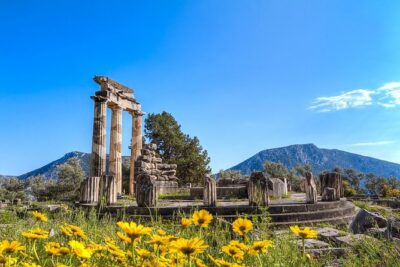
Historical Delphi One Day Tour with Arachova Stop & Expert Guide
Read our review →
From Athens: Ancient Corinth Day Trip with Canal & VR Guide
Read our review →
Historic Athens: Small Group Electric Bike Tour
Read our review →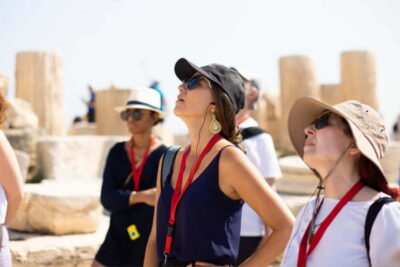
Acropolis, Parthenon & Athens Old City Heritage Walking Tour
Read our review →
Private Biblical Tour Ancient Corinth & Isthmus Canal from Athens
Read our review →
Athens: National Archaeological Museum Ticket w/ Opt. Audio
Read our review →Browse the lists this tour appears in