
Review · FRANCE
Carcassonne ‘s Medieval Walls: A Self-Guided Tour
Carcassonne’s walls are more than a fine photo backdrop. They tell the story of a fortified city shaped by Cathars, crusades, sieges, and clever medieval defense. This self-guided walk lets you follow that story at your own speed, using the VoiceMap app to connect the gates, towers, castle, and basilica.
I like the offline access, which means you can download the audio, map, and route before setting out. I also like the focus on medieval warfare, especially the sections that point out where attacking forces could become trapped in defensive kill zones. The main drawback is that this is an audio walk, not a ticket into the castle, ramparts, or museums. You must pay separately for any attractions you enter.
Key points before you book
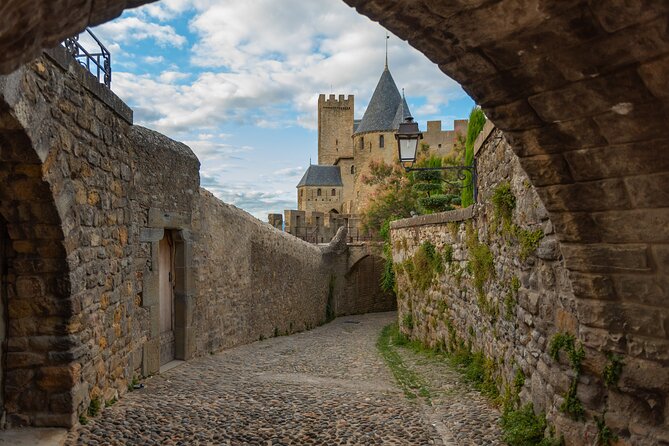
- Lady Carcas starts the story: Begin at the sculpture of Dame Carcas and hear the legend of how she helped save the city from Charlemagne.
- A full circuit of the Cité: The route follows the medieval walls and passes through or near the Aude, Nazaire, Toulouse, and Narbonne gates.
- Useful warfare context: You learn why the walls were built as they were and where attackers faced the greatest danger.
- Flexible timing: The walk takes about two to three hours, but you can pause, restart, or skip ahead when a section is closed.
- Good value for independent visitors: At $24.99 per person, it costs far less than many private guided options, though it does not include entry tickets.
- English audio only: The tour is offered in English through the VoiceMap app for Android and iOS.
Why the walls are the right way to see Carcassonne
The Cité de Carcassonne can feel like a medieval film set at first glance. Towers rise above the stone walls, narrow gates control entry, and the Château Comtal anchors the fortifications. The self-guided route helps turn that striking view into a readable military system.
You are not simply walking beside old stone. You are learning how the defenses worked. The route explains the walls, gates, and exposed approaches, then shows how an attacking army could be forced into tight spaces under fire. That practical angle gives the walk a clear purpose.
I would allow closer to three hours if you stop often for photographs, views, or a break. The stated duration is about two to three hours, but your pace depends on how carefully you follow the audio and how crowded the Cité is.
The route is private in the simplest sense: only your group uses the tour. You do not need to match a guide’s pace or wait for a scheduled group to gather. That makes it useful on a busy day, when the streets, castle, and ramparts may all have people moving through them.
More Medieval History Tours in France
- Colmar, Medieval Village & Castle Small Group from Strasbourg
★ 5.0 · 769 reviews - From Nice: Provence and its Medieval Villages Full-Day Tour
★ 4.8 · 352 reviews - From Strasbourg: Medieval Villages & Wine Tasting Day Trip
★ 4.8 · 329 reviews
Starting with Lady Carcas
The walk begins at Buste de Dame Carcas, the sculpture of Lady Carcas. This is a sensible starting point because the figure introduces one of Carcassonne’s best-known legends before you begin the more solid military history.
You hear the story of how Lady Carcas saved the city from Charlemagne. The tale gives the city its name and offers a memorable character before the route moves into gates, walls, and sieges.
From here, the audio helps you orient yourself around the Cité. You do not need to read a long guidebook while trying to find the next place. The app provides the route, map, and spoken commentary, which is especially useful if you are walking solo.
The exact presentation depends on your phone and headphones, so download the tour before starting. Offline access is included, but you still need your own smartphone and headphones.
Entering through Narbonne Gate
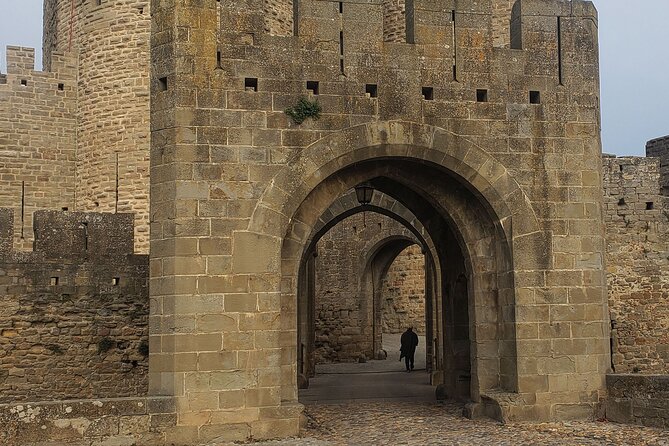
Narbonne Gate, or Porte Narbonnaise, is one of the most impressive entrances to the fortified city. It is also the official end point listed for the walk, even though the route takes you around the Cité before returning here.
The gate gives the tour a strong military opening. Medieval gates were not just openings in a wall. They were controlled points where defenders could slow, divide, or expose anyone trying to enter. The audio uses this setting to introduce the logic of the fortifications.
As you follow the walls, the route explains the Cathars who flourished in the region during the twelfth century. It also covers the crusade launched against them and several sieges connected with Carcassonne.
This part should appeal most to you if you want more than dates and royal names. The religious and political conflict helps explain why Carcassonne became such an important stronghold. The city was not built only for show. Its defenses mattered because power in this part of France was disputed and often violent.
Finding the medieval kill zones
The strongest part of the route is its attention to medieval warfare. Rather than treating the walls as a single impressive ring of stone, the commentary points out how attackers could be exposed at different points.
You learn to look for the places where an enemy might be trapped between defensive positions. These kill zones made a siege dangerous even before an army reached the main wall. The route shows how walls, gates, and angles worked together to give defenders an advantage.
This makes the walk more active. You are not just listening to a historical explanation. You are looking at the stones and trying to understand the danger built into them.
The subject is handled at a broad level, so do not expect a technical course in weapons or engineering. Still, the focus is clear enough to make the circuit worthwhile for anyone interested in castles, defense, or siege tactics.
I would take this tour before visiting the Château Comtal. The wall walk gives you useful context for the castle and its surrounding defenses. Once you understand how the outer defenses functioned, the castle visit has more meaning.
Same city, a different century:
- Normandy D-Day Sites & Cemetery Day Trip from Paris with Lunch
★ 5.0 · 6,877 reviews - Paris: Louvre Museum Entry with History of Mona Lisa
★ 3.9 · 2,823 reviews - Normandy D-Day Small-Group Day Trip with Omaha Beach, Cemetery & Cider Tasting
★ 5.0 · 2,786 reviews - Normandy D-Day Beaches and American Cemetery Day Trip from Paris
★ 4.5 · 2,673 reviews
Château Comtal and the inner defenses
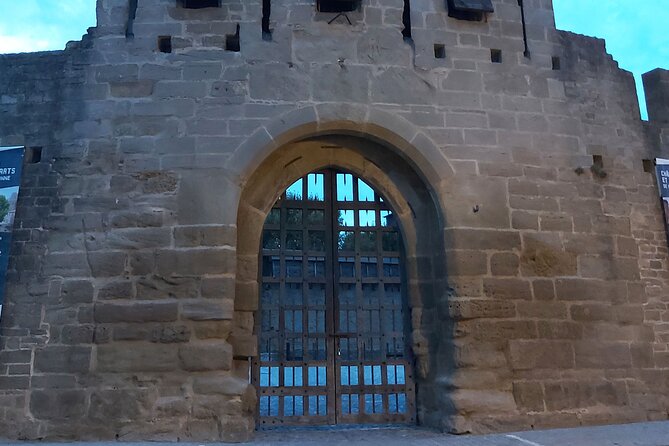
The route takes in the Château et Remparts de la Cité de Carcassonne, commonly called the Château Comtal. Here, the castle meets the wall system, making it one of the key places to understand how the city was protected.
The audio helps you see the castle as part of a larger defensive plan. You are not looking at an isolated palace. You are seeing the relationship between the inner stronghold, the surrounding walls, and the approaches through the Cité.
The tour does not guide you through the castle itself. If you enter, you need a separate admission ticket, and you will explore that attraction independently. This is an important distinction when comparing the $24.99 audio walk with a fully guided castle visit.
Restoration or temporary barriers may affect parts of the route. The app lets you skip a chapter and return to the next section, which is useful if a passage is closed. One reported barrier caused some trouble, and route changes are always possible around historic monuments, so keep the map open and stay alert for signs.
The Basilica of Saints Nazaire and Celse
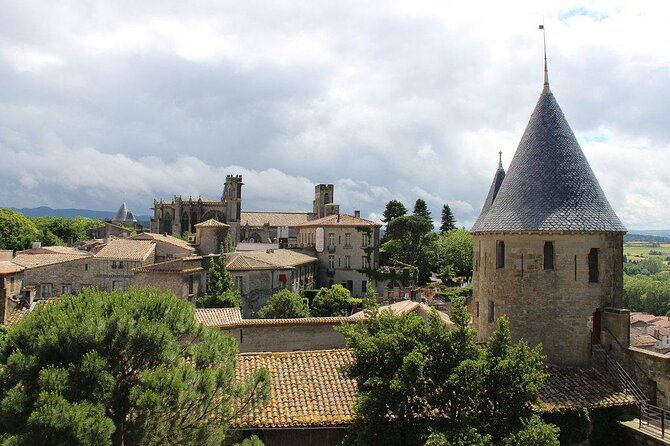
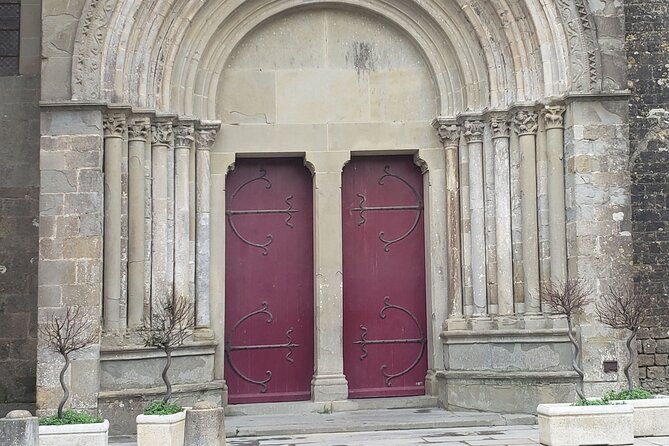
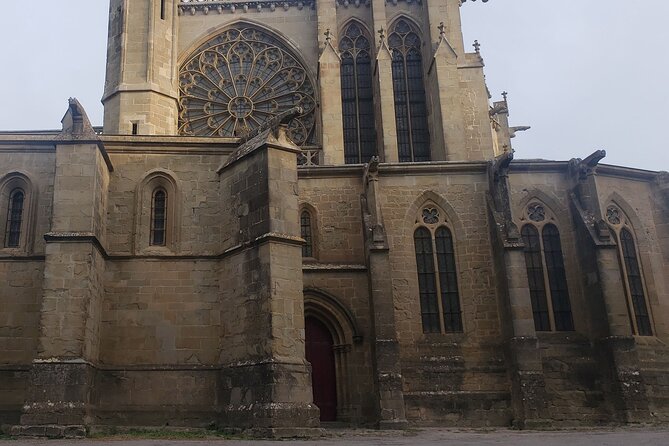
The walk also brings you to the Church of Saints Nazaire and Celse, often called the Basilica of Saint-Nazaire. It is one of the major religious landmarks inside the Cité and gives the tour a welcome change from military architecture.
Here, the focus shifts from walls and sieges to the city’s religious identity. The church honors its two patron saints, Nazaire and Celse, and helps show that life inside the fortifications was not only about defending against armies.
You should think of this stop as an exterior visit within the audio route. The tour does not include entry or a guided visit inside the church. If you decide to go in, any admission or visit arrangements are your responsibility.
The inclusion of the basilica also makes the route feel more complete. You move through the city’s military, religious, and civic spaces rather than circling the walls without entering the story of the people who lived there.
Four gates and the shape of the city
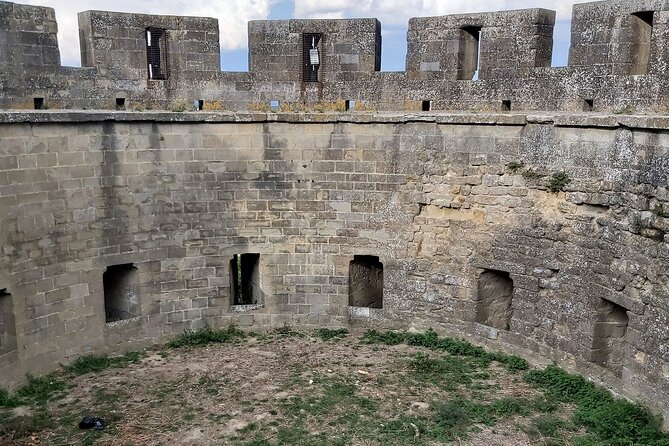
The route takes you into the center through several gates, including Aude, Nazaire, and Toulouse, while also beginning and ending near Narbonne Gate. Each opening offers a different way to understand the Cité’s layout.
Gates are good reference points during a self-guided walk. If you lose your position, you can match the audio with the stone entrance in front of you. The app’s geolocation is meant to keep the route moving at your pace, and the map helps you find your way around the old city.
The walk is not a straight line from one attraction to another. You follow the walls, enter the center, then continue around the fortified city. That makes comfortable shoes a sensible choice, although no special equipment is required.
The route can be easy to follow, but you should not expect a guide standing beside you to solve every navigation problem. A barrier, a crowded passage, or a temporary closure may require you to use the map and skip ahead. The ability to pause and restart is one of the tour’s better practical features.
Jean Pierre Cros Mayrevieille and the city’s rescue
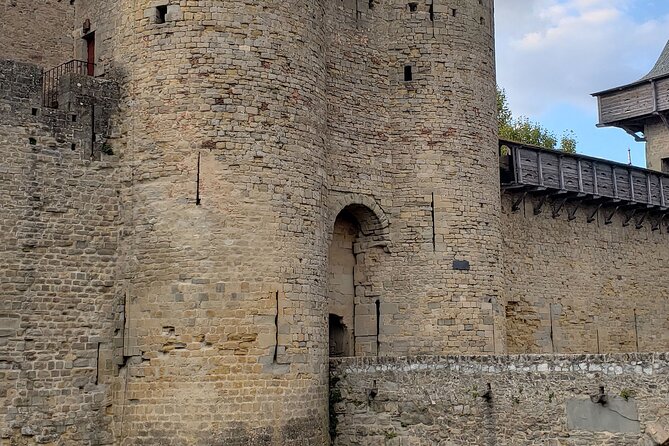
Another stop honors Jean Pierre Cros Mayrevieille, a doctor of law, historian, and Inspector of Historic Monuments. He helped save Carcassonne from ruin.
This stop adds an important later chapter. The walls and towers may look untouched, but historic places often survive because someone fought to preserve them. Mayrevieille’s role helps explain how Carcassonne moved from a vulnerable old fortress toward the monument you see today.
That context is easy to miss if you only walk the streets and take photographs. The audio gives you a reason to notice the difference between the medieval city and its later preservation.
The description of the site also notes that the fortifications are almost a century old in their current restored presentation. That is worth keeping in mind. Carcassonne is a medieval city, but the appearance you see today also reflects later restoration work.
What the VoiceMap format does well
The main strength is control. You can stop for a photograph, wait for a quieter moment, replay a section, or pause for food without losing a live guide.
The tour also works well for solo visitors. The app provides directions and commentary without requiring you to join a group. You can listen privately and set your own rhythm.
The commentary is described as clear, informative, and pleasant to hear. It is also paced for walking rather than delivered as a long lecture. One useful feature is the ability to skip a chapter when a section is closed and pick up the route later.
Offline access matters in an old fortified city. You do not want the route to depend on a constant connection while moving through narrow streets and stone gateways. Download the material before you arrive, then use the map and audio on site.
The tour is available in English only. If you need another language, this experience will not meet that need.
What the tour does not include
The $24.99 price covers lifetime access to the English audio tour, the VoiceMap app, and offline audio, maps, and geodata. It does not cover your phone, headphones, transportation, food, drinks, museum tickets, or admission to other attractions.
That makes the tour a good value if you mainly want an organized explanation of the walls and streets. It is less useful if you want an all-in-one visit with a live guide and included entries.
The audio also focuses heavily on defense, sieges, Cathars, and the political story of Carcassonne. You get less attention to ordinary daily life, local economics, art, and social customs. If those subjects matter most to you, you may want another source to fill the gap.
The current rating is 4.4 out of 5 from 43 ratings, with especially strong praise for the app, pacing, historical detail, and freedom to avoid the busiest parts of the Cité. One low rating came from someone who could not upload the program and ended up walking with local friends instead. That is a reminder to install and test the app before you set out.
Who should book this walk?
I would recommend it to independent visitors who want context but do not want to join a scheduled group. It is also a good fit for people interested in medieval warfare, fortified cities, Cathar history, and the practical design of castle defenses.
Families and couples can use it at their own speed. Older visitors may appreciate the ability to stop and restart, though the route around a historic fortified city can include uneven surfaces and barriers. The supplied information says most participants can take part, but it does not provide detailed accessibility notes.
You should choose a live guide instead if you want direct questions answered on the spot or a tour that includes the interiors of the castle and museums. You should also skip this audio walk if you prefer a short overview rather than a two to three hour circuit.
Book ahead if your date is fixed. The tour is often booked about 22 days in advance, and free cancellation is available up to 24 hours before the start time. After that point, changes and refunds are not accepted.
Is the $24.99 price worth it?
For the right visitor, yes. You get a full English route, lifetime access, offline maps, and a substantial explanation of the Cité for $24.99 per person. That is strong value compared with private guided tours priced above $130, provided you do not need tickets or a live guide.
The best value comes from using it as a framework for the whole visit. Walk the walls with the audio, then visit the castle or basilica separately if you want to go inside. The route gives those paid attractions useful context instead of leaving you to view them as unrelated monuments.
I would not buy it only to wander the streets. You can walk the Cité without an audio guide, and the main sights are visible without one. Buy it if you want the walls to explain themselves.
Should you book Carcassonne’s Medieval Walls self-guided tour?
Book this tour if you want a flexible, well-paced introduction to Carcassonne’s fortifications, with special attention to Cathars, crusades, sieges, and medieval defense. Start at Lady Carcas, download everything before arrival, and plan on three hours if you want time to stop.
The smartest plan is to take the audio walk before entering the Château Comtal. It will help you understand why the castle sits where it does and how the gates, walls, and defensive zones fit together. If you need a live historian, interior visits, or a social history of daily life, choose a different tour or add another source.
FAQ
Where does the tour start?
It starts at Buste de Dame Carcas in Carcassonne, France.
Where does the tour end?
It ends at Porte Narbonnaise, also called Narbonne Gate, after following the walls around the Cité de Carcassonne.
How long does the tour take?
The walk takes approximately two to three hours.
What language is offered?
The tour is offered in English.
What app do I need?
You need the VoiceMap app, which is available for Android and iOS.
Does the tour work offline?
Yes. You receive offline access to the audio, map, and geodata.
Are attraction tickets included?
No. Museum tickets, castle admission, church admission, and other entrance fees are not included.
Do I need to bring anything?
You need your own smartphone and headphones. Transportation, food, and drinks are also not included.
Can I pause the tour?
Yes. You can stop and restart the tour, and you can skip to another chapter if part of the route is closed.
Is cancellation available?
Yes. You can cancel for a full refund up to 24 hours before the experience start time. Cancellations or changes made less than 24 hours in advance are not accepted.
More Self-Guided Tours in France
- Taormina: Ancient Theater Skip-the-Line Ticket & Audio Guide
★ 4.5 · 2,412 reviews - Athens: National Archaeological Museum Ticket & Audio Guide
★ 4.3 · 1,330 reviews - Medieval Torture Museum Ticket with Audio Guide and Ghost Hunting
★ 5.0 · 962 reviews - Gettysburg Battlefield Self-Guided Driving Audio Tour
★ 4.5 · 910 reviews
Just added around France
- Medieval Carcassonne: Interactive Ghost Story & City Game★ 3.5 · 33 reviews
- Carcassonne During World War 2★ 5.0 · 127 reviews
- Small Group Guided D-Day Tour and Mémorial de Caen Museum★ 5.0 · 237 reviews
- Normandy: Private tour D-Day landing beaches American sector★ 5.0 · 62 reviews
- Mémorial de Caen Museum Admission and Guided Tour of D-Day Sites★ 4.5 · 275 reviews
- Private Day Tour including Normandy Landing Beaches & Battlefields from Caen★ 5.0 · 53 reviews
- Private Bordeaux History Tour with a glass of Bordeaux wine.★ 5.0 · 28 reviews
- Historical Center, Bordeaux Food Tour★ 5.0 · 33 reviews
France History Tours, compared.

Normandy D-Day Sites & Cemetery Day Trip from Paris with Lunch
Read our review →
Paris: Louvre Museum Entry with History of Mona Lisa
Read our review →
Normandy D-Day Small-Group Day Trip with Omaha Beach, Cemetery & Cider Tasting
Read our review →
Normandy D-Day Beaches and American Cemetery Day Trip from Paris
Read our review →
Normandy American D-Day Beaches Full Day Tour from Bayeux
Read our review →
Normandy American D-Day Experience – Group tour from Bayeux
Read our review →
Normandy Beaches Half-Day Afternoon Trip from Bayeux (A2)
Read our review →
Omaha Beach D-Day Experience – Afternoon group tour from Bayeux
Read our review →Browse the lists this tour appears in