
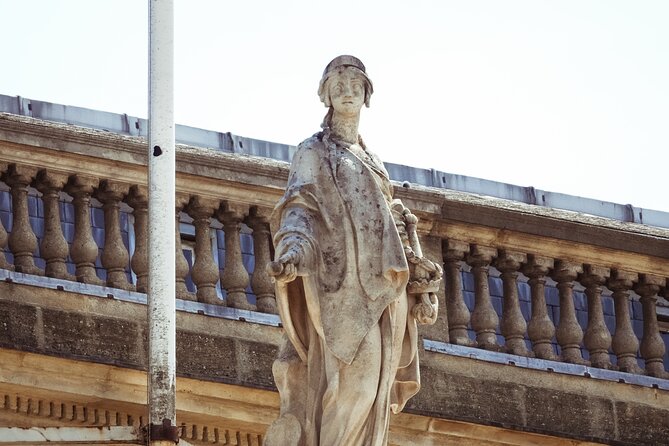
Review · FRANCE
Private Bordeaux History Tour with a glass of Bordeaux wine.
Bordeaux’s story comes into focus on foot, one grand square and medieval gate at a time. This private two-hour tour links Saint-André Cathedral, Porte Cailhau, Place de la Bourse, the Grand Théâtre, and other central sights, then finishes with a glass of Bordeaux wine at a local bar.
I like the private format, since you can ask about the English connection, the wine trade, or the city’s architecture without waiting for a large group. I also like the well-chosen route, which begins at the cathedral and ends at Place des Quinconces, leaving you with a useful map of central Bordeaux.
The main consideration is pace. The tour covers many stops in about two hours, so most places receive a short explanation from the outside rather than a full interior visit. Monument entrances are not included, and the $90.36 price is easier to justify for a small group than for one person traveling alone.
Key points to know before booking
- A private walk through Bordeaux’s central landmarks: Only your group participates, with an English-speaking guide.
- A route packed with major sights: Saint-André Cathedral, Porte Cailhau, Place de la Bourse, the Grand Théâtre, Place des Quinconces, and more.
- Medieval and English connections: Rue du Loup helps explain how Bordeaux came under English rule.
- A look at city planning: Learn how Allées de Tourny, Place Gambetta, and the great squares reshaped Bordeaux.
- Wine at the finish: A glass of Bordeaux is included at a partner bar after the walk.
- Guides who adapt to your interests: Victor and Emma are named in the available feedback, with particular praise for their clear explanations and friendly manner.
Why this private Bordeaux walk works well
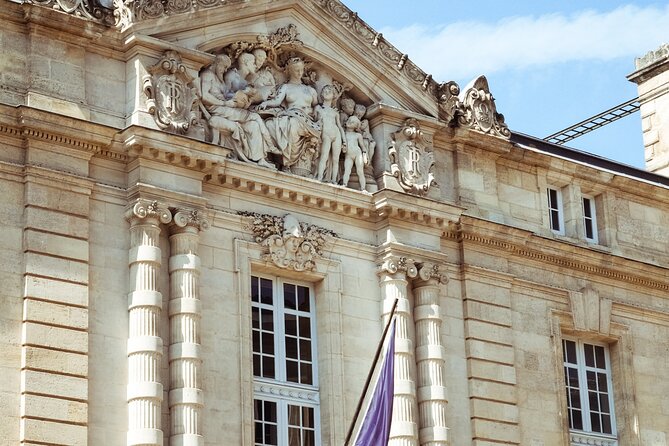
Bordeaux can look polished and easy to understand at first glance. Its broad avenues, classical façades, and handsome squares make a pleasant first impression, but the city’s story is layered. Medieval trade, English rule, royal power, revolution, wine, and modern city planning all appear within a compact central area.
That is where a private guide earns the fee. You are not just moving from one photo stop to another. You can ask why the cathedral is separate from its bell tower, how Bordeaux became connected to England, or why the city’s broad avenues feel so carefully arranged.
Guides Victor and Emma receive especially warm praise for explaining both the past and the present city. Victor is also noted for discussing Bordeaux wine, the city’s 300 years under English rule, and the mayor who spent five decades improving walkability, cycling, and traffic flow. That mix is useful because it connects old monuments with the Bordeaux you see today.
The tour is offered in English and lasts about two hours. Since it is private, the guide can spend more time on the subjects that interest you and move faster through sights you have already seen. The tradeoff is that the route is ambitious. Several stops receive only five or ten minutes, so think of this as a well-organized introduction rather than a series of long monument visits.
More Private History Tours in France
- Private D-Day Experience from Bayeux
★ 5.0 · 573 reviews - Private guided American D-Day Tour from Bayeux
★ 5.0 · 255 reviews - Normandy Battlefields D-Day Private Trip with VIP Services from Paris
★ 5.0 · 240 reviews
Starting at Saint-André Cathedral and Tour Pey-Berland
Meet your guide at Cathédrale Saint-André de Bordeaux on Place Pey Berland. This is a practical starting point because the cathedral immediately gives you a sense of Bordeaux’s religious and political importance.
Saint-André is a major Gothic building, with a tall façade, carved details, and a large interior built over centuries. The tour explains royal events connected with the cathedral, including the marriage of Eleanor of Aquitaine and Louis VII. That detail gives the building a place in European history, not just local church history.
You have about 15 minutes here, and admission is free. The guide’s explanation is the main value at this stop, since entrance inside the monuments is not part of the tour. If you want a longer look at the nave or a quiet visit on your own, plan to return later.
The route also includes Tour Pey-Berland. The supplied itinerary connects this part of the walk with Rue Sainte-Catherine, so expect your guide to point out the relationship between the cathedral district and one of the city’s main pedestrian streets. It is worth keeping the distinction clear: Tour Pey-Berland is the separate bell tower associated with the cathedral, while Rue Sainte-Catherine is the shopping street nearby.
Rue du Loup and Bordeaux’s English chapter
Rue du Loup provides a change of scale. Instead of a huge square or grand façade, you get a closer look at medieval architecture and the older street pattern.
This is where the guide discusses how Bordeaux became English. The connection lasted roughly 300 years and shaped the city’s commercial and political direction. Wine was central to that relationship, which makes this short stop especially useful before the tasting at the end.
Ten minutes is enough for a good explanation, but not for a full study of every building. Keep your eyes up as you walk. In streets such as this, the details are often around doorways, upper floors, and the way older buildings fit together.
Rue Sainte-Catherine and Promenade Sainte-Catherine then bring you into modern Bordeaux. Rue Sainte-Catherine is known as the longest pedestrian shopping street in Europe. The guide uses it to explain how an old route changed into a busy commercial corridor.
The modern shopping setting may be less scenic than the great squares, but it helps you understand how Bordeaux functions today. You will pass from medieval streets into an active retail district in just a few minutes. The itinerary lists two short visits connected with this area, so do not expect a long shopping break.
Place du Palais and Porte Cailhau
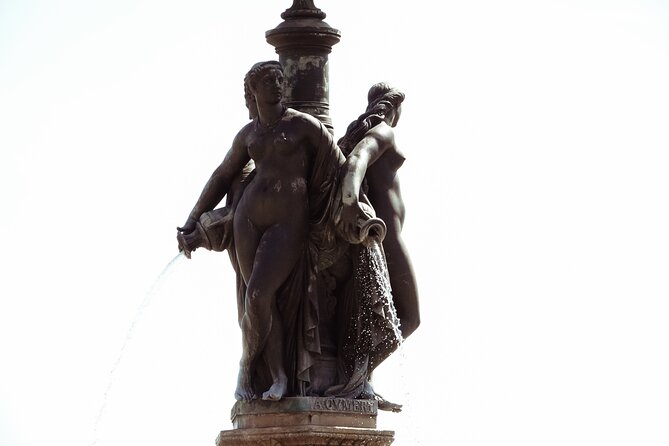
Place du Palais is a brief but useful stop for understanding urban design. The guide explains the idea behind the square and how its buildings work together. This is the kind of information you might miss if you simply walked through with a camera.
Then comes Porte Cailhau, one of the most memorable monuments on the route. This 15th-century gateway once served as a main entrance to Bordeaux. Its architecture mixes Gothic and Renaissance elements, and its construction honored King Charles VIII’s victory at Fornovo.
The gate also speaks to Bordeaux’s defensive past. Before the city became known mainly for elegant quays and wine, its entrances had strategic importance. The guide explains how the gateway controlled movement and symbolized access to the city’s growing prosperity.
You get about 15 minutes here. The tour treats the gate from the outside, so admission inside is not included. That is not a serious weakness for a short orientation walk, but you should know the experience is about context and architecture rather than climbing or exploring the interior.
Same city, a different century:
- Normandy D-Day Sites & Cemetery Day Trip from Paris with Lunch
★ 5.0 · 6,877 reviews - Paris: Louvre Museum Entry with History of Mona Lisa
★ 3.9 · 2,823 reviews - Normandy D-Day Small-Group Day Trip with Omaha Beach, Cemetery & Cider Tasting
★ 5.0 · 2,786 reviews - Normandy D-Day Beaches and American Cemetery Day Trip from Paris
★ 4.5 · 2,673 reviews
Place de la Bourse and the riverfront story
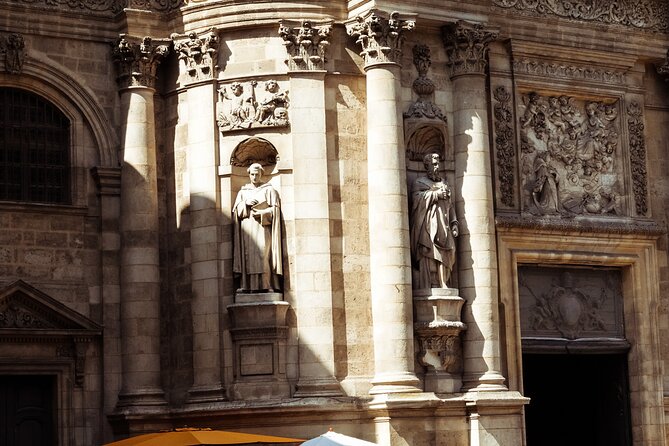
Place de la Bourse is one of Bordeaux’s essential views. Its elegant 18th-century façades face the river, creating the grand visual image most people associate with the city center.
The stop is listed at only five minutes, so the guide will focus on the square’s main story rather than giving a long architectural lecture. You will also hear about the Miroir d’Eau, the reflecting-water installation opposite the square. It creates the famous mirror effect, though the itinerary does not promise a specific operating schedule or time for a full photo session.
This is a good example of why the private format helps. If the light is good or you want to ask about the riverfront, you can request a little more time, although the overall two-hour schedule may limit how much the guide can adjust.
The broader route also identifies Pont de Pierre as one of Bordeaux’s important monuments, but it is not listed as a separate timed stop. Treat it as part of the city’s wider architectural setting rather than expecting a dedicated bridge visit.
The Grand Théâtre and Bordeaux’s public face
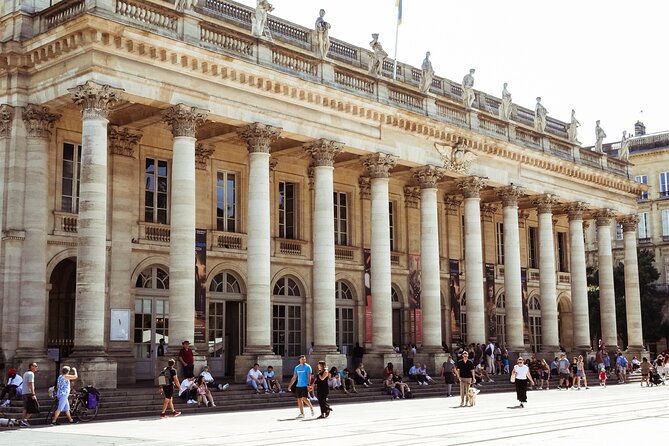
The Grand Théâtre receives a short stop, but it deserves attention. Built in 1780 and designed by Victor Louis, it is a major example of neoclassical architecture. Its front is marked by a row of columns and statues representing the nine muses and goddesses.
The guide explains the theater’s place in Bordeaux’s cultural life and points out the grand staircase and chandelier inside. Since monument entrances are not included, the interior details are presented as part of the explanation rather than a guaranteed indoor visit.
Five minutes may feel brief here, especially if you enjoy theater architecture. Still, the exterior tells much of the story. It was designed to project civic confidence, artistic ambition, and order. After the medieval streets and defensive gate, the theater shows Bordeaux presenting itself as a grand European city.
Place Gambetta, Passage Sarget, and Place du Chapelet
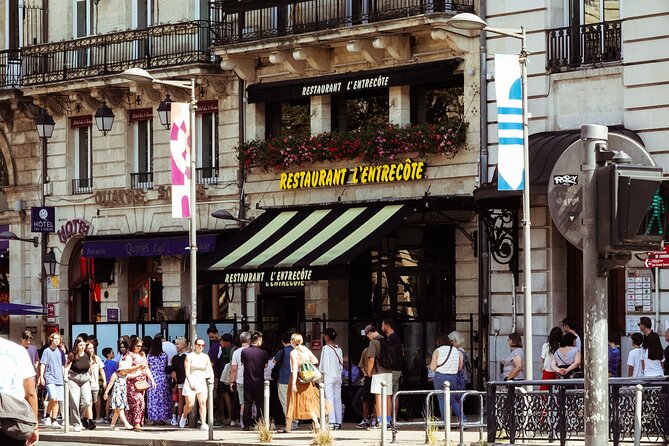
Place Gambetta adds a political and urban-planning chapter. Once associated with the city’s western gate, it was later reshaped during the great urban changes of the 18th century. Today, its gardens offer a quieter setting amid the central streets.
The guide connects the square with Bordeaux’s political history, including the French Revolution. You will also hear how the area changed from a defensive edge into an urban gathering place. With only five minutes allotted, this is a snapshot rather than a garden visit.
Passage Sarget offers a different kind of architecture. Built in the late 19th century, this covered passage links Rue de la Porte-Dijeaux with Place des Grands-Hommes. Its glass roof, ironwork, and stone details recall the Parisian arcade style.
The passage once attracted luxury shops and intellectual gatherings. Today, it remains a pleasant shortcut with shops and cafés. Ten minutes gives you enough time to appreciate its shape and hear why covered passages mattered in city life.
At Place du Chapelet, the focus shifts to the Church of Notre-Dame. The church dates from the 17th century and is known for its organ, which is still used for special performances. The guide also explains its connection with the funeral of a famous 19th-century painter.
This is another exterior-focused stop. If church interiors matter to you, ask the guide about visiting later, since entrance is not included in the tour.
Allées de Tourny and the Girondins monument
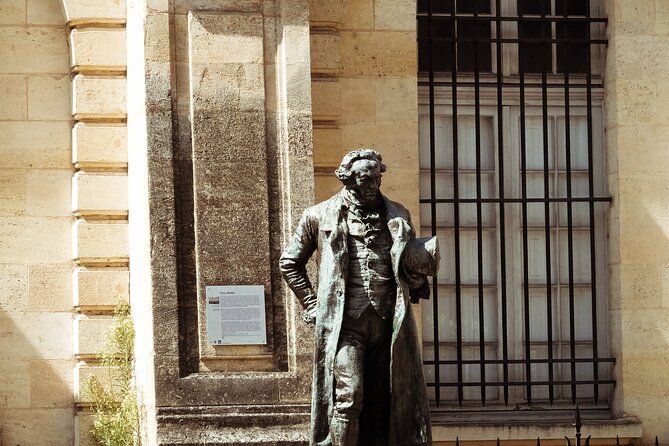
Allées de Tourny is a broad, tree-lined avenue that reflects the planning ambitions of Bordeaux’s later development. The guide explains the influential figure behind its design and the wider effect that person had on Bordeaux and Paris.
The stop lasts about five minutes, but it makes a useful point: Bordeaux was not shaped only by medieval streets and royal buildings. Its grand avenues were planned to improve movement, appearance, and civic life.
The walk finishes at Monument aux Girondins in Place des Quinconces. This towering monument honors Girondin deputies who died during the French Revolution. Sculptures represent liberty, the Republic, and Bordeaux’s maritime identity.
Place des Quinconces is one of the city’s largest public squares, and it makes a fitting endpoint. You finish with a broad civic view rather than a narrow old street. The tour ends here, so you can continue exploring, use public transportation, or arrange your next stop from this central location.
The included Bordeaux wine
After the walking portion, you receive a glass of Bordeaux wine at a partner bar. This is included in the $90.36 per-person price and gives the tour a social finish.
The tasting is not presented as a full winery visit or a formal wine class. You should think of it as one glass and a chance to continue the conversation after the monuments. That is still valuable in Bordeaux, where wine is tied to the city’s trade, politics, and connection with England.
The guide or company also provides a top local recommendation at the end of the tour. Since this is a private experience, you can use that moment to ask for ideas suited to your remaining time in Bordeaux. The exact bar and wine are not specified, so do not book this expecting a named château, several tastings, or a vineyard excursion.
Is $90.36 per person fair?
For a private two-hour tour, the price is reasonable if you are traveling with several people and want a personal introduction to Bordeaux. You are paying for an English-speaking guide, a private group, a carefully arranged route, and a glass of wine.
The calculation changes for a solo visitor. Since the price is per person, one person pays the full listed rate without the cost being shared across a group. A larger private party gets more value from the format, especially if different people want to ask questions or set the pace.
The included wine helps, but it is not the main reason to book. The real value is having someone connect the cathedral, English rule, wine trade, city planning, revolution, and modern Bordeaux in one walk.
Who should book this Bordeaux tour?
I would choose this for a first visit, a short stay, or a morning when you want to get oriented quickly. It also suits families or small groups who prefer not to join strangers and want the guide to adjust explanations to their interests.
History fans will get the most from the medieval, English, royal, and revolutionary material. Architecture lovers will appreciate the cathedral, Porte Cailhau, Grand Théâtre, covered passage, and large squares, though anyone wanting interior visits should plan separate stops.
This is less suitable if your main goal is wine production. You do receive a glass of Bordeaux, but the experience does not include a vineyard, château, cellar, or extended tasting. It is a city history walk with wine at the end.
Because most travelers can participate, service animals are allowed, and the meeting point is near public transportation. Wear comfortable shoes, since the route covers many central streets and public squares. Allow extra time before the start if you are driving, since parking and traffic can cause delays. One person arrived a few minutes late for those reasons, and the guide was accommodating, but arriving on time is still the wise choice.
You can cancel for a full refund up to 24 hours before the start time. Changes or cancellations made inside that window are not accepted for a refund.
Should you book it?
Book this tour if you want a private, history-led introduction to Bordeaux rather than a long wine excursion. The route covers an impressive number of central sights, and guides such as Victor and Emma bring useful context to the city’s English past, architecture, wine trade, and urban changes.
Skip it if you want extensive time inside monuments or a serious tasting program. For everyone else, especially a small group on a first day in Bordeaux, the route offers a practical way to get oriented, ask personal questions, and finish with a glass of local wine.
FAQ
How long does the Bordeaux private history tour last?
The tour lasts approximately two hours.
What language is the tour offered in?
The tour is offered in English with an English-speaking guide.
Is this a private tour?
Yes. Only your group participates in the activity.
Where does the tour start?
It starts at Bordeaux Cathedral, Cathédrale Saint-André de Bordeaux, Place Pey Berland, 33000 Bordeaux, France.
Where does the tour end?
The walking tour ends at Place des Quinconces in Bordeaux.
Is a glass of Bordeaux wine included?
Yes. A glass of wine at a partner bar is included after the walking tour.
Are monument entrance tickets included?
No. The tour includes the historical walking tour, but entrance inside the monuments is not included.
Can I cancel for a full refund?
Yes. You can cancel up to 24 hours before the experience start time for a full refund. Cancellations or changes made less than 24 hours before the start time are not accepted for a refund.
More Wine Trips in France
- From Strasbourg: Medieval Villages & Wine Tasting Day Trip
★ 4.8 · 329 reviews - Nice : Wine Tasting at a Historic Château in a Land Rover !
★ 4.9 · 156 reviews - Nice: Sunset & Wine Tasting in a historic Land Rover
★ 5.0 · 91 reviews - From Colmar: Alsace Medieval and Wine Tasting Day Tour
★ 4.7 · 91 reviews
Just added around France
- Medieval Carcassonne: Interactive Ghost Story & City Game★ 3.5 · 33 reviews
- Carcassonne During World War 2★ 5.0 · 127 reviews
- Carcassonne ‘s Medieval Walls: A Self-Guided Tour★ 4.5 · 43 reviews
- Small Group Guided D-Day Tour and Mémorial de Caen Museum★ 5.0 · 237 reviews
- Normandy: Private tour D-Day landing beaches American sector★ 5.0 · 62 reviews
- Mémorial de Caen Museum Admission and Guided Tour of D-Day Sites★ 4.5 · 275 reviews
- Private Day Tour including Normandy Landing Beaches & Battlefields from Caen★ 5.0 · 53 reviews
- Historical Center, Bordeaux Food Tour★ 5.0 · 33 reviews
France History Tours, compared.

Normandy D-Day Sites & Cemetery Day Trip from Paris with Lunch
Read our review →
Paris: Louvre Museum Entry with History of Mona Lisa
Read our review →
Normandy D-Day Small-Group Day Trip with Omaha Beach, Cemetery & Cider Tasting
Read our review →
Normandy D-Day Beaches and American Cemetery Day Trip from Paris
Read our review →
Normandy American D-Day Beaches Full Day Tour from Bayeux
Read our review →
Normandy American D-Day Experience – Group tour from Bayeux
Read our review →
Normandy Beaches Half-Day Afternoon Trip from Bayeux (A2)
Read our review →
Omaha Beach D-Day Experience – Afternoon group tour from Bayeux
Read our review →Browse the lists this tour appears in