
Review · CHARLESTON
Charleston’s Best Highlights: History, Culture & Architecture
Charleston’s past comes at you quickly on this walk, from the room where South Carolina ratified the Constitution to the waterfront where people watched Fort Sumter being bombarded. Brian and Fin turn streets and façades into a connected story, rather than treating each building as an isolated photo stop.
I like the route’s mix of grand landmarks and difficult subjects, especially its honest discussion of slavery and Charleston’s role in the interstate slave trade. I also like the guides’ flexibility: Brian and Fin have answered questions at length, adjusted the route to the group, and sometimes let the tour run well beyond two hours.
The main consideration is that the walk is mostly an exterior tour. Several buildings may be entered only if conditions allow, and admission fees for places such as the Old Exchange and Nathaniel Russell House are not included. Good shoes, water, and weather-friendly clothing will make the experience much better.
Key details before you book
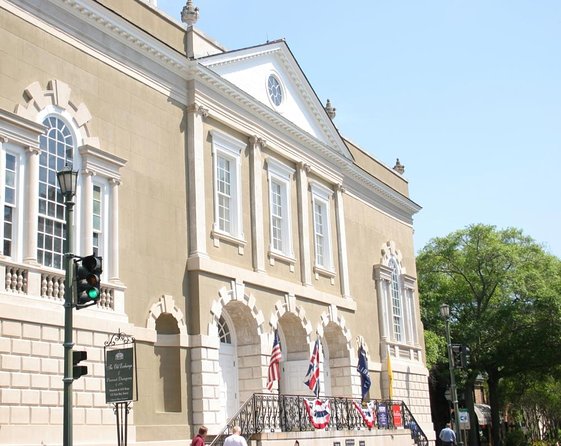
- The Old Exchange sets the historical tone: Start with the building tied to the Declaration of Independence, the American Revolution, George Washington, and South Carolina’s ratification of the Constitution.
- The route covers Charleston’s hardest story: At the Old Slave Mart Museum, you discuss the city’s part in the interstate slave trade, though you do not enter the museum.
- Brian and Fin bring different strengths: Brian is praised for connecting Charleston to wider American history, while Fin draws on decades of high school history teaching and years guiding in the city.
- You see more than pretty streets: Rainbow Row, Dock Street Theater, St. Michael’s Church, and the Battery create a useful mix of architecture, religion, politics, commerce, and war.
- The advertised two hours may stretch: Several walks lasted longer, sometimes around three hours, depending on questions, weather, and the group.
- A small group matters: The maximum is 20 people, and some departures have been much smaller, allowing more questions and personal attention.
Why this Charleston walk works as an introduction
A first walk in Charleston should help you understand how the city fits together. This one does that by moving through the old central district in a compact route, linking buildings to national events and local lives.
You begin at 122 East Bay Street and return there at the end. That makes the tour easy to fit into a first day, especially if you want an orientation before exploring on your own. You do not need a shuttle or a separate transfer between stops. The tradeoff is simple: you spend the full experience on foot, with no long indoor break built into the plan.
The guide is the key part of the experience. Brian is frequently praised for his command of Charleston and American history, along with his ability to connect people and events from different colonies and states. Fin brings a similar teaching approach, drawing on 30 years as a high school history teacher and 15 years guiding in Charleston.
That background matters. You are not just handed dates. You get explanations of why the city mattered, how its buildings changed use, and how local events fit into the creation of the United States. If you ask questions, the guide can adapt the conversation instead of rushing through a memorized script.
More Local Culture and Traditions Tours in the USA
- Portland Explorer | Maine History, Culture, & 3 Lighthouses Tour
★ 5.0 · 948 reviews - Carmel Small Group Walking Food & Cultural Tour
★ 5.0 · 392 reviews - The Original Greenwich Village Food & Cultural Tour Since 1999
★ 5.0 · 254 reviews
The Old Exchange and Provost Dungeon, 1771
The tour starts at one of South Carolina’s most important historic buildings. Completed around 1771, the Old Exchange was tied to major political and military moments long before Charleston became a popular weekend destination.
The Declaration of Independence was read here in 1776. During the American Revolution, the British used the building as a prison for roughly two years. South Carolina ratified the United States Constitution here in 1788, and George Washington was entertained at the building during his week-long visit in May 1791.
That list gives the guide plenty to work with, but do not expect the full paid museum experience to be included. The stop lasts about 15 minutes, and admission is not included. You will get the building’s place in Charleston’s story, but you should confirm current entry arrangements if you want to tour the interior separately.
I consider this an excellent opening stop because it immediately widens the frame. Charleston was not only a port of handsome houses. It was a place where national politics, war, trade, and public ceremony met.
Rainbow Row and the business behind the color
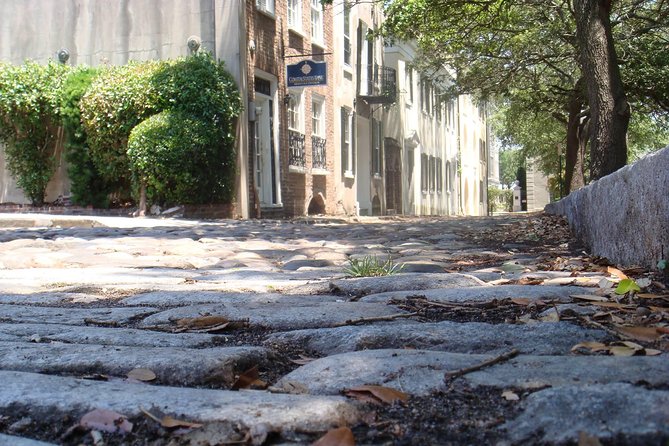
Rainbow Row is the briefest stop, about five minutes, but it is one of the easiest places to recognize in Charleston photographs. The attached Georgian row houses form the longest row of their kind in the country.
The colorful façades are not simply an old colonial design choice. The buildings began as mariners’ stores in the 18th and 19th centuries. During Charleston’s preservation efforts in the 1930s, they were restored in a bright Caribbean-inspired color scheme.
That detail gives you a useful lesson in historic preservation. The view feels old, but the appearance people associate with Rainbow Row was shaped by a later restoration era. The stop is free and outdoors, so it works well for photos and a quick explanation without slowing the walk.
You will not spend long here, and that is appropriate. Rainbow Row is a visual landmark, not a site that needs an extended visit on this route.
The Old Slave Mart and Charleston’s difficult past
The Old Slave Mart Museum is one of the most important stops because it keeps the tour from becoming a parade of pretty buildings and famous names. The building was known as Ryan’s Slave Mart in the 1850s and was used as an auction site connected to the interstate slave trade.
You do not enter the museum on this tour. The guide speaks outside about Charleston’s role in the trade, and you can visit the city-operated museum separately if you want a fuller indoor presentation. Admission is not included.
The limited time, about 10 minutes, means this is an introduction rather than a complete study of slavery in Charleston. Still, placing the subject within the walking route matters. You see that the city’s wealth, architecture, and political influence cannot be separated from the labor and lives of enslaved people.
I would pay close attention here and allow extra time later for the museum if the subject is important to your visit. The tour gives necessary context, but an outdoor conversation cannot replace a dedicated museum visit.
More Local Culture and Traditions Tours in Charleston:
- Amsterdam Food and Cultural Tour with Tastings
★ 5.0 · 4,315 reviews - Sevilla Food Tour: Tapas, Wine, History & Traditions
★ 5.0 · 3,468 reviews - Tromsø: Reindeer Camp and Sami Cultural Tour with Lunch
★ 4.7 · 3,326 reviews - Half Day Dominican Republic Cultural Tour : Small Group
★ 4.5 · 1,862 reviews
French Huguenot Church and the city’s religious mix

The French Huguenot Church adds another layer to Charleston’s identity. The Gothic Revival building dates to 1845 and houses one of the only practicing Huguenot, or French Protestant, congregations in the country.
The stop lasts about five minutes and is free. You may not spend much time inside, but the exterior and the guide’s explanation help show that Charleston was shaped by more than one religious tradition.
This is a good example of the tour’s range. In a short distance, you move from political power and forced labor to the religious communities that helped form the city. The church also prepares you for the later discussion at St. Michael’s, where religious history takes a more prominent role.
Dock Street Theater, with a chance of entry
Dock Street Theater occupies the site of the first theater in the British colonies. The present building, dating to about 1937, was restored from the former Planter’s Hotel, built around 1809.
The building’s story is a little more complicated than its polished façade suggests. It links early theater, hotel life, preservation, and the modern performing arts. Charleston Stage, the state’s largest professional theater company, operates here and presents roughly 120 performances each year.
The tour may enter if availability permits. That wording is important. You should not book this walk assuming that an interior theater visit is guaranteed. The listed entry is free, but access depends on conditions at the time.
Even from outside, the stop gives you a useful sense of how Charleston reuses and preserves old buildings. You are looking at more than a pretty historic shell. It remains a working cultural venue.
Charleston City Hall and the Four Corners of Law
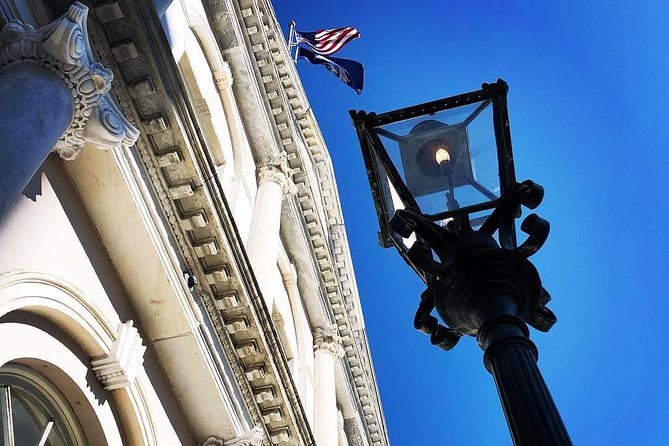
Charleston City Hall takes only about two minutes on the route, but its location gives the guide a chance to explain the Four Corners of Law. The name comes from Robert Ripley, of Ripley’s Believe It or Not, and refers to the four buildings representing different kinds of authority at this intersection.
City Hall was built in 1801 as a bank and has served as City Hall since 1818. It is one of the oldest continuously operating city halls in the country.
During weekdays, you may enter the council chamber and see the city’s collection at no charge. Because the stop itself is very short, treat this as an added possibility rather than the main reason to book the tour.
This small stop shows the value of having a guide on foot. Without an explanation, City Hall might be just another handsome civic building. With context, the intersection becomes a compact lesson in how Charleston organized public, religious, legal, and governmental power.
St. Michael’s Church and a preserved interior
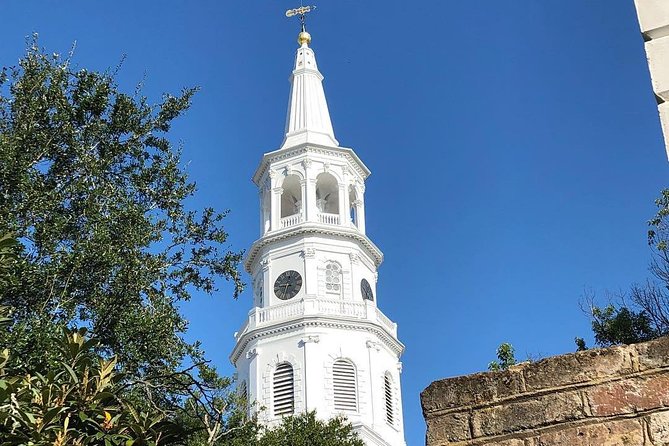
St. Michael’s Church dates to around 1761 and is described as the oldest house of worship in the city. The guide discusses Charleston’s religious past and present, while the building offers original woodwork and Tiffany stained-glass windows.
Entry depends on availability, so the full interior is not guaranteed. If you can go inside, the woodwork and glass add a visual reward that you cannot get from the street. The churchyard also contains the graves of John Rutledge and Charles Cotesworth Pinckney, both signers of the United States Constitution.
The stop is planned for about 15 minutes, making it one of the longer visits. It is especially useful after the French Huguenot Church because you can compare different religious traditions and see how worship spaces also became places tied to public life and national politics.
Nathaniel Russell House and the garden view
At the Nathaniel Russell House, the group enters the garden of a Federal-style townhouse built in 1808. Nathaniel Russell came from Rhode Island and was a wealthy merchant involved in shipping.
The garden visit is included in the route, but admission to the house is not included. That distinction is worth noting if you are hoping to see the interior rooms. The tour gives you the setting and the story of the owner, while a separate paid visit may be needed for a full house tour.
This stop helps explain the people who benefited from Charleston’s commercial world. After discussing the slave trade and maritime business, you see how wealth took physical form in private homes and gardens. It is a quieter pause in the route and a useful contrast with the larger civic and religious buildings.
The High Battery and the view toward Fort Sumter
The final major stop takes you along the High Battery wall, where you look toward waterfront mansions and discuss the beginning of the Civil War. Fort Sumter is visible from here.
The Edmondston-Alston House has remained in the same family since 1838. It was also a place where General Beauregard watched the bombardment of Fort Sumter with other onlookers. That detail turns the waterfront from a scenic endpoint into a place tied directly to the opening of the war.
The house is not included as an interior visit, and admission is not included. You are there for the exterior setting, the view, and the guide’s explanation. This is a fitting finish because the route has moved from the Revolution and Constitution through commerce, slavery, religion, and civic life to the crisis that began the Civil War.
How much walking and time should you expect?
The official duration is about two hours, with a maximum group size of 20. In practice, the walk can last longer. Some departures ran beyond two hours, and a few reached roughly three hours when the guide answered questions or spent more time with a small group.
That flexibility is a strength if you like history and conversation. It can be a drawback if you have a fixed lunch reservation or another timed activity immediately afterward. I would leave extra room in your schedule rather than planning the next appointment for exactly two hours after the start.
Most of the route is outdoors and includes ordinary city walking. The tour is described as suitable for most people, and service animals are allowed. It is near public transportation, but you should still arrive at the East Bay meeting point ready to walk and stand.
The experience is offered in English and uses a mobile ticket. Since it requires good weather, rain or other poor conditions can lead to a different date or a full refund. Wear shoes you can comfortably use for a long city walk, and remember that Charleston’s weather can change the feel of an outdoor tour quickly.
What the strong feedback tells you about the guides
The clearest strength is the teaching. Brian is repeatedly praised for his enthusiasm, humor, and ability to connect local events with the history of the wider United States. Fin receives similar praise for his storytelling, clear answers, and teaching background.
Several departures became almost private experiences when only a few people attended. You cannot count on that, since the group can reach 20, but the cap is still modest compared with large city tours.
The guides also appear willing to tailor the walk. Brian has adjusted attention to match what the group wanted to see, while Fin has worked around changing weather and welcomed questions. That is useful for returning visitors as well as first-time visitors. You can ask for more architecture, politics, religion, or social history rather than simply accepting a fixed lecture.
One point to keep in mind is that the tour’s quality depends heavily on who leads your departure. Brian and Fin are the named guides in the feedback, and both receive strong praise. The experience is at its best when you engage with the guide, ask questions, and allow enough time for the conversation to develop.
Is the tour worth booking?
I would book this walk if you want a strong first look at Charleston and prefer a guide who teaches rather than simply points out façades. The route covers major landmarks, includes slavery and the Civil War in the conversation, and gives you enough context to make later visits to museums and historic houses more meaningful.
It is a particularly good choice for first-time visitors, families with older children, history-minded couples, and returning visitors who want more context than a quick sightseeing loop. The tour also suits anyone who likes questions and discussion.
I would choose another plan if you mainly want extended interior visits. The Old Exchange, Nathaniel Russell House, and other sites may require separate admission, while entry to Dock Street Theater and St. Michael’s depends on availability.
Book with a little time around it, especially if you hope for a longer conversation. For the best value, take the walk early in your Charleston stay, then return to the sites that caught your attention. With its strong guides, compact route, and serious treatment of the city’s past, this is a practical way to get your bearings and understand what you are seeing.
FAQ
How long does Charleston’s Best Highlights tour last?
The advertised duration is approximately two hours. The walk may last longer, sometimes reaching three hours, depending on questions, weather, and the pace of the group.
Where does the tour begin?
The tour begins at 122 E Bay St, Charleston, South Carolina 29401.
Where does the tour end?
The activity ends back at the original meeting point.
Is the tour offered in English?
Yes. The experience is offered in English.
How large can the group be?
The maximum group size is 20 people.
Are admission tickets included?
No. Admission is not included for the Old Exchange and Provost Dungeon, Nathaniel Russell House, or Edmondston-Alston House. Entry to some other buildings depends on availability.
Do you enter the Old Slave Mart Museum?
No. The guide discusses Charleston’s role in the slave trade outside the building. The city operates the museum, and tours are available on site.
Can you enter Dock Street Theater?
Possibly. Entry depends on availability, so an interior visit is not guaranteed.
Can you enter St. Michael’s Church?
Possibly. Entrance depends on availability. The tour discusses Charleston’s religious history and the church from the outside if entry is not possible.
What happens if the weather is poor?
The experience requires good weather. If it is canceled because of poor weather, you will be offered a different date or a full refund. You can cancel for a full refund up to 24 hours before the start time, but cancellations within 24 hours are not refunded.
Just added around Charleston
- Charleston’s Historic Pubs, Taverns, and Taprooms Tour★ 4.5 · 33 reviews
- Charleston’s Strong Women of the South History Tour★ 4.5 · 27 reviews
- Small-Group Tour: Charleston Old Walled City Historical Walking Tour★ 4.5 · 283 reviews
- Private Sunset Sail BYOB Dolphin/History Tours on 43ft Mystique★ 5.0 · 42 reviews
- Sip History In a Secret Speakeasy Cocktail Class★ 5.0 · 40 reviews
- Sip History in The Sun Cabana Covered Cocktail Class★ 5.0 · 332 reviews
- Charleston History and Hops Tour: Bar and History Walk★ 5.0 · 316 reviews
- Private Walking Tour of Historic Charleston★ 5.0 · 38 reviews
Charleston History Tours, compared.
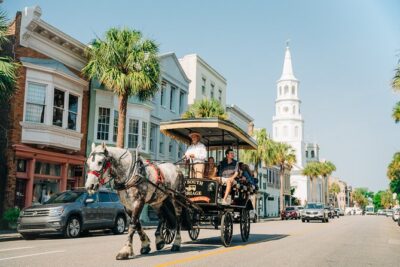
Charleston’s Old South Carriage Historic Horse & Carriage Tour
Read our review →
Historic Charleston Guided Sightseeing Walking Tour
Read our review →
Charleston Harbor History Day-Time or Sunset Boat Cruise
Read our review →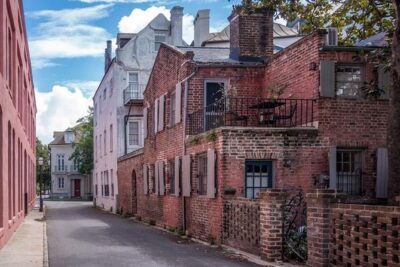
Hidden Alleyways and Historic Sites Small-Group Walking Tour
Read our review →
Charleston: Daytime or Sunset Historic Harbor Cruise
Read our review →
Charleston historical walking tour with a Professor of History at The Citadel
Read our review →
Charleston: Historical Downtown Tour by Horse-drawn Carriage
Read our review →
Undiscovered Charleston: Half Day Food, Wine & History Tour with Cooking Class
Read our review →Browse the lists this tour appears in