
Review · ATHENS
Full Day Biblical Ancient Corinth Canal Mycenae Epidauvro Nafplio
The Corinth Canal is a sharp opening act: a narrow cut through the isthmus that saves ships from sailing 185 extra nautical miles around the Peloponnese. From there, this long day moves through the world of Saint Paul, Bronze Age Mycenae, and handsome Nafplio.
I like the comfort of door-to-door transport and the chance to shape the day with your own driver. I also like the human touch reported by guests who traveled with Chris, Michael, Ioannis, Costas, Yiannes, and Dimitrios, all praised for careful driving, clear explanations, patience, and useful choices along the way.
The main drawback is the pace. You are covering a large piece of Greece in about nine to ten hours, and entrance fees, lunch, and a licensed guide inside the archaeological sites cost extra. Also, the title mentions Epidaurus, but the supplied route does not include a stop there, so confirm the plan before booking.
Key points to know before booking
- A private Athens pickup lets you start at your hotel, apartment, port, or another agreed point, then return to the same place or a preferred drop-off.
- The Corinth and Mycenae stops are history-heavy, with Paul’s Bema, the Temple of Apollo, the Lion Gate, and the Treasury of Atreus.
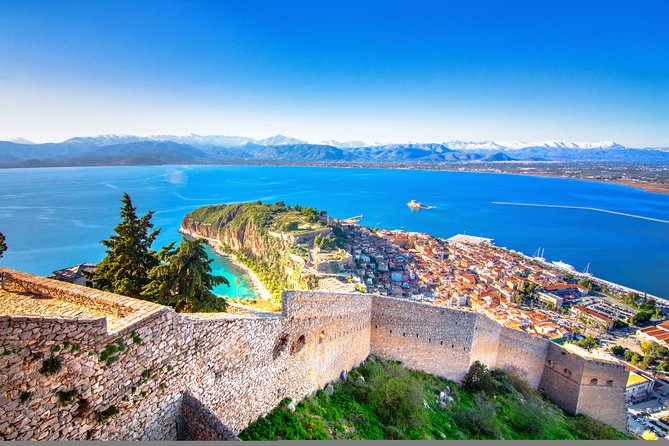
- Nafplio gives the day a welcome change of pace, with lunch time, old streets, Syntagma Square, fortress views, and the waterfront setting.
- Palamidi is not a casual photo stop if you climb from town. The route is commonly called the 999 steps, while the fortress itself involves more stairs.
- Your driver is not a licensed archaeological-site guide, so you receive historical help on the road and at stops, but formal guiding inside the ruins is not included.
- The $277.09 price buys privacy and convenience, but admission tickets, food, tips, and any airport pickup are additional.
What the full day really covers
This is a private road trip from Athens into the northeastern Peloponnese. Groups of one to three use a luxury sedan, while groups of four to seven travel in a minivan. Vehicles include air conditioning, Wi-Fi, and bottled water, which matters on a hot day when the route includes open ruins and exposed stone steps.
The driver collects you at your Athens hotel, Airbnb, or port. Airport pickup is possible for an added cost. The schedule can be adjusted, and the driver can return you to your original pickup point or another agreed location.
The advertised duration is nine to ten hours. That is enough for a broad introduction, but not enough for slow museum visits, long meals, and every fortress corner. I would think of this as a high-output day, not a relaxed countryside outing.
More Ancient History Tours in Athens
- Athens: Acropolis & up to 5 Archaeological Sites Combo Pass
★ 4.2 · 13,904 reviews - Athens: Ancient Greek Theater Performance
★ 4.7 · 2,481 reviews - Historical Delphi One Day Tour with Arachova Stop & Expert Guide
★ 4.5 · 1,247 reviews
The Corinth Canal: a quick stop with a big idea
The canal stop lasts about 15 minutes, and admission is free. You look down into the long, narrow waterway that cuts across the Corinth isthmus and separates mainland Greece from the Peloponnese.
The canal was completed in the late 19th century, but the idea reaches back to the ancient world. Periander, ruler of Corinth in the 6th century BC, is credited with considering a canal. With ancient engineering unable to manage the project, ships were moved overland on the diolkos, a stone track built for wheeled platforms.
You will not have time for a full canal visit, but the stop gives the rest of the day a useful geographical frame. You can see why Corinth mattered: it controlled a narrow crossing between two seas and sat at a key point for trade and movement.
Cenchreae and the Saint Paul connection
The route includes about 15 minutes in the Corinthia area around Kechries, ancient Cenchreae. This was an important port near Corinth and is named in the New Testament.
Acts describes Paul stopping at Cenchreae during his second missionary journey. He had his hair cut there as part of a vow, then sailed for Syria. Paul also refers to Phoebe, associated with the local Christian assembly, in his letter to the Romans.
This is a short visit rather than a full archaeological tour. Its value comes from the connection between geography and text: you are not hearing about Paul in an abstract classroom setting. You are seeing the port area tied to one of his journeys.
Ancient Corinth, where the Roman world meets Saint Paul
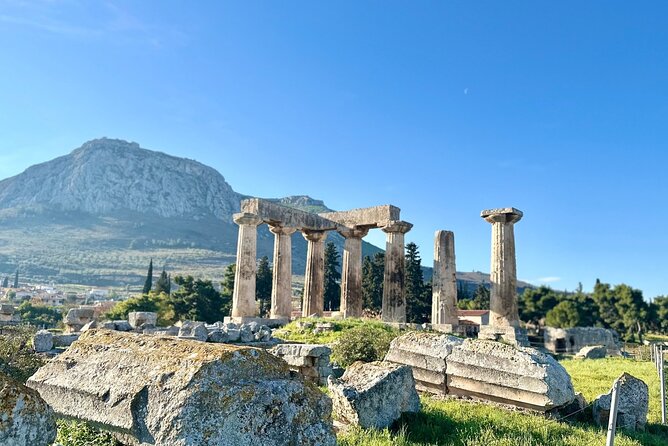
Ancient Corinth receives about 45 minutes, with another 30 minutes set aside for the archaeological museum. Site admission is not included.
The ancient city was a major center with a forum, roads, fountains, shops, religious buildings, and public monuments. The Bema, a raised platform in the Roman Forum, is traditionally linked with the hearing in which Paul was brought before the Roman proconsul Gallio. Gallio treated the matter as a dispute within Judaism rather than a criminal case.
That makes the Bema especially meaningful for visitors interested in early Christianity. It was later turned into a Christian church during the Byzantine period, likely because of its association with Paul.
The museum helps put names and objects to the stones outside. The site includes the Lechaion Road, the Basilica, the Fountain of Peirene, the Agora, the Odeon, and the Hadgimoustafa spring. Your driver can provide context on the road, but remember that a licensed guide entering the sites with you is not included.
The Temple of Apollo gets a short visit of about ten minutes. Its monolithic Doric columns date to around 550 BC, making it one of the earliest Doric temples in the Peloponnese and on the Greek mainland. Only a small number of columns remain, but their size and age give the stop real weight.
You also have a brief look at the Agora, a large rectangular public area measuring about 160 by 70 meters. Shops, smaller temples, an altar, and the Bema once filled this civic center.
Acrocorinth is seen for about 15 minutes. The fortress rises on a huge rock above the ancient city and guarded the route into the Peloponnese. Its water supply helped it serve as a defensive refuge over many centuries.
The short stop will not allow a full climb or detailed exploration. Still, even from below, the rock explains the military importance of Corinth better than a paragraph in a guidebook can.
More Ancient History Tours in Greece
- From Athens: Ancient Corinth Day Trip with Canal & VR Guide
★ 4.6 · 1,073 reviews - Acropolis, Parthenon & Athens Old City Heritage Walking Tour
★ 4.5 · 876 reviews - Private Biblical Tour Ancient Corinth & Isthmus Canal from Athens
★ 5.0 · 762 reviews - Athens: Ancient Corinth & Nafplio Full Day Trip with Swim
★ 4.8 · 531 reviews
Mycenae and the world behind Greek legend
Mycenae is the day’s strongest archaeological stop for many people. The fortified citadel was the center of a civilization that dominated much of southern Greece from roughly 1600 to 1100 BC. At its height around 1350 BC, the citadel and lower town covered about 32 hectares and may have held 30,000 people.
You have about an hour at Mycenae, with another 15 minutes at the archaeological museum. Admission is not included. The site is exposed, uneven, and made for walking, so sturdy shoes and water are sensible.
The Cyclopean walls are the first great visual surprise. Huge stones form the fortifications, and later Greeks believed that only the Cyclopes, the giant builders of myth, could have moved them. The walls also remind you that Mycenae was not only a legendary home of King Agamemnon. It was a powerful military center with control over trade and territory.
The Lion Gate and Treasury of Atreus
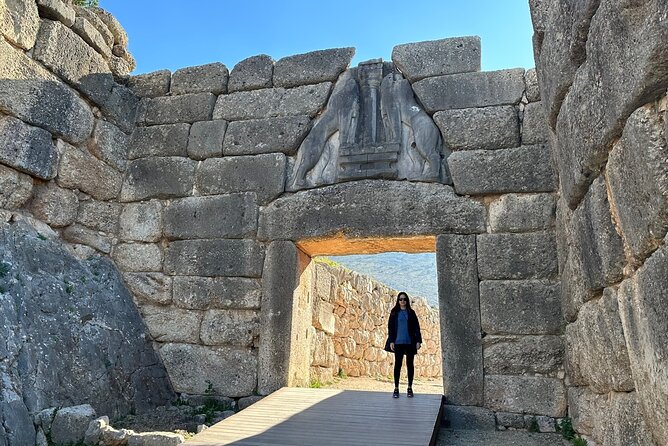
The Lion Gate was the main entrance to the citadel, built around 1250 BC. Two lions or lionesses face each other above the doorway in a relief set within the triangular space above the lintel.
This is the only surviving monumental piece of Mycenaean sculpture and one of the most important prehistoric monuments in the Aegean. The gate is not large by modern standards, but its age, position, and carved emblem make it a memorable stop.
The Treasury of Atreus, also called the Tomb of Agamemnon, is a tholos tomb on Panagitsa Hill. It was built around 1250 BC, with a beehive-shaped interior made from carefully stacked stone. The lintel above the entrance weighs about 120 tons, an astonishing piece of Bronze Age construction.
The tomb was visible in antiquity and was described by the Roman writer Pausanias. It was later connected to the discoveries of Heinrich Schliemann, who excavated the shaft graves at Mycenae in 1879. Your time here is listed as about 15 minutes, so expect a focused visit rather than a long archaeological study.
Nafplio brings a softer finish to the day
After Corinth and Mycenae, Nafplio feels easier on the senses. You have about two hours in the town, including time for lunch at a traditional seaside tavern. The meal is not included, so ask your driver about the timing and menu before you sit down.
Nafplio served as the capital of Greece until 1834. Its old town combines Venetian, neoclassical, and eastern architectural details, with paved lanes, flowered balconies, stone stairways, and Syntagma Square at the center.
This is where the private format has real value. You can spend more time over lunch, take a short walk, or focus on the parts of town that interest you most. The day has already included several ruins, so a slower hour in Nafplio helps keep the schedule from feeling like one long march through stones.
Palamidi Castle and the famous stair climb
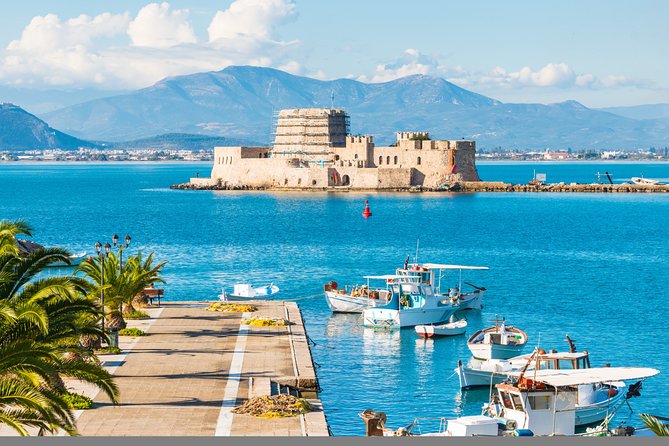
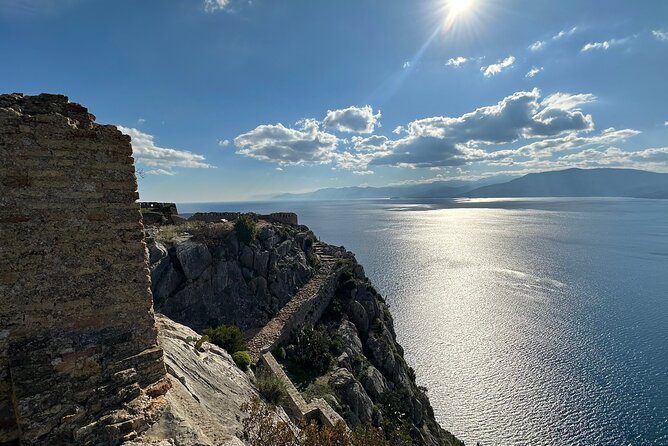
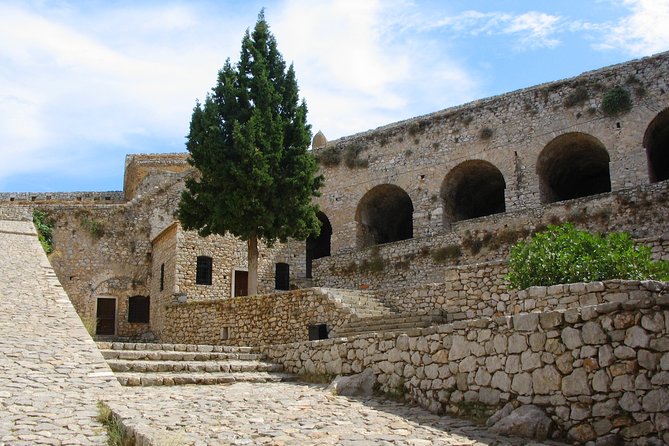
Palamidi Castle sits on a 216-meter hill above Nafplio. The Venetians built it during their second period of control, from 1686 to 1715. From the fortress, you can look across the Argolic Gulf and back over the town.
The route from the town is commonly called the 999 steps. The winding stairway is often described as 913 steps, while reaching the top of the fortress involves more than 1,000. The differing counts are worth knowing because the phrase can make the climb sound simpler than it is.
The itinerary allows about 30 minutes here. That is enough for a strong view and a taste of the fortress, but not a leisurely inspection of every wall and passage. Palamidi also includes the prison associated with Kolokotronis, one of the more sobering corners of the site.
If you do not want a hard stair climb, clarify how the vehicle reaches the fortress and how much walking remains. The information supplied promises the Palamidi visit, but it does not spell out the exact access arrangement.
Bourtzi, Syntagma Square, and Akronafplia
Bourtzi is the tiny fortress on the islet of Agioi Theodoroi. Built by the Venetians in 1473 and later named by the Ottomans, it served at different times as a prison and a hotel. The boat ride to the islet takes less than ten minutes, but admission and boat arrangements are not included in the tour price.
The schedule gives Bourtzi an hour, yet the overall day is already tightly packed. Ask your driver how this stop fits with the rest of the route, especially if you want time for lunch and Palamidi.
Syntagma Square provides a compact lesson in modern Greek history. The old Parliament building from the period of Ioannis Kapodistrias now houses the Municipal Gallery on the ground floor. The square also reflects Nafplio’s Ottoman and Venetian past.
Akronafplia is the oldest part of the city. It was once a separate settlement, then became part of the wider fortification system under Frankish and Venetian rule. Parts of it later served as a prison, and a hotel complex was built there after the Greek government recognized the value of its views.
The Lion of the Bavarians is a later monument carved into rock above Michael Iatrou Street. It remembers Bavarian soldiers who died in Nafplio in 1833 during a typhoid epidemic. The sleeping lion is set above a small park and gives the town visit one more link to the early years of the modern Greek state.
What the driver adds, and what the driver does not
The strongest service feature is the driver. Chris was praised for adapting the route to what mattered most. Michael was described as patient and attentive. Ioannis, Costas, Yiannes, and Dimitrios were also singled out for careful driving, historical explanations, good timing, and useful restaurant or sightseeing choices.
That matters because a private day in the Peloponnese depends on small decisions. You may want more time at Mycenae and less time in town, or a longer lunch and a shorter museum visit. A driver who listens can make the same route feel much better planned.
But this is a driver-led tour, not a fully guided archaeological excursion. The package specifically excludes a licensed guide inside the sites. If you want detailed interpretation of every structure, arrange a guide separately or treat the driver’s commentary as an overview.
Is $277.09 a fair price?
At $277.09 per person, the value depends heavily on group size. For one or two people, the cost is high compared with a shared bus excursion, but you are paying for private pickup, a premium vehicle, flexible timing, Wi-Fi, water, and a full day of transport across several destinations.
For a group of three to seven, the price can make more sense, especially when divided among the group. You avoid coordinating buses, navigating unfamiliar roads, and managing the long return to Athens after a day of walking.
You still need to budget for all attraction admissions, lunch, tips, and any airport transfer. The lack of included tickets makes the final cost higher than the headline figure. Confirm which Nafplio activities are actually planned, especially Bourtzi, and ask about the missing Epidaurus reference before paying.
Who should book this tour?
I would choose this for a first visit to the northeastern Peloponnese when you want to see several major places in one day and prefer a private car to public transport. It suits couples, families, and small groups who value hotel pickup and the ability to adjust the schedule.
It is also a good fit if you care about Saint Paul, Bronze Age Greece, and the early modern Greek state, since the route links all three themes. The drivers named above appear to be a major part of the experience, so requesting a driver with strong historical interests may be worthwhile.
I would not choose it if you want a slow archaeological study. The schedule gives some stops only ten or fifteen minutes, and the day includes considerable driving. You should also skip it if your main goal is Epidaurus, since that site is not listed among the actual stops supplied here.
Free cancellation is available up to 24 hours before the start time. Changes or cancellations inside that window are not accepted for a refund, and poor weather may lead to a new date or full refund.
Final recommendation
Book this tour if you want maximum coverage with minimum transport hassle. Corinth, Mycenae, and Nafplio make a strong trio, and a good driver can turn a crowded schedule into a useful, personal day.
Before booking, confirm three things: the exact route, whether Epidaurus is included, and how much time will be reserved for Palamidi, Bourtzi, lunch, and the museums. If the answers suit you, the private-car format offers a practical way to see a large slice of the Peloponnese from Athens.
FAQ
How long does the tour last?
The tour lasts approximately nine to ten hours.
Where can pickup and drop-off take place?
Pickup is offered from an Athens hotel, Airbnb residence, port, or another agreed point. Airport pickup is available for an additional cost. Drop-off can be at the original meeting point or another preferred location.
Is this a private tour?
Yes. The activity is described as private, with only your group participating. Groups of one to three use a luxury sedan, while groups of four to seven use a minivan.
Is transportation included?
Yes. Transportation is provided in a modern private vehicle with air conditioning, Wi-Fi, and bottled water.
Are entrance fees included?
No. Entrance fees for the attractions are not included in the tour price.
Is lunch included?
No. A lunch stop in Nafplio is scheduled, but the cost of the meal is not included.
Is a licensed guide included at the archaeological sites?
No. An English-speaking tour driver provides historical information, but a licensed guide accompanying you into the archaeological sites is not included.
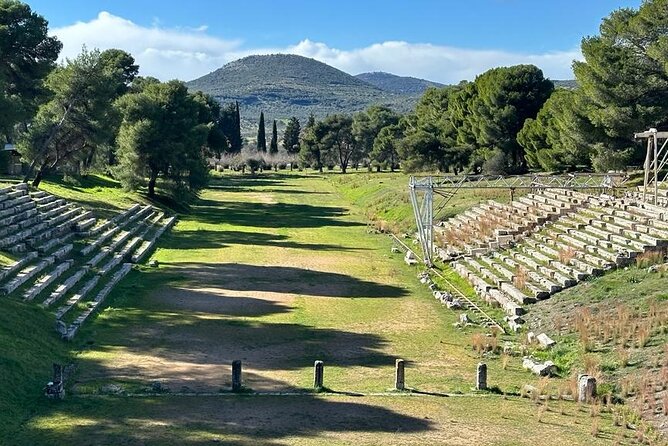
Does the tour include Epidaurus?
The supplied route does not list an Epidaurus stop. Because the title refers to Epidauvro, you should confirm the exact itinerary before booking.
What is the cancellation policy?
You can cancel up to 24 hours before the experience for a full refund. Cancellations or changes made less than 24 hours before the start time are not accepted for a refund. If poor weather causes the tour to be canceled, you are offered another date or a full refund.
More Full-Day Trips in Athens
- Ancient Corinth, Epidaurus, Nafplio full day private tour from Athens
★ 5.0 · 206 reviews - Ancient Corinth, Mycenae, Epidaurus, Nafplio full day private tour from Athens
★ 5.0 · 130 reviews - Ancient Olympia full day private tour from Athens
★ 5.0 · 83 reviews - Athens Highlights & Ancient Corinth Full Day Private Tour
★ 5.0 · 54 reviews
Just added around Athens
- Small-Group Women History in Ancient Greece Walking Tour★ 5.0 · 38 reviews
- The original Christian tour on Paul’s footsteps in Athens and ancient Corinth★ 4.5 · 25 reviews
- Ancient Athens tour: Acropolis, Parthenon and Acropolis Museum★ 5.0 · 256 reviews
- Ancient Athens Segway Tour with Agora and Kerameikos★ 5.0 · 94 reviews
- Ancient Sparta & Mystras Private Day Tour from Athens★ 5.0 · 52 reviews
- Athens National Archaeological Museum E-Ticket with Audio Guide★ 3.0 · 57 reviews
- Biblical Corinth Taste Faith & History with wine & Oil Tasting★ 5.0 · 28 reviews
- Ancient Corinth, Sanctuary of Hera, Blue Lake & Canal from Athens★ 5.0 · 26 reviews
Athens History Tours, compared.
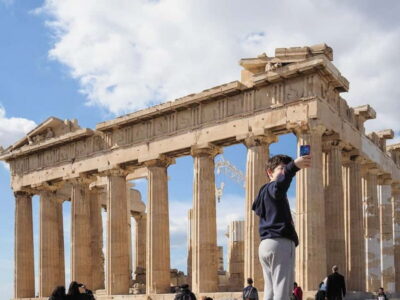
Athens: Acropolis & up to 5 Archaeological Sites Combo Pass
Read our review →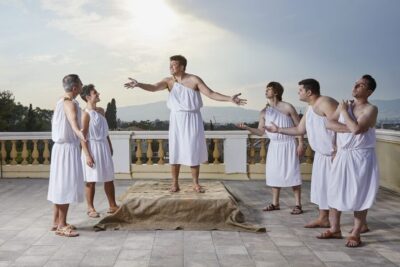
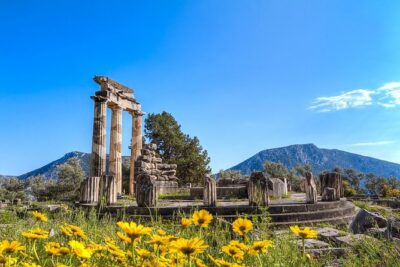
Historical Delphi One Day Tour with Arachova Stop & Expert Guide
Read our review →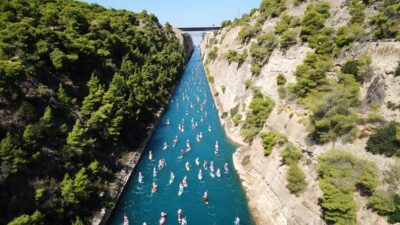
From Athens: Ancient Corinth Day Trip with Canal & VR Guide
Read our review →
Historic Athens: Small Group Electric Bike Tour
Read our review →
Acropolis, Parthenon & Athens Old City Heritage Walking Tour
Read our review →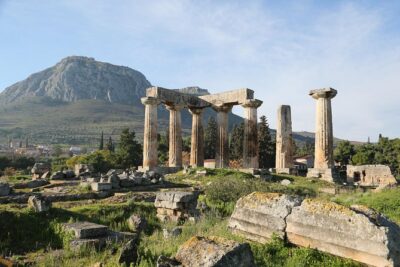
Private Biblical Tour Ancient Corinth & Isthmus Canal from Athens
Read our review →
Athens: National Archaeological Museum Ticket w/ Opt. Audio
Read our review →Browse the lists this tour appears in