Review · ST AUGUSTINE
Guided Historical Tour of St. Augustine Per Person
St. Augustine packs more than four centuries of American history into a compact downtown, and this one-hour electric vehicle tour gives you a quick way to see how the pieces fit. You pass the Castillo de San Marcos, Flagler College, the Cathedral Basilica, Tolomato Cemetery, and other landmarks while your driver explains what happened there.
I like the small group size, which makes it easier to hear the guide and ask questions. I also like that this works as an opening move in town: you get your bearings, learn which places deserve a longer visit, and avoid spending your first afternoon wandering in circles. The main drawback is that one hour goes by fast, so you see many sites from the vehicle rather than touring each one inside. Open-air seating can also feel cool or breezy on a winter day.
Key details before you book
- Small groups of up to nine: The compact vehicle keeps the ride personal and gives you a fair chance to speak with the guide.
- A broad downtown route: The tour passes the Castillo de San Marcos, Mission Nombre de Dios, Flagler College, the Cathedral Basilica, Tolomato Cemetery, and more.
- Guides who make the difference: Karen, Marc, Mark, and Deanna are praised for clear storytelling, humor, patience, and local suggestions.
- A useful first activity: Take the ride early in your visit, then return to the places that catch your interest.
- One hour, about $30.60 per person: The price is reasonable if you value orientation and historical context, but it is not a substitute for paid admissions and longer walking tours.
- Parking is your responsibility: The tour does not provide parking, and you should allow extra time to reach 1 Cordova Street.
Why this short ride works in St. Augustine

St. Augustine is easy to underestimate. The old center looks compact on a map, but its stories stretch from Spanish settlement and Catholic missions to British rule, American military use, railroad wealth, and Florida’s later growth.
Walking is still the best way to linger on narrow streets and enter historic buildings. Yet a vehicle gives you something walking does not: a quick view of the wider pattern. You can move from the northern edge near Mission Nombre de Dios to the plaza, the cathedral, the old cemetery, and the riverfront without using your legs for every mile.
The driver is also your guide. That matters because the ride is not simply a loop with recorded narration. You can ask about a building, a person, or a confusing date as it comes up. The strongest comments about the experience focus on guides who stop near the sights, speak clearly, and turn facts into a story.
Karen receives especially warm praise for her research, humor, patience, and ability to connect the past to places you can revisit later. Marc and Mark are also singled out for humor, passion, and strong command of the city’s story. Deanna is noted for mixing documented history with local hearsay in a light, entertaining way. Your guide will depend on the day, but the experience clearly benefits from a guide who treats the route as a conversation rather than a speech.
More Guided Tours in the USA:
- History and Hauntings of Salem Guided Walking Tour
★ 5.0 · 14,564 reviews - Historic Charleston Guided Sightseeing Walking Tour
★ 5.0 · 6,216 reviews - Historic Savannah Guided Walking Tour
★ 5.0 · 2,918 reviews
Starting at Mission Nombre de Dios

The tour covers the Mission Nombre de Dios area, one of the key places for understanding St. Augustine’s founding. Pedro Menéndez de Avilés landed here on September 8, 1565, claimed the site for Spain and the Church, and named it Nombre de Dios, meaning Name of God.
The Shrine of Our Lady of La Leche traces its origin to that founding. Father Lopez was placed in charge of the mission and became the city’s first parish priest. These details give the tour an early anchor: St. Augustine was not simply a military outpost. Religious life and colonial power arrived together.
You should think of this stop as an introduction rather than a full site visit. The ride points out the area and explains its importance, but the one-hour format does not allow time to explore every part at length. If the mission interests you, mark it for a separate visit after the ride.
The route also connects the founding story with the Timucua village of Seloy, located at what is now Fountain of Youth Archaeological Park. That connection helps you see that Spanish settlement did not begin on an empty shore. It unfolded at a place already used by Indigenous people.
The Castillo de San Marcos and the city’s defenses
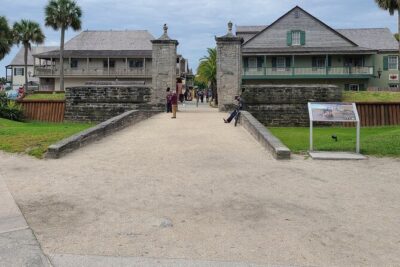
The Castillo de San Marcos is the tour’s most imposing landmark. Built by the Spanish to defend Florida and the Atlantic trade route, it is the oldest masonry fortification in the continental United States.
From the vehicle, you get the fort’s setting and its place in the city. The guide explains more than the stone walls themselves, including the cultural encounters tied to more than 450 years of changing control and contact. That context is useful because the fort can otherwise seem like a single dramatic building detached from the rest of town.
You will not have time during this ride to walk through the fort, climb its walls, or study its exhibits. I see that as a fair trade for a one-hour overview, as long as you understand what you are booking. Use the ride to decide if you want to return for a longer visit.
The Castillo also helps explain why St. Augustine grew where it did. The city’s story is tied to defense, shipping, rival empires, and control of the Florida coast. Once the guide places the fort in that setting, other stops make better sense.
Flagler College and the city’s grander side
The Ponce de Leon Hotel, now Flagler College, brings a later chapter into view. Henry Flagler built the hotel during the period when St. Augustine was being reshaped as a fashionable winter destination.
The building is a sharp contrast to the earlier Spanish structures. Instead of thick defensive walls and colonial streets, you see the scale and decoration associated with Florida’s late nineteenth-century tourism boom. The tour helps connect the old city to the people who recast it for wealthy visitors.
You pass Flagler’s Memorial Presbyterian Church as well. It was dedicated on March 16, 1890, after the congregation moved from its earlier church on St. George Street. Flagler built it for his daughter Jennie Louise Flagler, who died in 1889, and hired Carrere and Hastings, the same architects associated with the Ponce de Leon Hotel.
The church’s design draws on St. Mark’s Basilica in Venice. That is a useful detail to keep in mind as you look at the building. It shows how St. Augustine’s later image often borrowed from European models while creating something distinctly Floridian.
Again, the vehicle provides an exterior introduction. If architecture is your main interest, you will want to return on foot or arrange a separate interior visit. For a first pass, though, the contrast between the Spanish colonial core and Flagler’s grand buildings is one of the route’s strongest lessons.
More History Tours in the USA:
- Charleston’s Old South Carriage Historic Horse & Carriage Tour
★ 5.0 · 10,023 reviews - Beneath The Streets Underground History Tour
★ 4.5 · 8,006 reviews - Big Island in a Day: Volcanoes Waterfalls Sightseeing and History
★ 5.0 · 6,569 reviews - Boston: Freedom Trail History Small Group Walking Tour
★ 5.0 · 6,450 reviews
The Cathedral Basilica and the Catholic story
The Cathedral Basilica of St. Augustine is identified as the oldest Catholic church in the city and the oldest parish in the country. That makes it one of the most important stops for understanding continuity in St. Augustine.
The cathedral is not just another photogenic building in the historic center. It ties the city’s present-day religious life to the Spanish settlement that began in 1565. When the guide places it beside Mission Nombre de Dios, you can follow the thread from the first parish priest to an active downtown church.
The ride also makes clear how close many major sites are to one another. The cathedral borders the Plaza de la Constitución, so several important stories meet within a short distance. You get a sense of the city’s scale and can easily return later to inspect the exterior or go inside if open.
Tolomato Cemetery and St. Francis Barracks
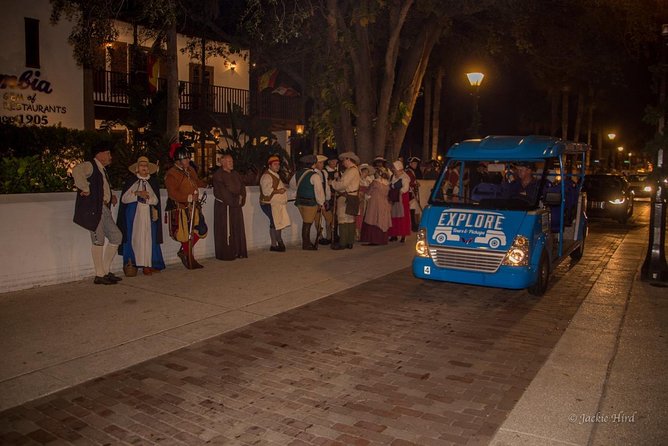
Tolomato Cemetery adds a quieter and more sobering note. The cemetery was in use from the eighteenth century until 1884, making it a record of the people and periods that shaped the city over generations.
A cemetery can be easy to pass without noticing when you are focused on grand buildings. The guide gives it a place in the story. You learn that St. Augustine’s past is not only forts, churches, and wealthy hotels. It is also found in burial grounds and the lives of ordinary people who lived through changing rulers and difficult periods.
The route also passes St. Francis Barracks on Marine Street. Franciscan friars built the coquina structure between 1724 and 1755. When Britain took possession of Florida in 1763, the barracks were converted for military use.
After the United States took control of Florida in 1821, the US Army used the barracks until deactivation in 1900. The property later went to Florida State Troops, an early form of today’s National Guard, in 1907. This single building traces the city’s shift from Spanish religious presence to British administration and American military control.
These stops reward careful listening. They are not as instantly dramatic as the Castillo, but they show how power changed hands and how old buildings were reused. If you prefer a tour built only around famous photo stops, the cemetery and barracks may feel slower. I think they make the hour more worthwhile.
The Gonzalez-Alvarez House and early homes
The Gonzalez-Alvarez House, also called the oldest house, is described as the oldest surviving Spanish colonial residence in Florida. It is owned and operated by the St. Augustine Historical Society.
The house offers a more domestic view of the city. Forts tell you about defense, churches tell you about faith, and large hotels tell you about money and tourism. A residence shows how people lived within that larger system.
The tour points it out as part of the downtown route, but you should not expect an extended house tour during this activity. Its value here is as a visual piece of the old city and as a reminder that St. Augustine’s story survives in ordinary buildings as well as major monuments.
The Plaza de la Constitución and the Bridge of Lions

The Plaza de la Constitución sits at the center of the historic city. It is bordered by the Cathedral Basilica, Trinity Episcopal Church, and Government House, and it faces the Bridge of Lions.
The plaza has been a public market since the 1500s, when people traded fish, vegetables, and other goods. Today, its central pavilion hosts city events, private events, and live entertainment. The guide can help you read the space as more than a pleasant square. It has been a civic and commercial center for centuries.
The Bridge of Lions gives the ride a look beyond the oldest streets. Completed in 1927 during Florida’s extravagant land boom, it was designed as a work of art as well as a road connection between downtown St. Augustine and Anastasia Island.
The bridge is a good example of how the city’s story keeps changing. Spanish colonial buildings, nineteenth-century tourism, and twentieth-century road design all sit within the same short route. That layered view is one of the best reasons to choose a vehicle tour instead of seeing only the fort and the main pedestrian street.
What the open-air vehicle feels like
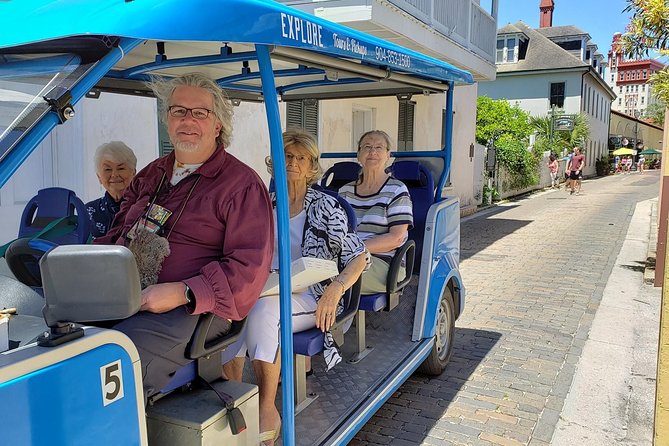
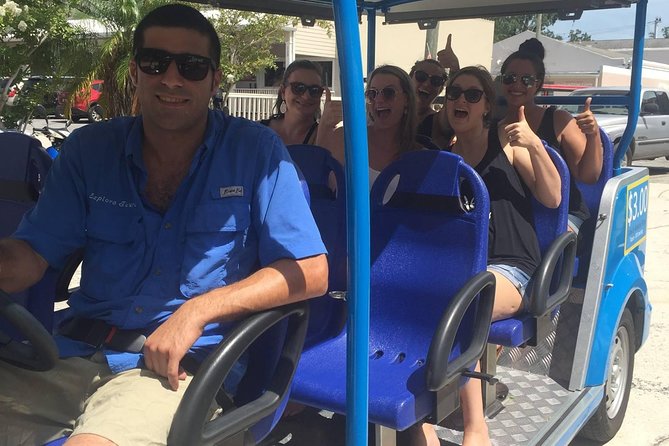
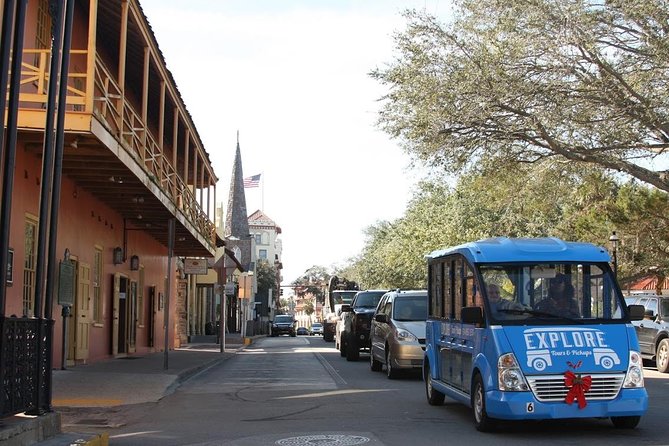
The vehicle is electric and open-air, with room for no more than nine people. A small group makes a real difference here. You can hear the guide without fighting a large crowd, and questions do not disappear into the back row.
The open sides also give you a clear view of the streets and buildings. On a pleasant day, that makes the ride comfortable and easy for taking in the city. On a cool or windy day, bring a light layer. One account mentions a cool breeze, while another notes that a blanket was offered on a chilly ride.
Rain is another practical factor. The vehicle can provide protection, and one ride continued comfortably during drizzle, but weather conditions still matter. The company says the experience requires good weather and may offer a new date or a full refund if poor conditions force cancellation.
The ride is suitable for most people, and service animals are allowed. It is near public transportation, but parking is not included. Since the starting point is 1 Cordova Street and downtown traffic can be slow, arrive early and leave extra time to find a space. One helpful tip is to give the company a phone number that will reach you on the day of the tour.
Is $30.60 a fair price?
At $30.60 per person, I see this as a reasonable orientation tour rather than a bargain sightseeing ticket. You are paying for a certified guide, a small vehicle, and a concentrated explanation of the city’s major periods.
The value is strongest if this is your first visit, you have only a short time, or walking long distances is not appealing. You also gain a practical plan for the rest of your day. Several guides offer restaurant suggestions, and the ride can point you toward sites you want to explore more closely.
The price is less compelling if you already know St. Augustine well or want long stops inside each attraction. Admissions to places such as the Castillo or historic houses are not part of the tour, so budget for separate visits if you want more than an exterior introduction.
I would book it near the start of your stay. The tour is often reserved around ten days ahead, so popular dates may fill. Free cancellation is available up to 24 hours before the start time. Inside that window, the payment is not refunded, and changes are not accepted.
Who should take this tour?
I recommend it for first-time visitors, families, couples, and small groups who want a clear introduction without committing half a day. It is also a smart choice if you want to save your energy for museums, meals, and walking after you understand the layout.
History fans will appreciate the range of subjects, from the Timucua village site and Spanish settlement to British rule, American military control, cemeteries, churches, architecture, and the Florida land boom. The hour is short, but the route gives you many threads to follow later.
You may want something else if you prefer a slow walking tour, extended time inside the fort, or a narrow focus on architecture. This is a moving overview. Its strength is connection and orientation, not detailed examination of a single building.
My recommendation
Book this tour if you want to get your bearings quickly and hear the city explained by a real person who welcomes questions. Karen, Marc, Mark, and Deanna are praised for making the ride personal, clear, and often funny, and the small group setting gives their storytelling room to work.
I would especially choose it early in a St. Augustine visit. Ride the route, note the places that catch your attention, then return to the Castillo, cathedral, mission, cemetery, or historic houses at your own pace. Just plan for parking, bring a layer in cool weather, and remember that one hour gives you an overview, not a full tour of every stop.
FAQ
How long does the historical tour last?
The tour lasts approximately one hour and ends back at the starting point.
Where does the tour start?
The meeting point is 1 Cordova Street, St. Augustine, Florida 32084.
Where does the tour end?
The activity returns to the meeting point at 1 Cordova Street.
How many people can join the vehicle?
The tour has a maximum of nine travelers.
Is parking included?
No. The tour provider does not offer parking, so you should arrive early to find a place nearby.
What language is the tour offered in?
The tour is offered in English.
What happens if the weather is poor?
The experience requires good weather. If it is canceled because of weather, you will be offered another date or a full refund.
Just added around the USA
- Red Rocks Amphitheatre Historical Walking Tour★ 5.0 · 74 reviews
- 1-Hour Segway Tour of Cheyenne Cañon Art, History and Nature★ 5.0 · 36 reviews
- Colorado Springs – Guided Walking Ghost / History Tour★ 5.0 · 168 reviews
- Ancient Landscapes Private Geology Hike at Garden of the Gods★ 5.0 · 31 reviews
- Village Food Tours Lunch & History Tour★ 5.0 · 80 reviews
- 2.5 Hour Kayaking with Manatee and History Tour in Tarpon Springs★ 5.0 · 24 reviews
- Safety Harbor Ghost Tour★ 5.0 · 60 reviews
- Historical Bicycle Tour of Dunedin★ 5.0 · 44 reviews
St Augustine History Tours, compared.

Medieval Torture Museum with Ghost Hunting and Tiny Art Gallery
Read our review →
Private Guided Historic Electric Cart Tour of St. Augustine
Read our review →