
Review · BELGIUM
Private Historical Tour: Legends of Antwerp
Antwerp’s legends are tied to its streets: a giant at Het Steen, a severed hand on the city symbol, and a Golden Age that made Antwerp one of Europe’s richest cities. This private walk turns those stories into a clear introduction, from the Grote Markt to the Cathedral of Our Lady.
I like the private format, since your guide can adjust the pace and answer your questions instead of following a fixed crowd. I also like the mix of famous sights and quieter corners, especially Vlaeykensgang, the tiny medieval lane. The drawback is time: two hours moves quickly, and most stops are outside views rather than full museum visits.
Key points to know before booking
- Antwerp’s legends come first: The tour begins with the hand symbol, the city’s giants, and the rise and fall of Antwerp’s Golden Age.
- A private guide sets the pace: The guide can adapt the walk to your group, as Beren did for one party, but the quality depends on the individual guide.
- The route covers the old center: You visit or pass the Grote Markt, Het Steen, Butcher’s Hall, Carolus Borromeus Church, Rubens-linked sights, Vlaeykensgang, the Cathedral, and Plantin-Moretus.
- Expect a walking tour, not a museum tour: Listed admissions are free because the focus is on exterior buildings, street stories, and brief stops.
- Cobblestones require sensible shoes: Joske’s tour was praised for its easy pace, but the old center can be hard work if you are not comfortable walking on uneven streets.
- The finish is central: The walk ends near Handschoenmarkt, about 50 meters from the Grote Markt and by the Cathedral.
Antwerp’s hand symbol and Golden Age set the tone
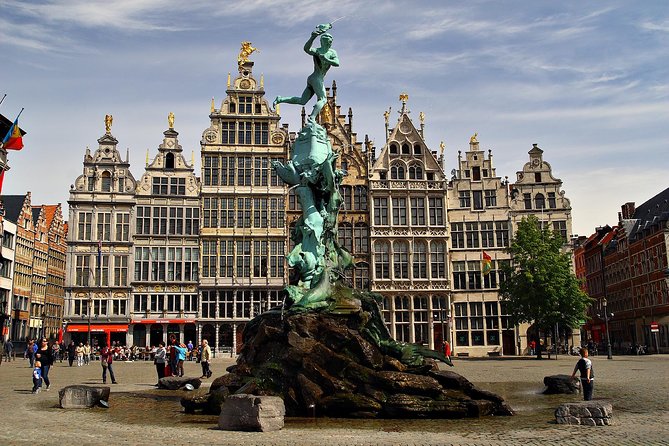
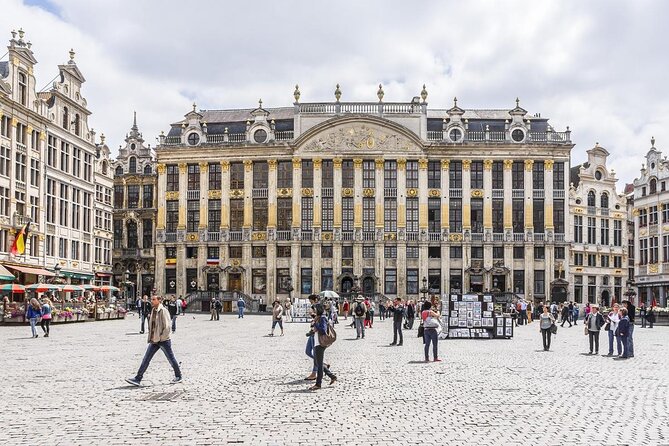
The tour starts at the Grote Markt, Antwerp’s grand central square. You get about 15 minutes here, enough time to look around while your guide explains how the city grew into a major commercial center in the 16th century.
This is the right place for the opening story. Antwerp’s coat of arms features hands, and the tour explains why that hand became the city’s symbol. You also hear why Antwerp is known as the city of giants. These are the sort of details that make later walks through the old center more meaningful, since you begin noticing the symbols instead of simply passing them by.
The guide also covers Antwerp’s rise and decline. That broad story gives you a useful frame for the rest of the walk. The city’s grand squares, churches, guild buildings, and merchant houses make more sense when you understand that Antwerp once held a major place in European trade.
I would arrive ready to listen rather than rush into photographs. The Grote Markt is one of the tour’s main storytelling stops, and the opening explanation helps connect the separate sights that follow.
More Private History Tours in Belgium
- Private Historical Tour: The Highlights of Bruges
★ 5.0 · 315 reviews - Private tour: Highlights & History of Antwerp
★ 5.0 · 299 reviews - Bruges: Private Historical Highlights Walking Tour
★ 4.7 · 191 reviews
Het Steen brings Antwerp’s oldest stonework and giant legends
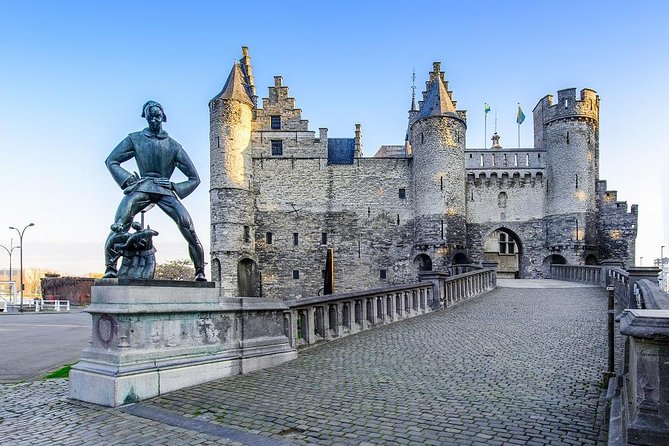
From the Grote Markt, the walk continues to Het Steen, known as the Stone Castle. The stop lasts about 10 minutes and introduces one of the city’s oldest buildings.
Your guide explains the many roles this old structure has played over time, along with the story of the famous giant associated with it. That combination of building history and local legend gives Het Steen more character than a quick photograph from the outside.
Do not expect a long visit inside. The emphasis is on the building’s place in Antwerp’s story and on the tales linked to it. If you enjoy old fortifications, unusual city myths, and explanations of how a structure changed purpose over time, this should be one of the more engaging early stops.
Butcher’s Hall reveals the working city
The five-minute stop at Museum Vleeshuis, or Butcher’s Hall, is brief but useful. It was the city’s oldest guild house, and its name points to its former trade.
This is where the tour shifts away from rulers and grand churches and toward the people and trades that helped run medieval Antwerp. Your guide explains the building’s long and sometimes bloody past, giving you a glimpse of the city as a working place, not only a collection of impressive façades.
Because the stop is short, you will not get a detailed museum visit. Think of it as a quick piece of context on guild life and urban work. The surrounding route benefits from these small explanations, since Antwerp’s historic center is easier to read when you know what its buildings were built to do.
Carolus Borromeus Church connects Antwerp to Rubens
The next stop is the Church of Carolus Borromeus, a striking Baroque building with a direct link to Peter Paul Rubens. The tour allows about 10 minutes here.
Your guide explains how the church was once a setting connected with Rubens, one of Antwerp’s most famous painters. This gives you an early Rubens reference before the route continues toward his former home and workplace.
The church stop is best for travelers who want art and architecture tied together rather than treated as separate subjects. You get a quick look at the building and the story behind it, but the schedule does not suggest a long interior examination. If church interiors are a major reason for booking, check what your guide plans to include on the day.
Same city, a different century:
- Ghent: 50-Minute Medieval Center Guided Boat Trip
★ 4.5 · 5,637 reviews - Historical Walking Tour: Legends of Bruges
★ 5.0 · 2,541 reviews - Historical Walking Tour: Legends of Antwerp
★ 5.0 · 1,837 reviews - Historical Walking Tour: Legends of Gent
★ 5.0 · 1,761 reviews
Meir, the Farmers Tower, and the Rubens connection
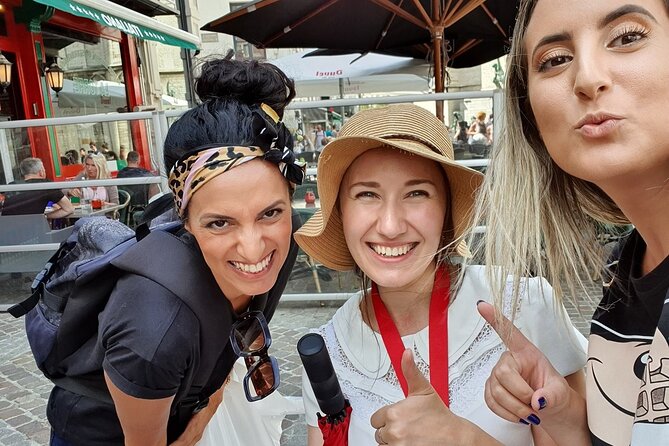
The route then passes the Farmers tower and Meir shopping street before taking you toward the Rubens museum, the former home and workplace of the painter. The information supplied for the tour does not assign a separate stop length to this section, so this part functions as a connecting walk with commentary.
Meir gives you a useful change of scene. It is Antwerp’s major shopping street, while the Rubens connection brings the route back to art and the city’s Golden Age. You can see how a modern commercial street fits into a walk that began with medieval legends and old guild buildings.
The Rubens museum itself is presented as the place where the painter lived and worked throughout his life. The tour is not described as including museum admission, so plan on an exterior explanation rather than a full museum visit. If you want to see the collection inside, you may need a separate visit and more time.
That limitation is worth noting. The tour gives you the story and location, which is valuable on a first visit, but it cannot replace an art museum visit in a two-hour walk.
Vlaeykensgang offers the most atmospheric detour
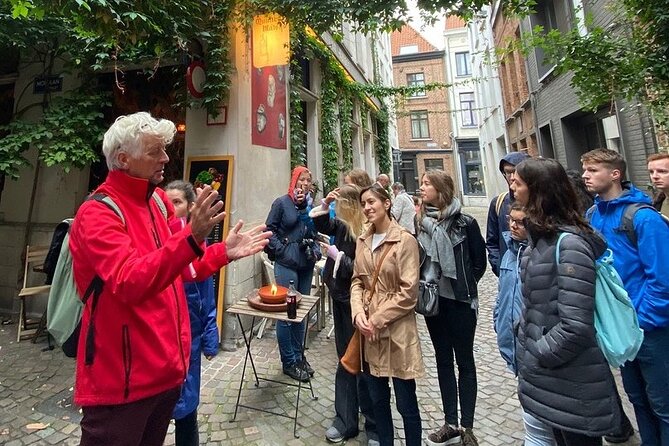
Vlaeykensgang is one of the strongest parts of the route. The guide takes you through what is described as Antwerp’s smallest street, a compact passage that offers a throwback to the Middle Ages.
This is the kind of place that is easy to miss if you follow only the city’s main streets. It is also where the private walking format earns its keep. A guide can point out why the lane matters and help you see it as more than a quick shortcut.
The stop lasts about 10 minutes. That is enough for a brief look and a story, but not enough for a slow photographic session if you want to linger. The surface may also be uneven, so wear shoes that handle cobblestones well.
I like this stop because it breaks up the larger monuments. Grote Markt, the cathedral, and the Baroque church give you scale; Vlaeykensgang gives you a sense of close, old urban space.
The Cathedral of Our Lady closes the main story
The tour ends by the Cathedral of Our Lady, with about 15 minutes devoted to its history and the legends connected with long-ago Antwerp. This is a fitting final major sight after the city’s symbols, castle, guild house, church, and Rubens references.
The cathedral is one of Antwerp’s defining landmarks, and the stop gives your guide room to pull the earlier stories together. You can expect historical explanation and local legends rather than a full cathedral tour. The meeting information places the end at Handschoenmarkt, right by the cathedral and about 50 meters from the Grote Markt.
That central finish is practical. You are left in the old center, close to the place where you began, with restaurants, shops, and further sightseeing nearby. It also makes the tour easy to combine with another activity afterward.
Plantin-Moretus adds printing and the fashion quarter

The route also includes a stop in front of the Plantin-Moretus museum after passing through the fashion quarter and fashion district. The stop is listed at about 10 minutes.
Plantin-Moretus is introduced as the place where industrial printing was born. That gives the tour another useful angle on Antwerp. The city’s story is not only about paintings, churches, trade, and medieval streets. It is also about the spread of printed information and the businesses that supported it.
The supplied route information places this stop after the Cathedral section, while the stated end point is by the cathedral. Since the exact walking order may vary, confirm the sequence with your guide if Plantin-Moretus is especially important to you. Either way, it is an exterior stop rather than a museum visit according to the included information.
What the private format changes
This is a private activity, so only your own group takes part. That matters more on a walking tour than it might on a bus excursion. You can ask why a symbol appears on a building, pause for a photograph, or request a slower pace without holding up a large group.
Beren adjusted the walk to the speed of one private party, and that is a useful sign of what the format can offer. Guides named in individual feedback include Beren, Luc D, Joske, Flip, and Pearson. Several were described as personable, enthusiastic, and good at making Antwerp’s past easy to follow.
The experience will still depend on who leads your tour. One account found the guide too forceful, said some facts seemed incorrect, and felt that too many questions interrupted the walk. It also pointed out that the guide did not cover Antwerp’s Jewish community. If that subject matters to you, ask about it before setting out rather than assuming it is part of the standard route.
Beren has also included background on the Red Star Line in at least one walk. That suggests some guides may add material beyond the listed stops, but you should not count on a particular extra subject unless it is arranged in advance.
Is $105.82 per person a fair price?
The listed cost is $105.82 per person for about two hours. That is not a low-cost city orientation, but it buys a private English-language guide rather than a place in a large group.
For two people, the price may feel high compared with a standard group walk. For a family or small party, the value improves, especially since the guide can adjust the pace and focus. Group discounts are available, though the exact saving is not given.
I would judge the price by how much you want personal attention. If you mainly need a quick list of Antwerp sights, you can see several of these places on your own. If you want the hand legend, giant stories, Golden Age background, Rubens connections, and medieval lanes explained in one compact walk, the private format offers a more useful introduction.
No separate attraction admissions are included in the stated inclusions. The listed stops show free admission, and the tour is built around outside commentary. Budget extra time and money if you want to enter museums or spend longer inside the cathedral.
Timing, walking effort, and practical details
The tour lasts about two hours and is offered in English. You can choose from departure times, and optional hotel pickup is included for convenience. The stated meeting point is Grote Markt in central Antwerp.
Most people can take part, and service animals are allowed. The route is near public transportation, which helps if you are arriving from another part of Antwerp. Since the walk includes old streets and cobblestones, comfortable shoes are the sensible choice.
The tour is recommended by 98 percent of participants and has a 4.9 rating from 125 reviews. Those numbers point to strong satisfaction, but they do not erase the need to match the experience to your interests. You should be happy with a brisk, story-led walk and short stops rather than a series of long indoor visits.
Free cancellation is available until 24 hours before the start time. After that point, the amount paid is not refunded, and late changes are not accepted.
Who should book Legends of Antwerp?
I would choose this tour for a first visit, a history-minded couple, a family that wants stories instead of a lecture, or a small group that values a flexible pace. It is especially useful if you want a quick map of the old center before exploring Antwerp on your own.
Art lovers will appreciate the Rubens links, but you should not book it as a substitute for visiting the Rubens museum. The same applies to Plantin-Moretus and the Cathedral of Our Lady. The tour gives you orientation and context; separate admission and extra time may be needed for the full interiors.
I would be more cautious if you dislike walking on cobblestones, want a tightly verified academic history, or need detailed coverage of Antwerp’s Jewish community. The guide you receive matters, and the tour’s style can be direct and question-heavy.
Should you book this private Antwerp walk?
Book it if you want local legends, major old-center sights, and a private pace packed into two hours. The strongest parts are the opening at Grote Markt, the giant story at Het Steen, the small medieval passage at Vlaeykensgang, and the final cathedral explanation.
Skip it if you want long museum visits or the cheapest way to see Antwerp. At $105.82 per person, the value depends on your group size and your interest in guided context. For a small group that wants a lively introduction before exploring alone, it is a practical choice.
FAQ
How long does the Private Historical Tour: Legends of Antwerp last?
The tour lasts approximately two hours.
Where does the tour begin?
The tour begins at Grote Markt, 2000 Antwerpen, Belgium.
Where does the tour end?
The stated end point is Handschoenmarkt, near the Cathedral of Our Lady. It is about 50 meters from the Grote Markt.
Is the tour private?
Yes. Only your group participates in the activity.
What language is the tour offered in?
The tour is offered in English.
What is included in the price?
A tour guide is included. The listed stops have free admission, and the experience focuses on the walking route and guided commentary.
Just added around Belgium
- Historic Battle of the Bulge Sites Tour from Brussels★ 5.0 · 31 reviews
- Historical Walking Tour: The Story of Brussels – by Legends★ 5.0 · 164 reviews
- Bruges Bites & Sights – Belgian Food, Beer & A Little Bit Of History★ 5.0 · 94 reviews
- Medieval Tour in Bruges with Chocolate Tasting★ 5.0 · 71 reviews
- 2-Hour Historical Walking Tour in Bruges with Praline Included★ 5.0 · 291 reviews
- Best of Bruges: History, Chocolate & Beer Tour★ 5.0 · 256 reviews
- Food tasting & Historical walk★ 4.5 · 47 reviews
- Bruges at Night: Murder, Mystery & Dark Stories Small Group Walk★ 5.0 · 137 reviews
Belgium History Tours, compared.
Ghent: 50-Minute Medieval Center Guided Boat Trip
Read our review →
Brussels: Historical Tour with Chocolate & Waffle Tasting
Read our review →
Brussels: Historical Walking Tour with Chocolate & Waffle Tasting
Read our review →
THE Storytelling Tour of Bruges | First Day Must | History & Tips
Read our review →
Ghent: 40 Minute Medieval Center Guided Boat Tour
Read our review →Browse the lists this tour appears in