
Review · AUSTRALIA
Ultimate Melbourne Walking Tour: History, Laneways & Culture
Melbourne reveals itself best at walking speed, especially in its narrow lanes, ornate arcades, and coffee-filled corners. This three-hour tour links the city’s major sights with places you could easily miss, from Duckboard Place and AC/DC Lane to Degraves Street and Chinatown.
I like the small group of up to 12 and the useful mix of history, street art, architecture, and local tips. I also like the two built-in breaks: a complimentary Melbourne coffee and a final beer, wine, cider, or soft drink at Captain Melville.
The main consideration is pace. You cover a lot of ground in three hours, and most of the stops are brief outdoor viewpoints rather than long visits inside attractions. If you want extended time at Old Melbourne Gaol, the State Library, or the MCG, you will need to return on your own.
Key points at a glance
- Street art with context: See Duckboard Place, AC/DC Lane, and possibly Hosier Lane while learning how Melbourne’s lane culture developed.
- A strong first-day orientation: The route connects Federation Square, Flinders Street Station, arcades, Chinatown, the Yarra River, and Old Melbourne Gaol.
- Two worthwhile breaks: Stop for a flat white, long black, or hot chocolate, then finish with a drink at Captain Melville.
- Local guides shape the experience: Guides such as Emily, Mike, Bo, Ian, Hugo, and Deneille are praised for storytelling, humor, and practical recommendations.
- Easy urban walking: The pace is designed for a three-hour city walk, with time to stop, listen, take photos, and ask questions.
- Good value for orientation: At $92.52 per person, the tour costs more than a self-guided stroll, but includes a small group, two drinks, a map, and local guidance.
Why this is a smart first look at Melbourne
Melbourne can feel scattered at first. Its grand railway station, modern cultural square, gold-rush buildings, laneways, shopping streets, sporting precinct, riverfront, and Chinatown do not form one obvious sightseeing circuit.
This tour solves that problem on foot. You begin in East Melbourne and finish near Franklin Street, passing through the central city in a way that gives you a useful mental map. I especially like this format for your first day, since the guide can point out places to return to later.
The mix is broader than a standard landmark walk. You get colonial architecture and Gold Rush wealth, but also recent street art, café culture, Australian sport, Ned Kelly, shopping arcades, and local food districts. That range helps you understand Melbourne as a living city rather than a collection of old buildings.
The local guide matters here. Emily is praised for making the tour feel fun and full, while Mike is noted for his affection for the city and his easygoing manner. Bo brings energy, humor, and a strong interest in Melbourne’s past. Ian is praised for making sure people feel included and for offering suggestions for further exploring.
Guides can vary, of course, but the format gives them room to answer questions and adjust the stories to the group. A small group is much better for this than a large coach tour, especially in tight lanes where keeping everyone together can be awkward.
More History Walking Tours in Australia
- Sydney: The Rocks 90-Minute History Walking Tour
★ 4.7 · 1,092 reviews - Discover Perth Walking Tour: History, Art, Local Insights + More!
★ 5.0 · 458 reviews - Ultimate Melbourne Walking Tour: History, Laneways & Culture
★ 4.8 · 338 reviews
Gordon Reserve and the city’s grand opening scene
The meeting point is Gordon Reserve, at 108 Spring Street, opposite the historic Hotel Windsor. The tour begins in a small park, with views toward the seat of Victoria’s state government and its impressive colonial architecture.
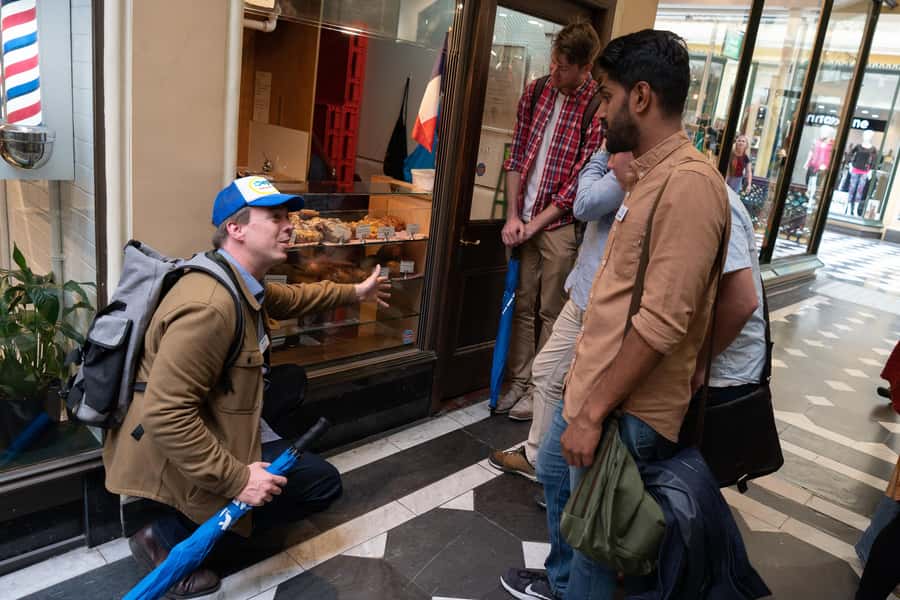
A practical tip: look for the guide near the fountain and the blue umbrellas. The starting area is central, but a clear meeting marker is useful in a busy city.
This opening stop sets up Melbourne’s architectural story. You are not simply looking at old stone and columns. You are starting with the civic ambition of Victoria, then moving toward the wealth created during the Gold Rush.
From there, the Old Treasury Building provides one of the clearest examples of that wealth. The stop is short, about five minutes, so expect an exterior explanation rather than a museum visit. The building’s Gold Rush-era architecture is the focus, along with the reason Melbourne became one of the world’s richest cities during that period.
Collins Street and Melbourne’s moneyed center
Collins Street brings a different side of the city. It is Melbourne’s premium shopping and financial district, lined with historic buildings and modern commerce.
The listed stop is only a couple of minutes, which tells you how the tour works. You pause for a sharp piece of context, then keep moving. This is not a slow architectural study, but the short commentary can help you notice the older façades among the offices and shops.
That rhythm continues throughout the day. You are given a reason to look, a story to remember, and a suggestion for where to return if a particular area catches your eye.
Melbourne’s laneways and ever-changing street art
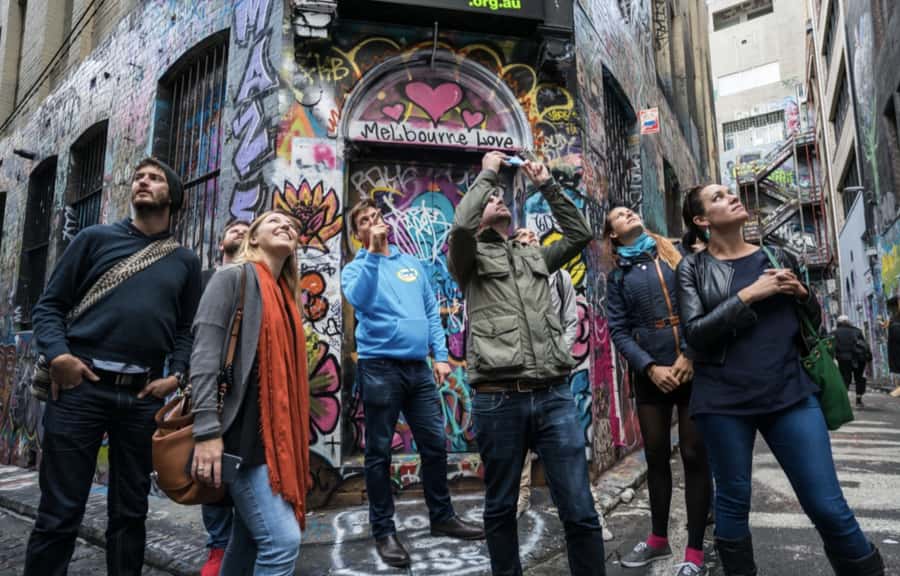
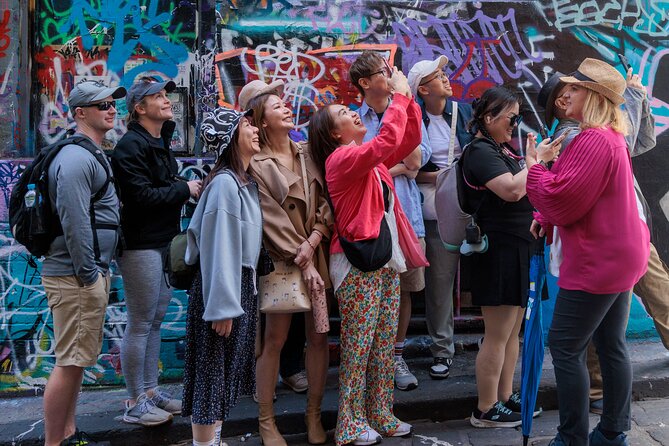
The laneways are one of the strongest parts of the tour. Duckboard Place and AC/DC Lane show off murals and graffiti by local and international artists, with artwork changing over time.
AC/DC Lane is especially memorable for its rock-and-roll murals. Depending on the day, the route may also include Hosier Lane, Melbourne’s best-known street-art destination. Since the route can vary, you should treat Hosier Lane as a possibility rather than a guarantee.
This section works well with a guide because the lanes are easy to wander through without understanding their place in the city. You will hear about the art scene while taking in the narrow walls, painted surfaces, and small urban spaces that make Melbourne feel different from a conventional European-style center.
Street art is also the part of the tour most affected by change. A mural you see may not be there on your next visit. That is part of the appeal, but it means the guide’s commentary and sense of place are as useful as any particular photograph.
More Local Culture and Traditions Tours in Australia
- Snorkel & Dive the Reef: Sustainable, Scientific & Cultural Tour
★ 4.5 · 841 reviews - From Perth: Wave Rock, York and Aboriginal Cultural Tour
★ 4.6 · 498 reviews - Authentic Indigenous Cultural Tour Including Scenic River Cruise
★ 5.0 · 88 reviews - 7 Day Adelaide to Uluru Adventure and Cultural Tour
★ 5.0 · 52 reviews
Federation Square, Flinders Street Station, and the river
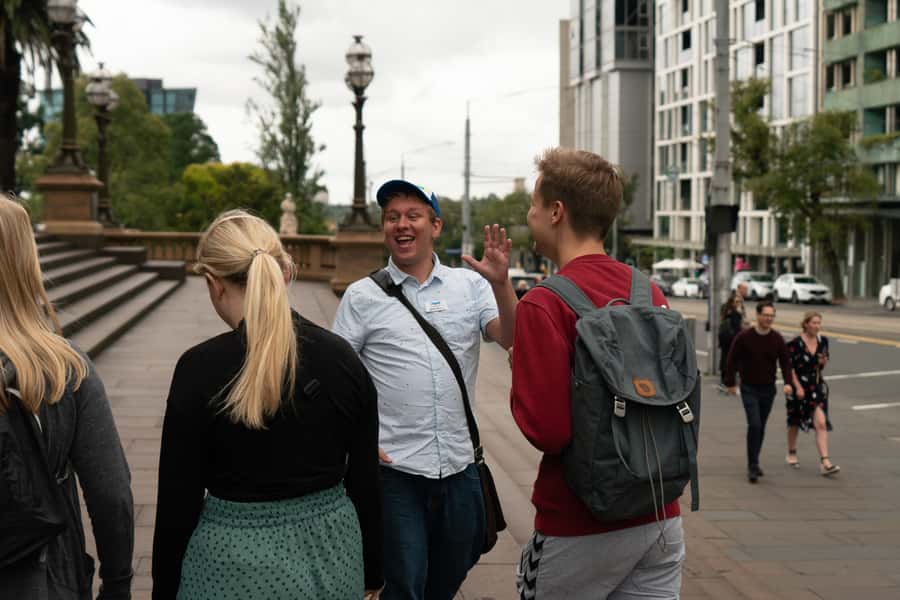
Federation Square gives you Melbourne’s main cultural gathering place and its bold modern architecture. The contrast with the Old Treasury Building is immediate: one stop represents nineteenth-century power and wealth, the other presents a modern civic identity.
The guide then offers distant views of the Melbourne Cricket Ground. You will not tour the stadium on this walk, but you will hear about the MCG as a major temple of Australian sport and see how it fits into the surrounding sporting precinct.
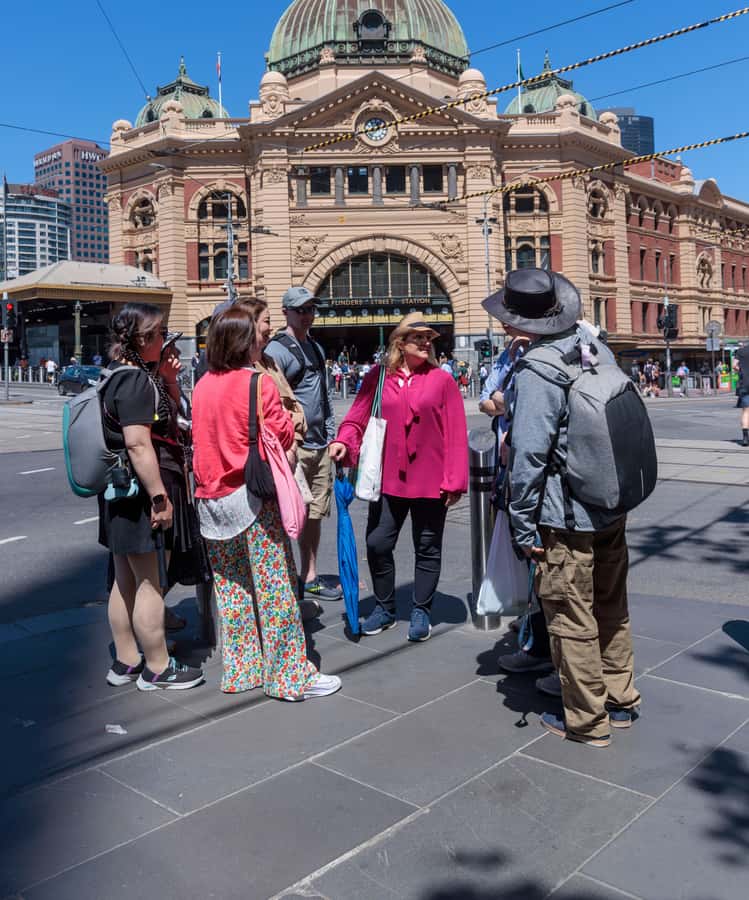
Flinders Street Station is one of the city’s most recognizable landmarks. The exterior stop is brief, but it is a good place to connect Melbourne’s transport history with its present-day street life.
Later, the route reaches the Yarra River and follows the riverbanks for a short stretch. This gives you a change of scene after the lanes and city streets. The river stop is not a long waterfront outing, but it adds breathing room and gives you another angle on central Melbourne.
Coffee on Degraves Street
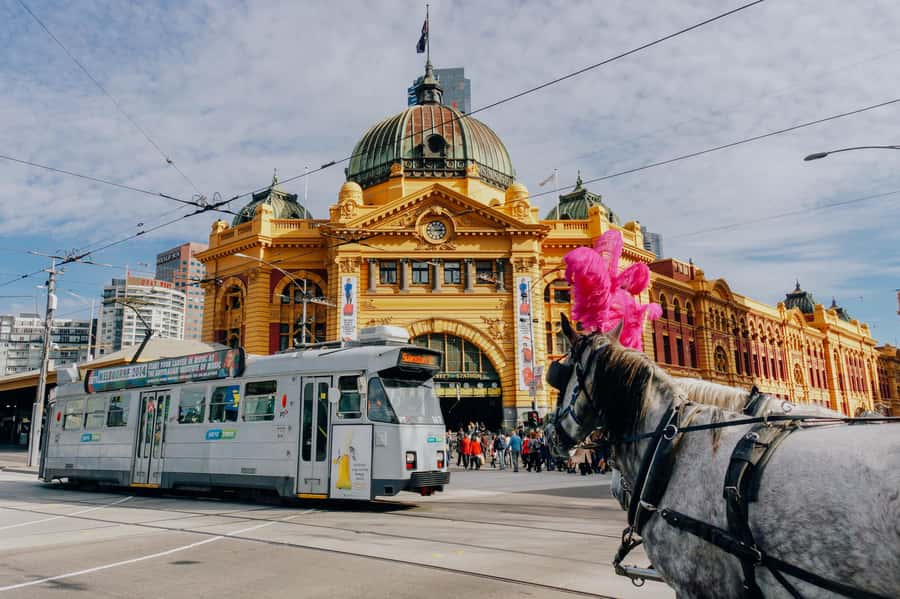
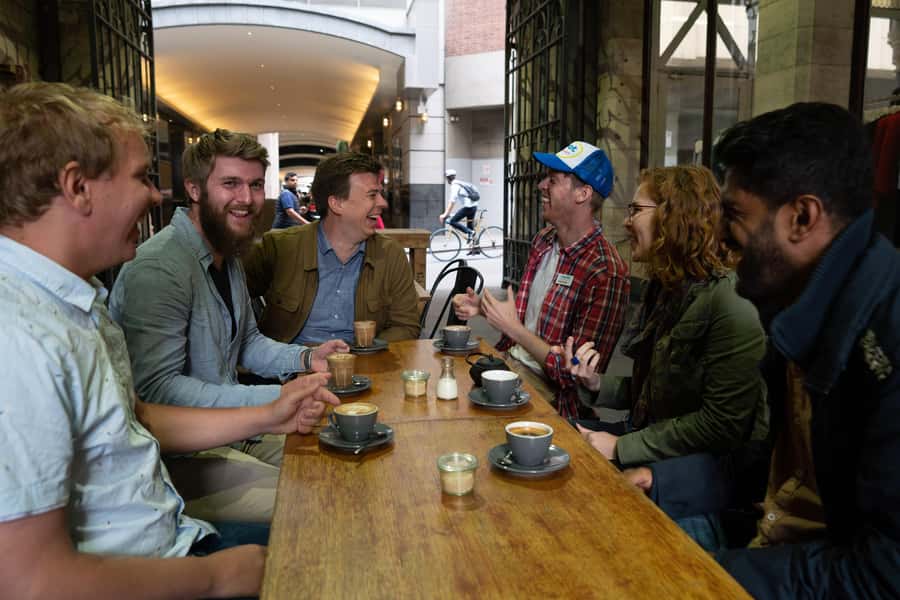
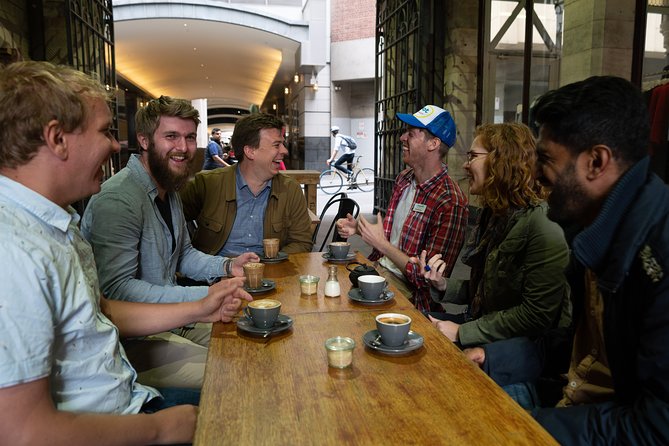
Degraves Street is where the tour’s coffee break earns its place. This narrow lane is known for café culture and a European-style dining atmosphere, and you receive a complimentary hot drink at a local café.
You can choose a flat white, long black, or hot chocolate. That small choice is useful because it makes the stop feel tied to Melbourne rather than like a generic refreshment break.
The twenty-minute pause is also one of the better chances to ask the guide questions. You can talk about restaurants, neighborhoods, further sightseeing, or the best way to spend the rest of your visit. Several guides are praised for giving practical recommendations, and this is the natural point to get them.
The coffee stop also helps the pace. Three hours of walking with constant commentary can feel packed, so a seated or slower café break makes the experience easier on the legs and gives you time to absorb the first half.
Arcades, boutiques, and the city center
The Block Arcade brings you into one of Melbourne’s elegant Victorian shopping passages. Its mosaic floors and decorative architecture are worth looking down for, not just ahead.
The Royal Arcade adds another layer. It is Australia’s oldest arcade and features the famous Gog and Magog figures. Both arcades show a side of Melbourne that can disappear if you stay only on the main streets.
The route also passes Little Collins Street, with its boutique lanes and hidden bars, then Bourke Street Mall, the city’s main pedestrian shopping area. These stops are short, but together they explain how Melbourne shifts from formal nineteenth-century architecture to retail, dining, and contemporary city life.
You will also hear about Melbourne’s tallest tower. The tour does not include a tower visit, but the guide can help arrange access at a special rate if you want to go to the top. Ask during the walk if that view interests you.
Ned Kelly, the Old Melbourne Gaol, and Chinatown
At the State Library Victoria, you see a magnificent heritage building and hear the story of Ned Kelly. The stop lasts about five minutes, so it is a story prompt rather than a full library visit.
That distinction matters. The tour gives you enough context to decide if you want to return for more time at the library or Old Melbourne Gaol. The gaol operated from 1845 to 1929 and is a major part of Melbourne’s darker past. On this walk, you view the historic bluestone prison from outside and receive background on its role in the city.
Chinatown provides a later change of tone. Melbourne’s Chinatown is described as the world’s oldest continuously operating Chinatown, with restaurants and a strong food identity. The short stop is enough to mark the district and help you find it again, but not enough for a meal.
If you want to eat in Chinatown or tour the gaol, plan to return separately. The walking tour is best understood as an introduction that helps you decide where to spend more of your own time.
Finishing at Captain Melville
The route ends at Captain Melville, a historic pub at 34 Franklin Street. You receive a complimentary house beer, wine, cider, or soft drink, and the twenty-minute finish gives the group a final chance to chat.
This ending is practical as well as pleasant. You finish with a clear destination rather than being dropped at a random street corner. It also gives you a chance to compare notes with the guide and ask for last-minute advice.
One review describes the final food and drink as a welcome part of the day, but the included item is specifically a drink. Do not book this expecting a full included lunch. You can use the end point as a starting place for your next meal or for exploring nearby streets.
Walking pace, group size, and what to bring
The experience lasts about three hours and has a maximum of 12 people. That is small enough for questions and easier communication, though you should stay close to the guide, especially in busy streets and narrow lanes.
The pace is generally described as easy and manageable for a three-hour walk. Still, you are moving between many stops, so comfortable shoes make sense. The itinerary includes outdoor viewpoints, city streets, arcades, lanes, and the riverbank. Weather can affect comfort, so dress for conditions and be ready to walk outside for most of the experience.
Children can participate but must be accompanied by an adult. Most people can take part, and the tour is offered to individual visitors in small groups. If you are arranging a school, business, or other group larger than 10, a private tour must be arranged instead.
The meeting time is 11:00 a.m. This is not an early-morning sightseeing walk. The schedule gives you time to reach Gordon Reserve, but you should still allow a few minutes to find the park and the guide.
Is $92.52 a fair price?
At $92.52 per person, this is not the cheapest way to walk around central Melbourne. You can see many of these streets and buildings at no charge on your own.
The value comes from the structure and the interpretation. You receive a professional English-speaking guide, a group capped at 12, a Melbourne map, local recommendations, a coffee, and a final alcoholic or soft drink. You also avoid spending the first day trying to work out which lanes, arcades, and landmarks belong together.
For a first visit, that can be money well spent. The tour gives you a broad orientation, and the recommendations can help shape the rest of your stay. The value is weaker if you already know central Melbourne well or prefer to stop for long periods at each attraction.
The price also does not include a full indoor visit to the Old Melbourne Gaol, the State Library, the MCG, or the tower. Think of the walk as a guided overview with selected treats, not an all-inclusive attraction pass.
Who should book this Melbourne walk?
I would choose this tour if you are visiting Melbourne for the first time and want the city explained through both famous sights and lesser-known lanes. It suits people who like architecture, urban history, street art, coffee, sport, and local stories in one compact outing.
It is also a good fit if you want recommendations early in your stay. Guides such as Emily, Mike, Bo, Ian, Hugo, and Deneille are singled out for warmth, humor, energy, and strong knowledge of Melbourne. That human element is central to the experience.
You may want something else if your priority is a deep visit to one attraction, a long food tour, or a private itinerary built around your interests. The route moves quickly and some stops last only a few minutes.
Should you book it?
Book this tour if you want a well-shaped first look at Melbourne, with local storytelling instead of a checklist of monuments. The best parts are the laneways, coffee stop, arcades, practical tips, and the way the route connects old Melbourne with its modern street-art and café culture.
Skip it if you already know the central city or want to spend most of your time inside museums and historic sites. For a first-day introduction, though, the small group and wide range of stops make the $92.52 fee reasonable, especially with two drinks included and a guide who can help you plan what comes next.
FAQ
How long does the Melbourne walking tour last?
The tour lasts approximately three hours.
What time does the tour begin?
It begins at 11:00 a.m.
Where does the tour start?
The meeting point is Gordon Reserve at 108 Spring Street, East Melbourne, opposite the Hotel Windsor. The meeting area is near the fountain, and guides may be carrying blue umbrellas.
Where does the tour finish?
The walk finishes at Captain Melville Bar, 34 Franklin Street, Melbourne.
Is coffee included?
Yes. You receive one complimentary hot drink, with a choice of flat white, long black, or hot chocolate.
Is an alcoholic drink included at the end?
Yes. At Captain Melville, you can choose a house beer, wine, cider, or a soft drink.
What is the maximum group size?
The tour has a maximum of 12 people. Children must be accompanied by an adult.
Just added around Australia
- Authentic Indigenous Cultural Tour Including Scenic River Cruise★ 5.0 · 88 reviews
- Cairns History Walking Tour★ 5.0 · 52 reviews
- Entry Ticket at Historic Village Herberton★ 5.0 · 114 reviews
- Self-Guided Ngilgi Cave Ancient Lands Experience★ 4.5 · 154 reviews
- Hinterland Heritage Wine Tour★ 4.0 · 28 reviews
- Albany’s Historic Whaling Station Admission Ticket★ 4.5 · 86 reviews
- 7 Day Adelaide to Uluru Adventure and Cultural Tour★ 5.0 · 52 reviews
- Sydney Convicts, History & The Rocks 2.5-Hour Walking Tour★ 4.9 · 181 reviews
Australia History Tours, compared.
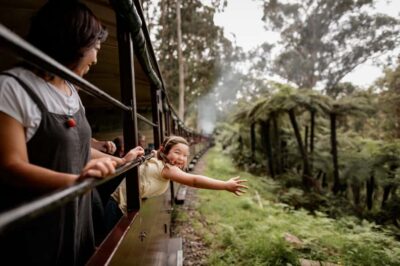
Puffing Billy Railway: Heritage Steam Train Journey
Read our review →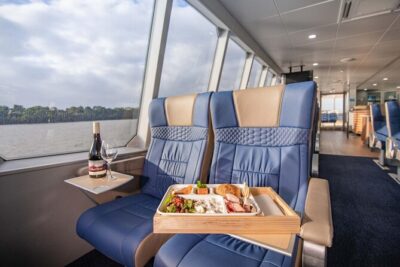
Morning World Heritage Cruise on the Gordon River from Strahan
Read our review →
Strahan: World Heritage Cruise on Gordon River with Lunch
Read our review →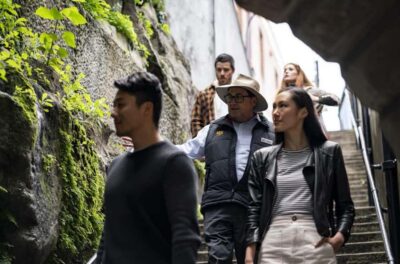
Sydney: The Rocks 90-Minute History Walking Tour
Read our review →
Experience History onboard The Mary Valley Rattler
Read our review →
Snorkel & Dive the Reef: Sustainable, Scientific & Cultural Tour
Read our review →
Derwent River Historic Harbour Cruise From Hobart
Read our review →
Port Arthur Historic Site Admission and Tour Options
Read our review →Browse the lists this tour appears in