
Review · 2-DAY EXPERIENCES
2 Days Guided Historical Tour in Angkor
Angkor Wat at sunrise is only the opening act. This two-day tour takes you from the great temple to Bayon’s stone faces, Ta Prohm’s tree-wrapped ruins, and quieter corners such as Ta Som and Preah Khan. Guides including Sam, Vone, Sok, and Heang are praised for clear history, humor, patience, and help with photos.
I like the small maximum of 15 people, which gives you a better chance to hear the guide and ask questions. I also like the simple comforts: an air-conditioned vehicle, hotel pickup, cold water, and wet towels, all useful when the heat begins to press down.
The main catch is cost clarity. The $35 tour price does not include the $62 temple pass, meals, or breakfast, so your basic outlay is $97 per person before food. The 4:30 am start and long hours on foot also demand a strong dose of energy.
Key points to know before you book
- Sunrise at Angkor Wat: Day one begins at 4:30 am, giving you a chance to see the temple before the main sightseeing schedule.
- Two different Angkor experiences: The first day covers the famous sights, while the second focuses more on Pre Rup, Ta Som, Neak Pean, and Preah Khan.
- Guides who add real value: Sam, Vone, Sok, Heang, Sary, Sayon, and Pheap are praised for history, personal stories, humor, and thoughtful pacing.
- Comfort in the Cambodian heat: Air-conditioning, cold water, wet towels, and regular toilet stops help make the long days easier.
- Bring extra money: The temple pass costs $62 per person, and meals are not covered.
- Expect walking and early starts: This is a serious sightseeing schedule, not a relaxed ride between a few photo stops.
Why two days makes sense at Angkor
Angkor is too large and too important to understand in one quick visit. You can photograph Angkor Wat in a morning, but the wider complex tells a much bigger story through different kings, religions, building styles, and city plans.
This tour gives you one day for the famous circuit and another for the temples that receive less attention. That split is smart. Day one brings the essential sights, including Angkor Wat, Bayon, Ta Keo, and Ta Prohm. Day two trades some of the crowds for Pre Rup, Ta Som, Neak Pean, and Preah Khan.
The schedule is guided, but you still receive time to look around on your own. Several people praised that balance. The guides explain the carvings and history, then allow time for photos and personal exploration instead of talking nonstop at every doorway.
The group limit is 15. That is not private touring, but it is small enough to make questions practical. It also helps the guide keep an eye on the group when everyone is spread across a temple courtyard.
One small point needs checking before booking. The tour is advertised as covering 11 temples, but the named schedule lists ten stops if you count Angkor Thom South Gate and the other sites individually. Ask the operator to confirm the final temple count and the exact order, especially if seeing a particular site matters to you.
More Two-Day Trips in the world:
- Heritage Binh Chuan 2 Days 1 Night discovery in Lan Ha Bay
★ 5.0 · 470 reviews - 2-Day Medieval Transylvania with Brasov,Sibiu and Sighisoara Tour from Bucharest
★ 4.5 · 145 reviews - All Inclusive 2-Day Ancient Egypt and Old Cairo Highlights Tour
★ 5.0 · 139 reviews
Day one begins with Angkor Wat before breakfast
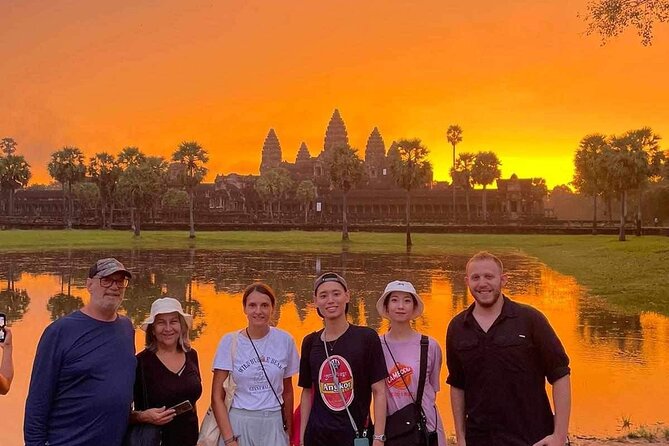
Pickup begins at about 4:30 am from your hotel or an agreed point in the Siem Reap area. The early departure is not a minor detail. You will be leaving while it is still dark, and the first part of the day is built around sunrise at Angkor Wat.
The sunrise itself is one of the strongest reasons to choose this outing. You arrive early, watch the light change around the temple, and then enter with the guide for a fuller visit. A flashlight is useful for the dark walk before dawn, and one French-speaking participant specifically noted that a flashlight was provided or advised.
Angkor Wat deserves more than a quick photograph from the pond. Your guide explains the temple’s design, religious purpose, and carved details while you move through the complex. You should still expect some waiting and crowding around the best sunrise views, but the early start gives you the best chance of seeing the temple before the heat becomes fierce.
The visit lasts about two hours. That is enough time for a proper introduction, though you should keep your pace steady. Comfortable shoes, water, sun protection, and modest clothing are practical essentials at every Angkor temple.
Angkor Thom and Bayon explain royal power
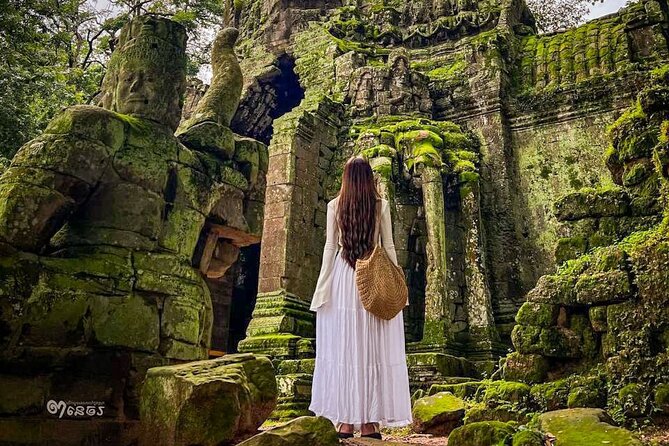
The South Gate of Angkor Thom is a short but memorable stop. A causeway lined with stone figures leads toward the gate, where large carved faces greet you from above. The scene gives you an immediate sense of scale and ceremony before you even reach Bayon.
The gate visit is listed at about 30 minutes. That sounds brief, but it is enough for an explanation, photographs, and a look at the faces and causeway figures. Your guide can help you notice details that are easy to miss when you are focused only on getting inside the city.
Bayon receives about two hours, and it deserves the time. Its towers carry the famous smiling faces associated with Angkor Thom, while the galleries contain carved scenes of warfare, daily life, and court activity. The temple can feel confusing at first, with corridors and towers packed close together. A guide helps you understand how the pieces fit.
This is also where a good guide matters most. Sam is praised for explaining Cambodian and Khmer history in a way that makes the stones easier to read. Vone is praised not only for his facts and jokes, but also for helping with small details and taking photos. Heang is described as patient and clear, which is useful when the group is tired or the temple is crowded.
Ta Keo gives you a temple-mountain break
Ta Keo follows a breakfast break, with the meal paid separately. This is a sensible point to pause. You have already been awake for hours, and the combination of sunrise, walking, and tropical heat can catch up with you quickly.
Ta Keo is a temple-mountain built mainly from sandstone. Its strong, steep form feels different from the enclosed galleries of Bayon. The visit lasts about an hour, though your comfort may depend on how much climbing and walking the group does.
Do not count on breakfast being part of the $35 price. Carry cash for food and drinks, and tell the guide early if you need a little more time to eat. The tour includes water, but that is not a substitute for breakfast during a long morning.
More Guided Tours in the world:
- Pompeii: Entry Ticket and Guided Tour with an Archaeologist
★ 4.8 · 19,459 reviews - History and Hauntings of Salem Guided Walking Tour
★ 5.0 · 14,564 reviews - Edinburgh: Edinburgh Castle Guided History Tour with Tickets
★ 4.8 · 9,933 reviews - Berlin: Third Reich & Cold War Guided Walking Tour
★ 4.9 · 8,378 reviews
Ta Prohm brings the famous jungle ruins
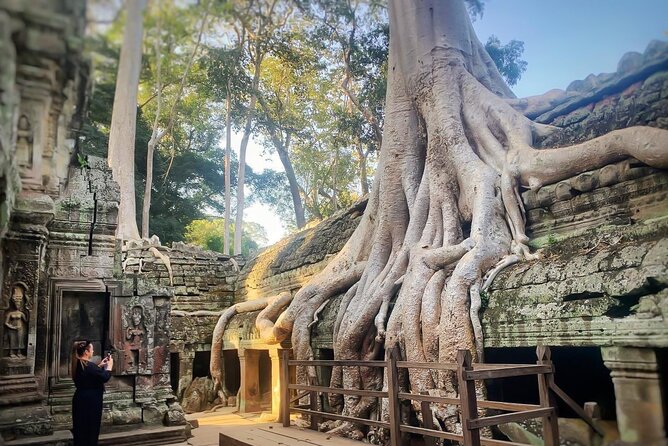
Ta Prohm is one of the most atmospheric stops on day one. Trees grow over and around the masonry, roots press against walls, and corridors open into shaded courtyards. It is the temple most associated with the image of nature reclaiming an ancient site.
The planned visit lasts about an hour. You will have time for the best-known views and for the guide to explain the temple’s place in the Angkor complex. You will also want time to take photographs, since the roots and stone create some of the most striking scenes of the two days.
Ta Prohm is popular, so it may feel busier than the smaller temples on day two. The guide helps you use your time well, but this is not a quiet private visit. If you want pictures without other people in them, patience and timing matter more than the camera.
By the end of day one, you will have seen the major sights, but you may also feel worn out. The air-conditioned vehicle becomes a real benefit here. Several detailed accounts praise the steady supply of cold water, clean toilet stops, and the chance to sit in the cool vehicle when the heat becomes too much.
Day two shifts toward quieter temples
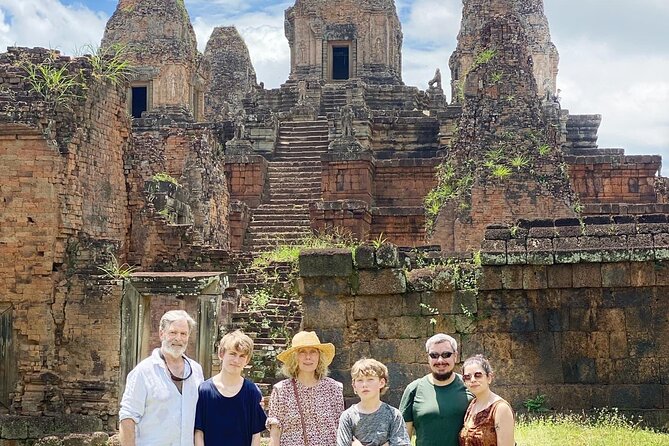
The second day starts with Pre Rup, a Hindu temple built as the state temple of King Rajendravarman in the tenth century. Its brick, laterite, and sandstone construction gives it a different look from Angkor Wat and Bayon.
Two hours are allotted here. Pre Rup is a temple-mountain, so expect steps and open exposure to the sun. The upper levels offer strong views across the surrounding area, but the climb can be tiring, especially after two consecutive early mornings.
This day feels less focused on famous photographs and more on seeing how varied Angkor’s building styles can be. The guide can help you connect the temples to different rulers and periods rather than treating the whole complex as one single monument.
Ta Som is smaller and easier to take in. Built at the end of the 12th century for King Jayavarman VII, it has a quieter mood than the best-known temples. The visit is listed at about an hour, giving you room to study the carvings and take photographs without the scale of Angkor Wat pressing in.
For many people, Ta Som is one of the better places to slow down. In the low season, you might find more open views and fewer people in the background. That makes the second day especially useful if you want photographs that feel less crowded.
Neak Pean and Preah Khan show a different Angkor
Neak Pean is unlike the other temples on the route. It sits on an artificial island in a reservoir linked to the reign of Jayavarman VII. The approach across the water gives the stop a distinct setting, and the temple itself is more compact than Bayon or Angkor Wat.
The visit lasts about an hour. This is a place where the surroundings matter as much as the building. Your guide provides the context, then you can take in the layout and water features at your own pace.
Preah Khan receives about two hours, making it one of the major stops on day two. Built in the 12th century for Jayavarman VII in honor of his father, it combines long corridors, courtyards, carved details, and partially restored sections.
Preah Khan rewards patience. Instead of rushing to one famous view, you can follow the structure through its layers and see how large temple complexes worked. Two hours gives the guide time to explain the site while leaving you room to wander and photograph.
Day two may be the better fit for anyone who has already seen Angkor Wat in photographs and wants a broader understanding of the complex. It also tends to feel calmer than the main day, though conditions change with season and time.
Phnom Bakheng is a very short listed stop
The schedule includes Phnom Bakheng near the end, with a listed duration of only two minutes. That timing is unusual for a temple built as a mountain dedicated to Shiva, and it does not suggest a full visit or a long sunset wait.
The overview says the tour stays for sunset, so you should confirm how Phnom Bakheng fits into your actual day. Ask whether the stop means a brief viewpoint visit, a sunset stop nearby, or a walk toward the temple with limited access.
This is one of the few parts of the plan that needs clarification. Do not assume the two-minute listing means you will have a full Phnom Bakheng visit. If sunset there is important to you, get the details before paying.
Guides can make or break the long days
The strongest part of this tour is the human element. The guides named in the feedback include Sam, Vone, Sok, Heang, Sary, Sayon, and Pheap. Their individual styles vary, but the repeated strengths are clear: solid temple information, patience, humor, answers to questions, and a willingness to help with photographs.
Sam is praised for stories about the Khmer Empire and Cambodian history. Vone is described as funny and unusually attentive to small details. Sok is praised for passion and clear answers. Heang receives strong marks for useful explanations across the temples.
One useful feature is the guide’s ability to adjust the pace when heat becomes a problem. A participant who became ill after the first day still found the first day worthwhile, in part because the guide offered water and allowed time in the air-conditioned vehicle.
Language may require attention. An account from French-speaking visitors suggests that understanding can be harder without a Francophone guide. If you need French, ask in advance rather than assuming it will be available.
What the $35 price really covers
At $35 per person, the tour is priced as a low-cost way to organize transport and guiding across two full days. You receive hotel pickup and drop-off, an air-conditioned vehicle, a guide, cold water, wet towels, and the planned temple visits.
The $62 temple ticket is extra. That makes the tour and pass together $97 per person, before meals. Breakfast on day one and restaurant meals are also separate, so keep the real budget in mind when comparing options.
I think the value is strongest if you want history explained and do not want to arrange transport between distant temples. The cost also makes sense for anyone who values a guide’s pacing and local context. It is less attractive if you prefer to move independently, sleep late, or spend a long time at only one temple.
Pickup is offered from hotels in Siem Reap, with the stated meeting point near Pub Street and the Angkor Night Market. Drop-off can be arranged at your hotel or somewhere around Pub Street. Confirm your pickup details carefully, since one poor experience involved a communication problem at the hotel and difficulty reconnecting with the group.
Who should book this two-day Angkor tour
This tour suits you if you want the main Angkor temples plus a wider selection of smaller sites. It is especially useful for first-time visitors who want a guide to explain what they are seeing rather than simply being driven from gate to gate.
It also suits families and mixed-age groups who appreciate water, air-conditioning, toilet stops, and some flexibility when the heat rises. The maximum of 15 keeps the group more manageable than a large coach tour.
You should think twice if you dislike 4:30 am starts, long walks, stairs, heat, or fixed schedules. You also need two days free and enough energy for early mornings. The tour is not designed for a slow, private temple study.
Cancellation is free if you cancel at least 24 hours before the start time. Changes or cancellations inside that window are not accepted for a refund.
FAQ
What is included in the $35 tour price?
The price includes an air-conditioned vehicle, a tour guide, cold water, wet towels, hotel pickup and drop-off, and the planned temple visits over two days.
Is the Angkor temple pass included?
No. The temple ticket costs $62 per person and must be paid separately.
How early does the tour start?
The stated start time is 4:30 am. This early departure is for sunrise at Angkor Wat on the first day.
Are meals included?
No. Meals are not included. The day one schedule includes a breakfast break at Ta Keo, but you pay for breakfast yourself.
How large is the group?
The tour has a maximum of 15 participants.
Which temples are visited?
The named schedule includes Angkor Wat, Angkor Thom South Gate, Bayon, Ta Keo, Ta Prohm, Pre Rup, Ta Som, Neak Pean, Preah Khan, and Phnom Bakheng. The tour description says 11 temples, so confirm the final count and route before booking.
Where does pickup and drop-off take place?
Pickup is offered at your hotel in Siem Reap. The listed meeting point is near Pub Street and the Angkor Night Market, and drop-off can be arranged at your hotel or somewhere around Pub Street.
Should you book it?
Book this tour if you want two full days of guided Angkor, with sunrise, sunset, major temples, smaller sites, and practical support in the heat. The strongest value comes from the guides, the transport, and the chance to see far more than Angkor Wat alone.
Before booking, budget for the separate $62 pass and meals, confirm the temple count, ask how Phnom Bakheng fits into the sunset plan, and make sure the pickup instructions are clear. If you can handle the early starts and long walks, this is a well-priced way to build a solid first visit to Angkor.
Just added around the world
- Scenic Train ride to historical cities of Morretes and Antonina★ 4.0 · 188 reviews
- 6-Day Cultural Tour to Machu Picchu★ 5.0 · 76 reviews
- Jewish Heritage of Curacao★ 4.5 · 68 reviews
- The Curacao’s Colorful History Walking Tour★ 5.0 · 55 reviews
- Discover Scuba Diving Amathounta’s Ancient Port★ 5.0 · 30 reviews
- Olous – Guided Snorkelling Excursion to Discover Olous Sunken Ancient City★ 4.5 · 31 reviews
- Night Walking Tour of Medieval Cuenca★ 5.0 · 64 reviews
- WWII – The Battle of Crete Day Tour★ 5.0 · 103 reviews
2-Day Experiences, compared.
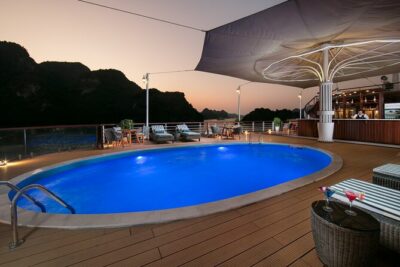
Heritage Binh Chuan 2 Days 1 Night discovery in Lan Ha Bay
Read our review →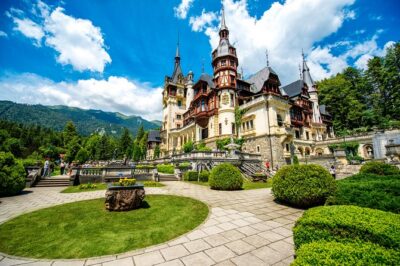
2-Day Medieval Transylvania with Brasov,Sibiu and Sighisoara Tour from Bucharest
Read our review →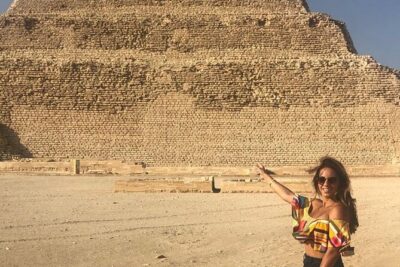
All Inclusive 2-Day Ancient Egypt and Old Cairo Highlights Tour
Read our review →
2 days Private tour of Hampi world heritage site from Bangalore by car
Read our review →
From Bucharest: 2-Day Medieval Transylvania Tour
Read our review →
Browse the lists this tour appears in