
Review · GREECE
WWII – The Battle of Crete Day Tour
The most moving part of this Battle of Crete tour is the chance to connect military plans with real places. From Maleme and Tavronitis to the German and Commonwealth cemeteries, you see where the 1941 invasion unfolded, then hear how Cretan civilians, German forces, and Allied troops were caught in it.
I like the small-group format, which makes it easier to ask questions and adapt the discussion to your interests. I also like the mix of battlefield views, quiet cemeteries, and personal objects from the war, including a private collection that has included Lee Enfield rifles and Tommy guns.
The main drawback is that six hours can feel short for such a complicated battle. If you do not already know the basic sequence of events, the troop movements may be hard to follow, especially when you are viewing battle areas from higher ground rather than walking every field.
Key points to know before booking
- Maleme puts you at the center of the 1941 invasion, where the German airborne assault began.
- Tavronitis Bridge adds a concrete sense of place, linking military strategy to a surviving wartime site.
- The German and Commonwealth cemeteries offer two quiet, very different memorial spaces.
- Guides such as Yannis, Babis, Ioannis, and Stelios bring strong local and military knowledge, with clear English reported throughout the experience.
- A private military collection may be included, adding personal stories and unusual battlefield objects.
- The $114.89 price includes transport, entrance fees, drinks, snacks, and Chania-area pickup, making the value strongest when you want both transport and interpretation.
Why the Battle of Crete is best understood on the ground
The Battle of Crete was not just a string of dates and military names. It was a fight for airfields, roads, bridges, ports, and high ground, carried out across villages and farmland that still form part of daily Cretan life.
That is why this tour works better than reading about the battle from a hotel room. You move between the main sites by minivan, and your guide can point out how each location fitted into the wider action. The tour gives you a physical sense of distance and direction that maps alone do not provide.
You also hear more than the German and Allied military story. The guides discuss the local resistance and the effect of the invasion on Cretan communities. That wider view matters, since the battle was fought by soldiers from several countries, but endured by the people who lived on the island.
The subject can be emotionally heavy. The cemetery visits, in particular, shift the mood from military tactics to the human cost of the fighting. I would not choose this excursion if you want a light sightseeing morning, but that seriousness is part of its value.
More WWII and D-Day Tours in Greece:
- Amsterdam: Life of Anne Frank and World War II Walking Tour
★ 4.8 · 10,467 reviews - Berlin: Third Reich & Cold War Guided Walking Tour
★ 4.9 · 8,378 reviews - Normandy D-Day Sites & Cemetery Day Trip from Paris with Lunch
★ 5.0 · 6,877 reviews
Maleme, where the tour begins
Maleme is the first major stop and the place where the tour starts its account of the battle. The visit lasts about 50 minutes, with no separate admission charge.
This is the point where the German airborne attack becomes easier to picture. Your guide sets the scene, explains the importance of the area, and helps you understand why control of the airfield mattered so much. For anyone interested in the first phase of the invasion, this is the essential opening chapter.
The strength of Maleme is not a large museum display or a dramatic monument. It is the explanation. A good guide turns an ordinary-looking place into a military position with competing objectives, confused orders, and urgent decisions.
Yannis, also written as Giannis or Ioannis, has led many of these tours, and Babis is another guide frequently associated with the route. Their approach appears to combine battlefield detail with wider stories about Crete. You can ask about the German assault, Allied planning, local resistance, or the island itself without being restricted to a fixed script.
You should arrive ready to listen closely. The battle involved several forces and shifting positions, so names and directions can pile up quickly. If you have read a book about Crete before coming, Maleme will probably make more sense. If not, ask your guide to pause and explain the basic sequence before moving on.
Tavronitis Bridge and the value of a real wartime site
The tour spends about 40 minutes at Tavronitis Bridge. Entrance is included.
A bridge may sound like a modest stop, but it gives the military story a useful physical anchor. Roads and crossings shaped how troops moved, and a location like this helps you see why a seemingly small point could matter during a fast-moving invasion.
This is also one of the places where an informed guide earns the transport time. Rather than simply taking a photograph and moving on, you can ask how the bridge related to nearby operations and the wider battle. The tour is designed around interpretation, not just collecting famous names.
One limitation is that the battlefield sites do not always offer a neat, museum-like presentation. You may be standing outdoors, looking across an area while your guide uses maps or spoken directions to explain the action. Some people will find that vivid; others may struggle to follow troop movements without preparing first.
My practical suggestion is simple: read a short account of the Battle of Crete before you go, even if you are new to military history. Knowing the basic roles of Maleme, Galatas, Souda Bay, and the airfield will help you make sense of what you see.
The German Military Cemetery at Maleme
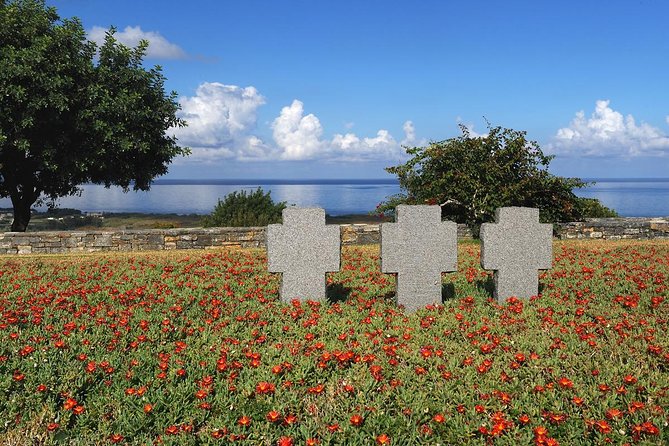
The German Military Cemetery is a 30-minute stop, with admission included.
This is a quiet, carefully maintained place, and the tone changes as soon as you enter. The guide can place the German losses within the larger invasion while also allowing time for reflection. The cemetery is not only about military success or failure. It reminds you that the people involved were young soldiers, often far from home, caught in a campaign with consequences that lasted well beyond the fighting.
The visit is especially useful because the tour does not treat the German side as a simple villainous presence. Understanding the German airborne operation and the decisions behind it does not excuse the occupation or the suffering caused. It does give you a clearer picture of the battle itself.
Guides such as Babis and Yannis have been praised for explaining the events with care rather than turning the stop into a checklist. That balance matters. You want enough detail to understand the site, but also enough quiet to take it in.
Allow yourself to slow down here. This is not the moment to rush through photographs. The cemetery is one of the places where the tour becomes less about military trivia and more about the cost of war.
More Battlefield and Military History Tours in Greece:
- Athens: Delphi, Corycian Cave, and 300 Battlefield Day Trip
★ 4.8 · 344 reviews - Marathon & Thermopylae Battlefields Private Day Tour from Athens
★ 5.0 · 64 reviews - 2-Hour Gettysburg Battlefield Guided History Bus Tour with a National Park Guide
★ 4.5 · 2,201 reviews - Prague Communism History and Nuclear Bunker Tour
★ 5.0 · 1,742 reviews
Souda Bay War Cemetery and the Commonwealth story
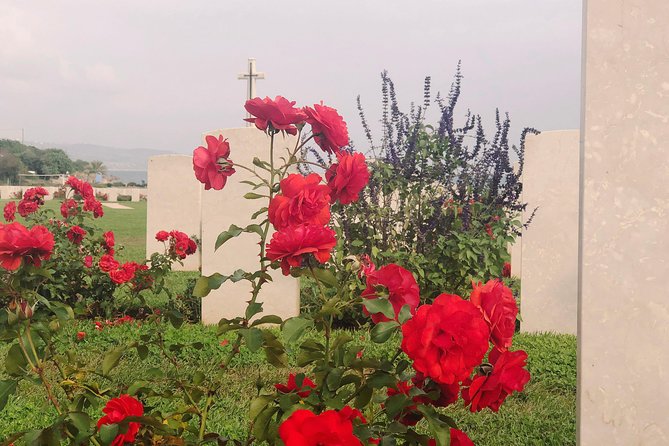
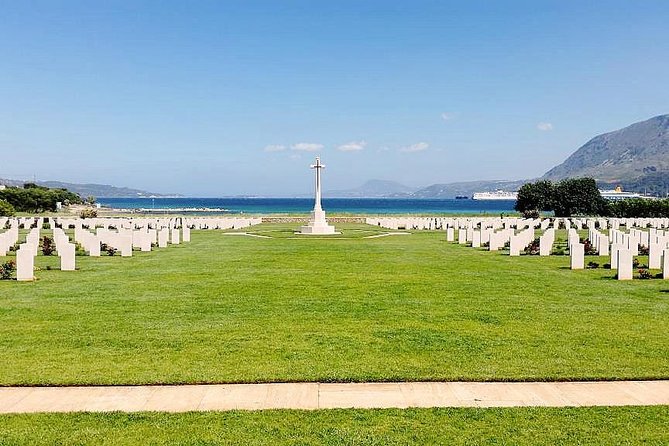
The visit to the Commonwealth War Cemetery at Souda Bay also lasts about 30 minutes, with admission included.
This stop broadens the story again. The cemetery contains the dead of the British Commonwealth forces, and it helps you connect the battle to the many units involved in the defense and attempted evacuation of Crete.
For some people, Souda Bay has a personal connection. The tour has helped people locate places connected with relatives who served in the Allied forces, including family members evacuated from the island. That can make the stop especially poignant, but you do not need a family link to find it meaningful.
The setting also gives your guide a chance to explain the role of Souda Bay in the campaign. The visit is not just a memorial stop added for atmosphere. It helps complete the picture begun at Maleme, moving from the German landing and struggle for the airfield to the Allied response and the fate of those who escaped, were captured, or died.
One unusual moment has included a Greek air force flypast. You should treat that as an incidental possibility, not a promised part of the excursion. The dependable experience is the cemetery, the setting, and the explanation of the Commonwealth connection.
The private military collection
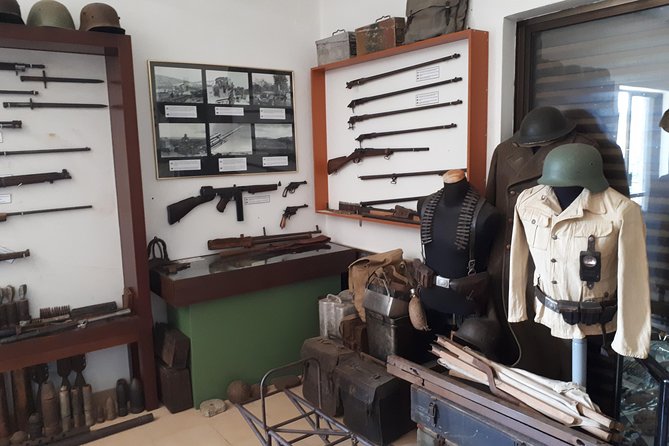
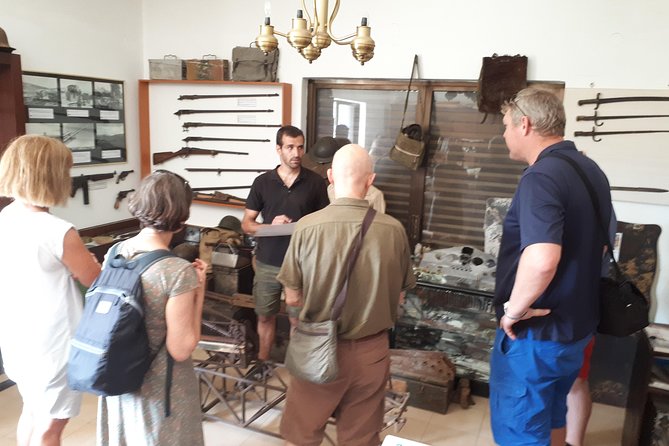
Several accounts of the tour describe a visit to a private collection of WWII objects, associated with a local collector named Stelios. This appears to be an additional highlight of the day, though the core schedule lists the four main stops rather than guaranteeing every detail of the collection visit.
The collection gives the battle a more personal scale. Instead of seeing only cemeteries and terrain, you may encounter objects connected with the soldiers who fought there. Some visits have included the chance to handle Lee Enfield rifles with bayonets and Tommy guns under the collector’s supervision.
That is not the sort of experience you usually get from a standard sightseeing route. It can be striking for anyone with a family connection to the war or a serious interest in military equipment. It also gives the guide a chance to explain how ordinary objects fit into the story of the campaign.
The collection is not a substitute for a formal museum, and you should not expect a large public institution. Its appeal comes from the personal nature of the material and the collector’s connection to the subject. For me, this kind of stop is most valuable when paired with careful historical explanation rather than treated as a display of weapons alone.
Ask at booking if this visit is included on your date. The published core itinerary names Maleme, Tavronitis Bridge, and the two cemeteries, while several accounts describe the collection as part of the day.
What the six-hour minivan format is like
The tour begins at 9:00 a.m. and lasts about six hours. Transport is by air-conditioned minivan or minibus, with pickup and drop-off at specific places in the Chania region.
That arrangement removes one of the main practical problems of battlefield sightseeing: reaching scattered sites without a car. You can focus on the story instead of navigating rural roads or working out local connections between stops.
The vehicle also matters during hot weather. Water and snacks are supplied for each person, and one account mentions lunch as an added comfort. The official inclusions specify snacks and bottled water, so you should not assume a full meal unless the operator confirms it.
The group can contain up to 15 people, though some departures have been much smaller. A small group is a real advantage here. You can ask about a relative, stop for clarification, and spend more time on a question without holding up a large coach.
The tradeoff is that the exact feel of the day may vary with group size and guide. A fuller minivan will feel less personal than a private or nearly private outing. Still, the maximum of 15 is modest compared with a large bus tour.
How good are the guides?
The guide can make or break a history tour, and this route depends heavily on the person leading it.
Yannis, Giannis, or Ioannis has been described as both warm and highly informed, with a talent for answering questions about the battle and Crete more generally. Babis has also led the tour, bringing an engaging style and strong command of the 1941 events. Stelios and Nikos have been involved on some departures, with Nikos adding information about the island and its natural setting while driving.
You should not assume a specific person will lead your departure unless the operator confirms it. What you can reasonably expect is an English-speaking local driver or escort who explains the sites and handles the route.
The strongest part of the guiding style is the human context. The discussion can move from strategy to the local resistance, from Allied movements to the lives of Cretan civilians, and from wartime events to later consequences in Greece and the wider region.
The amount of information is substantial. If you want a tightly structured military briefing with every movement laid out on a large map, you may occasionally find the six-hour format too compressed. Ask questions as you go, and tell the guide how much detail you want. The small-group setting makes that possible.
Is $114.89 a fair price?
At $114.89 per person, this is not the cheapest way to spend half a day around Chania. It is also more than a simple transport service, since the price covers an English-speaking local escort, air-conditioned transport, entrance fees, snacks, bottled water, taxes, and pickup and drop-off from specified Chania-area locations.
The value is strongest if you do not have a rental car, want the historical context explained on site, or have a family connection to the battle. Driving yourself might cost less for a group, but you would need to plan the route, find the cemeteries, understand what you are seeing, and manage the roads and timing yourself.
I also think the price makes more sense for people who will use the guide fully. If you plan to spend the day taking quick photographs and listening only occasionally, a self-guided visit may suit you better. If you want to ask about a regiment, a prisoner of war, an evacuation, or local resistance, the paid interpretation is the main reason to book.
The tour is recommended by 99 percent of customers and carries a 4.9 rating from 103 reviews. Those numbers suggest a very dependable experience, but they should not hide the one fair criticism: the battle can be difficult to follow in six hours. Preparation will improve the value considerably.
Who should book this tour?
I would choose this for anyone with a serious interest in WWII, military history, family research, or modern Greek history. It also suits you if you know little about the battle but want a clear introduction from a local guide rather than a long museum visit.
You do not need to be a military specialist. The guides have been able to make the subject accessible to people with very different levels of background knowledge. You can enjoy the human stories, the cemeteries, and the connection between Crete’s villages and the war without memorizing every unit.
I would hesitate to recommend it if you want a relaxed scenic excursion, a beach day, or extensive time walking through open battlefields. The experience is thoughtful and sometimes somber, with plenty of spoken information and several memorial stops.
Most people can participate, and the tour is near public transportation, but the supplied information does not describe detailed mobility arrangements. If you have specific mobility needs, confirm the vehicle and site conditions before booking.
Should you book the Battle of Crete tour?
Book it if you want to understand the Battle of Crete as a series of real places rather than a paragraph in a history book. Maleme, Tavronitis Bridge, the German cemetery, and Souda Bay each add a different piece, while the local guides provide the links between them.
The strongest reasons to go are the small-group setting, the local perspective, and the chance of visiting a private collection of wartime objects. The main caution is the pace. Read a brief account beforehand, keep asking questions, and expect a serious history lesson rather than a casual outing.
For a half-day from Chania, the combination of transport, entrance fees, refreshments, and expert explanation makes $114.89 reasonable. I would book this tour if the Battle of Crete matters to you, especially if your family or regiment has a connection with the island.
FAQ
How long is the Battle of Crete tour?
The tour lasts approximately six hours and starts at 9:00 a.m.
Where does the tour visit?
The core route includes Maleme, Tavronitis Bridge, the German Military Cemetery, and the Souda Bay Commonwealth War Cemetery.
Is hotel pickup included?
Pickup and drop-off are included from specific places in the Chania region. Confirm that your accommodation is within the covered area before booking.
What transport is used?
The tour uses an air-conditioned minivan or minibus.
Is the tour conducted in English?
Yes. The experience is offered in English and includes an English-speaking local driver or escort.
Are entrance fees included?
Yes. All listed entrance fees, taxes, handling charges, snacks, and bottled water are included.
Can I cancel for a full refund?
You can cancel at least 24 hours before the local start time for a full refund. Changes or cancellations made less than 24 hours in advance are not accepted for a refund. If poor weather or insufficient bookings cause the tour to be canceled, you will be offered another date or experience, or a full refund.
Just added around Greece
- Olous – Guided Snorkelling Excursion to Discover Olous Sunken Ancient City★ 4.5 · 31 reviews
- Heraklion Highlights: Knossos, Museum & Historic City Drive★ 5.0 · 64 reviews
- Knossos & Archaeological Museum Shared Guided Tour from Chania★ 5.0 · 41 reviews
- Chania’s Clash of Empires: A Self-Guided Audio Tour★ 4.5 · 28 reviews
- Ancient Corinth Private Tour from Corinth★ 5.0 · 56 reviews
- Epidavros sea kayak at the Ancient sunken city tour, small ancient theater★ 5.0 · 96 reviews
- Small-group Corfu Town Historical Walking Tour★ 5.0 · 39 reviews
- Sea Kayak Epidavros – Ancient Sunken City Tour★ 5.0 · 213 reviews
Greece History Tours, compared.
Athens: Acropolis & up to 5 Archaeological Sites Combo Pass
Read our review →
Athens: National Archaeological Museum Ticket & Audio Guide
Read our review →
Mykonos Town: Archaeological Site of Delos Guided Day Trip
Read our review →
Historical Delphi One Day Tour with Arachova Stop & Expert Guide
Read our review →
From Athens: Ancient Corinth Day Trip with Canal & VR Guide
Read our review →
Historic Athens: Small Group Electric Bike Tour
Read our review →
Acropolis, Parthenon & Athens Old City Heritage Walking Tour
Read our review →Browse the lists this tour appears in