
Review · HISTORY TOURS
Tbilisi: Discover History on an Old Town Walking Tour
Tbilisi’s past comes at you in layers on this three-hour Old Town walk: a crooked puppet theater, sixth-century church, synagogue, mosque, royal baths, and hilltop fortress views all fit into one compact afternoon. The route also includes Georgian wine, a cable car ride, and the city’s famously hospitable toastmaster, Tamada.
I like the way the tour links religion with daily life, rather than treating old buildings as empty shells. I also like the final cable car ride to Mother of Georgia, where the city opens below you. The main drawback is the pace and terrain: this is a walking tour with hills, steps, and uneven streets, so it is not suitable for people with mobility impairments.
Key points to know
- Gabriadze’s crooked clock tower: Begin with Tbilisi’s playful artistic side before turning to its oldest churches.
- Several faiths in one route: See a basilica, cathedral, synagogue, mosque, and the Patriarchate of Georgia.
- Georgian food and wine: A bakery stop is possible along the way, while a planned secret stop includes wine tasting.
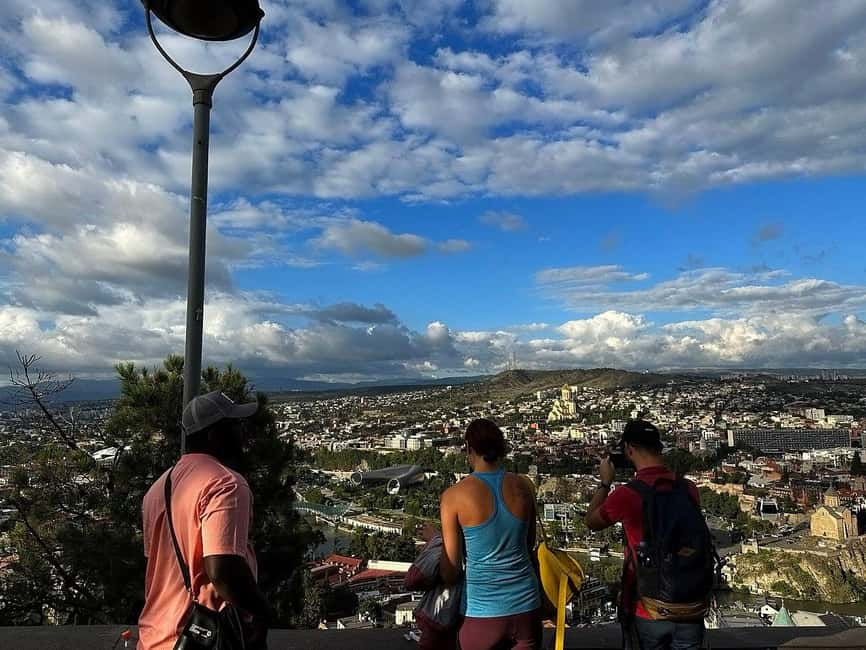
- Cable car to the hilltop: The ride from Rike Park saves some uphill effort and opens wide views over the Mtkvari River.
- Mother of Georgia’s symbolism: Learn why her sword and bowl of wine represent both strength and welcome.
- Good language choice: Tours are offered in English and Spanish, and guide Shmagi has been praised for his fluent Spanish and helpful city advice.
Starting beside the Berikaoba monument
You meet at 17 Ioane Shavteli Street, beside the Berikaoba monument and near Ambassadori Tbilisi Hotel. This is a useful meeting point in the heart of the old city, but give yourself time to find the exact monument rather than simply aiming for the hotel entrance.
The tour begins in the center of Tbilisi, so you are walking into the city’s old core from the first minute. There is no hotel pickup or drop-off, and the three-hour duration includes travel time, including the cable car ride.
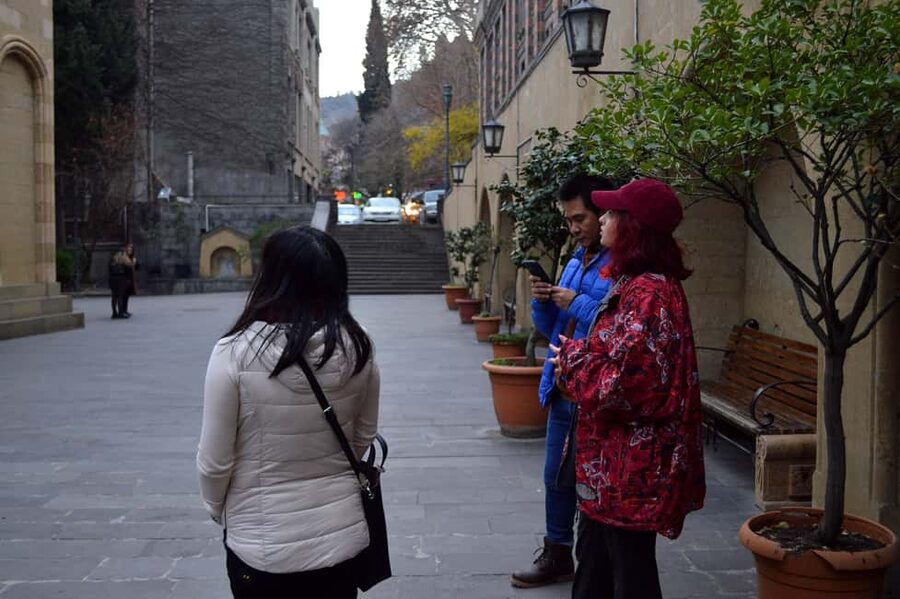
The route is best for someone who likes to keep moving. You will pause often for explanations and photographs, but this is not a slow, seated sightseeing experience. Wear shoes with a firm grip, carry water, and bring some cash for personal purchases.
More Old Town and Historic Centre Walks in the world:
- Madrid Essential: Historic Center, Plaza Mayor & Royal Palace
★ 5.0 · 6,416 reviews - Lisbon: Live Fado Show with Port Wine in Historic Center
★ 4.7 · 4,166 reviews - Valencia Old Town Tour with Wine & Tapas in 11th Century Historic Monument
★ 5.0 · 3,234 reviews
Gabriadze Theater and Tbilisi’s playful side
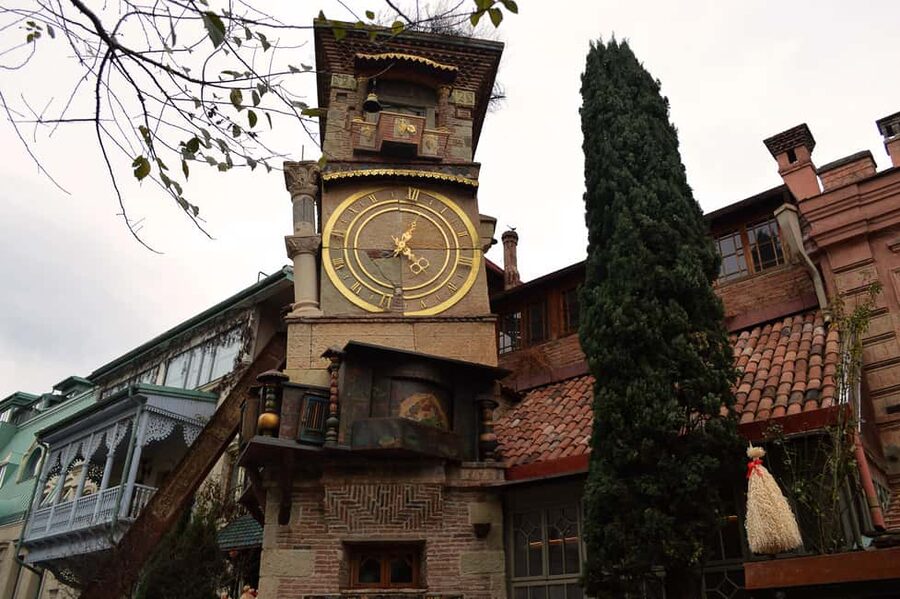
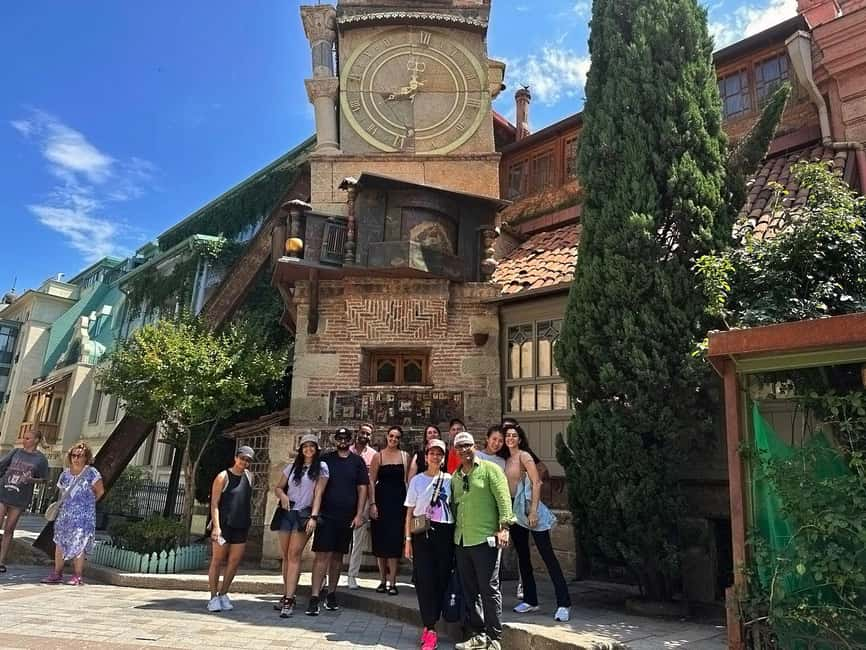
The first major stop is the Rezo Gabriadze Theater and its famous clock tower. The building’s crooked form looks almost too whimsical to be real, which makes it a fitting introduction to Tbilisi. This is not a city that keeps all its character inside neat lines.
You have about 15 minutes here for a guided visit, photographs, and views along the street. The clock tower is known for its puppet show, so ask your guide how the theater fits into Georgia’s modern creative culture. Even if the timing does not line up with a performance, the tower gives you an early sense that Tbilisi’s identity is both old and inventive.
This stop also helps break up the usual pattern of church after church. You begin with architecture, theater, and local humor before turning to religious history.
Anchiskhati Basilica and the roots of Georgian Christianity
Anchiskhati Basilica is the oldest surviving church in Tbilisi, dating to the sixth century. Its age gives the tour a firm historical anchor, but the guide’s explanation is what makes the stop useful. You learn how Christianity shaped Georgian identity and how faith remains tied to the country’s culture.
Plan on roughly 20 minutes here. You may enter the church, but photography inside is not allowed. Women need a head covering, and shorts are not permitted, so dress with church visits in mind from the start. It is easier to carry a scarf than to discover at the door that you cannot enter comfortably.
The basilica is one of the places where a guide adds real value. Without context, an old church can become just another stone building. With an explanation of its place in Georgian life, the visit has more weight.
The Patriarchate and the Bridge of Peace
The next stop is the Patriarchate of Georgia, an important center of the country’s religious life. The visit is short, about 10 minutes, but it helps connect the older churches with the role of the Georgian Orthodox Church today.
From there, the route moves toward the Bridge of Peace for about 15 minutes of sightseeing and photographs. Its modern glass-and-steel form provides a sharp contrast to the older streets and buildings nearby. That contrast is part of Tbilisi’s appeal. The city is not preserved in one frozen period, and the route lets you see old religious landmarks beside newer public architecture.
I like this pairing because it gives the walk a better rhythm. You are not only looking backward. You are also seeing how the city presents itself now.
More History Walking Tours in the world:
- History and Hauntings of Salem Guided Walking Tour
★ 5.0 · 14,564 reviews - Lisbon: History, Stories and Lifestyle Walking Tour
★ 4.8 · 10,902 reviews - Amsterdam: Life of Anne Frank and World War II Walking Tour
★ 4.8 · 10,467 reviews - Berlin: Third Reich & Cold War Guided Walking Tour
★ 4.9 · 8,378 reviews
Sioni Cathedral and a story linked to Stalin
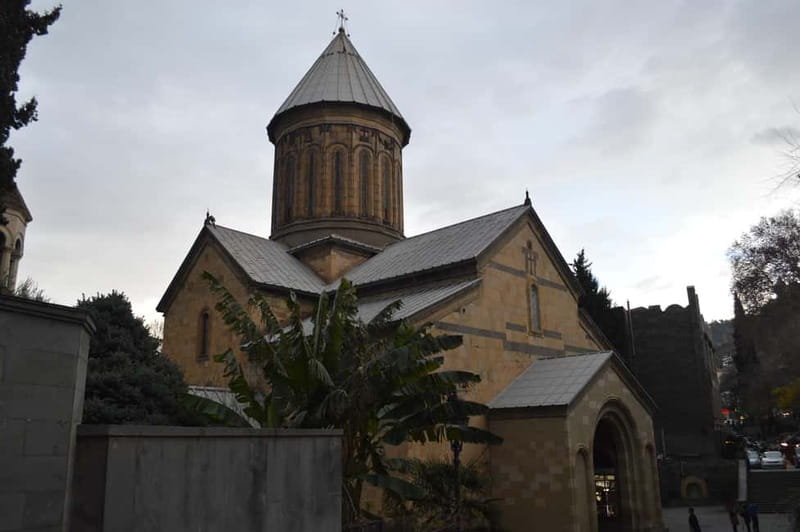
Sioni Cathedral is another central religious stop, with ancient relics and legends tied to Georgia’s past. The guide also points out the church where Joseph Stalin married his first wife, a detail that adds a more personal and unexpected thread to the route.
You have about 15 minutes for the cathedral. As with the other churches, remember the dress code and the ban on indoor photographs. The guide can explain which details matter, but you should not expect a long quiet visit. This is one piece of a tightly arranged walking route.
The cathedral is especially helpful for understanding how Georgian religious buildings function as places of memory. Their importance is not only architectural. They hold stories about faith, public life, and people whose names remain linked to the city.
Tamada, Georgian toasts, and a taste of local hospitality
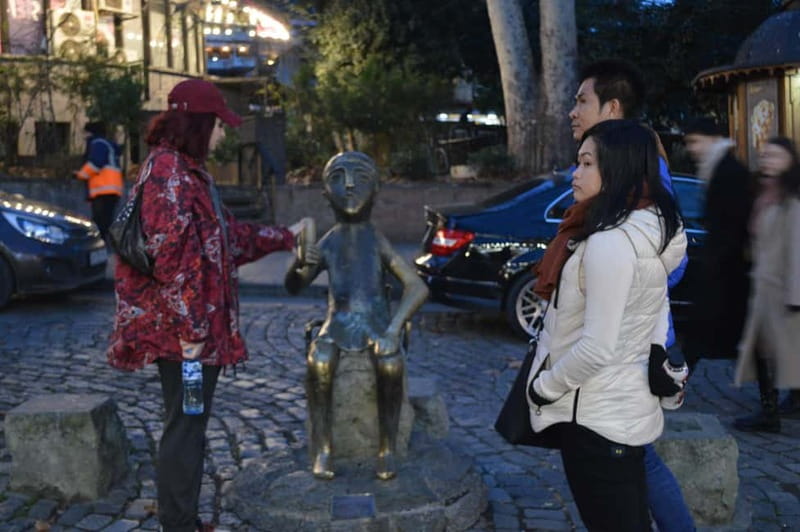
At the Tamada Sculpture, you meet one of Georgia’s most cheerful cultural symbols. Tamada is the traditional toastmaster, the person who guides a Georgian feast through a series of thoughtful toasts. The bronze figure gives your guide an easy way to explain why Georgian hospitality is connected to words, ritual, friendship, and wine.
The stop lasts about 10 minutes and is mainly for photographs and explanation. It is a small stop, but it gives the rest of the tour a human touch. You are not only studying buildings. You are learning how people gather and celebrate.
A planned secret stop follows, lasting about 20 minutes and including wine tasting. The exact location is not specified, which is part of the surprise. Bring cash, since personal spending is not covered in the tour price. The experience also includes a traditional bakery stop in the broader route, but bakery purchases are not included.
You may be able to try khachapuri or lobiani, two Georgian favorites. Khachapuri is cheese-filled bread, while lobiani is filled with beans. This is a practical chance to sample something warm and local without setting aside a full restaurant meal.
Synagogue, mosque, and the city’s shared religious space
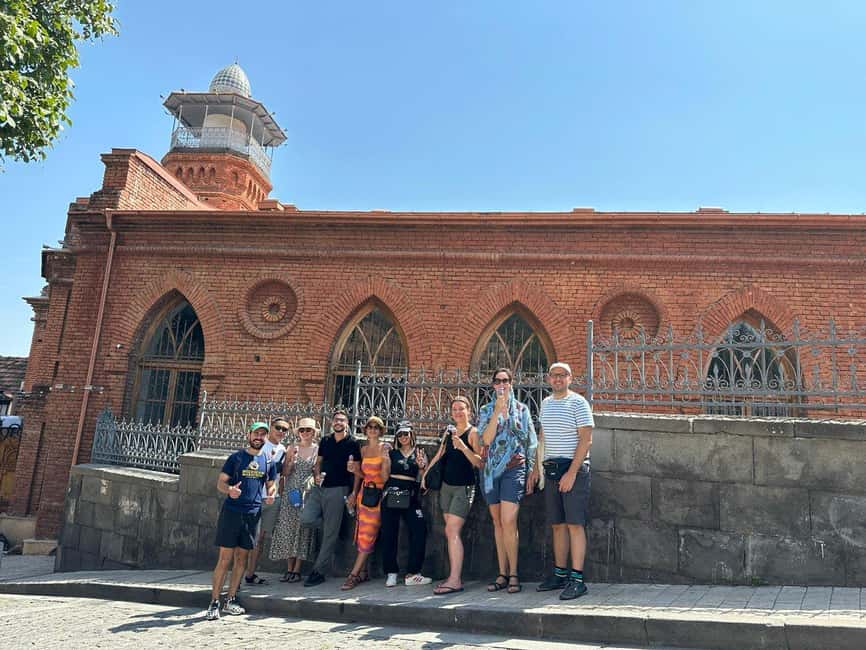
The Great Synagogue is the next major stop, with about 15 minutes for a guided visit. It is followed later by the Tbilisi Central Mosque, where you have another 15-minute guided stop and photo opportunity.
These visits are among the strongest parts of the route because they broaden your picture of Tbilisi. The city’s religious story is not limited to one tradition. A synagogue, mosque, churches, and the Patriarchate all appear within the same afternoon, giving you a clearer sense of the city’s layered identity.
The exact access and photography rules can vary by site, so follow your guide’s instructions. The stated restriction is clear for the churches: no interior photographs, with head coverings required for women and no shorts allowed. Modest clothing is the safest choice for the full route.
The mosque visit also helps you read the Old Town as a place shaped by different communities. You do not need a long lecture to appreciate this. Seeing several places of worship in one walking circuit makes the point naturally.
Rike Park and the cable car to Narikala
At Rike Park, the tour shifts from street-level history to a scenic ride. The cable car to the hill takes about 10 minutes, and the ride is included in the $38 price.
This is an important practical benefit. Tbilisi’s old streets lead into hills, and the cable car gives you a break from climbing while also providing a new view of the city. As you rise, you can look across rooftops and toward the Mtkvari River. The ride is brief, but it changes your sense of the city’s shape.
The stop also adds variety late in the tour. After churches, streets, statues, and indoor visits, you get open views and a little air. If you are taking photographs, have your camera ready before the car begins moving.
Mother of Georgia and the final city view
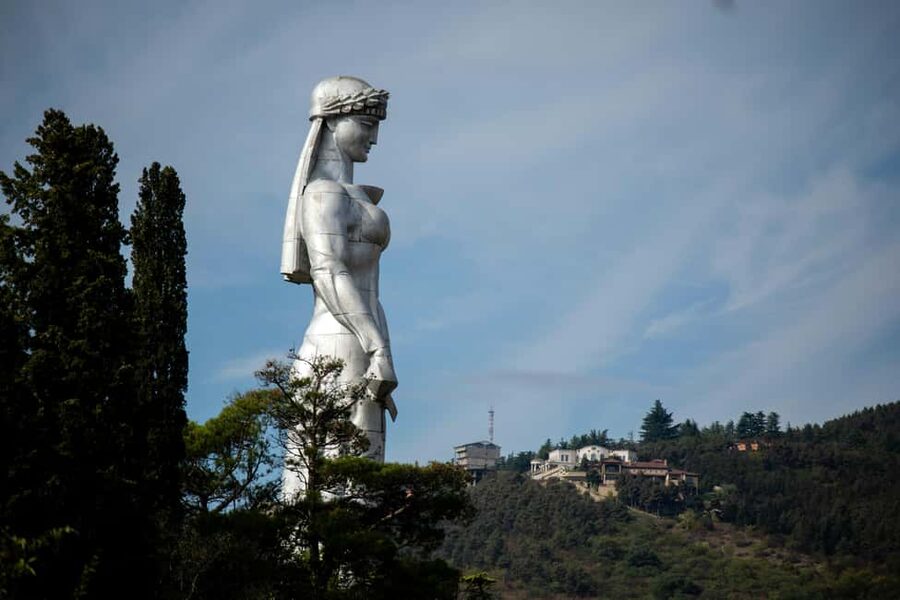
The tour finishes at Kartlis Deda, better known as Mother of Georgia. The monument holds a sword in one hand and a bowl of wine in the other. Your guide explains the image as a symbol of strength, pride, generosity, and welcome.
This is a good final stop because it gathers several themes from the afternoon. Tbilisi has endured, defended itself, welcomed outsiders, and kept its traditions alive. The monument turns those ideas into a simple image you can remember.
From the hill, you get broad views over the rooftops, the Mtkvari River, and Narikala Fortress. The view is likely to be the visual high point of the tour, especially if the weather is clear. Since the experience requires good weather, poor conditions can lead to a different date or a full refund.
The tour ends at Mother of Georgia rather than returning you to the starting point. That matters if you have a timed reservation afterward. Plan your next move from the hill, not from the Berikaoba meeting point.
What $38 gets you
At $38 per person, the tour offers a solid bundle for a first afternoon in Tbilisi. You receive a guided walk, explanations at major religious and cultural sites, the cable car ride, a wine tasting stop, and a final viewpoint. The price is easier to justify if you would otherwise pay separately for transport and a guide.
The bakery is not included, and the details of personal food or drink purchases are not specified. Carry cash so you can decide for yourself if something catches your eye. You are paying mainly for the route, guide, context, and cable car, not for a full meal.
The value also depends on how you like to see a city. If you want an independent wander with long pauses, this may feel too structured. If you want the main Old Town sights connected into one clear story, the price is reasonable.
The guides and language options
Tours are offered in English and Spanish. Guide Shmagi is specifically noted as a native Georgian who speaks Spanish fluently, explains the city with warmth, and gives practical suggestions about places to visit, things to do, and where to eat.
That sort of local advice can be especially useful at the start of a Georgia trip. You can ask questions during the walk and use the answers to shape the rest of your time in Tbilisi. The guide is not only pointing out buildings. He can help you understand how the city works for a short-term visitor.
If you book in Spanish, check that your selected departure is assigned to a Spanish-speaking guide. The activity information confirms English and Spanish availability, but it does not give a fixed guide schedule.
Who should book this walk
I would recommend this tour to a first-time visitor who wants a quick introduction to Tbilisi without spending a full day on a bus. It suits people who enjoy history, architecture, religious sites, local food, wine, and city views in one package.
It is also a good choice early in your stay. The route covers enough ground to help you get your bearings, while the guide’s advice can point you toward later meals and visits.
You should think twice if you have mobility limitations. The tour is on foot, includes old streets and hill terrain, and is not suitable for people with mobility impairments. It also may not suit anyone seeking a quiet, unhurried church visit, since the itinerary contains many stops within three hours.
Comfortable shoes, water, a camera, cash, and modest clothing will make the afternoon easier. Remember that travel time counts within the three hours, so the tour moves at a steady pace.
Should you book it?
Book this tour if you want Tbilisi explained through its churches, shared religious spaces, food customs, and hilltop views rather than through a checklist of monuments. The strongest reasons are the mix of sites, the included cable car, the wine stop, and the chance to ask an English or Spanish-speaking local guide about the city.
Skip it if you need step-free access, dislike walking, or prefer to explore at your own speed. For most able-bodied first-time visitors, $38 is a fair price for a compact introduction that ends with one of Tbilisi’s best views.
FAQ
How much does the Tbilisi Old Town tour cost?
The tour costs $38 per person.
How long does the tour last?
The experience lasts three hours, including travel time.
Where is the meeting point?
Meet at 17 Ioane Shavteli Street beside the Berikaoba monument, near Ambassadori Tbilisi Hotel.
Where does the tour finish?
The tour finishes at Mother of Georgia, also called Kartlis Deda.
Is the cable car ride included?
Yes. The cable car ride to Narikala mountain is included.
Which languages are available?
The tour is offered in English and Spanish.
Is hotel pickup included?
No. Hotel pickup and drop-off are not included.
Is food from the bakery included?
No. Bakery purchases are not included.
What should I wear for the church visits?
Women need a head covering, and shorts are not allowed in the church. Modest clothing is recommended.
Can I take photographs inside the churches?
No. Photography inside the church is not allowed.
Is the tour suitable for people with mobility impairments?
No. The activity is not suitable for people with mobility impairments.
What happens if the weather is poor?
The experience requires good weather. If it is canceled because of poor weather, you can receive a different date or a full refund.
Can I cancel the booking?
Yes. You can cancel up to 24 hours in advance for a full refund.
Do I have to pay when I book?
No. Reserve now and pay later is available, so you can keep your plans flexible.
Just added around the world
- Scenic Train ride to historical cities of Morretes and Antonina★ 4.0 · 188 reviews
- 6-Day Cultural Tour to Machu Picchu★ 5.0 · 76 reviews
- The Curacao’s Colorful History Walking Tour★ 5.0 · 55 reviews
- Discover Scuba Diving Amathounta’s Ancient Port★ 5.0 · 30 reviews
- Jewish Heritage of Curacao★ 4.5 · 68 reviews
- Olous – Guided Snorkelling Excursion to Discover Olous Sunken Ancient City★ 4.5 · 31 reviews
- Night Walking Tour of Medieval Cuenca★ 5.0 · 64 reviews
- WWII – The Battle of Crete Day Tour★ 5.0 · 103 reviews