
Review · FRANCE
1 day Canadian WW1 private tour including Vimy Ridge
Canada’s First World War story comes sharply into focus on this private day out from Arras. You walk through the trench system at Vimy Ridge, face the old no-man’s-land, and then follow the Canadian front south toward the Somme. Guide Olivier Dirson uses battlefield maps and photos on the vehicle’s GPS screen, helping you see how the lines moved across ground that now looks calm and rural.
I like two things right away: the tiny group size, capped at three, and the clear Canadian focus. You are not being hurried through a large group tour with a general wartime speech. The main concern is time. Seven hours covers a lot of ground, so expect a full day with driving between sites, and remember that lunch is extra.
The Canadian battlefield story in five key points
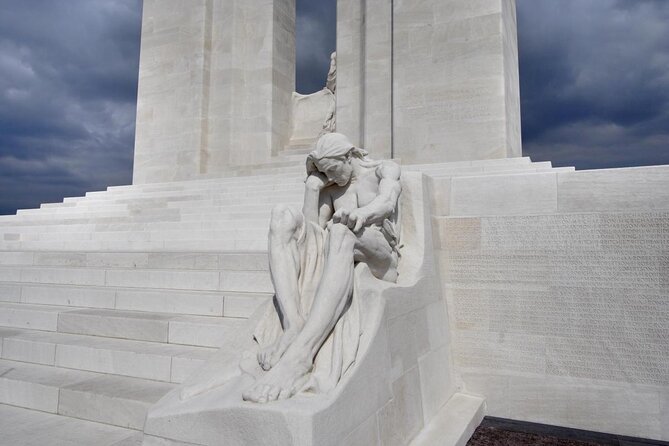
- Walk inside the Grange Tunnel area at Vimy Ridge, when attendance allows, then cross from the Canadian line toward the German trench system.
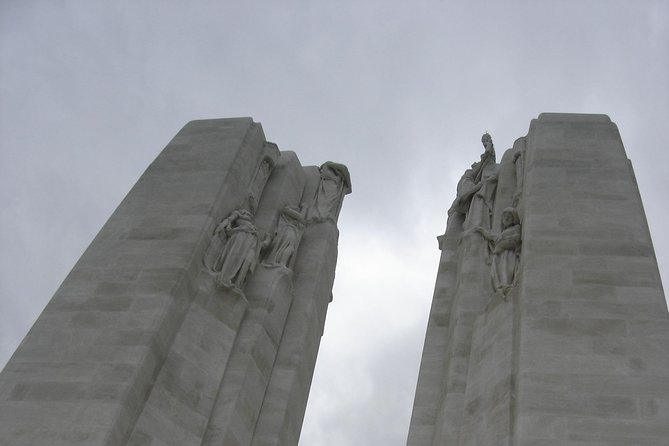
- See the Vimy Memorial in context, rather than treating it as an isolated monument.
- Visit Givenchy Road Canadian Cemetery, where 108 Canadians killed on April 9 and the days after are buried.
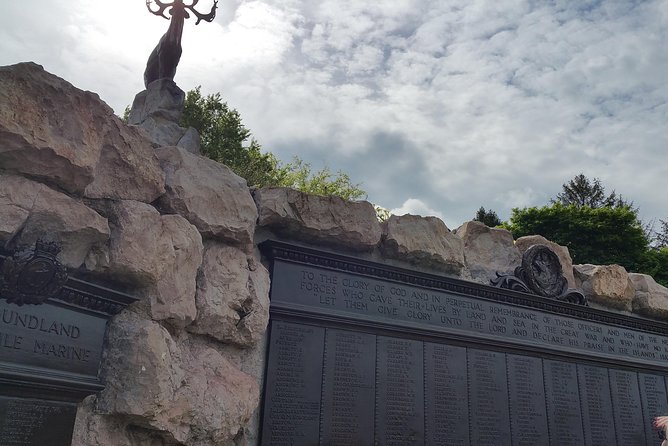
- Stand among preserved trenches at Beaumont-Hamel, including the Caribou Memorial and the Danger Tree.
- Use historic maps and photos in the vehicle to connect Vimy, Arras, the Somme, and Courcelette.
Why this private Canadian tour works
The best battlefield tours do more than point out monuments. They help you understand distance, direction, terrain, and timing. This tour does that by linking several Canadian sites across northern France, from the April 1917 Battle of Arras to the Somme fighting of 1916.
That sequence matters. Vimy Ridge is often the emotional center of a Canadian visit to France, but the surrounding sites explain how soldiers lived, attacked, and died. The smaller cemetery at Givenchy Road is personal and quiet. Beaumont-Hamel shows the physical shape of trench warfare. Courcelette connects Canada to the first use of tanks in battle.
You have Olivier Dirson as your driver and guide. His approach combines commentary in the vehicle with visual material shown through the car’s GPS system. That is useful here. A flat field can be hard to read without help, but a historical map showing trench lines and troop movements gives the ground a military shape again.
The private format also lets you ask questions without waiting for a group to catch up. If your family has a Canadian, Newfoundland, or military connection, Olivier can give more time to the places that matter most to you. The group limit of three keeps the day personal, though it also means the price is aimed at couples, families, or small parties rather than solo budget visitors.
More Private History Tours in France
- Private D-Day Experience from Bayeux
★ 5.0 · 573 reviews - Private guided American D-Day Tour from Bayeux
★ 5.0 · 255 reviews - Normandy Battlefields D-Day Private Trip with VIP Services from Paris
★ 5.0 · 240 reviews
Starting at Vimy Ridge and the Grange Tunnel
The day begins at about 9:30 am, with pickup arranged at a preferred location in Arras, Amiens, or Saint-Quentin. You are not restricted to one fixed meeting point. A train station, hotel, or bed-and-breakfast can be used, with the final details arranged after booking.
At Vimy Ridge, the first stop is the visitor centre area. Depending on attendance, the Grange Tunnel visit may be added. This is an important qualification: tunnel access is not presented as guaranteed, so you should see it as a possible extra rather than the central promise of the day.
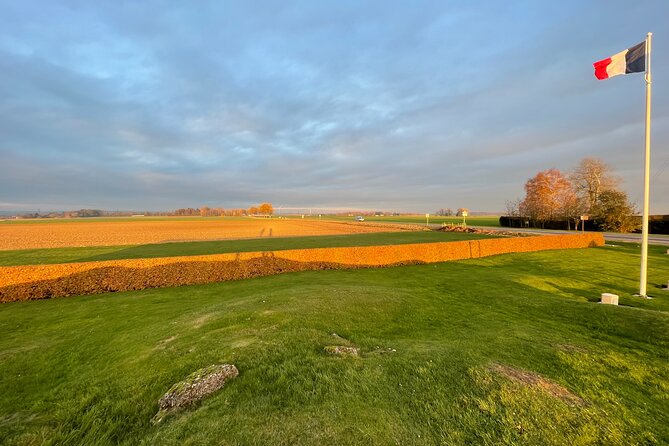
The trench section gives the tour its strongest physical connection to the past. You cross the former no-man’s-land from the Canadian side and enter the German trench system opposite. The preserved earthworks help you understand why trench warfare was so difficult to break. You are not just looking at a memorial inscription. You are following the shape of the battlefield on foot.
Allow about two hours for this opening section. That time includes the visitor centre, trench area, and Vimy Memorial, with the exact balance shaped by access and attendance. Wear shoes that can handle uneven ground, and expect the outdoor portion to feel more demanding in wet weather.
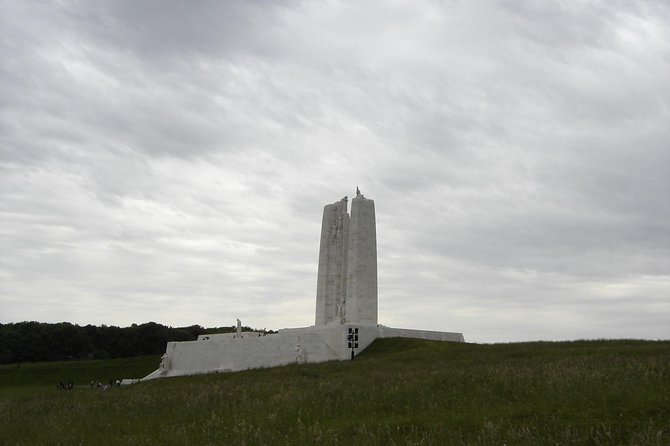
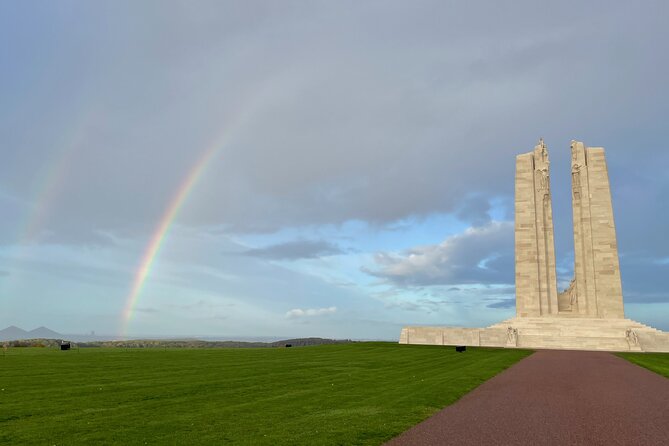
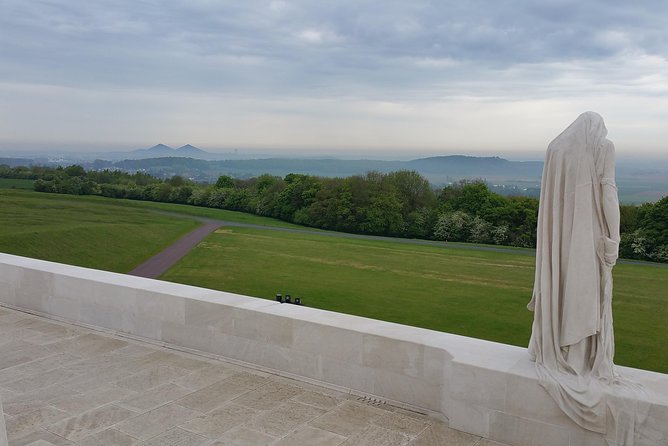
The Canadian National Vimy Memorial comes after the trench visit. Designed by Walter Seymour Allward and fully refurbished in 2007, it is the grandest monument on this route. The scale can be startling, but the guide’s battlefield explanation keeps it connected to the men and units who fought nearby.
I especially like the order here. You first see the ground and the trench system, then the memorial. That makes the monument feel less like a standalone photo stop and more like a marker of the battle you have just begun to understand.
Givenchy Road Cemetery and the human scale of war
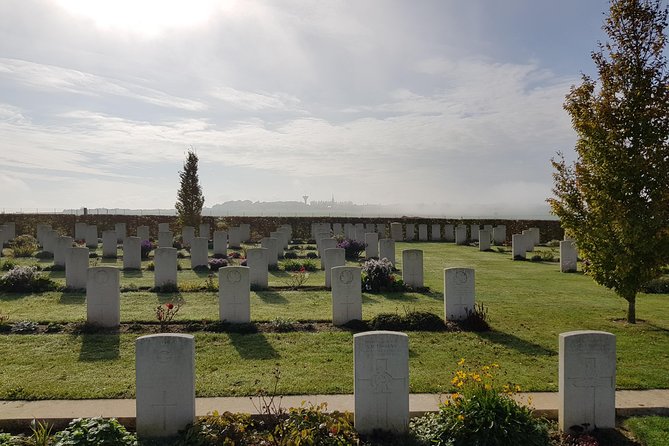
Before heading south toward the Somme, the tour pauses at Givenchy Road Canadian Cemetery. This is a short stop of about 15 minutes, but it carries a weight that the larger Vimy site cannot quite provide.
The cemetery contains the graves of 108 Canadians who died on April 9, 1917, and in the following days. The date places these names directly into the opening phase of the Battle of Arras. You can move from the large national memorial to a much quieter burial ground where the cost of that offensive is counted one grave at a time.
Fifteen minutes is enough for a respectful visit, though you may wish it were longer if you want to read many headstones. The tour has a tight schedule, and the short pause helps preserve time for the Somme sites later in the day.
Lunch near Pozières and La Boisselle
The lunch break lasts around 45 minutes and takes place at a local café or restaurant in La Boisselle or Pozières. Lunch is not included in the tour price, so plan to pay separately.
This is more than a practical fuel stop. Both villages sit within the Somme battlefield area, and the setting keeps the meal tied to the day’s subject. One possible choice is Le Tommy, a café and war museum that displays wartime items, including pieces visitors can touch. The exact lunch venue can vary, but the tour’s past arrangements have included this kind of local, informal stop rather than a rushed meal at a generic roadside chain.
The tradeoff is clear. A local café gives you a more grounded break, but you do not get a long restaurant lunch. Forty-five minutes is enough for a simple meal and a breather, not a leisurely afternoon table.
If you are travelling with children, the stop can also provide a useful pause before the outdoor visit at Beaumont-Hamel. Children must be accompanied by an adult on the tour.
Same city, a different century:
- Normandy D-Day Sites & Cemetery Day Trip from Paris with Lunch
★ 5.0 · 6,877 reviews - Paris: Louvre Museum Entry with History of Mona Lisa
★ 3.9 · 2,823 reviews - Normandy D-Day Small-Group Day Trip with Omaha Beach, Cemetery & Cider Tasting
★ 5.0 · 2,786 reviews - Normandy D-Day Beaches and American Cemetery Day Trip from Paris
★ 4.5 · 2,673 reviews
Beaumont-Hamel and Newfoundland’s terrible morning
After lunch, the route turns to the Newfoundland Park of Beaumont-Hamel. This is one of the most affecting stops for anyone interested in Newfoundland’s military story.
The Newfoundland Regiment suffered the second-highest casualty level of any regiment on the first day of the Battle of the Somme. The park’s preserved trench system makes that event easier to picture. You can see the defensive cuts in the ground and the exposed space between opposing positions, rather than relying only on dates and casualty figures.
The Caribou Memorial and the Danger Tree face the former German line. Those features give the visit a clear visual focus, but the preserved trenches do the harder work. They show how close the two sides could be and how little protection earthworks offered once troops moved out into open ground.
Plan on about an hour here. If you have a Newfoundland connection, tell Olivier before or during the tour. He has made a point of giving Newfoundland visitors extra time at Beaumont-Hamel when possible, which can make this stop more meaningful than a standard timed visit.
This is also one of the more physically demanding parts of the day. You are walking outdoors over uneven ground, and the emotional tone is serious. It is not a theme park or a museum display designed to entertain. Give yourself room to be quiet.
Courcelette and the Somme connection
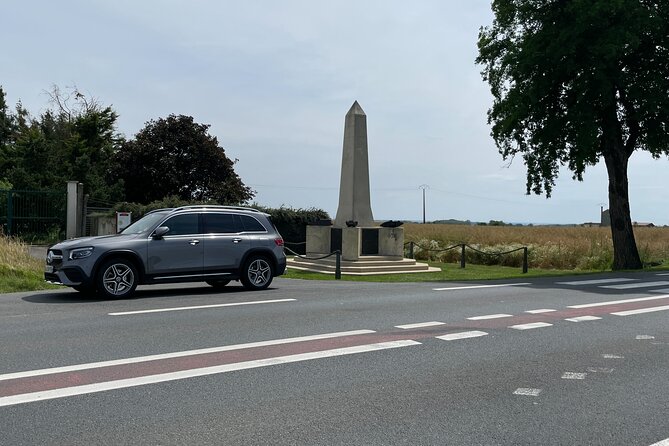
The final named stop is the Canadian Memorial at Courcelette, reached after the Vimy and Beaumont-Hamel sections. The visit lasts about 15 minutes.
Courcelette was captured by Canadian forces in mid-September 1916. On that same day, tanks were used for the first time in history. That detail gives the stop a wider military importance. The Canadian action was part of a battle still fought through mud, trenches, infantry attacks, and terrible losses, but the arrival of tanks hinted at a new kind of warfare.
A quarter of an hour is enough to see the memorial and hear the main explanation. It is not enough for a long, reflective walk, so I would think of Courcelette as the closing piece of the route rather than its emotional high point.
The itinerary makes good historical sense even though the stops are spread out. Vimy represents the Canadian role in Arras in 1917. Courcelette and Beaumont-Hamel bring you into the Somme fighting of 1916. Olivier’s maps help bridge the gap between dates and places.
Olivier’s guiding style and the value of the vehicle
Much of this tour’s value comes from the commentary between stops. Northern France can look deceptively ordinary from the road. Without context, you may see villages, farm fields, and roads. With historic maps displayed on the vehicle’s GPS system, you can track troop positions and understand how the front shifted.
Olivier is especially useful if you want more than a short introduction. He explains Canadian and British operations, troop movements, tactics, and the way the separate battle sectors fit together. He also helps with practical travel details, including directions for reaching Arras by train from Paris.
That last point matters because the tour cannot originate in Paris. You need to arrange your own way to Arras, Amiens, or Saint-Quentin, then use the flexible pickup service from there. For many visitors, Arras is the simplest base, but the pickup area also gives you options if your itinerary is built around Amiens or Saint-Quentin.
The vehicle includes bottled water and private transport. You avoid the uncertainty of changing trains or arranging taxis between scattered cemeteries and memorials. The price pays for that transport, the guide’s time, and the private format, not just admission to sites that are mostly free.
Price, group size, and who gets good value
At $372.43 per person, this is not a bargain sightseeing bus. It becomes more reasonable when you divide the cost across two or three people and consider that it includes a private vehicle, a licensed local guide, live commentary, pickup within the stated area, and a seven-hour route.
The strongest value is for people who want interpretation. If you only want to photograph the Vimy Memorial, you can visit for less on your own. But arranging Vimy, Givenchy Road, Beaumont-Hamel, Courcelette, and a lunch stop in one day requires transport and planning. The guide also supplies the military maps and narrative that make the sites connect.
The tour suits:
- Canadians tracing family or national military history
- Visitors with a strong interest in the First World War
- Couples or small families who prefer a private day
- People staying in Arras, Amiens, or Saint-Quentin
- Visitors who want a focused Canadian route instead of a broad Western Front overview
It may not suit you if you want a relaxed day with long stops, a large museum component, or a departure from Paris. The schedule is efficient, and the main sites are open-air memorials, cemeteries, trenches, and battlefield ground.
Practical details before you book
The experience lasts about seven hours and is offered in English. Pickup is flexible within the Amiens, Arras, and Saint-Quentin areas, but you should provide your preferred location after booking. Confirmation is sent within 48 hours, subject to availability.
Most people can take part, but outdoor walking is involved. Children must be with an adult. Bottled water is included, while lunch is not.
The tour offers free cancellation up to 24 hours before the local start time for a full refund. Cancellations or changes made inside that 24-hour window are not accepted for a refund.
Should you book this Vimy and Somme tour?
I would book it if your main goal is to understand Canada’s First World War role across several battlefields, not just to see one famous monument. The combination of Vimy’s trenches, Givenchy Road Cemetery, Beaumont-Hamel, and Courcelette gives you a stronger picture than a single-site visit.
I would also choose it for the private access to Olivier’s time and the small group limit. His battlefield maps, local knowledge, and ability to adjust attention to Canadian or Newfoundland connections add real value.
I would skip it only if $372.43 per person feels too high for a private day, if you need a Paris departure, or if you prefer a slower schedule. For a small group already based in northern France, this is a focused and thoughtful way to visit the Canadian battlefields, with enough personal guidance to make the ground speak.
FAQ
How long is the Canadian WWI tour?
The tour lasts approximately seven hours.
Where can the tour pick me up?
Pickup can be arranged within the Amiens, Arras, and Saint-Quentin areas. Possible locations include a train station, hotel, or bed-and-breakfast.
Can the tour start in Paris?
No. The tour cannot originate from Paris because of the travel distance and time limits. You need to arrange pickup in the Amiens, Arras, or Saint-Quentin area.
Is the tour private?
Yes. It is a private activity for your group, with a maximum group size of three people.
Is lunch included?
No. Lunch is not included in the price. The itinerary allows about 45 minutes for lunch at a local café or restaurant in La Boisselle or Pozières.
Is the Grange Tunnel visit guaranteed?
No. The Grange Tunnel visit depends on attendance and access conditions, so it may be added when possible.
What is the cancellation policy?
You can cancel at least 24 hours before the local start time for a full refund. Cancellations or changes made less than 24 hours before the start are not accepted for a refund.
More Day Tours in France
- Paris: Normandy D-Day Sites Guided Day Trip with Lunch
★ 4.7 · 1,082 reviews - From Strasbourg: Best Of Alsace Historical Day Trip
★ 4.7 · 633 reviews - From Paris: Normandy D-Day Beaches Day Trip
★ 4.6 · 566 reviews - From Strasbourg: Medieval Villages & Wine Tasting Day Trip
★ 4.8 · 329 reviews
Just added around France
- Medieval Carcassonne: Interactive Ghost Story & City Game★ 3.5 · 33 reviews
- Carcassonne ‘s Medieval Walls: A Self-Guided Tour★ 4.5 · 43 reviews
- Carcassonne During World War 2★ 5.0 · 127 reviews
- Small Group Guided D-Day Tour and Mémorial de Caen Museum★ 5.0 · 237 reviews
- Normandy: Private tour D-Day landing beaches American sector★ 5.0 · 62 reviews
- Mémorial de Caen Museum Admission and Guided Tour of D-Day Sites★ 4.5 · 275 reviews
- Private Day Tour including Normandy Landing Beaches & Battlefields from Caen★ 5.0 · 53 reviews
- Private Bordeaux History Tour with a glass of Bordeaux wine.★ 5.0 · 28 reviews
France History Tours, compared.

Normandy D-Day Sites & Cemetery Day Trip from Paris with Lunch
Read our review →
Paris: Louvre Museum Entry with History of Mona Lisa
Read our review →
Normandy D-Day Small-Group Day Trip with Omaha Beach, Cemetery & Cider Tasting
Read our review →
Normandy D-Day Beaches and American Cemetery Day Trip from Paris
Read our review →
Normandy American D-Day Beaches Full Day Tour from Bayeux
Read our review →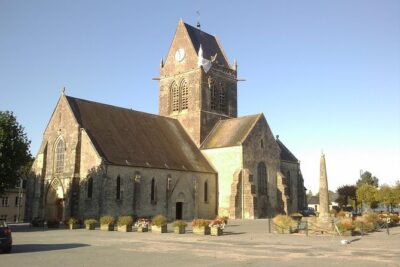
Normandy American D-Day Experience – Group tour from Bayeux
Read our review →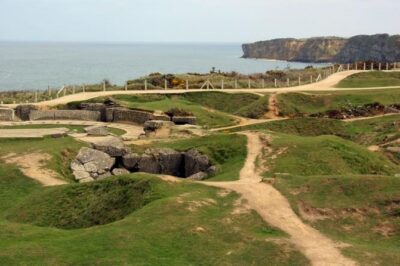
Normandy Beaches Half-Day Afternoon Trip from Bayeux (A2)
Read our review →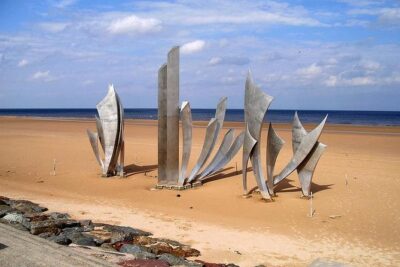
Omaha Beach D-Day Experience – Afternoon group tour from Bayeux
Read our review →Browse the lists this tour appears in