
Review · ATLANTA
2.5hr Guided Segway Tour of Historic Atlanta
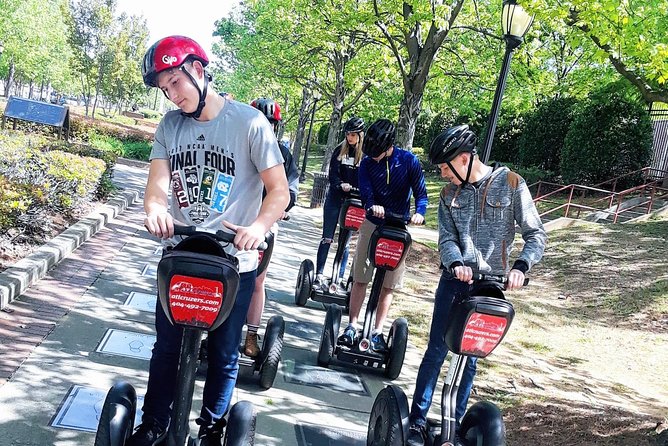
Atlanta’s past and present come together on this 2.5-hour Segway tour, which links civil rights landmarks, Victorian neighborhoods, a historic cemetery, public art, and the modern BeltLine. You cover far more ground than on foot, yet you still get close enough to notice old houses, murals, and changing streets.
I like the careful training, especially for first-time riders, and the route’s mix of serious history and easygoing city sights. Guides such as Jet, Jett, Jeremy, and Steve are praised for being patient, funny, alert to road hazards, and good at keeping the stories moving. The main drawback is that you only get a few minutes at some major stops, so this is an overview rather than a substitute for visiting the King Center or exploring Oakland Cemetery on foot.
Key points to know before you book

- Training comes first: Plan on 15 to 30 minutes learning to start, stop, steer, and handle the Segway before leaving downtown.
- The route covers several sides of Atlanta: You ride through Old Fourth Ward, Inman Park, Cabbagetown, Downtown, and along the Eastside Trail of the Atlanta BeltLine.
- Civil rights history is central: Ebenezer Baptist Church and the Martin Luther King Jr. National Historic Site anchor the historical side of the tour.
- The best photo stop is Jackson Street Bridge: You get a clear downtown skyline backdrop for a group picture.
- Krog Street Market provides a useful break: The stop lasts about 10 minutes, enough for a quick drink or bite.
- Comfort and safety rules matter: Wear flat, closed-toed shoes, avoid loose clothing and flip-flops, and note the 100 to 260 pound weight requirement.
Why a Segway works well in Atlanta
Atlanta is spread out, and its most interesting districts do not sit in one compact historic center. A walking tour can show you one or two neighborhoods well, but it cannot easily connect the Martin Luther King Jr. National Historic Site, Oakland Cemetery, Inman Park, Cabbagetown, and the BeltLine in one morning.
A Segway solves part of that problem. You move at a steady pace without the fatigue of a long walk, and the open-air ride gives you time to look around. You are not sealed behind a bus window. You can hear the guide point out a building, mural, or street corner as you pass.
The tradeoff is attention. You must watch the pavement, other people, traffic, and the rider ahead of you. The tour is designed for beginners, but riding still takes balance and concentration. The guides place clear emphasis on training and safety, which is important here. Several first-time riders needed a little time to feel comfortable, while patient instruction from Jet, Jett, or Jeremy helped them settle in.
The group size is capped at 16 people. That is large enough to give the tour some energy, but small enough for the guide to keep an eye on the group. Your experience may depend on how quickly everyone learns the controls, so the training portion can vary within the stated 15 to 30 minutes.
More History Tours by Bike, Segway and Tuk-Tuk in the USA:
- Charlotte’s Ultimate Southern Charm Historical City Cart Tour
★ 5.0 · 1,347 reviews - Asheville Historic Downtown Guided Electric Bike Tour with Scenic Views
★ 5.0 · 1,234 reviews - Private Guided Historic Electric Cart Tour of St. Augustine
★ 5.0 · 1,194 reviews
Starting with training at 160 Ted Turner Drive
The tour begins at 160 Ted Turner Drive NW in Downtown Atlanta at 10:00 a.m. You receive the Segway and a safety lesson before setting off. The equipment is included, and no previous Segway experience is required.
Expect instruction on basic movement and handling rather than a quick explanation followed by immediate city riding. This is one of the strongest parts of the experience for a first-timer. Guides have been praised for staying calm, pointing out obstacles, and making sure riders feel ready before moving into busier streets.
You need to be at least 14 years old, and anyone under 18 must be accompanied by an adult. The stated weight range is 100 to 260 pounds, or 45 to 117 kilograms. The broader tour description gives a 300-pound upper limit, but the additional participation rules specify 260 pounds, so I would treat 260 as the effective limit and confirm if you are near it.
Wear weather-appropriate clothing, flat closed-toed shoes, sunscreen, sunglasses, and possibly a hat. Flip-flops and loose or hanging clothing are not allowed. Pregnant participants cannot join because of the risk of falling.
Ebenezer Baptist Church and the King historic site
The first major historical section centers on Ebenezer Baptist Church and the Martin Luther King Jr. National Historic Site in Old Fourth Ward. Ebenezer was led by Dr. King’s grandfather and father. It is also where King was baptized and where he and his father served as pastors.
The church gives the civil rights story a personal setting. Instead of hearing only about speeches and national events, you connect King’s public work with the family and religious community that shaped him. The stop itself is listed at about three minutes, followed by roughly five minutes at the national historic site, so the guide’s explanation matters.
The Martin Luther King Jr. National Historic Site includes several buildings, including King’s childhood home and the original Ebenezer Baptist Church. The site follows his life from childhood through his death and burial. You should think of this part of the tour as an introduction. If you want to enter buildings, spend time with exhibits, or visit the tomb at length, plan a separate visit.
That short timing may feel rushed for anyone coming mainly to study civil rights history. Still, the Segway route gives you the useful context of seeing where these places sit within the neighborhood, rather than treating them as isolated attractions.
Oakland Cemetery and the Atlanta skyline
From the King area, the route heads toward Oakland Cemetery, the oldest cemetery in Atlanta and one of the city’s largest green spaces. The grounds include the final resting places of figures such as Maynard Jackson, Margaret Mitchell, Bobby Jones, Civil War soldiers, and Kenny Rogers.
The cemetery offers a welcome change in pace. After city streets and historical discussion, you get leafy surroundings and a broad view toward the skyline. The listed stop is only about three minutes, so you will not have time to wander through the grounds or search for individual graves. Your guide can point out the cemetery’s importance, but this is another place to revisit if you want a slower look.
Oakland is valuable on this tour because it shows how Atlanta preserves open space in the middle of a growing city. It also puts the city’s past and present in one frame: historic graves in the foreground, modern buildings beyond them.
More Guided Tours in the USA:
- History and Hauntings of Salem Guided Walking Tour
★ 5.0 · 14,564 reviews - Historic Charleston Guided Sightseeing Walking Tour
★ 5.0 · 6,216 reviews - Historic Savannah Guided Walking Tour
★ 5.0 · 2,918 reviews - 2-Hour Gettysburg Battlefield Guided History Bus Tour with a National Park Guide
★ 4.5 · 2,201 reviews
Inman Park and the Battle of Atlanta
The ride continues through Inman Park, established in 1890 as Atlanta’s first planned community and one of the nation’s early garden suburbs. You see Victorian homes and the former home of the founder of Coca-Cola.
The neighborhood is also tied to the Civil War’s Battle of Atlanta in 1864. That detail helps explain how Atlanta’s residential streets can carry several layers of history at once. The tour does not pause for long here, with about two minutes listed at the stop, so you will mainly absorb the guide’s comments while rolling through.
I like this part because it shows Atlanta beyond its monuments. The historic houses, street plan, and connection to the battle give you a clearer sense of how the city developed. If you want architectural photos, keep your eyes open as you ride, since the group will continue moving rather than stopping at every house.
The BeltLine, Cabbagetown, and Krog Street Market
The tour then follows part of the Atlanta BeltLine, a former railway corridor being remade as a path around the city’s core. The Eastside Trail is one of the clearest examples of Atlanta’s current redevelopment. Old infrastructure becomes a route for walking, cycling, public art, dining, and neighborhood connections.
This is where the tour shifts from Atlanta’s past to its present. You see how a former rail corridor is being put to new use, and you get a feel for the changes affecting Inman Park, Old Fourth Ward, and nearby Cabbagetown.
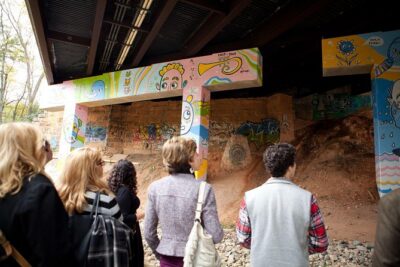
Cabbagetown began as a mill town and is now known for art, food, and public murals. One highlighted work is Forward Warrior, described as one of the city’s largest public mural projects. You pass through an area that feels different from the formal historic sites: more creative, local, and tied to current neighborhood life.
Krog Street Market is the midway break. The stop lasts about 10 minutes, giving you time to grab a quick bite or drink. It is not a full meal break, so do not arrive expecting a leisurely lunch. Still, it is a practical pause after riding and a chance to reset before the final stretch.
The market is described as Atlanta’s oldest food hall and sits along the BeltLine. That makes it a fitting stop: you see the redevelopment project, then pause at one of the businesses that benefits from the new foot and bike traffic around it.
Jackson Street Bridge and the downtown return
Jackson Street Bridge is the main skyline photo stop. It is known as a top place in the city for an iconic view of Downtown Atlanta, and the tour allows about five minutes for a group photo.
This is one of the most useful photography moments on the route because the skyline is the subject, not just a background glimpsed between buildings. Five minutes is enough for quick pictures, but not for a long photo session. Keep your camera ready and follow the guide’s instructions so the group can stay together.
The ride then returns toward the Downtown starting point. Along the way, the guide continues filling in Atlanta’s story, including the city’s neighborhoods, architecture, redevelopment, and past. Some descriptions also include a pass by a major educational institution in the heart of Downtown, though the exact stop and timing are not specified.
The activity ends where it began. You finish with a broad overview rather than a deep visit to any one attraction, which is exactly why the tour works best early in an Atlanta stay. It helps you decide which places deserve a longer return visit.
What the guide adds to the experience
The guide is the difference between simply riding through Atlanta and understanding what you are seeing. Jet and Jett are repeatedly praised for clear instruction, humor, patience, and careful attention to obstacles. Jeremy is also noted for being a calm teacher, especially with riders who have never used a Segway.
Steve has been described as keeping the information interesting and knowing people along the route, adding a more personal feel to the ride. Guide assignments can change, so you should not book on the assumption that one particular person will lead your tour.
The strongest pattern is not a single personality. It is the combination of instruction and active supervision. Guides point out road hazards, manage the group, and give historical details without turning every stop into a lecture. That balance matters because you are learning to operate a vehicle at the same time you are trying to look at Atlanta.
Is $69 a fair price?
At $69 per person, this is not the cheapest way to see Atlanta, but it covers equipment, a 2.5-hour guided route, training, and a local guide. You also get a small-group experience capped at 16 people, skyline photo opportunities, and a stop at Krog Street Market.
The value is strongest if you want to see several districts in one morning and are comfortable paying for convenience. Covering this route independently would require careful planning and a mixture of walking, public transportation, rideshares, or driving. You would also miss the guide’s running commentary and the basic Segway instruction.
The price is less compelling if your main goal is an in-depth visit to the King historic site, Oakland Cemetery, or the BeltLine. The stops are brief, and the tour is designed to connect places rather than explore them at length. In that case, use this experience as an orientation, then return to your priorities on foot.
The tour is highly rated overall, with a 4.9 rating from 311 reviews and 99 percent recommendation. There are also a small number of serious service complaints tied to cancellations and delayed refunds. That does not change the sightseeing value, but it is worth keeping in mind when your schedule is tight.
Who should book this Atlanta ride?
I would choose this tour for a first morning in Atlanta, especially if you want history, neighborhoods, and city views in one outing. It suits active adults, couples, families with teenagers aged 14 and older, and anyone who wants something more engaging than a standard bus circuit.
It can also work well for people in their 60s who are active and open to learning a new vehicle. The careful training helps, but you still need to balance, steer, and stay alert for the full ride.
I would skip it if you dislike small wheeled vehicles, have trouble standing or balancing, are pregnant, or want long visits inside historical attractions. Rain and poor weather can also affect the outing. If weather causes cancellation, you are offered another date or a full refund.
Free cancellation is available up to 24 hours before the 10:00 a.m. start. Inside that window, the payment is not refunded, and changes are not accepted.
Should you book it?
Book this tour if you want a lively introduction to Atlanta that combines the civil rights story with neighborhoods, public art, redevelopment, and skyline views. The strongest reasons are the thorough beginner training, the attentive guides, and the ability to cover a wide area without spending the morning on foot.
Do not book it expecting an extended museum visit or a slow cemetery walk. The stops are short, and the Segway itself is the main event. For a first look at Atlanta, though, it offers a smart mix of movement, history, and local detail for the price.
FAQ
How long does the Segway tour last?
The tour lasts approximately 2 hours and 30 minutes, including a 15 to 30-minute training session before the ride.
Where does the tour begin?
The meeting point is 160 Ted Turner Drive NW, Atlanta, Georgia 30303. The tour starts at 10:00 a.m. and ends back at the same meeting point.
Do I need previous Segway experience?
No. A guided training session is included, and the tour is designed for people who have not ridden a Segway before.
What is the minimum age?
The minimum age is 14. Children must be accompanied by an adult.
Is there a weight requirement?
Yes. Participants must weigh at least 100 pounds and no more than 260 pounds.
What should I wear?
Wear weather-appropriate clothing and flat, closed-toed shoes. Flip-flops and loose or hanging clothing are not allowed. A hat, sunscreen, and sunglasses are recommended.
Can pregnant participants join?
No. Pregnant participants are not allowed because of the risk of falling.
What places does the tour visit?
The route includes Ebenezer Baptist Church, the Martin Luther King Jr. National Historic Site, Oakland Cemetery, Inman Park, the Atlanta BeltLine Eastside Trail, Krog Street Market, Jackson Street Bridge, Cabbagetown, and Downtown Atlanta.
Can I cancel for a full refund?
Yes, if you cancel at least 24 hours before the scheduled start time. Cancellations made less than 24 hours before the tour are not refunded. If poor weather causes the operator to cancel, you are offered a different date or a full refund.
Just added around the USA
- Red Rocks Amphitheatre Historical Walking Tour★ 5.0 · 74 reviews
- 1-Hour Segway Tour of Cheyenne Cañon Art, History and Nature★ 5.0 · 36 reviews
- Colorado Springs – Guided Walking Ghost / History Tour★ 5.0 · 168 reviews
- Ancient Landscapes Private Geology Hike at Garden of the Gods★ 5.0 · 31 reviews
- Village Food Tours Lunch & History Tour★ 5.0 · 80 reviews
- 2.5 Hour Kayaking with Manatee and History Tour in Tarpon Springs★ 5.0 · 24 reviews
- Safety Harbor Ghost Tour★ 5.0 · 60 reviews
- Historical Bicycle Tour of Dunedin★ 5.0 · 44 reviews
Atlanta History Tours, compared.

Atlanta’s Black History and Civil Rights Tour
Read our review →
3-Hour Atlanta Beltline Food, Street Art and History Tour
Read our review →
2 Hour Historic Market Food Tour and Hands-On Biscuit Class
Read our review →
2-Hour Food, History and Street Art Tour of Ponce City Market
Read our review →
Atlanta: Black History & Civil Rights City Bus Tour
Read our review →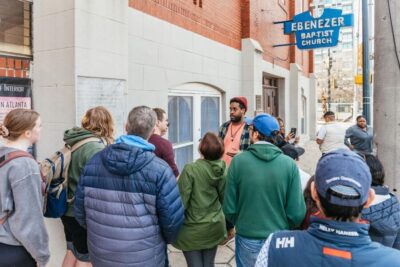
Atlanta: Martin Luther King Historical Park Walking Tour
Read our review →
Atlanta: Beltline Food, Street Art, and History Walking Tour
Read our review →Browse the lists this tour appears in