
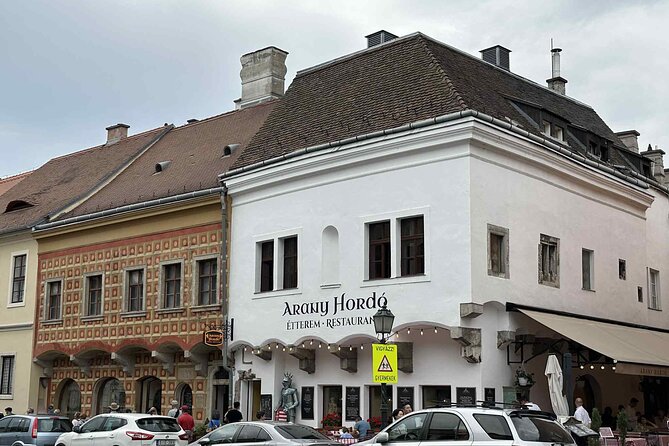
Review · BUDAPEST
Buda Castle Tour: History and Architecture
Buda Castle is not one building waiting to be toured. It is a hilltop record of Hungary’s wars, rulers, faiths, and rebuilding campaigns. This 3.5-hour walking tour reads that record through royal ruins, medieval streets, Gothic churches, Ottoman-era scars, and modern reconstructions.
I like the small maximum of 12 people, which gives the guide room to answer questions. I also like the use of archaeological evidence and historic images, including pictures shown on an iPad to help you picture buildings that no longer survive. The main drawback is clear: you do not tour inside the Royal Palace, Matthias Church, or the upper terrace of Fisherman’s Bastion.
Key points to know
- Buda Castle is treated as an archaeological site: You see foundations, reused medieval walls, and buildings shaped by centuries of destruction and repair.
- The walk reaches beyond the palace: Tárnok Street, Úri Street, the medieval Jewish quarter, and Bécsi Kapu Square reveal ordinary and aristocratic life.
- The Jewish Prayer House is included: This is one of the most meaningful stops, but it is closed on Saturdays and Mondays.
- The guide brings strong academic background: Matthew, also called Máté in tour feedback, is described as a historian and archaeologist who uses images to explain lost buildings.
- The route ends beside Matthias Church: You can continue on your own to visit the church interior or buy access to the upper Fisherman’s Bastion terrace.
- The walk requires stamina: It is not suitable for people with limited mobility, and children under 10 are not permitted.
A royal palace rebuilt again and again
The tour begins at the Statue of Prince Eugene of Savoy, near the Royal Palace. From here, you get your first lesson in the basic problem of Buda Castle: almost everything has been built, damaged, altered, or rebuilt more than once.
The palace began as a medieval stronghold. Over time, it became a royal residence and took on Gothic, Baroque, and Neoclassical features. Wars and political change repeatedly damaged the complex, leaving behind a mixture of surviving foundations, reconstructed façades, and later additions.
You spend about 20 minutes at the palace, but this is not an interior tour. The Royal Palace admission fee is not included. If you want to visit its museums or rooms, plan to return independently after the walk.
The short stop at the remains of the medieval Sigismund Church adds useful context. King Sigismund expanded Buda in the early 15th century and built a Gothic royal chapel as part of his palace complex. Today, the visible foundations in the lower courtyards point to the period when Buda was being shaped into an imperial residence.
This is the sort of stop that benefits from a guide. A few low walls can be easy to overlook. With the right explanation, they become evidence of a major royal building program.
More History Tours in Budapest:
- Budapest: Historic Cruise with Welcome Drink
★ 4.7 · 6,512 reviews - Budapest Historical Sightseeing – Free Walking Tour
★ 5.0 · 1,302 reviews - Buda Castle District Dark History, Legends and Vampire Night Tour
★ 4.5 · 1,240 reviews
Tárnok and Úri Streets reveal two sides of medieval Buda
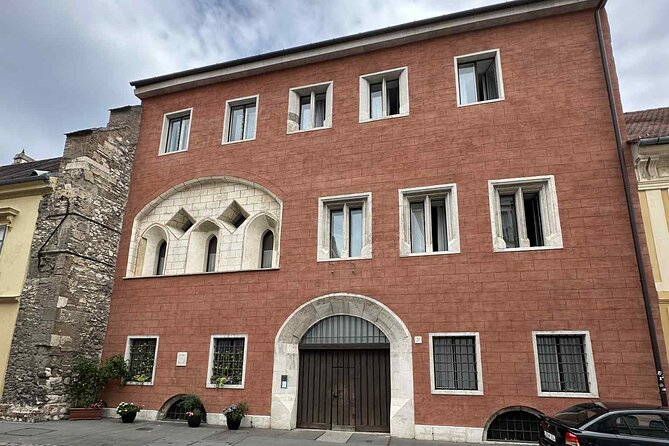
The walk then leaves the palace precinct and enters the former burgher town. Tárnok Street was the main commercial lane below the royal court. Its cobbled surface and old façades offer a useful change of scale: instead of focusing only on kings, you begin to see how merchants and householders lived.
The tour visits three historic buildings on original medieval foundations. You learn how goods were stored, traded, and displayed, and how the thick-walled houses served both business and domestic purposes.
I find this part especially valuable because it gives Buda a human scale. Royal ceremonies are important, but so are the shops, storage rooms, workshops, and homes that kept the town working. The 15-minute stop is brief, so do not expect long interior visits. Its value lies in the explanation of what survives behind the façades.
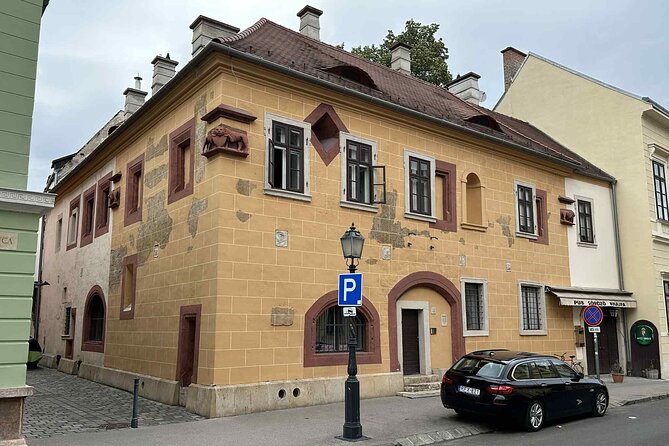
Úri Street was the more aristocratic quarter. Here, the focus shifts to noble residences, old gateways, and the social hierarchy of medieval Buda. Many buildings rest on 14th and 15th-century foundations, even where the visible façades belong to later periods.
The gateways are among the most interesting details. They were practical entrances for merchants, craftsmen, and residents, but their size and decoration also announced status. As you walk beneath them, the guide traces how noble architecture changed over time.
Churches, ruins, and the memory of siege
The Church of Saint Mary Magdalene is one of the clearest reminders that Buda’s religious map was once more varied than it appears today. Founded on the site of the earliest church on Castle Hill, it served the Hungarian-speaking population of the district.
The church was partly destroyed during the siege of Buda in 1686. Its ruined remains were later demolished under Hungary’s communist government in the 1950s. Only the medieval tower survived through the efforts of archaeologists and preservation workers.
Admission is not included, and the stop lasts about eight minutes. The tower is worth seeing for what it represents: not a complete church, but a surviving fragment that connects medieval worship, wartime damage, and modern preservation.
Országház Street brings another layer of Buda’s past. In medieval times, it was known as Italian Street because Italian merchants lived and worked here. Their presence reflects the commercial and cultural links that connected Buda with other parts of Europe.
Look for the surviving 16th-century sgraffito decoration, described as the only example of its kind in the Castle District. This delicate Renaissance detail is easy to miss among the larger stone buildings. The 15-minute stop shows how trade brought not only goods, but also styles, skills, and new ideas.
The former Royal Hungarian Ministry of Finance provides a sharper lesson in modern intervention. Built in the early 20th century in a Neo-Gothic style, it was designed to look at home among the medieval buildings. Its construction also removed several older structures.
World War II caused heavy damage, and later authorities simplified the façade. In the past five years, much of the original exterior has been reconstructed, though the work has caused debate because part of an original wing was demolished. This is a useful reminder that heritage decisions are not always simple. Restoring an old appearance can also mean removing something old that survived.
Matthias Church is nearby, but not part of the admission
The Church of the Assumption of the Buda Castle is usually called Matthias Church, though that is not its official name. The tour pauses here for about five minutes and explains the church’s changing religious and cultural role.
It was originally built for Buda’s German-speaking community, a detail that fits the broader story of a city shaped by several language groups. The church interior is not included in the price. You can visit independently after the tour, and the walk ends nearby at Szentháromság Square.
This arrangement is practical if you want to spend more time inside. It also keeps the walking tour focused on streets and archaeology rather than adding several admission queues.
Same city, a different century:
- Budapest: Sir Lancelot Medieval Dinner with Drink and Show
★ 4.1 · 1,155 reviews - BloodThirsty Hungary: Walking tour & Dark Historical Stories
★ 4.9 · 633 reviews - Budapest Jewish Heritage Memorial Walking Tour & Synagogue Entry
★ 5.0 · 568 reviews - Budapest: Jewish Heritage Guided Tour with Synagogue Ticket
★ 4.8 · 533 reviews
Fortuna Street connects printing, inns, and noble life
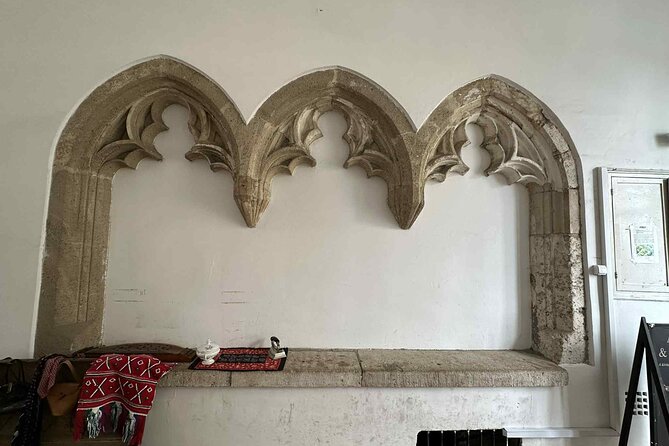
Fortuna Street has a calmer feel today, with restaurants and wine bars. In medieval Buda, it was lined with aristocratic residences and townhouses.
The street is linked to Andreas Hess, a German-born printer who produced Hungary’s first printed book, the Chronica Hungarorum, in the 1470s. That detail gives the street an intellectual side. It was not only a residential address, but also a place tied to one of Hungary’s early printing milestones.
The former Red Hedgehog Inn, or Vörös Sün, was another local landmark. It served as a meeting place for merchants, visitors, and intellectuals over the centuries. The stop works best if you enjoy small historical connections. You are not simply looking at old façades. You are being shown how a particular street once functioned as a center of commerce, lodging, and new ideas.
Bécsi Kapu Square and the National Archives
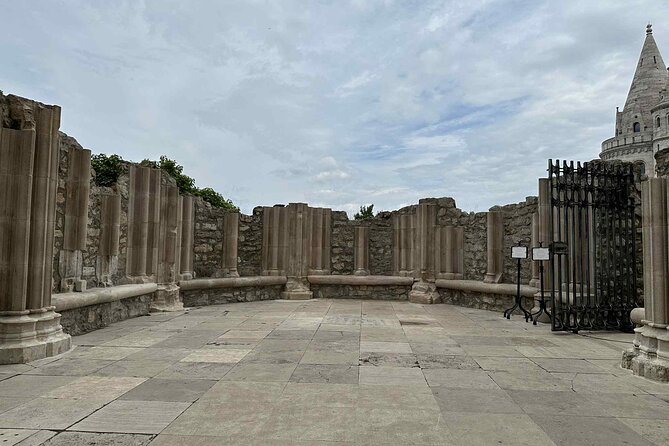
Bécsi Kapu Square once served as a marketplace and one of medieval Buda’s main entrances. The tour connects the square with Hungarian townspeople and the local Jewish community, who traded and worshipped in this part of the city.
The stop lasts only about five minutes, but it helps broaden the story of the Castle District. Buda was not merely a royal enclosure. It was also a working town with markets, neighborhoods, and communities living close together.
Nearby, the National Archives of Hungary presents a different kind of historical statement. Built in the early 20th century in a Neo-Romanesque style, it was designed to echo the medieval buildings around it.
Its heavy stonework, arched windows, and monumental form make it appear older than it is. Inside are documents covering Hungary’s written past, but the tour focuses on the building and its place in the district. I like this stop because it shows how modern Hungary chose to present its national memory through architecture.
The 1686 siege and the Ottoman past
Along the outer castle walls, the walk turns to the Siege of Buda in 1686. The route passes the location where Christian allied forces first broke through the walls. Nearby is the memorial to Arnavut Abdurrahman Abdi Pasha, the Ottoman Pasha of Buda who died during the battle.
A nearby monument honors the multinational Christian forces that fought in the city’s liberation. This section is important because it avoids treating the castle as a peaceful medieval postcard. Buda was a strategic stronghold, and its walls carry the marks of long conflict.
The explanation of the siege is likely to be one of the more demanding parts of the tour. The subject involves changing rulers, religious divisions, and military campaigns. A guide with historical training adds real value here, especially when the physical remains are limited.
The medieval Jewish quarter and its prayer house
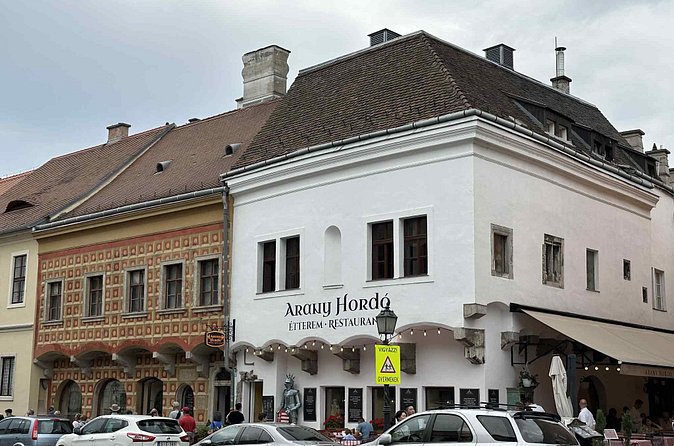
The medieval Jewish quarter is one of the most significant sections of the walk. The tour visits the site of a former Gothic synagogue and enters an excavated medieval Jewish Prayer House.
The prayer house is included in the tour price. It is small, but its scale is part of its power. You get a rare look at a surviving Jewish religious space from medieval Hungary and a reminder of a community that once formed part of daily life inside the Castle walls.
This is not a quick photo stop. The visit connects architecture with community, faith, and the destruction or silencing of historical memory. Keep the scheduling restriction in mind: the Jewish Prayer House is closed on Saturdays and Mondays.
Táncsics Street and the Dominican monastery
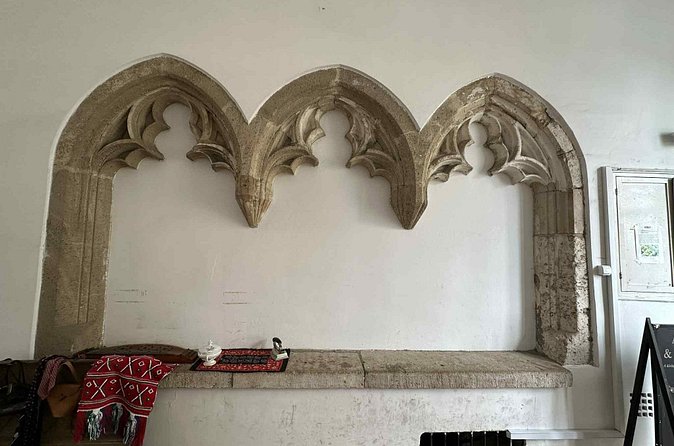
Táncsics Mihály Street shows how later residents reused older structures. Gothic walls and cellars were incorporated into Baroque and later homes rather than being completely removed.
This layered construction helps explain why Buda can feel visually confusing in the best way. A later building may contain a much older wall, while a modern façade may cover medieval foundations. The five-minute stop is short, but the idea is central to understanding the district.
At Dominikánus Udvar, you see the remains of the Dominican monastery of Saint Nicholas. The site is connected with Friar Julianus, who set out on a notable 13th-century journey from this order.
The ruins were later affected by fire, siege, neglect, and modern development. During construction of the Hilton Hotel, medieval stonework was combined with contemporary architecture. Some people will appreciate the bold contrast; others may find the pairing uneasy. Either way, it raises a serious question about how a living city should use historic ruins.
Fisherman’s Bastion and the tour’s practical ending
The final stop is Fisherman’s Bastion, with its famous views and the equestrian statue of King Saint Stephen, Hungary’s first Christian king.
You see the monument and main level, but access to the upper lookout terrace is not included. You can buy a ticket on site if you want the higher viewpoint. The tour ends beside Matthias Church at Szentháromság Square, giving you an easy choice: continue sightseeing, visit the church interior, or pause in the square.
The ending is well planned for independent exploration. You are not left at an isolated meeting point. You finish in one of the Castle District’s main public areas.
What the $43.25 price gets you
At $43.25 per person, the price is reasonable if you want history, architecture, and archaeology explained as one connected story. You are paying for an official English-speaking guide, a small group capped at 12 people, and admission to the medieval Jewish Prayer House.
You are not paying for the Royal Palace interior, Matthias Church, the Buda Castle Garden Bazaar, or the upper Fisherman’s Bastion terrace. Those costs are separate, so budget for them only if you plan to add more sightseeing afterward.
The value is strongest for first-time visitors who want to understand what they are seeing rather than simply photograph it. It is also a good choice for repeat visitors who have already seen the main viewpoints and now want the streets, foundations, minority communities, and architectural details.
The tour is offered in English and uses a mobile ticket. It is generally booked well ahead, with an average booking time of 44 days, so do not leave it until the last minute if your Budapest dates are fixed.
Who should book this Buda Castle walk?
Book it if you enjoy historical explanation, old streets, archaeological remains, and buildings that tell several stories at once. The guide’s background in history and archaeology is a major advantage, and the use of historic images helps make lost structures easier to understand.
It suits adults and children aged 10 or older who can manage a long walking route. It is not suitable for people with limited mobility, and you should expect a moderate level of physical effort.
The small group size makes it more personal than a large city walk. It also gives you a better chance to ask about details that catch your eye, from a gateway on Úri Street to a reused Gothic wall on Táncsics Mihály Street.
Should you book it?
I would book this tour if your main goal is to understand Buda Castle as a living historical district, not to tour a royal palace interior. The route gives you a strong mix of royal power, merchant life, religious history, Jewish heritage, wartime destruction, and modern reconstruction.
Skip it if you want a short sightseeing circuit, an indoor palace visit, or a tour built mainly around panoramic views. For everyone else, the combination of a 12-person maximum, an academically trained guide, and access to the medieval Jewish Prayer House makes this a solid use of half a day.
Free cancellation is available up to 24 hours before the start time. The experience depends on good weather and a minimum number of participants, so a cancellation may lead to another date or a full refund.
FAQ
How long does the Buda Castle Tour last?
The tour lasts approximately 3 hours and 30 minutes.
What language is the tour offered in?
The tour is offered in English with an officially licensed English-speaking guide.
Where does the tour begin?
The meeting point is at the Statue of Prince Eugene of Savoy in Budapest, 1013 Hungary.
Where does the tour end?
The tour ends at Szentháromság Square beside Matthias Church.
Is admission to the Royal Palace included?
No. The Royal Palace interior is not included, but you may visit it independently after the tour.
Is admission to Matthias Church included?
No. Admission to the interior of Matthias Church is not included in the tour price.
Is the upper terrace of Fisherman’s Bastion included?
No. The tour visits the main level. Access to the upper panoramic terrace requires a separate ticket.
Is the medieval Jewish Prayer House included?
Yes. Admission to the Jewish Prayer House is included, but it is closed on Saturdays and Mondays.
Just added around Budapest
- Time Machine Budapest Historical Exhibition Ticket★ 5.0 · 32 reviews
- Budapest Jewish Heritage: Synagogues, Shoes, Secrets & Flódni★ 5.0 · 47 reviews
- Michael Jackson History Exhibition Ticket★ 5.0 · 42 reviews
- Private Jewish Heritage Tour including Hotel Pickup★ 4.5 · 35 reviews
- Communist History Evening Walking Tour of Budapest★ 4.5 · 23 reviews
- Jewish Heritage / Full tour★ 5.0 · 59 reviews
- Jewish Heritage in Hungary with a Historian★ 5.0 · 37 reviews
- Budapest: Historic Downtown ride on E-Bicycles Buda & Pest★ 5.0 · 227 reviews
Budapest History Tours, compared.
Budapest Historical Sightseeing – Free Walking Tour
Read our review →
Buda Castle District Dark History, Legends and Vampire Night Tour
Read our review →
Budapest: Sir Lancelot Medieval Dinner with Drink and Show
Read our review →
BloodThirsty Hungary: Walking tour & Dark Historical Stories
Read our review →
Budapest Jewish Heritage Memorial Walking Tour & Synagogue Entry
Read our review →
Budapest: Jewish Heritage Guided Tour with Synagogue Ticket
Read our review →
Budapest Paddle Steamer Danube Cruise with Tokaj & Audio Guide
Read our review →Browse the lists this tour appears in