
Review · FRANCE
Medieval Carcassonne: Interactive Ghost Story & City Game
Carcassonne’s medieval citadel becomes a puzzle board in this self-guided ghost story, which leads you from the lower town across the Aude and up to Château Comtal. Instead of following a guide with a flag, you use the Questo app to find clues, solve challenges, and pick up stories about persecution, plague, architecture, and city life.
I like two things right away: the route connects the modern lower town with the fortified Cité, and you can stop whenever you need. At about $6 per person, it is also a low-cost way to add structure to a walk that you might otherwise make without much context.
The weak spot is the technology. Starting the game has been confusing for some people, and a few have been unable to access it at all. Download and test the app before you set off, and keep your phone charged.
Key points to know before you go
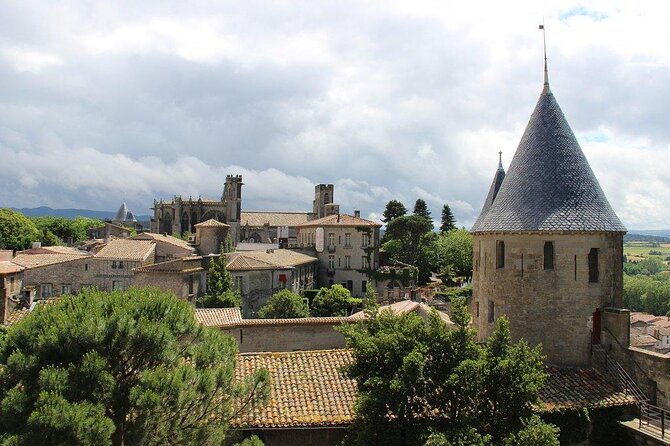
- A 3-kilometre route: Walk from Square Gambetta to Château Comtal through both the Bastide and the medieval Cité.
- Ten interactive puzzles: Use your phone to answer location-based challenges and move to the next stop.
- English-language play: The experience is offered in English, with no physical guide or audio guide.
- Flexible timing: The advertised play time is about 1 hour 40 minutes, but you can pause and resume later.
- A very low price: At $6 per person, it costs far less than a traditional guided tour, but you trade live explanation for app support.
- A private experience: Your group plays alone, without a guide or other participants joining you.
Starting at Square Gambetta in the lower town
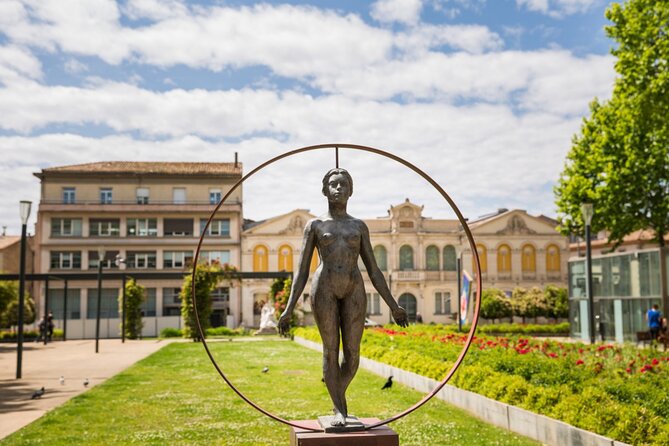
The game begins at Square Gambetta, across the river from the famous fortified Cité. This is not just a random meeting point. You are starting in La Bastide de Saint Louis, the planned lower town built under King Louis IX, often called Saint Louis.
That gives the route a useful shape. You do not begin inside the postcard version of Carcassonne. You begin in the later town, then work your way toward the walls and towers that most people come to see.
At the square, the app asks you to look around for the answer to your first challenge. This style of play rewards attention. You need to inspect signs, buildings, and details in the surroundings rather than simply follow a line on a map.
The first puzzle may take a little patience while you learn how the app works. The instructions are not as intuitive as some users expect, so allow extra time at the start. If the game does not open properly, use the app’s chat support or contact Questo rather than spending an hour guessing at the problem.
More Dark History and Haunted Tours in France
- Normandy D-Day Sites & Cemetery Day Trip from Paris with Lunch
★ 5.0 · 6,877 reviews - Normandy D-Day Small-Group Day Trip with Omaha Beach, Cemetery & Cider Tasting
★ 5.0 · 2,786 reviews - Normandy D-Day Beaches and American Cemetery Day Trip from Paris
★ 4.5 · 2,673 reviews
Crossing the Aude at Notre Dame de la Santé
The route then takes you toward the river and the small chapel of Notre Dame de la Santé. According to the local story presented here, the chapel was built in 1527 with money left by Jean de Saix. It served as a hospital for people suffering from the plague.
Its setting matters. The chapel stood near a narrow passage between fortified buildings, a strategic position at the approach to the old city. You get a sense of how disease, trade, religion, and defense overlapped in a medieval town.
This is one of the stops where the ghost-story format can make a grim subject easier for families to approach. The experience touches on plague and persecution, but it does not appear to be a full study of medieval disease. If you want detailed medical or religious history, you will need another source as well.
The river crossing also gives the walk a natural change of mood. Behind you is the lower town. Ahead are the bridge, the old walls, and the uphill route into the Cité.
The old cloth factory near Pont-Vieux
At the foot of Pont-Vieux, you stop at a building linked to Carcassonne’s later commercial success. A noble local family once owned the house. In 1694, it was bought by a person connected with Colbert, the powerful minister of Louis XIV, and turned into a cloth factory.
The factory received the title Manufacture Royale in 1696. The building still visible today is the former owners’ residence, not the whole industrial complex. Its design resembles buildings from the 18th century in the lower town.
This stop is useful because it widens the story beyond knights and fortifications. Carcassonne was also a place of production, trade, and wealth. The city’s story did not end with the Middle Ages, and the route gives you a glimpse of the economic period that followed.
You should expect an exterior puzzle rather than an indoor visit. The activity does not include admission to attractions, and the game is designed around looking at places from public areas.
Saint-Gimer Church and Viollet-le-Duc’s quieter work
The next stop is Saint-Gimer Church, built between 1854 and 1859 by Eugène Viollet-le-Duc. He is best known for restoring Carcassonne’s fortifications, but this church shows a more modest side of his work.
The building has a nave, two aisles, a polygonal apse, two vestries, and a porch. Its plain scale was deliberate. The church was intended to serve its neighborhood rather than impress with the size of a major cathedral.
I like this addition to the route because it keeps the walk from becoming a parade of medieval walls. You see how the city changed in the 19th century, when architects and local authorities were reshaping the way people understood Carcassonne’s past.
The puzzle asks you to inspect the church and its surroundings. If you are playing with children, this is a good place to slow down and explain that the city is not one single historical period. Roman, medieval, early modern, and 19th-century layers sit close together.
More Medieval History Tours in France
- Colmar, Medieval Village & Castle Small Group from Strasbourg
★ 5.0 · 769 reviews - From Nice: Provence and its Medieval Villages Full-Day Tour
★ 4.8 · 352 reviews - From Strasbourg: Medieval Villages & Wine Tasting Day Trip
★ 4.8 · 329 reviews - Nice: Medieval Villages Full-Day Guided Trip
★ 4.8 · 319 reviews
Porte de l’Aude, the dramatic entrance to the Cité
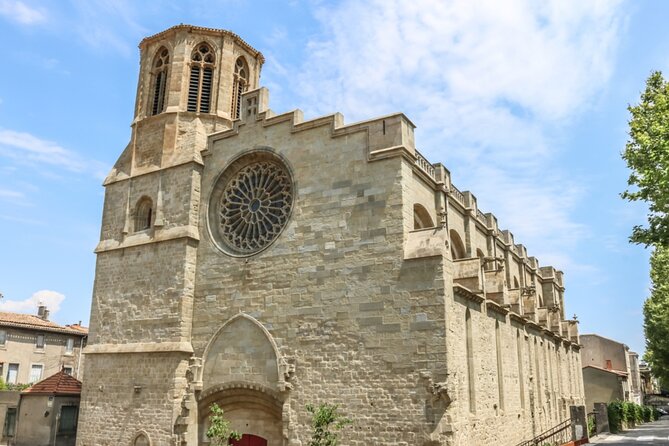
Porte de l’Aude is one of the most atmospheric points on the route. This preserved gate looks over the Aude and forms part of the medieval walled city.
The approach is important. You are not simply dropped at the main tourist entrance. The route brings you toward the Cité from the river side, where the walls and gate have a strong defensive presence. The location helps you understand why Carcassonne was so difficult to attack and why control of the river approach mattered.
At the gate, the app again asks you to examine the site for a clue. That makes the visit slower and more observant than a quick photo stop. You may need to look closely at architectural details before the next part of the story becomes available.
The route is around 3 kilometres, and some of it is uphill toward the citadel. The supplied information does not give a full accessibility assessment, so anyone concerned about steep sections or uneven ground should plan carefully. The activity is near public transportation, and most people can take part, but it is still an outdoor walking game.
The Inquisition Museum and the darker story
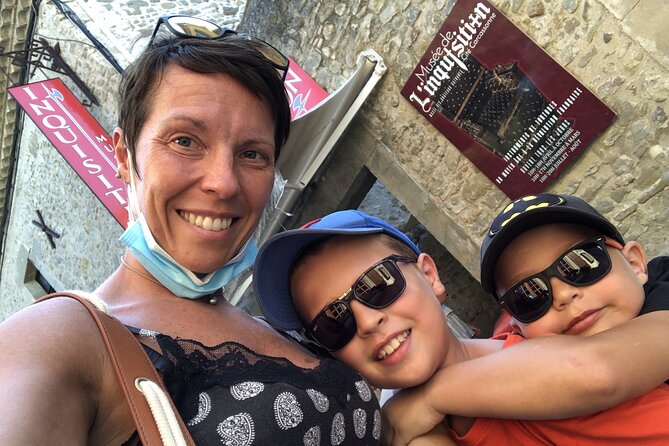
The Inquisition Museum occupies a large 17th-century building and presents instruments of torture dating from the 12th century through the French Revolution. It also covers important figures, biographies, Cathar castles, and the history of the Inquisition in the region.
The game uses this part of Carcassonne to bring in the darker side of the city’s past. Its central story includes medieval persecution, so the tone is not entirely light. Parents should decide if this material suits their children. One account found the history more suitable for children and architecture fans than for someone looking for detailed treatment of illness and persecution, so keep your expectations in check.
The museum itself may be an optional paid attraction rather than part of the game. Entry tickets are not included. You can complete the outdoor activity without assuming that museum admission is covered in the $6 price.
This is also where the difference between an app game and a guided tour becomes clear. A guide can adjust the explanation if you want more context about Cathars, the Inquisition, or the museum’s objects. The app gives you a set path and short pieces of information, then sends you on to the next challenge.
The cathedral and Château Comtal finish
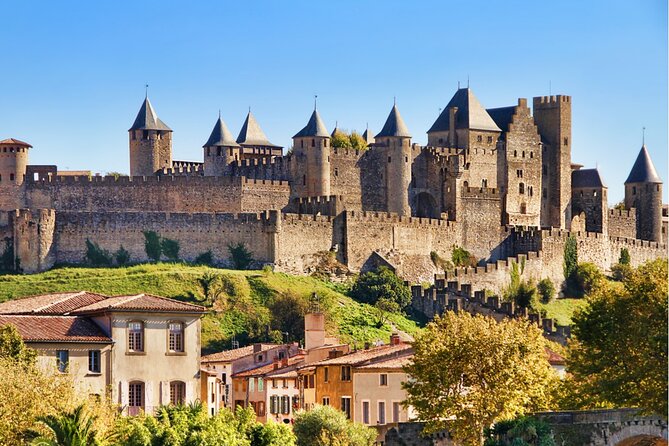
The final section brings you toward the cathedral and Château Comtal. The Romanesque cathedral began in June 1096. A Lady Chapel was added in the early 15th century, beside an infirmary and chapel built by Bishop Radulph in the 1260s.
The Château Comtal was built in the 12th century by Bernard Aton Trencavel over the western part of the Roman walls. That detail helps explain why the castle feels like more than a single building. It grew from earlier defenses and became the core of the fortified town.
The game ends at Château Comtal. You are guided step by step by the Questo app, but admission to the castle is not included. If you plan to tour the interior, treat the game and the castle visit as two separate expenses and time commitments.
This ending works well because the route has gradually built toward Carcassonne’s most famous sight. You begin with the lower town, cross the river, pass through later history, and finish at the medieval stronghold.
How the Questo app works in real life
You receive access to the mobile escape game through the Questo app. The experience is private and contactless, so only your group takes part. There is no physical guide, live commentary, or audio guide.
That last point matters. One person can use a phone to lead the group, and there is no audio narration included. If you expected headphones and a spoken tour, this will feel different. You read the story, inspect the site, and enter answers as you go.
The game includes ten puzzles along the route. Seven major locations are described in the route details, so some challenges may occur between the principal stops or form smaller steps within them.
You can start at any hour during the listed operating period, from 6:00 in the morning to 11:30 at night, every day. The advertised play time is about 1 hour 40 minutes, but the pause feature is one of the best practical features. If your phone battery is low, or you want lunch, you can stop and return later. The game can be resumed even more than 24 hours later.
For the smoothest start, install the required app before reaching Square Gambetta. Check that your booking email and QR code are available. If access fails, use Questo’s in-app chat, which is listed as available around the clock, or contact the provider at [email protected].
Is $6 per person good value?
At $6 per person, this is inexpensive by sightseeing standards. You get a planned route, ten puzzles, local stories, and a private activity that can occupy roughly two hours. The price is especially reasonable if you want something to do between major monument visits.
The value drops if you need a human guide or expect a full audio tour. You are paying for access to a digital game, not for an expert who can answer questions about architecture or change the pace for your group.
Also note the per-person pricing. The game may be played on one phone, but the stated cost is still per person. Group discounts are available, and groups larger than 15 should make multiple bookings.
Free cancellation is available if you cancel at least 24 hours before the start time. Cancellations within 24 hours are not refunded, so sort out the app and your plans before the final day.
Who should choose this Carcassonne game?
I would choose this for families with older children, couples who like puzzles, and independent visitors who want more purpose than a standard walk. It suits people who enjoy spotting small details and solving clues at their own speed.
It is also a sensible backup for a busy sightseeing day. You can begin early or late, pause for food, and return to it without staying with a fixed group.
I would not choose it as your only history experience in Carcassonne. The app offers a playful introduction, not a detailed lesson. It is also a poor fit if you dislike phone-based activities, need a guide in a language other than English, or want spoken narration.
The overall score of 3.5 reflects that split. The route and flexibility can be genuinely fun, while technical problems at the start have caused real frustration. The small price makes the risk easier to accept, but you still need to prepare your phone.
Should you book Medieval Carcassonne?
Book it if you want a cheap, private way to connect the lower town, Pont-Vieux, the river gate, and Château Comtal. The route has a good sense of progress, and the freedom to pause is ideal for a relaxed day in Carcassonne.
Skip it if you are looking for an in-depth guided tour, an audio guide, or guaranteed simplicity with the app. For the best chance of a smooth experience, install everything before arrival, bring a charged phone, and contact Questo quickly if the game does not start.
FAQ
Where does the Carcassonne game begin?
It begins at Square Gambetta, in La Bastide de Saint Louis, on the lower-town side of the Aude River.
Where does the activity end?
The route ends at Château Comtal in the fortified Cité. The Questo app provides step-by-step directions.
How long does the game take?
The advertised duration is about 1 hour 40 minutes. You can pause and resume later, so the total time can be longer.
Is a guide included?
No. This is a private, self-guided mobile game. There is no physical tour guide or audio guide.
Are monument admission tickets included?
No. Entry tickets to monuments and attractions are not included in the price.
What language is offered?
The experience is offered in English. Other languages are not listed as available.
Just added around France
- Carcassonne During World War 2★ 5.0 · 127 reviews
- Carcassonne ‘s Medieval Walls: A Self-Guided Tour★ 4.5 · 43 reviews
- Small Group Guided D-Day Tour and Mémorial de Caen Museum★ 5.0 · 237 reviews
- Normandy: Private tour D-Day landing beaches American sector★ 5.0 · 62 reviews
- Mémorial de Caen Museum Admission and Guided Tour of D-Day Sites★ 4.5 · 275 reviews
- Private Day Tour including Normandy Landing Beaches & Battlefields from Caen★ 5.0 · 53 reviews
- Private Bordeaux History Tour with a glass of Bordeaux wine.★ 5.0 · 28 reviews
- Historical Center, Bordeaux Food Tour★ 5.0 · 33 reviews
France History Tours, compared.

Normandy D-Day Sites & Cemetery Day Trip from Paris with Lunch
Read our review →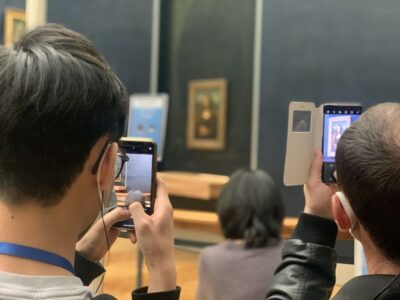
Paris: Louvre Museum Entry with History of Mona Lisa
Read our review →
Normandy D-Day Small-Group Day Trip with Omaha Beach, Cemetery & Cider Tasting
Read our review →
Normandy D-Day Beaches and American Cemetery Day Trip from Paris
Read our review →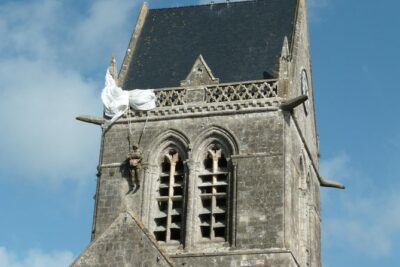
Normandy American D-Day Beaches Full Day Tour from Bayeux
Read our review →
Normandy American D-Day Experience – Group tour from Bayeux
Read our review →
Normandy Beaches Half-Day Afternoon Trip from Bayeux (A2)
Read our review →
Omaha Beach D-Day Experience – Afternoon group tour from Bayeux
Read our review →Browse the lists this tour appears in