
Review · FRANCE
Aix-en-Provence: Between History and City Charm
Aix-en-Provence reveals itself best on foot, one fountain, school, church, and shaded square at a time. This walking tour links the city’s grand avenues with smaller passages and corners, using stories about Paul Cézanne, King René, European church history, and the city’s architects to turn a pleasant stroll into a useful introduction.
I like the clear route through Aix’s historic center and the way the guide uses old images to show how places changed. I also like the human angle: Paula has adjusted explanations for children, answered individual questions, and added practical suggestions for what to do afterward. The main consideration is timing, since the advertised length is 90 minutes while the listed stop-by-stop timings add up to more than that.
Key points at a glance
- Start at La Rotonde: Meet by the fountain across from Five Guys, an easy landmark for beginning the walk.
- Cézanne’s early years: Hear stories connected with Lycée Mignet and artists from Provence.
- A route with variety: Move from Cours Mirabeau and its shops to quieter squares, churches, passages, and the cathedral.
- A guide-led history lesson: Paula is praised for clear English, humor, kindness, and adapting the tour to questions.
- Useful for first-time visitors: The walk finishes at Saint Sauveur Cathedral and can help you plan the rest of your time in Aix.
- Good practical value: At $29 per person, you pay for a focused introduction rather than museum admission or a long full-day excursion.
Why this Aix walking tour works
Aix-en-Provence can seem simple at first glance: a broad avenue, old stone buildings, fountains, cafés, and narrow streets leading toward the cathedral. The trick is knowing what you are looking at. This tour gives each stop a story, so the city feels less like a series of pretty façades and more like a place shaped by artists, kings, architects, religion, schools, and daily life.
The route is compact and stays within central Aix. You do not spend time on a bus or waiting for transport. Instead, you walk from La Rotonde through Cours Mirabeau and the old center, ending at Saint Sauveur Cathedral.
I especially like the balance between headline sights and small details. You get the city’s best-known avenue, but you also pass through Passage Agard and Place d’Albertas. The guide also points out architectural curiosities and jokes left by local builders, details you could easily miss if you simply followed a map.
The tone appears to be relaxed rather than academic. Paula is repeatedly described as funny, kind, clear, and well prepared. One family found that she changed the focus to suit their children and their questions. That matters because a city tour can lose younger visitors quickly if every stop turns into a lecture.
More History Tours in France:
- Normandy D-Day Sites & Cemetery Day Trip from Paris with Lunch
★ 5.0 · 6,877 reviews - Paris: Louvre Museum Entry with History of Mona Lisa
★ 3.9 · 2,823 reviews - Normandy D-Day Small-Group Day Trip with Omaha Beach, Cemetery & Cider Tasting
★ 5.0 · 2,786 reviews
La Rotonde gives you a useful starting point
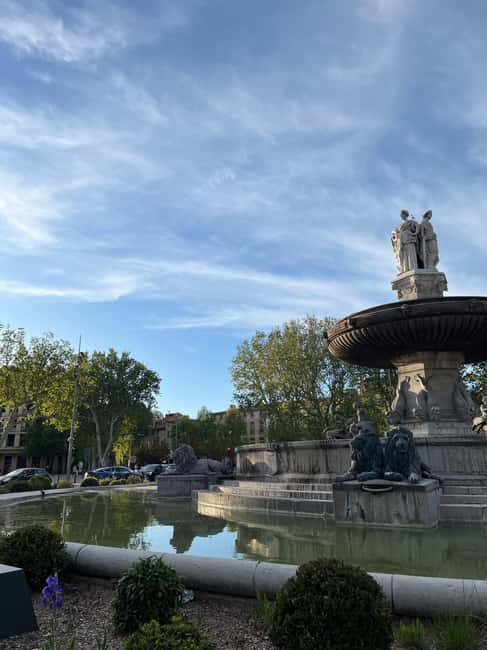
The meeting point is at the fountain in the roundabout across from the Five Guys restaurant. Look for the guide holding a sign marked Happy Walking Tour. This is a practical place to begin because La Rotonde is one of Aix’s most recognizable landmarks and a natural reference point in the center.
The opening explanation provides a short account of Aix’s past before the walk moves onto Cours Mirabeau. That opening matters. If you arrive without any context, the city’s Roman, religious, artistic, and royal connections can feel scattered. A quick overview helps you understand why the later stops belong together.
The fountain and roundabout are also useful for orientation. If you are meeting the guide early in your stay, you can use this area as a base for finding your way around afterward.
Cours Mirabeau: Aix’s grand public room
The tour spends about 25 minutes on Cours Mirabeau, the longest single stop listed. This tree-lined avenue is the city’s main social and commercial spine, with boutiques, restaurants, and a steady flow of pedestrians.
A guide can help you look beyond the obvious café scene. The avenue is not only a pleasant place for photos. It also shows how Aix presents itself: elegant, open, and tied to public life. As you walk, the guide’s historical overview gives the avenue more meaning than a simple shopping street.
This part should suit you if you want a gentle start. There is time for photographs and questions, and the route does not begin with a demanding cluster of narrow lanes. If you have limited mobility, the tour is marked wheelchair accessible, though you may still want to ask the provider about the exact walking conditions on the day.
The listed schedule includes a short additional photo stop after Cours Mirabeau. The supplied details do not identify it by name, so you should treat it as a brief pause rather than a major separate attraction.
Lycée Mignet and the young Paul Cézanne
One of the more personal sections concerns Lycée Mignet and the early lives of Paul Cézanne and other major artists from Provence. This is a useful change of pace from monuments and fountains. Instead of only hearing about famous people at the height of their careers, you get a connection to where their lives began.
Cézanne is central to Aix’s identity, but a short city walk cannot cover his whole career. That is not a weakness, as long as you treat this stop as an introduction rather than a full art lesson. The value is in linking the artist to a real place in the city and showing that Aix was part of his everyday world.
The guide uses images to show the passage of time. That can make a difference around a school or altered building, where the present-day view may not immediately reveal its earlier role. If Cézanne is a major reason for your visit, use this tour to get your bearings, then seek out a more focused art or studio visit separately. Museum admission is not included.
Same city, a different century:
- Normandy D-Day Beaches and American Cemetery Day Trip from Paris
★ 4.5 · 2,673 reviews - Normandy American D-Day Beaches Full Day Tour from Bayeux
★ 5.0 · 2,103 reviews - Normandy American D-Day Experience – Group tour from Bayeux
★ 5.0 · 1,566 reviews - Normandy Beaches Half-Day Afternoon Trip from Bayeux (A2)
★ 4.5 · 1,116 reviews
Saint Jean de Malte connects Aix with Europe
The visit to Saint Jean de Malte lasts about 20 minutes and includes a photo stop and guided explanation. This church is presented in connection with European history, giving the route a wider frame than local anecdotes alone.
Churches can be difficult to understand without a guide. You may notice a façade, stained glass, or a grand interior, but not know how the building fits into the city’s past. Here, the guide explains the church’s place in a larger European story.
This stop should appeal to you if you enjoy religious buildings but do not want to spend the day reading architectural panels. It is also a good example of the tour’s range. The route is not limited to famous artists or attractive streets. It includes the institutions that helped shape Aix.
Place des Prêcheurs and the city’s human stories
The itinerary then moves to Place des Prêcheurs, with about 20 minutes for a photo stop and explanation. The stop is grouped with the story of the Fontaine du Roi René and the history behind the Palais de Justice and its market square.
King René is remembered as a beloved king of Aix, and the fountain gives the guide a chance to discuss the city through one memorable figure. This kind of story can be easier to retain than a list of dates. You may not remember every detail, but you will have a clear link between the fountain, the king, and local affection for his memory.
The Palais de Justice section adds another layer. The material refers to the history behind its ruins and the nearby market square, suggesting a place where the city’s older remains meet later civic life. Because the tour is short, expect an overview rather than a full architectural study.
I like this section for its human scale. Aix is not presented only as a collection of grand buildings. Kings, students, artists, architects, and townspeople all enter the story.
Place d’Albertas offers a quieter pause
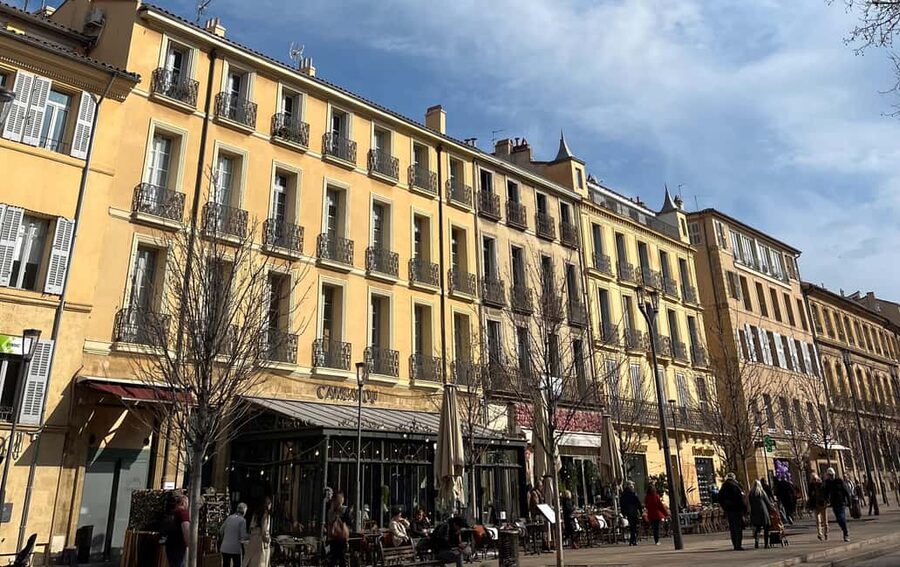
Place d’Albertas is described as a calm square with a central fountain and elegant buildings. The scheduled explanation lasts about 10 minutes, making this one of the shorter stops.
That brevity works well. After the broader avenues and church history, a quieter square gives you time to look around without rushing from one major sight to another. It is also the sort of place where an architectural joke or odd detail might be easy to miss without a guide pointing it out.
The tour highlights curiosities left by the city’s architects. These details are often the most enjoyable part of a walking route because they reward careful looking. You are not simply told that a building is old or attractive. You are encouraged to notice the decisions, quirks, and bits of wit built into the city.
Passage Agard and the pleasure of getting off the main road
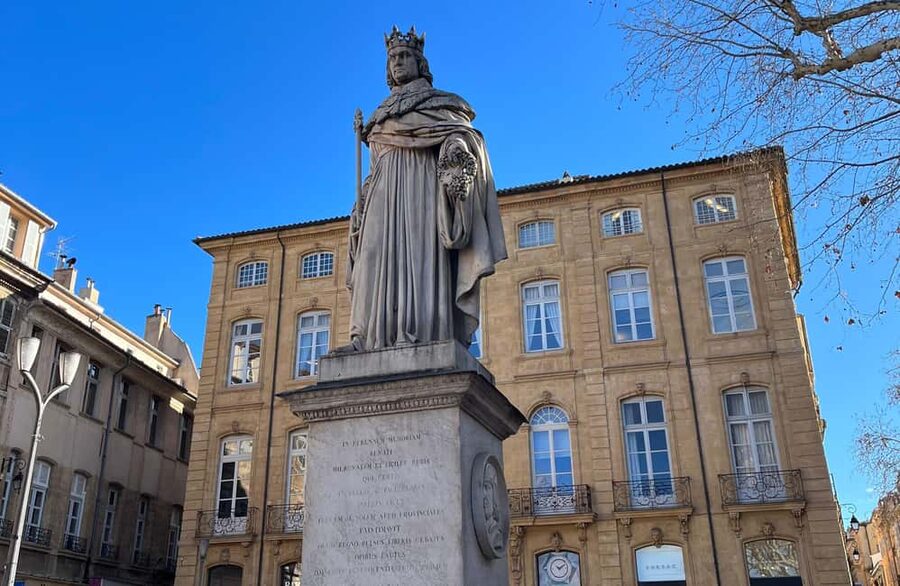
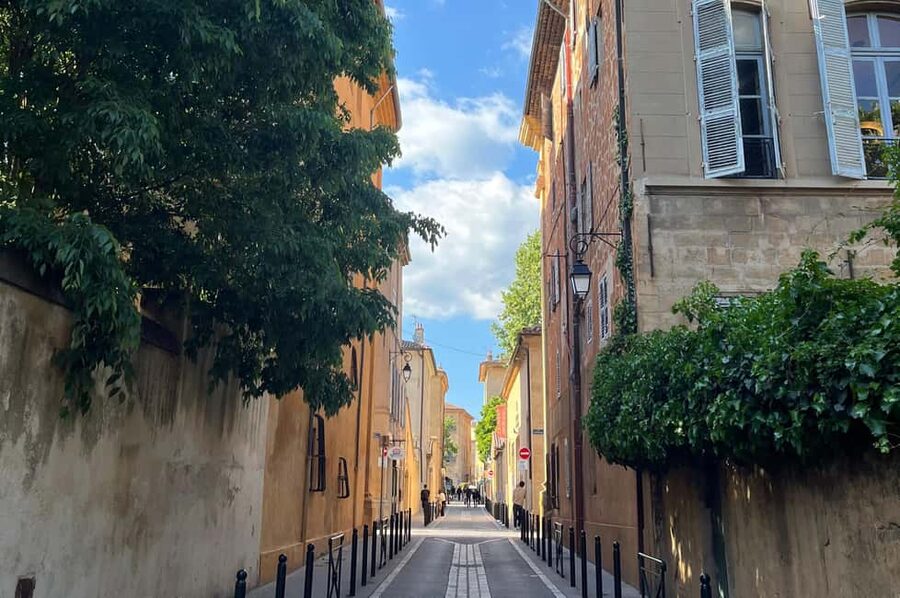
Passage Agard brings the tour into a pedestrian passageway lined with shops and art galleries. It is a small but useful change from Cours Mirabeau. You see how Aix works at a more intimate level, where commercial life fits into older urban spaces.
I like the inclusion of this passage because it keeps the walk from becoming a parade of major landmarks. It also gives you a place to return to later if you want to browse. The information does not promise time for shopping, so keep your focus on the guided route and plan to come back on your own.
This is one reason to take the walk near the start of your stay. Paula has offered suggestions for other things to do in Aix, and a route through the center helps you identify places worth revisiting after the tour.
Hotel de Ville and the route toward Saint Sauveur
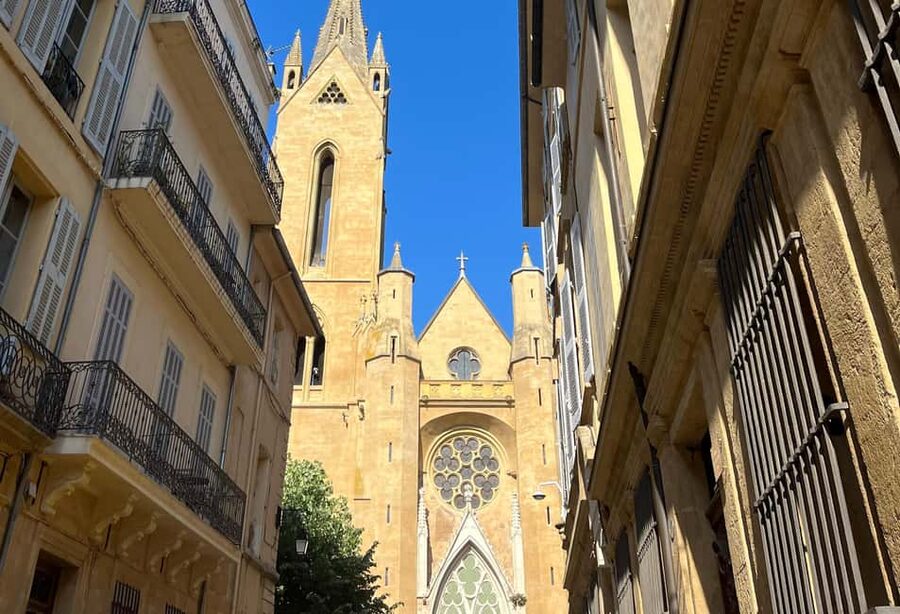
The stop at Hotel de Ville includes about 15 minutes for photos and a guided explanation. Civic buildings can look formal and self-contained, but they often tell you how a city organizes public life. The guide’s broader account of Aix helps place the town hall within that story.
From here, the route continues toward Saint Sauveur Cathedral. The walk links civic, commercial, religious, and residential parts of the center rather than treating them as isolated attractions.
The listed itinerary calls the final stop Paroisse Cathedrale Saint Sauveur, while the tour finishes at Catedral de St Sauveur. In practical terms, this is the same cathedral complex named in the highlights. The walk ends there, which is convenient if you want to continue exploring the cathedral or the surrounding old center afterward.
Saint Sauveur Cathedral is the strong finish
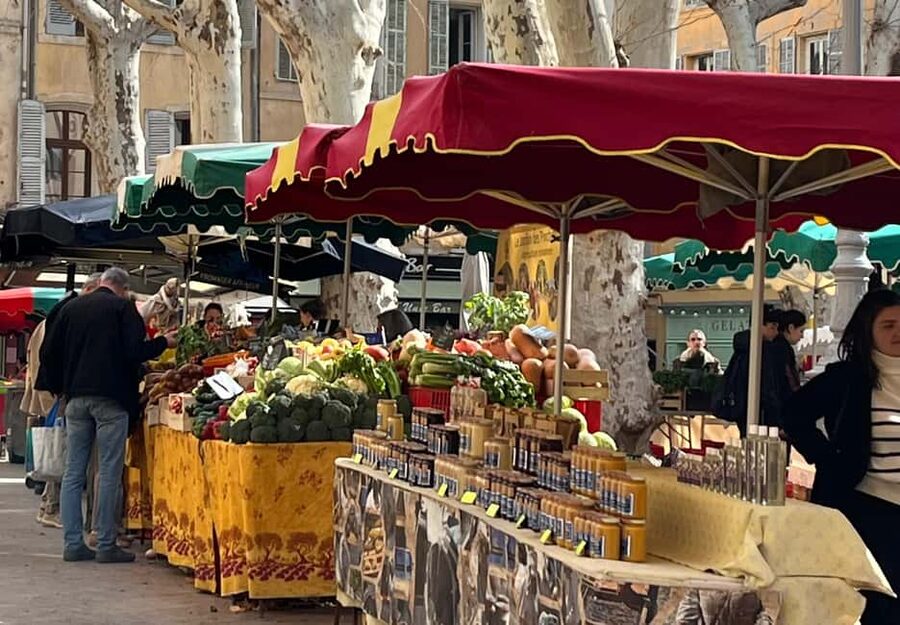
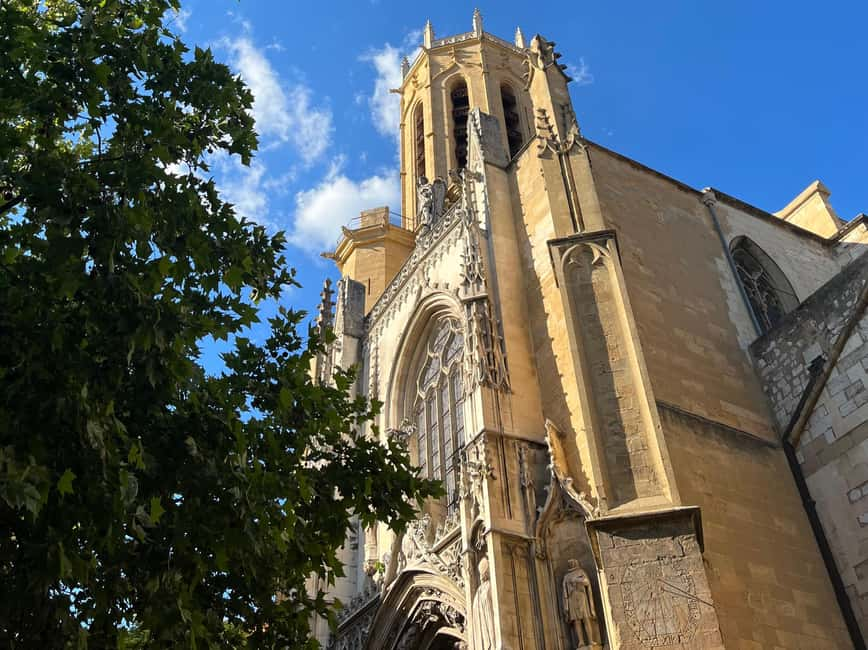
Saint Sauveur Cathedral is the final major stop and receives about 15 minutes in the listed schedule. The description points to its Gothic character, stained-glass windows, and architectural details.
A cathedral makes a fitting end point because it gathers several themes from the walk: faith, art, politics, architecture, and centuries of change. The guide can give you a framework for what you see, while the building itself provides the visual finish.
Do not expect a long, specialist cathedral tour in a 90-minute city walk. The cathedral stop is part of a broader introduction to Aix. If you want to study every chapel, window, or architectural period, you will need additional time on your own.
What the guide adds to the experience
The strongest feature here is the guide’s storytelling. Paula is the guide named in several pieces of recent feedback, and the descriptions of her approach are consistent: clear English, a warm manner, humor, patience, and a willingness to change the emphasis for the group.
One especially useful quality is her response to questions. Instead of delivering a fixed speech and moving on, she has adjusted the material for children and followed up on individual interests. That makes the walk more useful for families and mixed-age groups.
The available languages are English, Spanish, and Portuguese. Some content may be shown in its original language, so you should be comfortable with that possibility. The activity is listed as wheelchair accessible, but the route includes historic streets and pedestrian passages, so confirm any specific access needs when booking.
The tour provider is Mateo Cortés. Since the guide may vary by departure, check the booking details if meeting Paula specifically matters to you.
Is $29 a fair price?
At $29 per person, this is a reasonable price for a 90-minute guided introduction to central Aix. You are paying for a live guide, a planned route, visual material, and local context. The cost is especially fair if you are new to the city and want to understand what you are seeing before exploring on your own.
The price does not include museum admission. That keeps the tour focused, but it also means art lovers should budget separately for any museums or paid sites they want to visit.
The main point to watch is the timing. The activity is advertised as 90 minutes, but the listed stop durations total more than 90 minutes. That may reflect rounded figures, overlapping walking time, or a flexible route. Ask about the expected end time if you have a train, meal reservation, museum slot, or another tour afterward.
You can cancel up to 24 hours in advance for a full refund, and the reserve-now, pay-later option gives you some flexibility while planning.
Who should book this walk?
I would choose this tour if you want a first look at Aix that combines major sights with local stories. It suits first-time visitors, families, art fans interested in Cézanne, and anyone who prefers a guide to explain the city rather than simply hand over a list of monuments.
It is also a good choice for a short stay. In 90 minutes, you cover Cours Mirabeau, Saint Jean de Malte, Place des Prêcheurs, Place d’Albertas, Hotel de Ville, and Saint Sauveur Cathedral, with additional references to Lycée Mignet, Passage Agard, the Fontaine du Roi René, and the Palais de Justice.
I would be more cautious if you want museum interiors, a detailed Cézanne study, or a long architectural lecture. Those are not included. The route gives you a solid foundation, then leaves you free to choose what deserves more of your time.
Should you book Aix-en-Provence: Between History and City Charm?
Book it if you want a friendly, story-led orientation to Aix for $29, especially near the beginning of your visit. The combination of Cézanne, King René, churches, civic buildings, fountains, and architectural oddities gives you more than a basic photo walk.
The best reason to go is the guide’s personal approach. Paula’s ability to explain clearly, use humor, answer questions, and adapt the route’s emphasis can make the city easier to appreciate. Just allow some flexibility around the advertised duration and remember that museums are not included.
FAQ
Where does the tour start?
Meet at the fountain in the La Rotonde roundabout, across from the Five Guys restaurant. The guide will be holding a sign that says Happy Walking Tour.
Where does the tour finish?
The walk finishes at Saint Sauveur Cathedral in Aix-en-Provence.
How long does the tour last?
The advertised duration is 90 minutes. The individual stop times provided add up to more than 90 minutes, so check the expected finish time if you have plans afterward.
Which languages are available?
The live guide can conduct the tour in Portuguese, English, or Spanish. Some content may be shown in its original language.
Is museum admission included?
No. The price includes the guided visit and images used to illustrate changes over time, but museum access is not included.
Is the tour wheelchair accessible?
Yes, the activity is listed as wheelchair accessible. If you have specific access requirements, confirm the route details when booking.
Just added around France
- Medieval Carcassonne: Interactive Ghost Story & City Game★ 3.5 · 33 reviews
- Carcassonne During World War 2★ 5.0 · 127 reviews
- Carcassonne ‘s Medieval Walls: A Self-Guided Tour★ 4.5 · 43 reviews
- Small Group Guided D-Day Tour and Mémorial de Caen Museum★ 5.0 · 237 reviews
- Normandy: Private tour D-Day landing beaches American sector★ 5.0 · 62 reviews
- Mémorial de Caen Museum Admission and Guided Tour of D-Day Sites★ 4.5 · 275 reviews
- Private Day Tour including Normandy Landing Beaches & Battlefields from Caen★ 5.0 · 53 reviews
- Private Bordeaux History Tour with a glass of Bordeaux wine.★ 5.0 · 28 reviews
France History Tours, compared.

Normandy D-Day Sites & Cemetery Day Trip from Paris with Lunch
Read our review →
Paris: Louvre Museum Entry with History of Mona Lisa
Read our review →
Normandy D-Day Small-Group Day Trip with Omaha Beach, Cemetery & Cider Tasting
Read our review →
Normandy D-Day Beaches and American Cemetery Day Trip from Paris
Read our review →
Normandy American D-Day Beaches Full Day Tour from Bayeux
Read our review →
Normandy American D-Day Experience – Group tour from Bayeux
Read our review →
Normandy Beaches Half-Day Afternoon Trip from Bayeux (A2)
Read our review →
Omaha Beach D-Day Experience – Afternoon group tour from Bayeux
Read our review →Browse the lists this tour appears in