
Review · BELGIUM
From IEPER Private 4-hour Tour of the Ypres Battlefield
The most powerful part of this private Ypres battlefield tour is the way it connects wide military events with individual soldiers. At Essex Farm, you see where John McCrae wrote In Flanders Fields. At Tyne Cot, the numbers become human names, dates, and unanswered questions.
I like the flexible pickup from your Ypres hotel or the train station, and I like the care taken with family connections. Send Soren or Sabine a relative’s service details before the tour, and they may shape the visit around that soldier. The main drawback is time: four hours gives you a strong introduction, but not the full Ypres battle zone.
Key points at a glance
- Walk through original trenches at Sanctuary Wood, with a small First World War museum beside them.
- See the mine-crater ground at Hill 60, where massive explosives were set off on June 7, 1917.
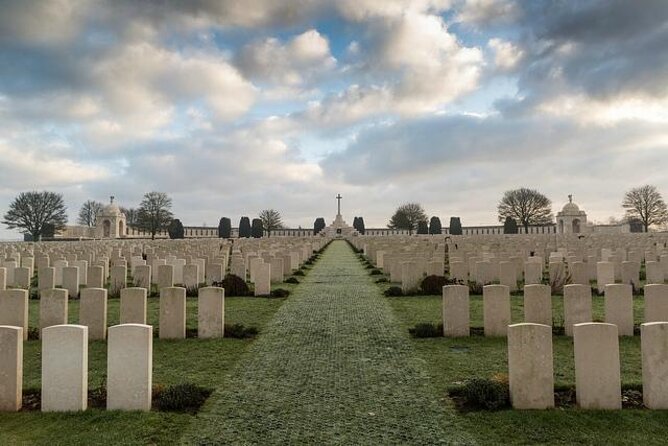
- Visit Tyne Cot Cemetery, the largest Commonwealth War Graves Commission cemetery in the world.
- Follow the Canadian story at Saint Julien, site of the first German gas attack of the war.
- Connect Essex Farm with John McCrae and the poppy, one of the most recognizable symbols of remembrance.
- Travel privately by vehicle, with pickup available at Ypres hotels, bed-and-breakfasts, or the train station.
Why a private four-hour tour works well in Ypres
Ypres is not a battlefield you can understand by ticking off monuments. The fighting ran across a broad area, and the names of places can blur together quickly. A good guide gives you a map, places each site in the wider battle, and explains why one ridge, cemetery, or ruined village mattered.
That is the real value of this tour. Soren is described as a passionate guide who uses maps and photographs to make the events easier to follow. Sabine, a local who grew up in Ypres, also leads tours and brings strong local knowledge to the subject. The guide does not simply point at a memorial and recite a date. The aim is to show how the battles developed from 1914 to 1918 and how they affected British, Canadian, Australian, New Zealand, French, German, and other forces.
You ride in a private vehicle, reported by several participants as a comfortable hybrid SUV. With a maximum of four people, the tour can feel more like a conversation than a formal group excursion. You can ask questions as they occur, pause when a family connection comes up, and adjust the pace if someone in your party has trouble walking.
The four-hour length is also useful if you are visiting Ypres by train or fitting the battlefields into a larger Belgium trip. Morning and afternoon departures are available. Just remember that the listed stop times add up to more than four hours once driving time is included, so this is a focused circuit, not a slow visit at every site.
More Private History Tours in Belgium
- Private Historical Tour: The Highlights of Bruges
★ 5.0 · 315 reviews - Private tour: Highlights & History of Antwerp
★ 5.0 · 299 reviews - Bruges: Private Historical Highlights Walking Tour
★ 4.7 · 191 reviews
Hill 60: starting with the earth beneath your feet
Hill 60 is a strong opening because the ground itself tells part of the story. The guide explains the huge mines detonated here on June 7, 1917, during the Battle of Messines. The subject is technical, but it is also deeply physical: soldiers fought for a rise in the ground, then engineers worked underground to place explosives beneath it.
You spend about 40 minutes here, with no admission charge. That leaves enough time for an explanation of the mine attack and for questions without turning the stop into a rushed photo break.
I find Hill 60 most useful when you listen closely to the geography. The point is not simply that an explosion happened. It is understanding why this patch of ground mattered and how control of high ground shaped artillery observation and troop movement.
The site may feel more open and less immediately emotional than a cemetery. That is normal. Hill 60 asks you to picture the battle through terrain, maps, and the guide’s explanation rather than through rows of graves. If you want a single dramatic memorial, this may not be the most moving stop. As an introduction to the battle zone, it does important work.
Sanctuary Wood: original trenches and a small museum
Sanctuary Wood provides the tour’s clearest physical link with the front line. Here you see original First World War trenches and visit the Sanctuary Wood Museum. The museum is described as quaint rather than large, which is useful to know. This is not a vast national institution with hours of exhibits. Its appeal is its direct connection to the site.
You have about 45 minutes, and part of the visit includes walking through a tunnel among the trenches. That detail matters. The confined passage and uneven wartime earth make the experience more immediate than looking at a trench diagram in a book.
I would allow extra attention here if you are interested in the ordinary conditions of soldiers’ lives. Trenches were not just firing positions. They were sleeping quarters, work areas, routes for carrying supplies, and places where men waited under threat. A guide can help you read these remains rather than treating them as a curious old ditch.
Walking is part of the stop, and the ground may not suit every visitor. The guide has adjusted the tour for people recovering from surgery and for older family members, but you should still mention mobility limits before setting out. The private format makes this easier than a large coach excursion, since your pace can be discussed directly.
Families with children can also make good use of this stop. The guide has led groups with children from ages six to ten and has kept the explanation lively with facts and humor. The subject is serious, but a flexible guide can explain it without expecting younger children to absorb a long lecture.
Tyne Cot Cemetery: scale, silence, and names
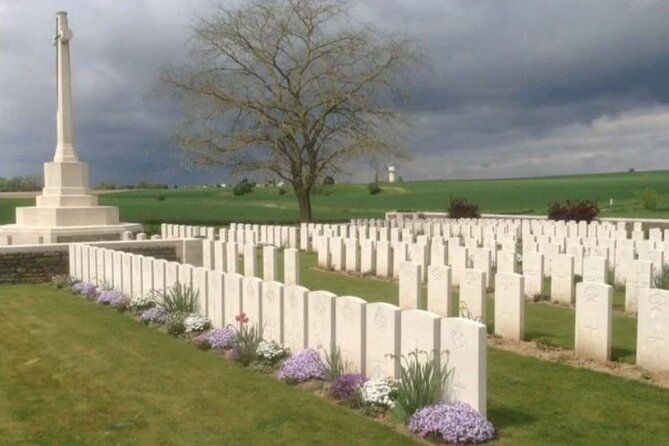
Tyne Cot is the tour’s largest and most solemn stop. It is the world’s largest Commonwealth War Graves Commission cemetery, with about 12,000 soldiers buried there. Only around 3,000 have identified names, a detail that gives the cemetery a particularly stark character.
You spend about 45 minutes at the cemetery, and admission is free. The stop includes the graves, memorial inscriptions, and the stories of two Australian Victoria Cross recipients and one Canadian Victoria Cross recipient buried there.
The scale can be difficult to take in. A guide helps you move past the numbers and notice the structure of the cemetery, the repeated names, and the different ways remembrance was arranged after the war. If a relative served in the area, give the guide that information before the tour. The personal research is one of the best reasons to choose a private visit.
This is also a place where you should expect a quieter pace. The guide’s role is not to fill every second with talk. There is value in having time to look, read, and absorb the setting. You can ask about a particular regiment or grave, but you may also prefer a few silent minutes.
The cemetery is free to enter, but its value is not measured by an entrance ticket. It is one of the places where the human cost of the Ypres battles becomes clearest. Some visitors find the emotional effect comparable to other major sites of mass wartime death. That response is personal, but you should not treat this as a light sightseeing stop.
More Battlefield and Military History Tours in Belgium:
- Historic Battle of the Bulge Sites Tour from Brussels
★ 5.0 · 31 reviews - From Ypres: WWI Battlefields Private Tour
★ 5.0 · 25 reviews - 2-Hour Gettysburg Battlefield Guided History Bus Tour with a National Park Guide
★ 4.5 · 2,201 reviews - Prague Communism History and Nuclear Bunker Tour
★ 5.0 · 1,742 reviews
Saint Julien and the Canadian line
The Saint Julien Memorial is a shorter stop, about 15 minutes, but it carries major importance. Here the guide explains the first German gas attack of the First World War, launched on April 22, 1915, against French troops.
The story then turns to the Canadian soldiers who held the line in the path of the chlorine gas cloud. For Canadian visitors, this stop adds a national connection to the broader Ypres story. The guide can also relate the action to wider imperial and Allied forces, which helps prevent the battlefield from becoming a collection of separate national memories.
Fifteen minutes may sound brief, but that is enough for the central explanation and memorial visit. It is a good example of why the private vehicle matters. You can make a focused stop, hear the key context, and continue without waiting for a large group to gather or disperse.
The subject is grim, and the guide’s tone matters. Soren has been praised for combining humor with respect, but the humor is used to keep a difficult subject approachable, not to make light of the suffering. You can expect a direct explanation of what happened and why the event changed the nature of warfare.
Essex Farm: the place behind In Flanders Fields
At Essex Farm Cemetery, the tour links military history with literature and remembrance. This was a wartime hospital site, and it is where Lieutenant Colonel John McCrae composed In Flanders Fields. The poem helped make the red poppy an enduring symbol of the First World War.
You spend around 30 minutes here. The visit is less about a large battlefield action than about the human response to death, grief, and memory. The setting helps explain why McCrae’s poem lasted far beyond the war itself.
For many people, this is the most accessible stop. You do not need a detailed grasp of military campaigns to understand the connection between a field hospital, a poem, and the poppy worn on Remembrance Day. At the same time, the guide can place McCrae’s work within the wider conditions of the front rather than presenting it as an isolated literary moment.
The cemetery is free to visit. As at Tyne Cot, you should expect a reflective stop rather than a busy attraction. The half-day schedule gives you enough time for the site without forcing you to linger after you have taken in the main story.
Family research can change the whole experience
The strongest feature of this tour is the attention given to family history. The guide has researched ancestors who served in the Ypres area, located relevant battles, and in one case found documentation relating to a soldier’s second Military Medal. Another family received help tracing a grandfather’s movements so they could understand which actions he may have taken part in.
This service is not a promise that every family record can be found. The useful point is that the guide is willing to work with the information you bring. A service record, regiment, name, date, or country of origin may help connect your family story with the ground you visit.
Tell the guide about your connection before the tour. Canadian, Australian, New Zealand, British, and other family links have all been worked into the route. The guide can also adapt the emphasis for visitors who arrive with little prior knowledge.
If you have no family connection, you will still receive a full tour. The maps, photographs, and explanations provide a clear framework. But if you do have an ancestor in the Ypres battles, the private format gives you a chance to turn a general battlefield visit into a personal one.
Price, timing, and what you receive
The price is $399.25 per group of up to four people. That works out to about $100 per person for four people, or roughly $200 each for a couple. Compared with a shared group outing, the cost is higher. Compared with arranging a private vehicle, guide, and battlefield route yourself, the price can be reasonable, especially if family research is important to you.
Pickup is offered at Ypres hotels and bed-and-breakfasts. If you arrive by train, the guide can meet you at Ypres station, provided you send your arrival time. This makes the tour practical for a day or half-day visit without a rental car.
The activity is offered in English and uses a mobile ticket. Confirmation is sent within 48 hours, subject to availability. It is a private activity for your group only, and service animals are allowed.
You should plan around the local cancellation rule: cancel at least 24 hours before the start time for a full refund. Changes or cancellations inside that window are not accepted for a refund.
Who should book this Ypres battlefield tour?
I would choose this tour if you want an informed introduction without spending a full day on every corner of the Ypres battle zone. It suits couples, families, and small groups who prefer questions and conversation over a fixed coach commentary.
It is especially well suited to:
- Families tracing a soldier, regiment, or national connection
- First-time visitors who do not want to drive between scattered sites
- Canadian, Australian, New Zealand, British, and French history enthusiasts
- Families with older children who can handle a serious subject
- Visitors using Ypres as a base before or after a train journey
- People who need a more flexible pace than a large group tour can offer
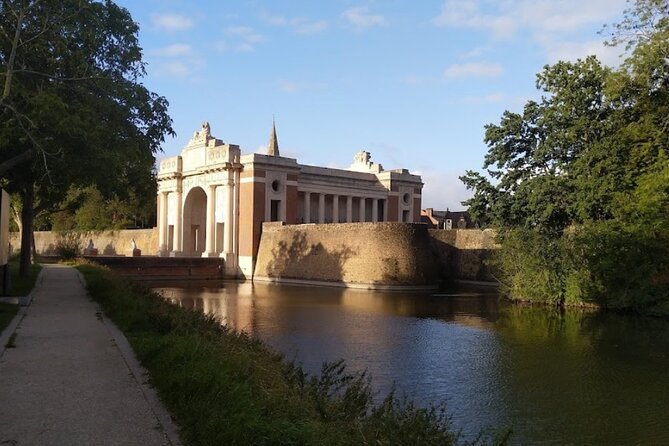
You may want a longer tour if you want to cover many more cemeteries, the Menin Gate, Passchendaele sites, or additional sections of the front. Four hours gives you five strong locations, but it cannot explain every major action around Ypres.
Should you book it?
Book this tour if you want the battlefield to make sense, not just appear as a string of monuments. The private vehicle, small group, maps, photographs, and possible family-history research give the visit real purpose.
The best reason to choose it is the guide’s willingness to tailor the experience. Send your ancestor’s details ahead of time, explain your national or family connection, and tell the guide about walking limits. If you simply want a quick panoramic drive, the price may feel high. If you want to understand the ground and the people connected to it, this four-hour visit offers strong value.
FAQ
How long does the private Ypres battlefield tour last?
The tour lasts approximately four hours.
How many people can join the private tour?
The price covers one private group of up to four people.
Is the tour offered in English?
Yes. The experience is offered in English.
Where can pickup take place?
Pickup is available at Ypres train station and at Ypres hotels and bed-and-breakfasts. If your accommodation is not listed, you can send its name to the guide.
Which sites does the tour visit?
The route includes Hill 60, Sanctuary Wood Museum, Tyne Cot Cemetery, Saint Julien Memorial, and Essex Farm Cemetery.
Is admission included at Sanctuary Wood Museum?
Yes. Admission to Sanctuary Wood Museum is included.
Are there admission fees at the other stops?
The listed admission details show free entry at Hill 60, Tyne Cot Cemetery, Saint Julien Memorial, and Essex Farm Cemetery.
Can the tour focus on a family member who served in the war?
Yes. You can provide the guide with service information for an ancestor, and the visit may be tailored to relevant battlefields and family connections.
What is the cancellation policy?
You can cancel at least 24 hours before the local start time for a full refund. Cancellations or changes made less than 24 hours before the start time are not refunded or accepted.
Just added around Belgium
- Historic Battle of the Bulge Sites Tour from Brussels★ 5.0 · 31 reviews
- Historical Walking Tour: The Story of Brussels – by Legends★ 5.0 · 164 reviews
- Bruges Bites & Sights – Belgian Food, Beer & A Little Bit Of History★ 5.0 · 94 reviews
- Medieval Tour in Bruges with Chocolate Tasting★ 5.0 · 71 reviews
- 2-Hour Historical Walking Tour in Bruges with Praline Included★ 5.0 · 291 reviews
- Best of Bruges: History, Chocolate & Beer Tour★ 5.0 · 256 reviews
- Food tasting & Historical walk★ 4.5 · 47 reviews
- Bruges at Night: Murder, Mystery & Dark Stories Small Group Walk★ 5.0 · 137 reviews
Belgium History Tours, compared.
Ghent: 50-Minute Medieval Center Guided Boat Trip
Read our review →
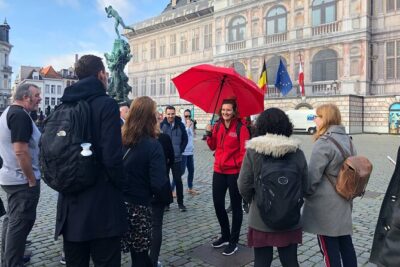

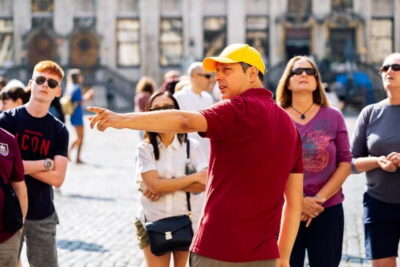
Brussels: Historical Tour with Chocolate & Waffle Tasting
Read our review →
Brussels: Historical Walking Tour with Chocolate & Waffle Tasting
Read our review →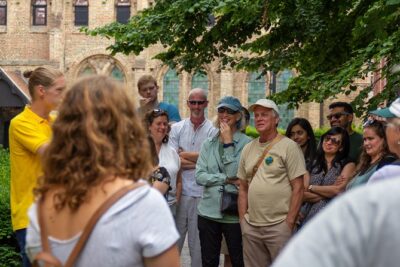
THE Storytelling Tour of Bruges | First Day Must | History & Tips
Read our review →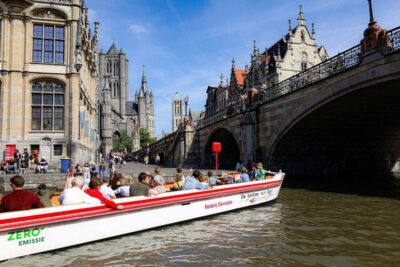
Ghent: 40 Minute Medieval Center Guided Boat Tour
Read our review →Browse the lists this tour appears in