Review · DUBROVNIK
Dubrovnik Old Town History Walking Tour
Dubrovnik’s Old Town can feel like a beautiful maze until you understand how its streets, churches, fountains, palaces, and harbor fit together. This 90-minute walk gives you that map in your head, while explaining how Ragusa grew from a small maritime republic into one of the Adriatic’s most important trading cities.
I like two things right away: the route covers a lot without rushing, and the local guides add family stories, folklore, and clear explanations of the 1990s Homeland War. Guides such as Ivana, Jelena, Sara, Ermina, Joseph, and Pero have all led tours praised for their warmth and easy storytelling.
The main drawback is the group size, which can reach 30 people. That is still manageable in most streets, but you may need to stay close to the guide. Old Town also has uneven paving and steps in the surrounding streets, so this is not the best choice for anyone who finds walking difficult.
Key points to know before booking
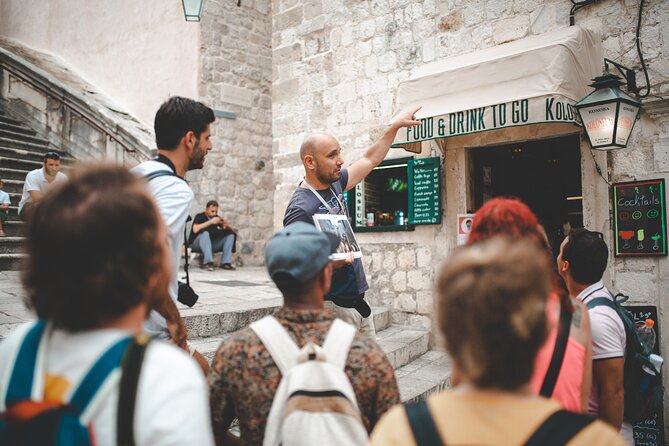
- The 90-minute route covers Dubrovnik’s essential landmarks, from the Large Onofrio’s Fountain to the Old Port and Orlando Column.
- The tour starts and finishes at the same place, making it easy to continue exploring on your own.
- Local guides bring the past up to the present, including Ragusa, Yugoslavia, and the Croatian War of Independence.
- You pay about $24.19 per person, with no separate admission fees for the walk itself.
- The tour is offered in English, with departure times chosen to fit your plans.
- It is best taken early in your stay, when the layout and guide’s tips can shape the rest of your visit.
Meeting under the red umbrella by Onofrio’s Fountain
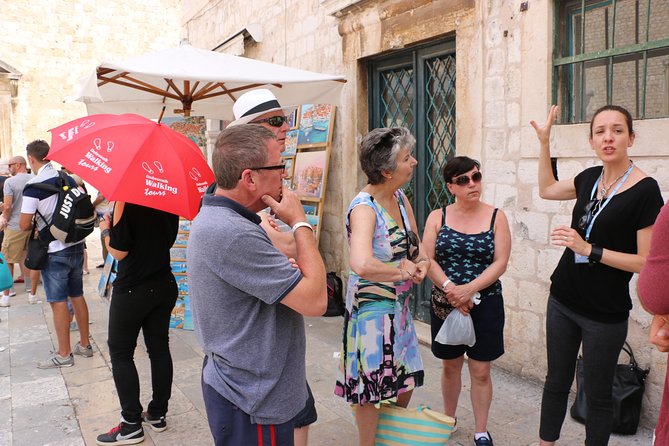
The tour begins at the Large Onofrio’s Fountain, next to the Hard Rock Cafe. Look for the red umbrella used by Dubrovnik Walking Tours. This is a practical meeting point because the fountain is easy to find at the western entrance to the Old Town.
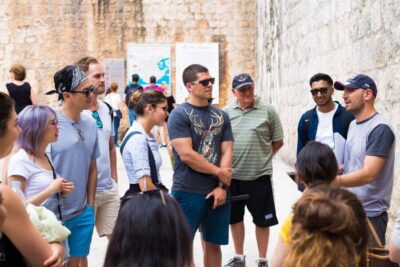
The guide introduces the group, then gives a quick sense of what lies ahead. You do not spend long standing around. After about five minutes, the group begins walking into the walled city.
This location also sets up the story well. The fountain was part of Dubrovnik’s aqueduct system, an impressive piece of public works for a medieval trading city. Your guide uses it to explain how Ragusa managed water, trade, defense, and government while living on a narrow strip of coast.
That opening matters. Instead of seeing Dubrovnik as a collection of handsome stone buildings, you begin to see a carefully managed city-state. Its leaders had to protect trade, handle outbreaks of disease, maintain fresh water, and balance relations with larger powers.
More History Walking Tours in Croatia
- Dubrovnik: Ancient City Walls & Wars Walking Tour
★ 5.0 · 1,270 reviews - Dubrovnik: Old Town History Walking Tour
★ 4.9 · 474 reviews - Dubrovnik Jewish Heritage Private Walking Tour
★ 5.0 · 121 reviews
From the Holy Savior Church to the Franciscan Monastery

The walk continues down the main street, passing the small votive Church of the Holy Savior. Here the guide explains the role religion played in daily life and public identity.
You then reach the Franciscan Church and Monastery, one of the most useful stops on the route. The complex includes a church, monastery, library, and pharmacy. The pharmacy dates from 1317 and is described as the third oldest still functioning pharmacy in the world.
The library holds more than 20,000 books, including about 1,200 old manuscripts. You do not enter these areas as part of the walking tour, and no admission to interior sites is included. Still, the outside explanation gives you a reason to return later if you want to look more closely.
This is also where local customs enter the story. The best guides do not just list dates. They connect old religious practices and town traditions with life in Dubrovnik today. Sara, Ivana, and Jelena have been especially praised for mixing facts with personal stories and humor.
Reading Stradun as Dubrovnik’s main stage
Stradun, also called Placa, is Dubrovnik’s central street and the widest route through the Old Town. It divides the city’s northern and southern sections and serves as a business street, meeting place, parade route, and setting for public celebrations.
A guide can help you read the street instead of simply photographing it. The regular stone buildings, broad paving, and orderly layout reflect the city’s rebuilding after a major earthquake in 1667. The tour uses this central stretch to explain how the Old Town developed and how its public spaces worked.
The discussion then moves into the fall of the Republic of Ragusa in 1808, followed by the later period of Yugoslavia and the Croatian War of Independence in the 1990s. That modern section is important. Dubrovnik is often presented as an almost untouched medieval city, but its recent past is part of the place you are seeing.
Ermina, described as a local who had lived in the city, has been praised for explaining areas affected by the 1991 and 1992 war. Personal local context can make this part more meaningful, but the subject is serious. Expect a respectful account rather than a light sightseeing talk.
A side street, an Orthodox church, and Gundulic Square
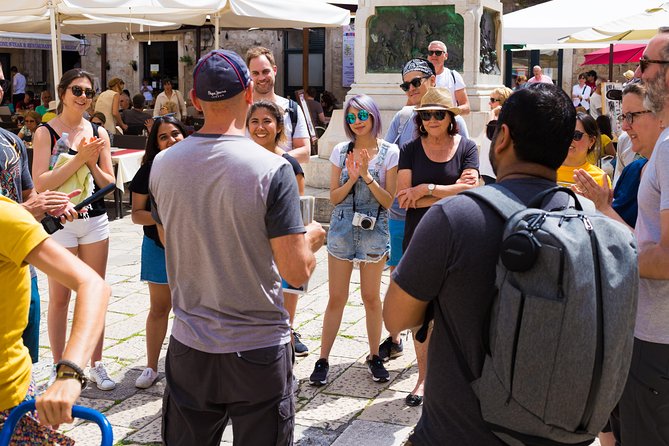
The group leaves the main street and turns toward the port through narrower inner lanes. This change of scale helps you notice how compact the Old Town is. You move from a broad ceremonial street into quieter passages that once served homes, workshops, religious communities, and government buildings.
At the Church of the Holy Annunciation, the guide discusses Dubrovnik’s Orthodox Christian community. The tour also touches on the city’s Jewish and Muslim communities and their influence on local life.
That wider view is one of the tour’s strongest features. Dubrovnik’s story is not only Catholic, Latin, or Croatian. It is also a story of merchants, migrants, diplomats, sailors, and religious groups living within a small republic that depended on outside connections.
The route continues to Gundulic Square and the green market. The Monument of Poet Ivan Gundulic provides a natural stop for local customs, food, and daily life. The market is a useful reminder that the Old Town is not just a historic shell. People still shop, work, and live here.
You may not spend long at the market, and the tour does not promise time to browse every stall. If the produce and local atmosphere interest you, note the square and return after the walk.
More Old Town and Historic Centre Walks in Croatia
- Dubrovnik Combo: Old Town & Ancient City Walls
★ 5.0 · 1,019 reviews - Dubrovnik Old Town: Night tour with History, Wine & Bites
★ 4.7 · 59 reviews - Dubrovnik: Small-Group Guided Old Town History Walking Tour
★ 4.9 · 37 reviews - SPLIT-PRIVATE Walking Tour of Diocletian’s Palace & Old Town
★ 5.0 · 467 reviews
The Rector’s Palace and the Cathedral
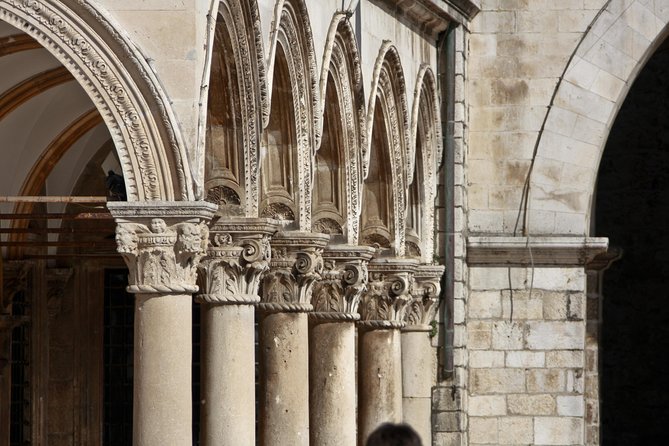
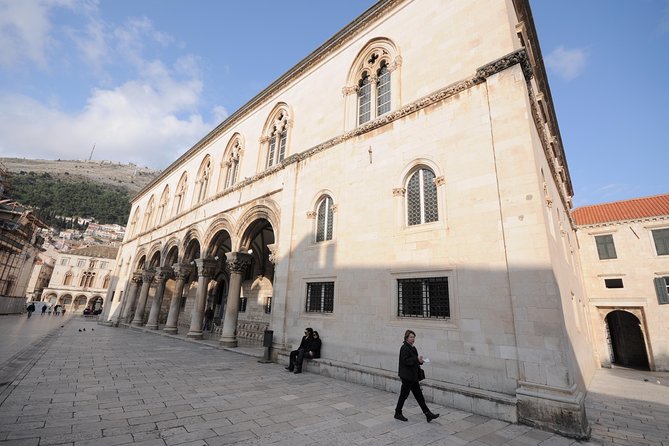
The Rector’s Palace is one of the city’s most important buildings. It served as the seat of the Rector of the Republic of Ragusa from the 14th century until 1808. It also housed the Minor Council and state administration, along with an armoury, powder magazine, watch house, and prison.
This is a good place to understand how Ragusa was governed. The Rector held office for a limited term, and the palace was not simply a royal residence. It was a working center of government, security, and diplomacy.
The tour continues to the Cathedral of the Assumption of the Virgin Mary. The guide shares the local legend that Richard the Lionheart was shipwrecked near Dubrovnik on his return from the Crusades in 1192 and came ashore on Lokrum Island.
The cathedral stop is short, about five minutes. That keeps the walk moving, but it also means you should not expect an interior art tour or a detailed examination of the cathedral treasury. If you want more time inside, return independently after the group walk.
The Old Port and Dubrovnik’s working sea
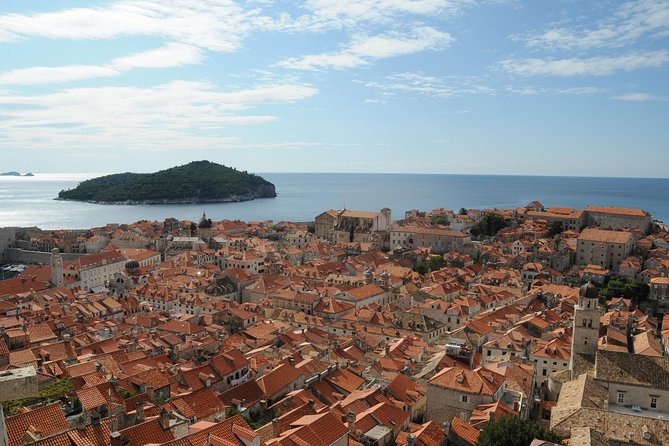
The route reaches the City Harbor, where the maritime side of Dubrovnik’s story comes into focus. Ships from the Republic sailed across the Mediterranean, and its galleons served in naval fleets across Europe and beyond.
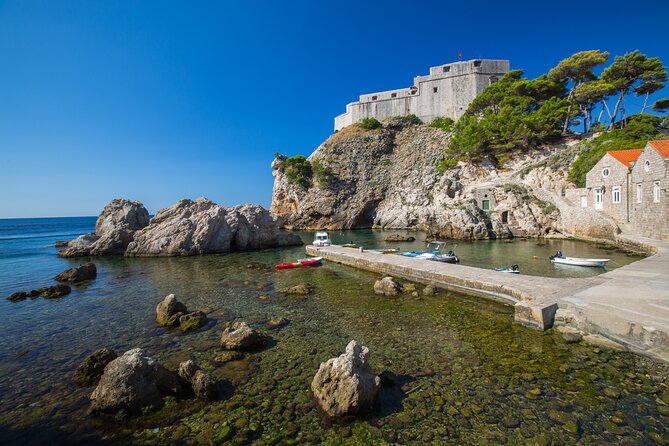
The guide explains the Arsenal, where ships were built and loaded. You also hear about the old quarantine system and the nearby fortresses of St. Luke and St. John.
This section gives useful context for the city’s success. Dubrovnik was not wealthy because it sat passively on a pretty coast. It built ships, moved goods, negotiated with stronger powers, and protected its port. The harbor makes that practical side of the republic easier to picture.
You spend about 15 minutes here, the longest stop on the route. The pace should feel comfortable, but the waterfront can be exposed to sun and weather. Bring water in summer and dress for the forecast. The tour may be canceled in poor weather, with a new date or full refund offered.
Luza Square, Orlando Column, and the end of the walk
The final section returns toward the eastern end of Stradun and Luza Square, under the City Bell Tower. The guide covers St. Blaise’s Church, Dubrovnik’s patron saint, and the story of the knight Orlando.
You also see the Orlando Column, Sponza Palace, the Small Onofrio’s Fountain, and the high bell tower. This is a compact finish with many landmarks close together. It works well as a final orientation point because you can easily return to any of them later.
The tour ends back at the original meeting point. That makes planning simple. You can continue along Stradun, return to the market, visit a museum, walk toward the harbor, or stop for food without arranging transport.
The end point is also useful for anyone staying outside the Old Town. You are not left at an unfamiliar corner of the city. The guide can also offer suggestions for the rest of your visit, which is one reason I would schedule this walk near the start of a Dubrovnik stay.
What the $24.19 price gets you
At about $24.19 per person, the tour is fairly priced for a 90-minute guided walk in one of Croatia’s most expensive destinations. The fee covers the local English-speaking guide and taxes, fees, and handling charges.
There are no separate admission tickets included because the route is mainly an exterior orientation walk. That keeps the cost down, but you should budget extra if you later enter the Franciscan complex, Rector’s Palace, Cathedral, or other paid sights.
The real value is not the number of buildings. You can walk past many of them for free. The value comes from understanding what you are seeing, learning how the republic worked, and getting practical suggestions for the rest of your time.
A good guide can also save you time. Instead of wandering past the same streets without context, you leave with a short list of places worth revisiting. Several guides, including Ivana, Jelena, Sara, and Joseph, have been praised for giving useful recommendations alongside the formal history.
Pace, group size, and accessibility
The advertised duration is about one hour and 30 minutes. That is long enough to cover the main core of Old Town but short enough to leave most of your day free.
The route includes roughly five to 15 minutes at each major stop. You will be standing and walking most of the time, with explanations given in public squares and along streets. The tour is not built around sitting inside museums or churches.
The maximum group size is 30. That is not a private walk, and the guide may need to repeat directions or gather everyone at busy corners. On the other hand, the route is compact, and the group should remain manageable if you stay near the guide.
Most people can participate, and service animals are allowed. Public transportation is nearby. Still, take the paving seriously. One detailed account described the introduction as step free but also warned that Dubrovnik has many steps and crowded areas. If you have limited mobility, ask about the exact route before booking rather than assuming every Old Town street will be easy.
The guide can shape the whole experience
The strongest feature here is the guide. The route itself is fixed, but the feel of the walk depends on the person leading it.
Ivana has been praised for making the tour fun while answering questions with ease. Jelena has been noted for combining history and culture with humor. Sara has been described as bringing personal stories into the account, while Joseph and Pero have been praised for warmth, humor, and strong local detail.
Ermina’s family connection to the Old Town adds another useful angle. Her grandmother still lives there and walks the steep streets near her home. That kind of detail helps you picture the Old Town as a lived-in neighborhood rather than a film set.
The provider uses several guides, so you cannot count on a specific person unless the booking process confirms it. You can, however, expect an English-language local guide and a format that mixes dates, buildings, folklore, daily life, and modern history.
When to book and who should take it
This is best for a first visit, especially if you want a quick sense of direction before choosing museums, restaurants, boat trips, or viewpoints. The average booking time is 37 days ahead, so popular departure times may fill well before your arrival.
I would choose an early time in your stay if possible. You can then use the guide’s suggestions to plan the next few days. A later departure works if you mainly want an overview before an evening walk.
The tour suits couples, families, and solo visitors who prefer a clear introduction rather than a long specialist lecture. It also works for a short Dubrovnik visit because the route checks off many major sights in 90 minutes.
It is less suitable if you want extensive interior visits, a private guide, a slow photography walk, or a detailed focus on only one subject. A group of up to 30 also means the experience may feel less personal than a private tour.
Free cancellation is available up to 24 hours before the start time. Cancellations inside that window are not refunded, and changes are not accepted. Since the walk requires good weather, a weather cancellation leads to a different date or a full refund.
Should you book the Dubrovnik Old Town History Walking Tour?
I would book it if you are visiting Dubrovnik for the first time and want the Old Town to make sense quickly. The route covers the big landmarks, but its better moments come from the links between trade, religion, government, war, and everyday life.
At $24.19, it is a sensible introduction rather than an expensive sightseeing package. You will not enter every building, and a group of 30 can feel busy, but you get a useful 90-minute framework and a local guide who can help shape the rest of your stay.
Book it near the beginning of your visit, wear comfortable shoes, and keep the rest of the day flexible. After the final stop, you will know which streets deserve a slower second look.
FAQ
Where does the Dubrovnik Old Town History Walking Tour start?
It starts at the Large Onofrio’s Fountain on Poljana Paska Miličevića, next to the Hard Rock Cafe. The tour gathers by the red umbrella.
Where does the tour finish?
The walk ends back at the original meeting point by the Large Onofrio’s Fountain.
How long does the tour last?
The tour lasts approximately one hour and 30 minutes.
What language is the tour offered in?
The tour is offered in English.
How much does the tour cost?
The listed price is $24.19 per person.
What sights does the walking tour cover?
The route includes the Large Onofrio’s Fountain, the Franciscan Church and Monastery, Stradun, the Church of the Holy Annunciation, Gundulic Square, the Rector’s Palace, the Cathedral of the Assumption, the City Harbor, Orlando Column, Sponza Palace, the Small Onofrio’s Fountain, and the City Bell Tower.
Are attraction admission fees included?
The tour includes a local guide and all taxes, fees, and handling charges. Admission to individual interiors is not listed as included.
Can I cancel the tour for a full refund?
Yes. You can cancel at least 24 hours before the start time for a full refund. Cancellations or changes made less than 24 hours before the start time are not accepted or refunded. If poor weather cancels the experience, you can receive a different date or a full refund.
More History Walking Tours in Dubrovnik
- History and Hauntings of Salem Guided Walking Tour
★ 5.0 · 14,564 reviews - Lisbon: History, Stories and Lifestyle Walking Tour
★ 4.8 · 10,902 reviews - Amsterdam: Life of Anne Frank and World War II Walking Tour
★ 4.8 · 10,467 reviews - Berlin: Third Reich & Cold War Guided Walking Tour
★ 4.9 · 8,378 reviews
More Old Town and Historic Centre Walks in Dubrovnik
- Madrid Essential: Historic Center, Plaza Mayor & Royal Palace
★ 5.0 · 6,416 reviews - Lisbon: Live Fado Show with Port Wine in Historic Center
★ 4.7 · 4,166 reviews - Valencia Old Town Tour with Wine & Tapas in 11th Century Historic Monument
★ 5.0 · 3,234 reviews - Prague Old Town, Medieval Underground and Dungeon Historical Tour
★ 4.5 · 3,227 reviews
Just added around Dubrovnik
- Dubrovnik: Red History Museum Regular Ticket★ 4.6 · 134 reviews
- Dubrovnik Old Town: Night tour with History, Wine & Bites★ 4.7 · 59 reviews
- Dubrovnik History and Game of Thrones Locations Tour★ 4.8 · 49 reviews
- Dubrovnik: Historical Tour with Game of thrones details★ 4.9 · 43 reviews
- Dubrovnik: Small-Group Guided Old Town History Walking Tour★ 4.9 · 37 reviews
- Dubrovnik: Game of Thrones & History Tour★ 4.7 · 72 reviews
- Dubrovnik: Game of Thrones and History Small Group Tour★ 5.0 · 76 reviews
- Dubrovnik Jewish Heritage Private Walking Tour★ 5.0 · 121 reviews
Dubrovnik History Tours, compared.
Dubrovnik: Ancient City Walls & Wars Walking Tour
Read our review →
Dubrovnik Combo: Old Town & Ancient City Walls
Read our review →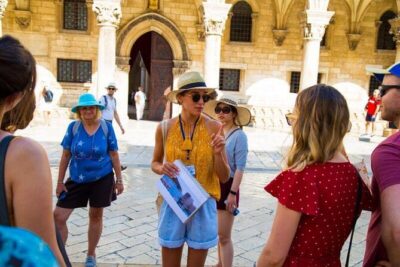

Dubrovnik: Game of Thrones and History Small Group Tour
Read our review →