
Review · BUCHAREST
Guided Walking Tour of Historical Bucharest
Bucharest’s story is written in sharp contrasts: an old inn beside Orthodox churches, grand nineteenth-century buildings beside communist-era monuments, and a huge Palace of Parliament looming over a boulevard built for dictatorship. This private walk connects those contrasts in about three hours. I especially like the small-group format, since your guide can adjust the pace and answer questions, and the route gives you both famous sights and less obvious corners such as Passage Macca-Villacrosse.
The best feature is the human explanation behind the stone and concrete. Guides including Alina have brought strong local knowledge and personal memories of Romania’s recent past to the walk. The trade-off is simple: this is a serious amount of walking, often at a brisk pace, and one guide has drawn criticism for political opinions and English that was sometimes difficult to follow.
Key points to know before booking
- A private walk through central Bucharest: Only your group participates, so the experience can feel more like a conversation than a standard group outing.
- A route shaped by Romanian history: You move from medieval Wallachian rulers to the 1989 Revolution, with communism and the Cold War linking the stops.
- About 17,000 steps may be possible: One guest’s watch recorded more than 17,000 steps, even without a fast pace.
- Manuc’s Inn is both meeting point and subject: You begin outside this famous old inn and learn why it matters to Bucharest.
- Strongest for history-minded visitors: The focus is on buildings, political change, culture, and personal stories more than museum interiors.
- Good value at $30.77: For a private three-hour orientation with hotel pickup offered, the price is attractive, though you should confirm the pickup details.
Starting at Manuc’s Inn in the old center
The walk begins outside the main entrance of Manuc’s Inn, Hanul lui Manuc, at 62 Strada Franceză. This is a useful starting place because the inn introduces one of Bucharest’s oldest urban stories before you take a single step toward the larger monuments.
You learn about the inn’s past and its role in the city’s commercial life. The setting also gives you an early taste of Bucharest’s layers: old walls, restored restaurants and taverns, narrow streets, and busy central routes all sit close together.
The Old Princely Court comes next. Its ruins are tied to the Wallachian rulers and to Vlad the Impaler, whose residence once occupied this site. You only spend about five minutes here, so do not expect a long archaeological visit. Instead, your guide uses the remains as a quick doorway into medieval Bucharest.
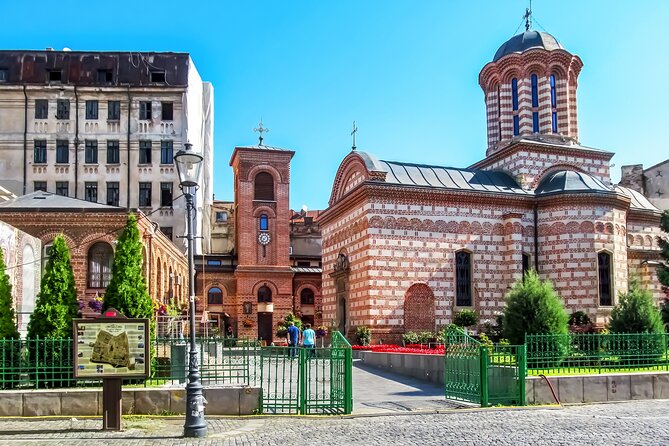
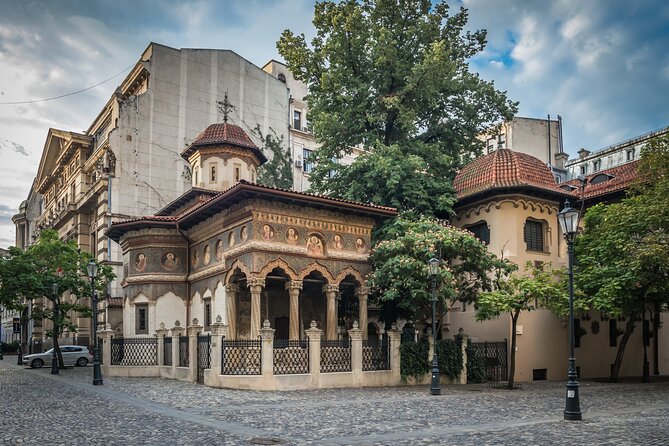
That approach continues at St. Anton Orthodox Church, once the coronation church of Wallachian rulers. The church was built in 1724 and carries more weight than its short stop suggests. It helps explain how religion, rulers, and public ceremony shaped the city long before the modern capital took form.
More History Walking Tours in Bucharest:
- Bucharest: Communism and History Guided City Walking Tour
★ 4.9 · 918 reviews - Roma Culture, Realities and Slavery History, Walking tour
★ 4.9 · 52 reviews - History and Hauntings of Salem Guided Walking Tour
★ 5.0 · 14,564 reviews
Unirii Square and the boulevard built for socialist power
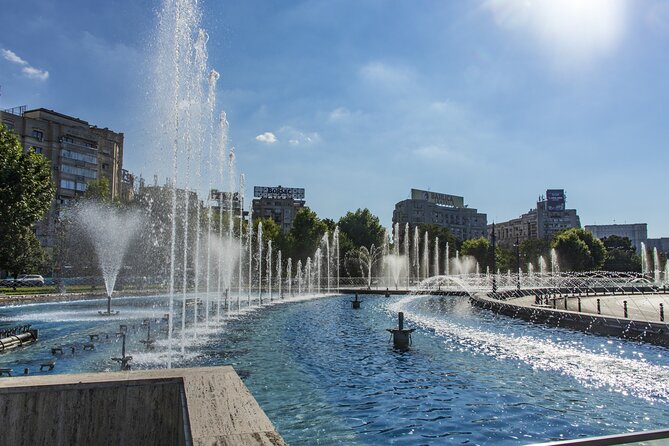
From the old court, you head toward Piata Unirii, the central square at the heart of the route. Its refurbished fountains offer some of the walk’s best photo stops, but the square matters for another reason too. It is where the old center opens into the enormous urban scale created under Nicolae Ceaușescu.
Bulevardul Unirii was once called the Boulevard of Socialist Victory. Its broad axis was designed to project state power, and it is often compared with the Champs-Élysées. The comparison is useful only up to a point. Paris’s famous avenue grew from a long urban tradition, while this Bucharest boulevard was imposed as part of a sweeping communist redevelopment project.
Your guide explains how Ceaușescu’s dictatorship changed Bucharest and how the Cold War affected the city. The useful part is seeing the political story directly in the street plan. The boulevard is not simply a place for a photograph. It is evidence of how governments can reshape a capital to display authority.
At the far end, Piata Constitutiei opens in front of the Palace of Parliament. You receive excellent views across the square and toward the building, but the walk does not list an interior visit. That distinction matters. You are seeing the palace from outside and learning about its place in the city, not taking a guided tour through its halls.
The Palace of Parliament and the cost of spectacle
The Palace of Parliament is the route’s biggest visual moment. It dominates the area and makes the scale of Ceaușescu’s building program easy to grasp. From the square, you can photograph the building and the boulevard together, which gives you a better sense of its relationship with central Bucharest.
I find this part most useful when you pay attention to what is missing as well as what is present. The palace and its surrounding avenues represent an era when ordinary neighborhoods and older buildings were cleared to make space for a grand political vision. Your guide connects the structure to dictatorship, state control, and the changes that followed 1989.
Because the stop is outdoors, weather matters. The experience requires good weather, and the exposed squares can be tiring in heat or unpleasant in cold wind. Wear shoes suited to pavement and bring water. One person completed the walk in freezing conditions, while another specifically warned that summer heat made the route demanding.
Churches, banks, and the old center’s surviving details
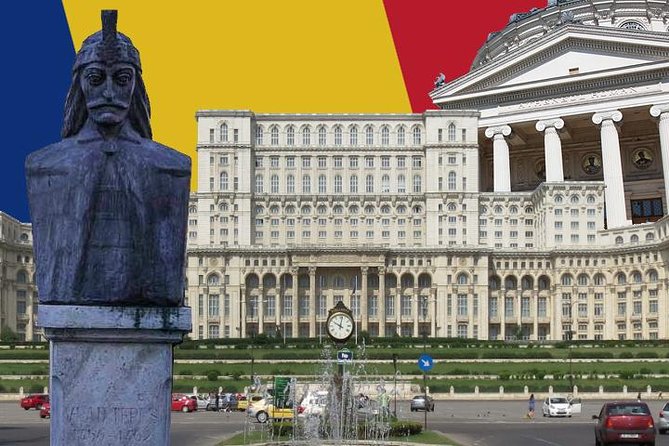
The route turns back toward the historic core, passing another church built in 1724. The supplied details do not identify it by name, but the point is clear: Bucharest’s religious buildings offer a counterweight to the monumental communist avenues.
You also hear about CEC Palace, one of the city’s most recognizable historic financial buildings. Its story fits with the stop at the National Bank of Romania, where the focus shifts to money, institutions, and the growth of modern Bucharest. These are brief exterior visits, but they help you read the city through more than kings and dictators.
Part of Calea Victoriei follows. This is one of Bucharest’s notable central avenues, lined with shops and grand buildings. You also enter Passage Macca-Villacrosse, a covered passage with an unusual atmosphere and its own past. It is one of the route’s more intimate moments, especially after the broad scale of Unirii Boulevard.
The old center itself dates back more than 500 years. You may pass restored taverns, restaurants, alleyways, and buildings that sit slightly away from the main tourist flow. One private group was taken inside several old taverns and restored restaurants, along with less expected buildings and malls. That sort of detour depends on the guide, but it shows why a private walk can offer more than a fixed list of viewpoints.
More Guided Tours in Bucharest:
- Pompeii: Entry Ticket and Guided Tour with an Archaeologist
★ 4.8 · 19,459 reviews - Edinburgh: Edinburgh Castle Guided History Tour with Tickets
★ 4.8 · 9,933 reviews - Berlin: Third Reich & Cold War Guided Walking Tour
★ 4.9 · 8,378 reviews - Historic Charleston Guided Sightseeing Walking Tour
★ 5.0 · 6,216 reviews
University Square and Bucharest’s public life
University Square brings you into a different part of the capital. Here you see the University of Bucharest, founded in 1864 by Alexandru Ioan Cuza, and the square’s role as a center of public life and protest.
Nearby, Suțu Palace houses the History Museum of Bucharest and was once the residence of Costache Suțu. Colțea Hospital and its church add another important central landmark. The hospital building dates from 1888, and its presence shows how medical, religious, educational, and civic institutions were gathered into this part of the city.
You also pass the National Theatre of Bucharest. Its design has changed several times, which gives your guide a chance to explain how buildings can reflect changing tastes and political periods. This is not a museum tour of the theatre, but it is a useful exterior lesson in how Bucharest keeps rebuilding its public face.
The route includes Biserica Kretzulescu, a particularly attractive church with an interesting past. You may appreciate this stop most if you enjoy the way Bucharest places ornate religious buildings close to major roads, offices, squares, and state institutions.
Revolution Square and the memory of 1989
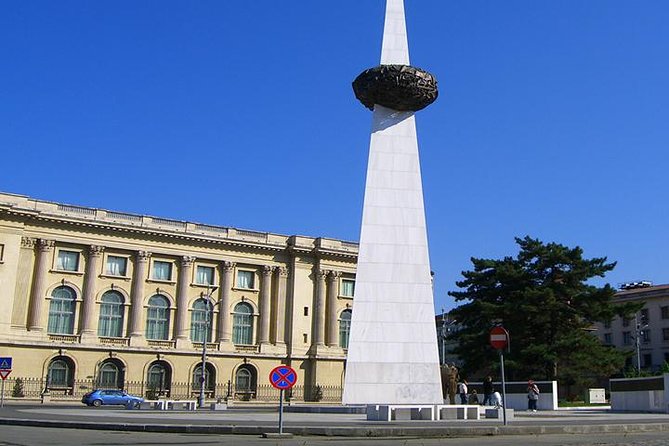
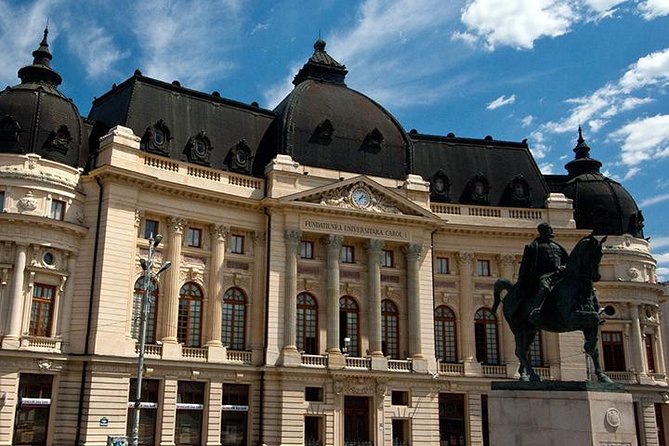
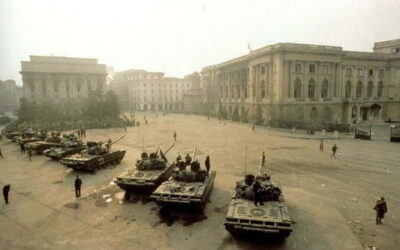
The most emotionally charged section comes around Revolution Square. This is where the 1989 uprising began and where several memorials mark the fall of communism. The walk points out the balcony where Ceaușescu gave his final speech, the former Communist Party headquarters, the University Library, and the equestrian statue of King Carol I.
The Memorial of Rebirth is the central symbol here. The 25-meter monument commemorates the struggles and victims of the Christmas 1989 Revolution. Its design has sparked strong reactions, but that is part of the point. Revolution Square is not a tidy historical lesson. It is a place where national memory, grief, politics, and public art continue to collide.
Your guide can help you connect the buildings and monuments instead of seeing them as separate photo stops. Personal memories are especially valuable here. Several guides, including Alina, have spoken about growing up in Romania and living through the later decades of the communist period. That can make the recent past feel less remote than a textbook account.
Still, you should know what kind of conversation this may become. The tour’s discussion of communism, monarchy, government, media, and Romania’s place in the world can be strongly personal. One person enjoyed the unusual perspective, while another felt the political commentary went too far. If you prefer a strictly neutral presentation, ask early for the focus you want.
Military Circle, Sărindar Fountains, and the return walk
The route continues to the Military Circle and the Sărindar Fountains. The Military Circle is a grand historic building, and the fountains add another good place for photographs. This closing stretch gives you one more example of Bucharest’s mix of civic architecture and open public space.
The final listed stop is a beautiful historic building with gardens, described as having been built for the people of Bucharest by the people of Bucharest more than 100 years ago. The supplied details do not name it, so you should treat this as a guide-led final viewpoint rather than a promised interior visit.
The activity is listed as ending back at Manuc’s Inn. That is helpful if you want to continue exploring the old center afterward. At the same time, one private group found the route confusing at the end while trying to reach a bus back to its hotel. If you use public transportation, ask your guide to point out your onward route before saying goodbye.
Pace, language, and guide style
This is not a gentle stroll with long cafe breaks. The route covers a large part of central Bucharest, and the pace may be brisk because the guide is trying to fit medieval sites, churches, financial buildings, communist avenues, and the 1989 memorials into one session.
The walking is on city streets and public squares, with no stated physical assistance. A moderate fitness level is required. I would bring water, wear supportive shoes, and avoid scheduling anything demanding immediately afterward.
Alina receives especially warm praise for her energy, humor, personal stories, and command of Romanian history, architecture, religion, and social change. Elena is also named as an excellent guide and historian. Guides can make this tour feel lively rather than academic, but the experience may vary in English clarity. One person found it occasionally hard to understand the guide, while another had no trouble following a fast and energetic presentation.
The private format helps. If a question is unclear, you can ask for it to be explained again. You can also set expectations at the start by saying you want more architecture, more daily life, or less political discussion.
Is $30.77 good value?
At $30.77 per person, the price is appealing for a private activity lasting about three hours. You are paying not only for walking directions, but for a guide who can connect Bucharest’s buildings with medieval rule, monarchy, communism, the Cold War, and the 1989 Revolution.
The value is highest if you are new to Bucharest and want a strong first orientation. You see the main historic center, the Palace of Parliament area, University Square, and Revolution Square in one outing. You also get enough context to choose which places deserve a closer visit later.
The value is less clear if you want long visits inside monuments. Admission is listed as free at the named stops, and the experience is primarily an outdoor walk. There is no promised Palace of Parliament interior tour, museum entry, or meal.
Hotel pickup and drop-off are offered, but the stated meeting details place the start outside Manuc’s Inn and say the activity ends there. Confirm the pickup arrangement when booking, especially if you are staying outside the old center.
Free cancellation is available up to 24 hours before the start time. The activity requires good weather, so a poor-weather cancellation can lead to another date or a full refund.
Who should book this Bucharest walk?
You should book it if you like cities explained through politics, architecture, religion, and personal stories. It suits first-time visitors, history fans, and anyone who wants a local guide before exploring Bucharest alone.
It is also a good match for a private couple or small family group that wants to ask questions and set the pace. Children must be accompanied by an adult, and the long walk makes it better for families with older children who can manage several hours on foot.
You may want a different activity if you dislike political discussion, need frequent rest stops, or want indoor sightseeing. You should also think twice during very hot or very cold weather unless you are prepared with water and suitable clothing.
For me, the strongest reason to book is the route’s range. In one morning or afternoon, you move from Vlad the Impaler’s court to Ceaușescu’s monumental boulevard, then to the streets where Romania’s communist regime began to collapse. That is a lot of Bucharest in three hours, and it gives you a useful map for the rest of your stay.
FAQ
Where does the tour start?
It starts outside the main entrance of Manuc’s Inn, Hanul lui Manuc, at 62 Strada Franceză in Bucharest’s old center.
Where does the tour end?
The activity is listed as ending back at the meeting point.
How long does the tour last?
The planned duration is approximately three hours.
How much does the tour cost?
The listed price is $30.77 per person.
Is the tour private?
Yes. Only your group participates in the activity.
Is the tour offered in English?
Yes. English is the listed tour language.
Is hotel pickup available?
Hotel pickup and drop-off are offered. The specific meeting instructions also identify Manuc’s Inn as the starting point, so confirm the pickup details when booking.
What sights are included?
The route includes Manuc’s Inn, the Old Princely Court, Piata Unirii, Unirii Boulevard, Piata Constitutiei, the Palace of Parliament area, churches, CEC Palace, Calea Victoriei, Passage Macca-Villacrosse, the National Bank, University Square, Suțu Palace, Colțea Hospital, the National Theatre, Biserica Kretzulescu, Revolution Square, the Memorial of Rebirth, the Military Circle, and Sărindar Fountains.
Is the Palace of Parliament visited inside?
The route provides views and photo opportunities outside the Palace of Parliament. An interior visit is not listed.
How fit do I need to be?
You should have a moderate fitness level. The tour involves a lot of walking, and one completed walk exceeded 17,000 steps.
Can I cancel for a refund?
You can cancel up to 24 hours before the start time for a full refund. If poor weather cancels the activity, you are offered another date or a full refund.
Just added around Bucharest
- Private Tour: Transylvanian Castles and Brasov’s Medieval Old Town★ 5.0 · 42 reviews
- Visit Bulgaria – Veliko Tarnovo Medieval Fortress – Private tour from Bucharest★ 5.0 · 51 reviews
- Day Trip to Medieval Bulgaria- Small group tour★ 3.5 · 75 reviews
- Bucharest Jewish Heritage | Holocaust Memorial | Private Car Tour★ 5.0 · 38 reviews
- 2-Day Medieval Transylvania with Brasov,Sibiu and Sighisoara Tour from Bucharest★ 4.5 · 145 reviews
- Day trip to Dracula’s Castle, Peles Castle and Medieval Brasov★ 4.5 · 41 reviews
- 3-Day Medieval Transylvania Package Tour★ 4.7 · 31 reviews
- Roma Culture, Realities and Slavery History, Walking tour★ 4.9 · 52 reviews
Bucharest History Tours, compared.
Bucharest: Communism and History Guided City Walking Tour
Read our review →
From Bucharest: Small Group Day Trip to Medieval Bulgaria
Read our review →
Bucharest: 3-Hour Dark History Tour with a Local
Read our review →
Peles Castle, Dracula’s Castle and Medieval Town of Brasov in one day
Read our review →
Bucharest: Small Group History, Art & Secrets Tour
Read our review →
2-Day Medieval Transylvania with Brasov,Sibiu and Sighisoara Tour from Bucharest
Read our review →
Roma Culture, Realities and Slavery History, Walking tour
Read our review →Browse the lists this tour appears in