
Review · FLORENCE
Renaissance & Medieval Florence Guided Walking Tour plus mobile App
Florence’s great strength is how much history sits within a short walk. This tour links the Medici quarter, Brunelleschi’s dome, the sculpture-filled Piazza della Signoria, and the Ponte Vecchio in one compact route. I like the clear story line, from Medici power to Renaissance art, and I like that the walk crosses the Arno instead of staying only around the Duomo. The main drawback is that the tour is mostly outdoors, with little time inside major sights.
I also like the local guide format, especially for a first morning in Florence. Guides such as Helena, Larisa, Sylvia, and Maximilian have been praised for their stories, history, and practical tips. But check the language arrangement at the meeting point: although English is offered, some groups have been run in English and French or Spanish, which can cut the talking time in half.
Key points to know before booking

- A compact Florence orientation: Cover the Medici district, Duomo, Straw Market, Piazza della Signoria, Uffizi courtyard, Ponte Vecchio, and Pitti Palace in about 90 minutes.
- The Medici story gives the walk shape: Learn how one banking family shaped Florence’s politics, churches, palaces, and art.
- Mostly exterior sightseeing: Attraction entry is not included, so this is an overview walk rather than a museum tour.
- A useful south-bank finish: Ending at Ponte Vecchio gives you an easy launch point for Pitti Palace and the Oltrarno.
- The app adds independent exploring: Use the VOX CITY app afterward for audio commentary and self-guided routes.
- Language can affect the pace: Ask at check-in if your group will be English only or bilingual.
Why this walk works as a first look at Florence
At $30.04 per person, this is priced as a low-cost introduction, not a full museum experience. You are paying for a professional guide, a structured route, meeting-point assistance, and access to a mobile city guide. That is fair value if you want the city explained while you walk and you plan to return to selected sights later.
I would choose this for a first day, especially if your time in Florence is short. It helps you mark the main sights on your mental map, decide where to spend more time, and understand why the Medici family appears almost everywhere in central Florence.
The route also makes practical sense. It starts near Via de’ Martelli, close to the Duomo, and ends at Ponte Vecchio. You do not finish back where you began, so you can continue toward Pitti Palace, remain on the south side of the Arno, or walk back through the historic center.
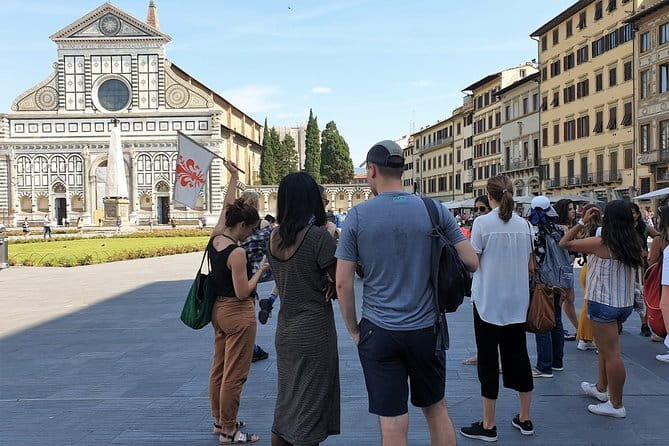
The group size can reach 20 people, though smaller groups are possible. A small group makes it easier to ask questions and hear the guide. A full group, especially in crowded squares, may require you to stay close and watch for the guide.
More History Walking Tours in Italy
- Venice: City Center Historical Guided Walking Tour
★ 4.2 · 1,873 reviews - Palermo: Street Food and History Walking Tour
★ 4.9 · 1,486 reviews - Verona: History and Hidden Gems Guided Walking Tour
★ 5.0 · 1,379 reviews
San Lorenzo and the Medici family
The walk begins at Via de’ Martelli 50 and heads toward San Lorenzo. This is an excellent opening because the neighborhood connects daily Florence with the city’s ruling family. The open-air market sells leather goods, clothing, and other items, giving you a quick look at a commercial side of Florence that is different from its churches and museums.
The guide then explains the Medici family’s rise and its effect on civic life and art. This background matters. Without it, the palaces, chapels, churches, and patronage of artists can feel like a disconnected list of grand buildings. With it, you begin to see Florence as a city shaped by money, family ambition, public image, and artistic competition.
The route includes the Medici Chapels in the discussion and passes the Palazzo Medici Riccardi, designed by Michelozzo for Cosimo de’ Medici. Its courtyard is one of the early signs of Medici taste and influence. You should confirm exactly what you will enter on your departure day, since attraction admission is not included and the itinerary is mainly an exterior walk.
The Basilica di San Lorenzo is the key stop in this part of the route. It was the Medici family church, and its elegant cloister, attributed to Brunelleschi, offers a quiet green space in the middle of the busy district. About 15 minutes are assigned here.
This stop is especially useful because it gives you a pause from Florence’s crowded streets. Still, do not expect a long interior visit. The walk’s purpose is to explain the setting and its importance, not to replace a paid visit to the Medici Chapels or the basilica.
The Duomo complex in a 20-minute stop
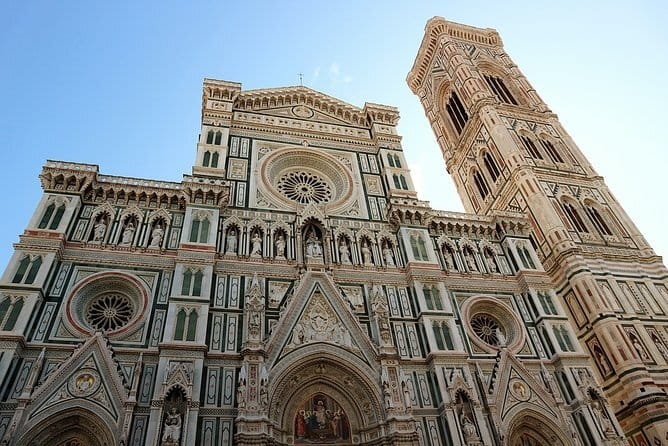
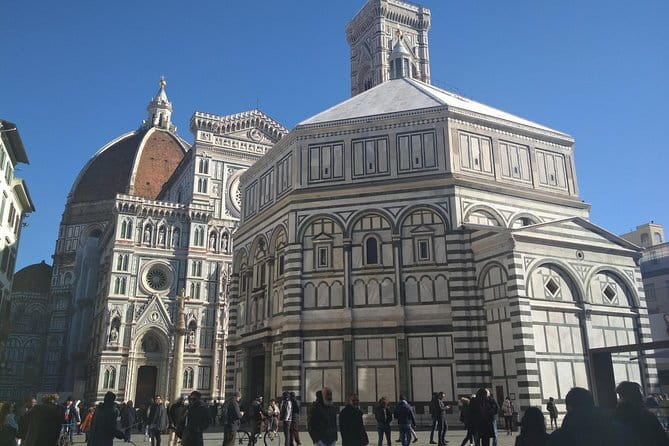
From San Lorenzo, the route moves to Piazza del Duomo. Here you see the Cathedral of Santa Maria del Fiore, Brunelleschi’s Cupola, Giotto’s Bell Tower, and the Baptistery of Saint John. The guide covers the architecture and explains how these buildings work together as Florence’s religious center.
The Duomo is the visual high point of the route, but 20 minutes goes quickly. You will have time to look, listen, and take in the main details. You will not have time for the dome climb, the bell tower, or a full cathedral visit, and no entry tickets are included.
That limitation is important when planning your day. If you want to climb Brunelleschi’s dome or see the Baptistery interiors, arrange those visits separately. This walk helps you understand what you are looking at, but it does not provide the ticketed experience.
I like having the guide explain the architectural relationship between the dome, bell tower, and baptistery. Florence can sometimes feel like a series of beautiful façades. A good explanation turns the square into a story about civic pride, engineering, religion, and competition.
The square can be crowded, and the guide may stop at the edge rather than directly in front of each building. Wear comfortable shoes and keep the meeting-point details handy. A city walk here involves cobblestones, crossings, and frequent pauses.
Rubbing the nose of Il Porcellino

The next stop is the bronze Fontana del Porcellino at the Mercato della Paglia, or Straw Market. The small piglet is tied to a local luck tradition: rubbing its nose is said to bring good fortune.
This is a short stop of about 10 minutes, but it adds a welcome bit of folklore to the serious Medici and Renaissance material. It also gives you a chance to notice the difference between Florence’s major monuments and its everyday street traditions.
The market setting can be crowded, so stay close to the guide. The statue is popular, and the route may pause only long enough for the story, a look, and a photograph. You can return later if you want more time in the market area.
More Medieval History Tours in Italy
- Private Tour of the Medieval Village of Ostuni by Tuk Tuk
★ 4.5 · 278 reviews - Discover the Medieval Charm of Siena on a Private Walking Tour
★ 5.0 · 247 reviews - Roman countryside Food & Wine Tasting in a medieval winery
★ 4.5 · 220 reviews - From Turin: Half-Day Medieval Sacra di San Michele Tour
★ 4.7 · 94 reviews
Piazza della Signoria and Florence’s outdoor sculpture gallery

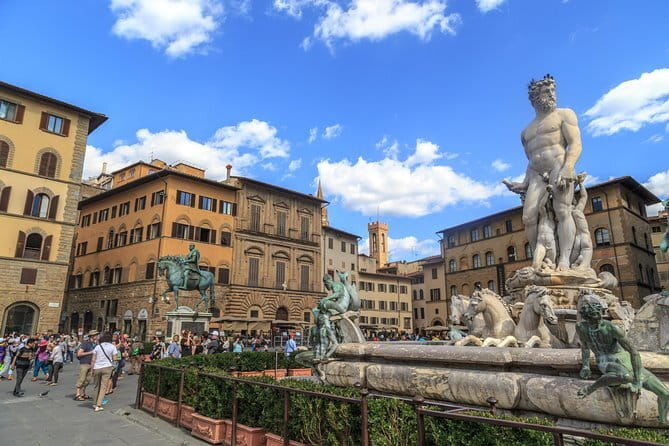
Piazza della Signoria is one of the strongest sections of the walk. It is dominated by Palazzo Vecchio and filled with sculptures, making it an outdoor display of Florentine art and political messaging.
The guide points out Giambologna’s Rape of the Sabine Women, one of the works included in the Loggia dei Lanzi area. The sculpture is worth more than a quick photograph. Its twisting bodies and complicated viewpoint reward a few minutes of close attention, and a guide can explain how the piece was designed to be seen from several sides.
You also get an exterior look at Palazzo Vecchio, Florence’s historic seat of civic power. The square helps connect public buildings with the Medici story already introduced in San Lorenzo. Politics, art, and spectacle meet here.
Allow about 10 minutes at the square, though the pace may vary. This is another location where a bilingual tour can feel slow because the guide gives the same explanation twice. On a monolingual tour, the short stops leave more room for questions and extra details.
The Uffizi courtyard and the route of the Vasari Corridor
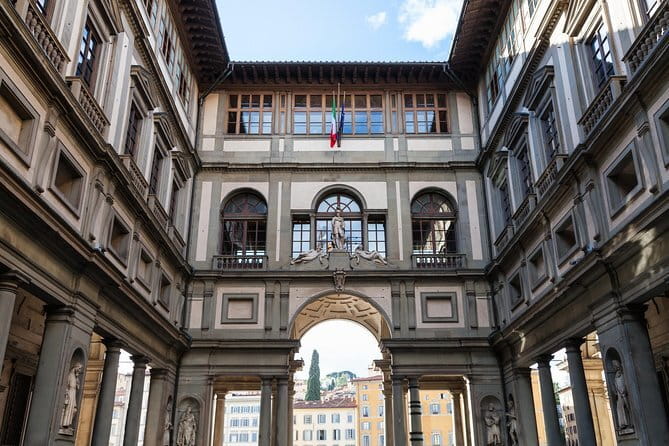
From Piazza della Signoria, the walk passes through the courtyard of the Uffizi Gallery. The Uffizi itself is one of the world’s major art museums, associated with works by Botticelli, Leonardo da Vinci, Michelangelo, and Raphael. You will not enter the museum on this experience, but the courtyard gives you a useful introduction to its place in Florence.
The guide also follows the route of the famous Vasari Corridor from the outside. Built as a private passage for the Medici, the corridor connected Palazzo Vecchio with Pitti Palace across the river. Seeing its path helps you understand how the ruling family moved through the city without mixing with ordinary street life.
This is a good example of the tour’s value. You are not simply checking off famous buildings. You are tracing how Florence’s ruling family connected government, residence, art, and security.
Crossing the Arno on Ponte Vecchio
The route continues across the Ponte Vecchio, Florence’s oldest bridge and its famous jewelry bridge. This is the longest stop after San Lorenzo, with about 15 minutes assigned to it.
The bridge is narrow and often crowded. You may need to pause along the side rather than walk as one neat group. Look up and around as you cross. The shops, river views, and Vasari Corridor above create a layered picture of how the bridge has served commerce, movement, and Medici access.
Ending at Ponte Vecchio is useful. You can continue to Pitti Palace, explore the south side of the Arno, or return to the center on your own. One participant specifically found the crossing helpful because it opened up the other side of Florence, an area easy to miss if you spend all your time around the Duomo and Uffizi.
The tour description also names Pitti Palace as part of the route, but the listed end point is Ponte Vecchio. Treat Pitti Palace as a view or nearby landmark rather than a ticketed visit. Entry is not included.
The medieval quarter and Dante’s Florence
The full route also includes Florence’s medieval quarters, associated with Dante Alighieri, as well as the Badia Fiorentina and the Bargello Palace. These locations add an earlier layer to a walk that often focuses on the Renaissance.
That contrast is valuable. Florence was not created all at once during the age of Michelangelo and Brunelleschi. Medieval streets, religious buildings, civic institutions, and later Medici projects overlap in a compact area.
The precise order can change. Your guide may place these sights at a different point in the walk, and the total time may feel closer to two hours depending on stops, questions, and language needs. The advertised duration is approximately one hour and 30 minutes.
How the guides shape the experience
The strongest part of this experience depends on the person leading it. Guides praised by name include Helena, Larisa, Sylvia, and Maximilian. The best feedback points to clear explanations, personal stories, humor, and useful suggestions for the rest of a Florence visit.
A good guide can make a short stop feel worthwhile. Several guides have been described as passionate about Florence and willing to answer questions about history, architecture, local life, and current city issues. That is exactly what you want from an orientation walk.
The weak point is consistency. Some groups have been bilingual in English and French or Spanish, even when the booking was made with the expectation of an English tour. Repeating every explanation can make the walk longer while giving you less content in your chosen language.
Ask before the tour starts what languages will be used. If the guide must switch languages, stay patient but recognize that the experience may feel less full. Some visitors also found that standing in one place for long explanations was uncomfortable on a cold day. Warm layers and good shoes help.
Using the VOX CITY app after the walk
The mobile app is a useful extra, but it should not be mistaken for a replacement for the guide. You download VOX CITY from the Apple App Store or Google Play and receive login details from the assistant before the walk.
Your own smartphone and headphones are required. Headphones are not included, so bring a pair that works with your phone. The app provides multilingual audio commentary for itineraries and points of interest, allowing you to continue exploring after the guided portion ends.
This feature improves the value of the $30.04 price if you plan to stay in Florence for more than one day. You can use the guided walk to get your bearings, then use the app to revisit areas or follow another route at your own pace.
The app does require preparation. Download it before the meeting time if possible, charge your phone, and make sure you have headphones. If you prefer to keep your phone tucked away while walking, the app may matter less to you.
Who should book this Florence walk?
I would recommend it to first-time visitors who want the main sights explained without paying for a private guide. It also suits anyone with limited time, since the route covers both sides of the Arno and ends near several major attractions.
It is a good fit if you enjoy history, architecture, and short stories about famous works. The Medici theme gives the walk a clear thread, while the Porcellino and Dante references keep it from becoming only a lecture about grand buildings.
I would think twice if your main goal is interior access. No attraction tickets are included, and the tour does not provide extended time at the Duomo, Uffizi, Medici Chapels, or Pitti Palace. You will need separate reservations and extra time for those.
I would also ask about language before booking. The overall rating is 4.1 from 140 reviews, which reflects a generally solid introduction with some unevenness when guides must lead in two languages.
Cancellation is free if you cancel at least 24 hours before the local start time. Changes or cancellations inside that window are not accepted for a refund.
Should you book it?
Book this tour if you want a practical first look at Florence for about $30, with a local guide, a compact route, and an app for further exploring. Its best qualities are the clear Medici thread, the number of major landmarks covered, and the chance to cross Ponte Vecchio rather than remain in one small part of the center.
Skip it if you want museum entry, a dome climb, or a slow art-focused visit. Before joining, bring comfortable shoes, your phone, and headphones, and confirm that your group will receive the tour in English as expected. With those points understood, this is a useful way to get your Florence bearings fast.
FAQ
How long does the Renaissance and Medieval Florence walking tour last?
The advertised duration is approximately one hour and 30 minutes. The exact timing can change because of the order of visits, questions, crowd conditions, and language arrangements.
Where does the tour begin and end?
The tour begins at Via de’ Martelli 50 in central Florence. It ends at Ponte Vecchio.
Is the tour offered in English?
English is offered. The tour may also be conducted in another language if groups are combined, so you should confirm the language arrangement at the meeting point.
Are attraction entry tickets included?
No. Entry to attractions is not included. The walk focuses mainly on exterior views and selected areas such as the San Lorenzo cloister.
What should I bring?
Bring comfortable shoes, your own smartphone, and headphones. Headphones are required to use the self-guided app and are not provided.
What is the VOX CITY app?
VOX CITY is a mobile city guide with self-guided itineraries and multilingual audio commentary. You download it on an iOS or Android phone and receive access details before the tour.
How many people can join the tour?
The maximum group size is 20 people. Smaller groups may be possible, depending on the date and bookings.
More Self-Guided Tours in Italy
- Taormina: Ancient Theater Skip-the-Line Ticket & Audio Guide
★ 4.5 · 2,412 reviews - Naples: National Archaeological Museum Ticket & Audio App
★ 4.4 · 617 reviews - Matera: Sassi di Matera Historical Self-Guided Audio Tour
★ 3.6 · 183 reviews - Naples: National Archaeological Museum audio guide
★ 4.0 · 155 reviews
Just added around Italy
- Guided Cultural Tour of the Godfather Film in Messina★ 5.0 · 31 reviews
- Guided tour of the Riace Bronzes and the Archaeological Museum of Reggio Calabria★ 5.0 · 44 reviews
- SU NURAXI BARUMINI Unesco World Heritage Site★ 5.0 · 129 reviews
- Brescia the Unexpected: History, Local Stories & a drink★ 5.0 · 31 reviews
- Bolognese Cooking Class with Margherita in the Historic Center★ 5.0 · 26 reviews
- Tower and Power, Virtual tour in Medieval Bologna★ 4.5 · 54 reviews
- Bologna historical art walking tour with hidden gems and tastings★ 5.0 · 108 reviews
- Best of Bologna in one day : Food, architecture, art and history★ 5.0 · 27 reviews
Florence History Tours, compared.
Siena, San Gimignano and Chianti Wines Day Tour from Florence
Read our review →
Guided Medici Tour Florence: Discover Mysteries & History
Read our review →
Florence Walking Tour with Accademia, Uffizi & Lunch
Read our review →
Tipsy Tour: Guided Bar Crawl In Florence with Dark History
Read our review →
Florence to Fiesole golf cart tour:History & Panoramic views
Read our review →
Florence: Fashion History Guided Walking Tour & Museum Visit
Read our review →
Florence Wine &Food: Taste Tuscan Flavors in Historic Cellar
Read our review →Browse the lists this tour appears in