
Review · PHILADELPHIA
Revolution and the Founders: History Tour of Philadelphia
Philadelphia’s Revolutionary story comes alive street by street on this two-hour walk. You’ll see the Liberty Bell, Independence Hall, Franklin Court, Congress Hall, Carpenters’ Hall, and the sites tied to the country’s first government, while a history-trained guide explains what happened there.
I like the strong route for first-time visitors and the fact that every guide has a history degree. I also like the lively storytelling: Josh, Kyle, Vince, Joseph, and Ted have all been praised for making the past feel personal, funny, and easy to follow. The main drawback is simple: this is mostly an outdoor tour, so you will not tour the main interiors during the walk, and cold, wind, or rain can make long stops uncomfortable.
Key points to know
- See the essential Old City sights in two hours: The route covers Philadelphia’s main Revolutionary landmarks without taking your whole day.
- Expect a history-focused guide: Guides include Josh, Kyle, Vince, Joseph, and Ted, with backgrounds in history, teaching, or college-level American history.
- The tour keeps moving: You get an overview of many sites, then can return to the ones you want to explore inside.
- Liberty Bell and Independence Hall require extra planning: Free entry is available, but interior visits take additional time and may require timed passes.
- The storytelling is lively: Guides may act out scenes, answer questions, and adapt the talk to your interests.
- Dress for the weather: The tour runs rain or shine unless severe weather causes cancellation.
Why this walk is a useful first look at Philadelphia
Philadelphia’s historic district rewards a guide because the important buildings sit close together, yet their stories overlap in complicated ways. A short walk can take you from the symbol of liberty to the room where the Constitution was debated, then on to the first presidential residence, early banks, printing shops, and meeting halls.
That is the basic strength of this experience. You are not spending two hours inside one museum. You are getting an organized introduction to the whole district, with a person connecting the buildings to the people who used them.
The focus is the Revolution and the founders, especially Philadelphia in and around 1776. Benjamin Franklin receives plenty of attention, as do George Washington, John Adams, Alexander Hamilton, James Madison, Thomas Jefferson, and other figures who shaped the new country.
I would take this tour near the start of a Philadelphia visit. It gives you a working map of Old City and helps you decide where to spend more time afterward. Since the route ends near City Tavern and the Merchants Exchange, you are well placed to continue exploring on foot.
More History Tours in the USA:
- History and Hauntings of Salem Guided Walking Tour
★ 5.0 · 14,564 reviews - Charleston’s Old South Carriage Historic Horse & Carriage Tour
★ 5.0 · 10,023 reviews - Beneath The Streets Underground History Tour
★ 4.5 · 8,006 reviews
A two-hour route through the Liberty Bell area
The walk begins with check-in and an introduction to the Revolutionary period. From there, you head through the Independence National Historical Park area and toward the Liberty Bell.
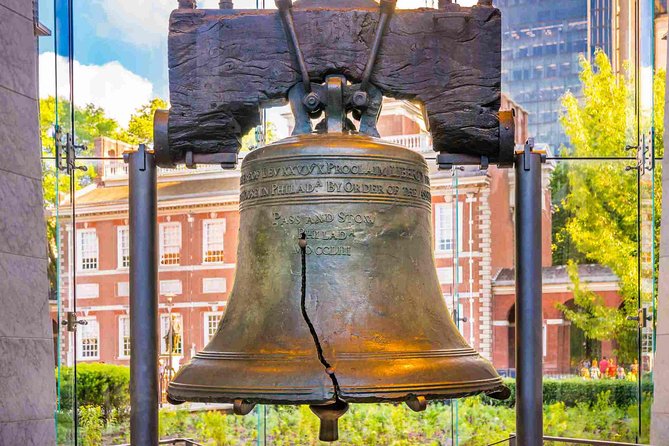
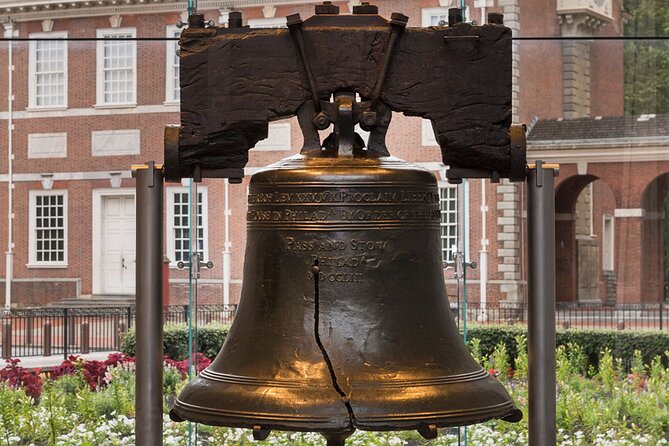
The guide explains how the bell was made, why it cracked during its first test ring, and how local workers John Pass and John Stow recast it in 1754. The inscription about liberty throughout the land comes from the King James Bible and refers to a jubilee tradition involving the freeing of enslaved people and the forgiveness of debts.
That detail gives the bell more depth than the usual quick photo stop. Its meaning has changed over time, and the guide places the object within both its colonial setting and its later role as a symbol of liberty.
The tour views the Liberty Bell Pavilion from outside. This is important to understand before booking. You receive the key story and directions for entering the pavilion on your own, but you do not spend the extra hour waiting in line and visiting the interior as part of the walking tour.
During busy periods, the line can stretch around the corner and take close to an hour. If seeing the bell up close is a priority, plan to return after the tour and allow extra time. The walking tour is better viewed as an orientation, not a substitute for the pavilion visit.
Independence Hall and the founding of the United States
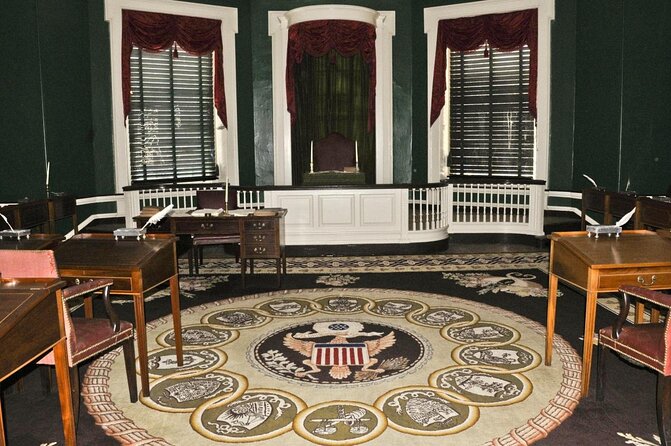
Independence Hall is the emotional center of the route. This is where the Declaration of Independence and the Constitution were debated and adopted, making the building central to both the Revolution and the creation of the federal government.
The guide covers the key story and points out the most important parts of the complex. When crowds and closures allow, the group may make a short stop inside the East Wing, the oldest and most historic section of the complex. This area served as Supreme Court chambers when Philadelphia was the national capital.
Again, do not confuse the walking tour with a full Independence Hall visit. Free timed entry passes are required for the main interior experience, and you should allow about two additional hours if you want to explore the complex properly.
That arrangement can actually work in your favor. The guide shows you what matters, then you can return with a better sense of what you are seeing. If you are short on time, the tour gives you the core story. If you are a serious history fan, plan a separate interior visit.
Washington, Adams, and Philadelphia’s first presidential home
The route continues to the site of the President’s House, where George Washington and John Adams lived and worked while Philadelphia served as the national capital from 1790 to 1800.
This stop helps correct a common mental picture. The early presidency did not begin in Washington, D.C. The national government operated in Philadelphia for a decade, and the city was filled with officials, diplomats, congressional business, and private dealings.
The site also connects to Benedict Arnold, who lived there as military governor after the British left Philadelphia during the Revolutionary War. That gives the stop a useful link to the war years and to one of the most famous betrayals in American history.
You will hear this story from the street rather than touring a preserved presidential residence. Still, the location gives the early government a sense of place, which is one reason a walking route works well here.
Same city, a different century:
- Big Island in a Day: Volcanoes Waterfalls Sightseeing and History
★ 5.0 · 6,569 reviews - Boston: Freedom Trail History Small Group Walking Tour
★ 5.0 · 6,450 reviews - Historic Charleston Guided Sightseeing Walking Tour
★ 5.0 · 6,216 reviews - Charleston Horse-Drawn Carriage Tour: Explore Historic Charleston
★ 5.0 · 3,561 reviews
Congress Hall and the young republic
At Congress Hall, your guide explains how the building served as the home of the United States Congress from 1790 to 1800. It also hosted the inaugurations of Washington and Adams.
This is a small but important piece of the national story. Washington’s presidency is often taught through grand portraits and formal speeches, but Congress Hall shows the government as a working institution operating in a compact urban setting.
The stop also helps connect the Revolution to the next phase of American history. Independence was not the end of the story. The new country still had to build a government, choose leaders, handle money, and define the limits of federal power.
Franklin Court and the many lives of Benjamin Franklin
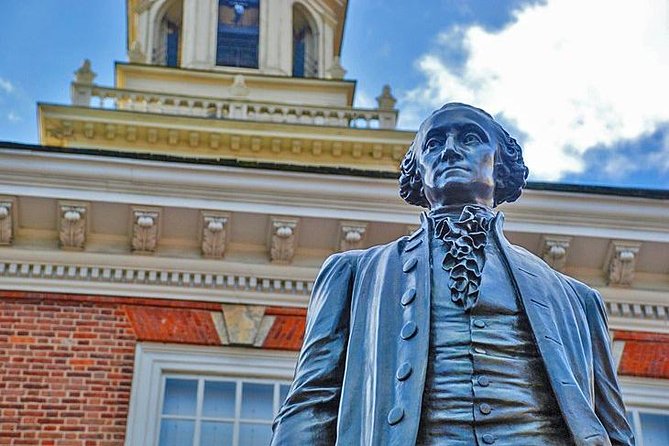
Franklin Court is one of the most useful stops for understanding Benjamin Franklin beyond the familiar kite story. The complex includes museums, historic sites, and the location associated with Franklin’s Philadelphia home during the period of the Constitutional Convention.
Your guide discusses Franklin as a printer, publisher, inventor, electrical experimenter, diplomat, and statesman. That range matters because Franklin did not fit neatly into one role. He helped shape public debate through print, worked with science, and later negotiated abroad for support during the Revolution.
The tour also uses Franklin to explain the practical side of independence. His work was not only about speeches and ideals. Printing, communication, postal systems, diplomacy, and money all helped keep the revolutionary cause alive.
You will hear Franklin’s famous warning that the founders had to hang together or hang separately. The line works especially well on a walking tour because the guide can tie it to the political disagreements and fragile alliances of the period.
Philadelphia’s first military strategy center
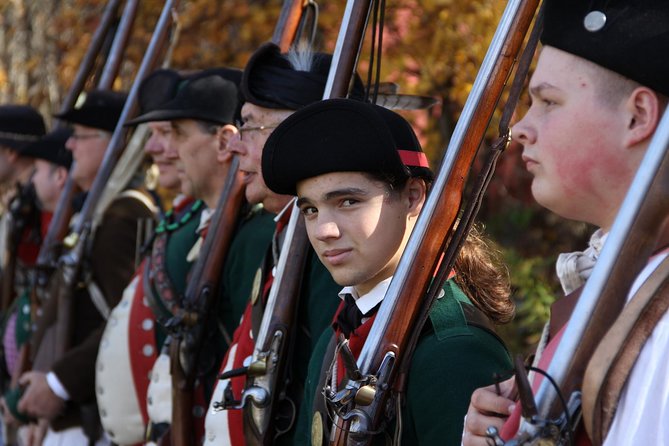
The route includes the location described as America’s first Pentagon, where military strategy and intelligence were developed during the Revolution.
This stop is less familiar than Independence Hall, and that is part of its value. It adds the behind-the-scenes side of the conflict: planning, information, command, and the practical decisions needed to fight a war.
Do not expect a large military museum at this point. The importance comes from the explanation and the location. If you enjoy the mechanics of war rather than only the famous speeches, pay close attention here.
The Franklin Post Office and a surviving colonial tradition

The Benjamin Franklin Post Office and Museum offers one of the more unusual stops on the route. It is the only Colonial-themed post office operated by the United States Postal Service, and it continues to use the postmark B. Free Franklin.
The building does not fly the American flag because Franklin became postmaster general in 1775, before the flag existed. That small detail makes the site memorable and shows how everyday institutions can preserve political history.
The second floor includes postal displays and memorabilia. The walking tour focuses on the story and helps you decide if you want to return for a closer look. You might find this especially appealing if you enjoy the practical side of history: mail, printing, communication, and the way information moved through the colonies.
Carpenters’ Hall and the French connection

Carpenters’ Hall was the meeting place of the First Continental Congress in 1774. The guide also explains secret meetings held there in December 1775 involving Benjamin Franklin, John Jay, Francis Daymon, and the French spy Julien Achard de Bonvouloir.
Those meetings helped lead to negotiations for French support. That support became a major factor in the American victory, so this stop widens the story beyond the thirteen colonies.
The building also had a difficult wartime chapter. British forces occupying Philadelphia during the winter of 1777 used it during the occupation. In a few minutes, the site can represent colonial protest, secret diplomacy, and military occupation.
Carpenters’ Hall is one of the places where a strong guide makes a real difference. The building itself may not explain its full importance, but the surrounding story gives it weight.
The First and Second Banks of the United States
The tour then turns to the financial arguments that shaped the new nation.
The First Bank of the United States was championed by Alexander Hamilton, the first Secretary of the Treasury. The tour discusses the bank’s founding and its notable architecture, along with Hamilton’s role in building the country’s financial system.
The Second Bank of the United States brings the later conflict into view. It was modeled on Hamilton’s first bank, chartered during James Madison’s presidency, and lost its charter under Andrew Jackson in 1834.
This is a useful reminder that the founders did not agree on everything. The new nation argued fiercely over banks, federal authority, and the balance between national and state power. The guide also connects Hamilton and Jackson to famous duels, giving the financial story a more personal and dramatic edge.
The American Philosophical Society and Library Company
The American Philosophical Society was founded by Franklin in 1743 and remains tied to the University of Pennsylvania. Early members included Washington, Adams, Jefferson, Hamilton, Thomas Paine, James Madison, and other major figures.
The tour discusses Franklin, the university, and the first surgical center associated with the area. You may not spend much time inside, but the stop shows how Philadelphia served as a center for science, education, medicine, and political thought.
Nearby, the Library Company recalls another Franklin project. Founded in 1731, it was the first institution in the world to lend materials to members of the public. That is a small but revealing part of Franklin’s legacy: he helped build systems that spread useful information beyond a narrow elite.
Dolley Todd House and the life behind the famous names
The route includes the former home of Dolley Todd, later Dolley Madison, where she lived with her first husband, John Todd, from 1791 to 1793.
The site offers a glimpse into middle-class life in eighteenth-century Philadelphia. It also opens the door to a more personal story about Dolley and James Madison, which one guide used to explain how the future first lady and president came together.
This stop adds welcome balance to a route dominated by male political leaders. It reminds you that the city’s history is also made of homes, marriages, illness, work, and ordinary daily routines.
What the guides do best
The guide can shape the entire experience. The company requires a history degree for every guide, and its guides include history teachers and American history professors.
Josh is repeatedly praised for his energy, humor, storytelling, and ability to keep a group involved. Kyle has been described as especially theatrical, with dramatic portrayals that made one group feel as if James Madison himself were leading the walk. Vince is known for answering questions and adapting the pace and detail to the group.
Joseph is a natural storyteller with a strong feel for the order in which the sites are presented. Ted has worked hard to keep groups comfortable and engaged even in freezing conditions.
That style will not suit everyone. One person found the acting too prominent and wanted a more direct history lesson. If you prefer a quiet, academic lecture, ask yourself how much performance you enjoy. If you like anecdotes, character voices, humor, and questions, the approach should fit well.
Price, pace, and what you actually receive
At $29 per person, this is a good-value introduction to Philadelphia’s historic core. You are paying for two hours with a trained guide, not admission to the major buildings.
The value is strongest if you are new to Philadelphia, have limited time, or want help deciding which sites deserve a longer visit. The route covers far more ground than you could easily organize on your own in two hours.
The tradeoff is that you must pay with your feet and attention. You will walk between stops and often stand outside while listening. The maximum group size is 24, so the experience is not private, though it is still small enough for questions when the guide keeps the group together.
Morning and afternoon departures make it easy to fit around other plans. The tour runs in rain or shine, unless poor weather forces a cancellation. Wear comfortable shoes and check the forecast before choosing your clothing. Cold days have been manageable when guides keep the group moving, but standing still in wind can be unpleasant.
Mobile tickets are provided, and the meeting point is at 523 Market Street. The tour ends at the Merchant Exchange Building at 143 South Third Street, behind City Tavern and near the area connected to the Continental Congress and Alexander Hamilton’s Philadelphia home.
You can cancel for a full refund up to 24 hours before the start time. Children must be accompanied by an adult, service animals are allowed, and most people can take part.
Who should book this Philadelphia history tour?
I would choose this walk for a first visit, a short city break, or a family trip with older children interested in American history. It also suits solo visitors who want a clear introduction without committing to a full day of museums.
History fans should book it as a framework, then return to Independence Hall, the Liberty Bell Pavilion, Franklin Court, or Carpenters’ Hall for longer visits. The tour does not replace those interiors, but it helps you choose among them.
I would be more cautious if you dislike outdoor tours, have difficulty standing for long periods, or want extensive time inside each landmark. You also need to accept that the exact interior stops can depend on crowds and closures.
Should you book it?
Book this tour if you want a lively, efficient introduction to Revolutionary Philadelphia and value a guide who can connect famous buildings with lesser-known stories about banks, postal systems, diplomacy, medicine, and daily life.
Skip it if your main goal is entering every major building during one continuous experience. For most first-time visitors, though, the $29 price is fair, the route is well chosen, and the two-hour format leaves the rest of your day open for cheesesteaks, museums, or a closer look at the places that caught your interest.
FAQ
How long does the Revolution and the Founders tour last?
The walking tour lasts approximately two hours.
What landmarks are included?
The route includes the Liberty Bell area, Independence Hall, the President’s House site, Congress Hall, Franklin Court, the location of America’s first Pentagon, the Benjamin Franklin Post Office and Museum, Carpenters’ Hall, the First and Second Banks of the United States, the American Philosophical Society, the Library Company, and the Dolley Todd House site.
Do I enter Independence Hall during the tour?
The tour provides the key highlights and clear directions for a later visit. Free timed entry passes are required for the main interior experience, and you should allow about two extra hours if you want to explore the complex.
Do I go inside the Liberty Bell Pavilion?
The tour explains the Liberty Bell from outside the pavilion and provides directions for entering on your own. The interior visit is free but is not included in the walking tour and may take about an additional hour.
Are the guides trained in history?
Yes. Every guide has a history degree, and many are history teachers or American history professors. Guides named in the experience include Josh, Kyle, Vince, Joseph, and Ted.
What happens if the weather is poor?
The tour runs rain or shine, but it requires good weather. If it is canceled because of poor weather or because the minimum number of participants is not met, you can choose another date or receive a full refund.
Just added around the USA
- Red Rocks Amphitheatre Historical Walking Tour★ 5.0 · 74 reviews
- 1-Hour Segway Tour of Cheyenne Cañon Art, History and Nature★ 5.0 · 36 reviews
- Colorado Springs – Guided Walking Ghost / History Tour★ 5.0 · 168 reviews
- Ancient Landscapes Private Geology Hike at Garden of the Gods★ 5.0 · 31 reviews
- Village Food Tours Lunch & History Tour★ 5.0 · 80 reviews
- 2.5 Hour Kayaking with Manatee and History Tour in Tarpon Springs★ 5.0 · 24 reviews
- Safety Harbor Ghost Tour★ 5.0 · 60 reviews
- Historical Bicycle Tour of Dunedin★ 5.0 · 44 reviews
Philadelphia History Tours, compared.
Philadelphia Old City Historic Walking Tour with 10+ Top Sites
Read our review →
2.5 Hour Philadelphia History Tour with Washington War Tent Show
Read our review →
Philadelphia: Revolution and The Founders History Tour
Read our review →
Philadelphia: History, Highlights & Revolution Walking Tour
Read our review →
Philadelphia: Grim, Dark, and Twisted History Tour
Read our review →
Philadelphia: Revolutionary Walk Through Historic Old City
Read our review →
Philadelphia: Guided Walking Tour of Historic District!
Read our review →Browse the lists this tour appears in