
Review · HISTORY TOURS
Siem Reap: Banteay Srei and Grand Circuit Heritage Tour
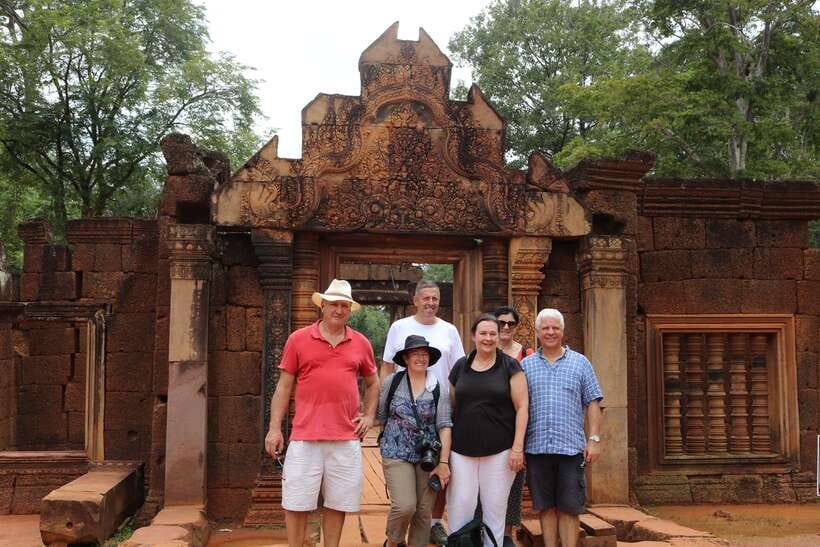
Banteay Srei is the star here, but the real strength of this day is variety. You move from a brick temple mountain at Pre Rup to Cambodia’s most delicate carvings, then on to a water-bound Buddhist shrine and the root-filled ruins of Preah Khan. It is a useful second day in Angkor, not just a repeat of Angkor Wat.
I like the small-group format, which gives guides such as Pal, Bun, Sak, and Sokpee room to explain Hindu and Buddhist ideas clearly and help with photographs. I also like the practical care: air-conditioning, cold bottles of water, and mint-scented towels after temple walks. The drawback is the long day, often around 8 am to 6 pm, with plenty of walking and heat.
Five things to know before you book
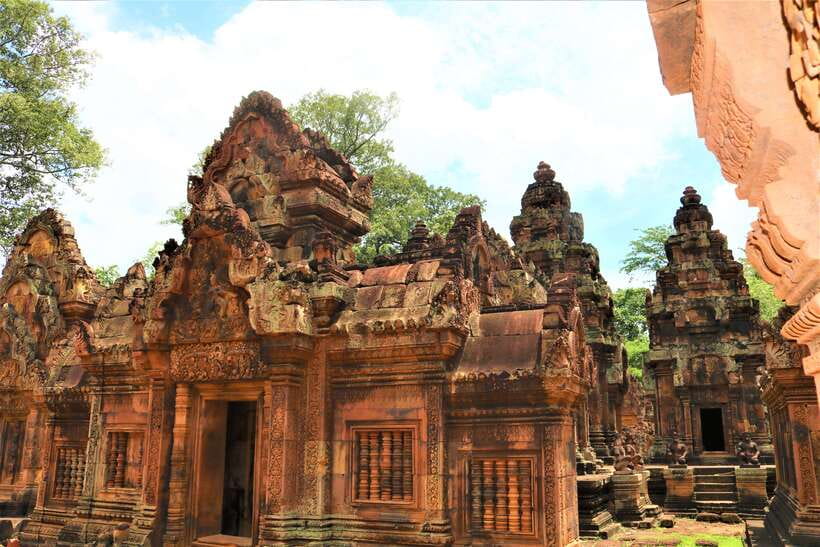
- Banteay Srei is the artistic high point: Its small sandstone buildings carry exceptionally fine reliefs.
- The temples feel different from Angkor Wat: Preah Khan is atmospheric and partly overgrown, while Neak Pean is tied closely to water and Buddhist symbolism.
- Guiding is a major strength: English-speaking guides often use tablet images to explain damaged or hidden details.
- The $18 price is only the tour cost: You must also pay $37 for a one-day Angkor Pass, plus your own lunch and drinks.
- Plan for heat and walking: Bring a hat, sunglasses, insect repellent, suitable outdoor clothing, and no shorts.
Why this makes a strong second day at Angkor
If you have already visited Angkor Wat, Ta Prohm, and Angkor Thom, this tour gives you a different rhythm. The famous temples are grand and busy. The stops on this route are smaller, more scattered, and often calmer, with more time to notice carvings, corridors, ponds, and tree roots.
I would not treat this as a lesser version of the main Angkor day. Preah Khan has its own mood, Banteay Srei has a level of detail that can surpass larger monuments, and Neak Pean offers a different kind of setting altogether. The sites also help explain how Khmer rulers used temples for worship, royal power, water management, and remembrance.
The day begins with hotel pickup in Siem Reap, generally around 8 am. Exact pickup time depends on your hotel, and you are told the time one day in advance. The route includes roughly 30-minute vehicle sections between some stops, so you get breaks between walks rather than spending nine straight hours on your feet.
The van is air-conditioned, and the driver usually meets you with cold water and a cool towel when you return. That sounds like a small perk until you are walking across sun-baked stone in Cambodia. Then it becomes part of the day’s basic survival kit.
More History Tours in the world:
- Prague: Medieval Dinner with Unlimited Drinks
★ 4.4 · 19,847 reviews - Pompeii: Entry Ticket and Guided Tour with an Archaeologist
★ 4.8 · 19,459 reviews - History and Hauntings of Salem Guided Walking Tour
★ 5.0 · 14,564 reviews
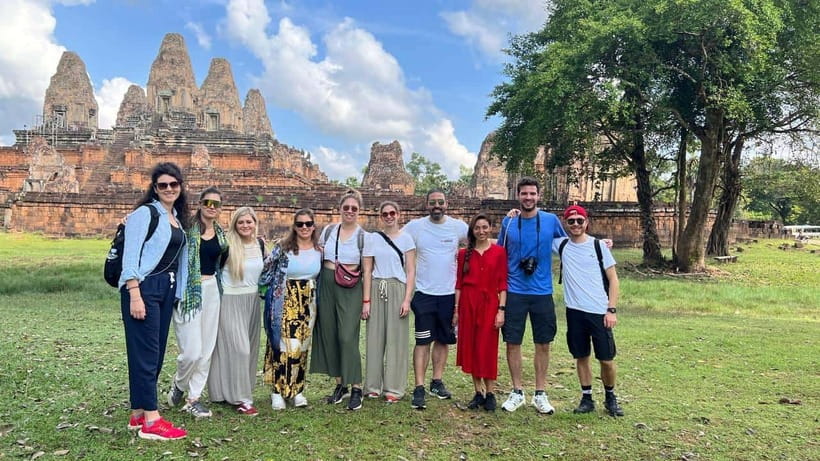
Pre Rup, a brick temple mountain with a big sky
Pre Rup was built as the state temple of King Rajendravarman and dedicated in 961 or early 962. It is made from brick, laterite, and sandstone, and its stepped form gives it the classic temple-mountain shape.
The site is a good introduction to the day because it looks and feels different from the polished towers of Angkor Wat. Brick dominates many of the upper sections, and the structure has a more weathered, earthy appearance. I like the way the broad setting lets you step back and see the temple as a whole.
The supplied schedule describes Pre Rup as the sunset stop, while the day’s temple order can vary. In practice, confirm the final sequence with your guide, since Pre Rup may also appear earlier in the route. The sunset portion is weather-dependent, and rain can shorten the final stop or lead the group back to Siem Reap sooner.
If sunset conditions cooperate, this is a fitting close to a long temple day. If clouds or rain interfere, the tour still works because Pre Rup is worth seeing for its architecture, not only for the evening light.
Banteay Srei and Cambodia’s finest stone carving
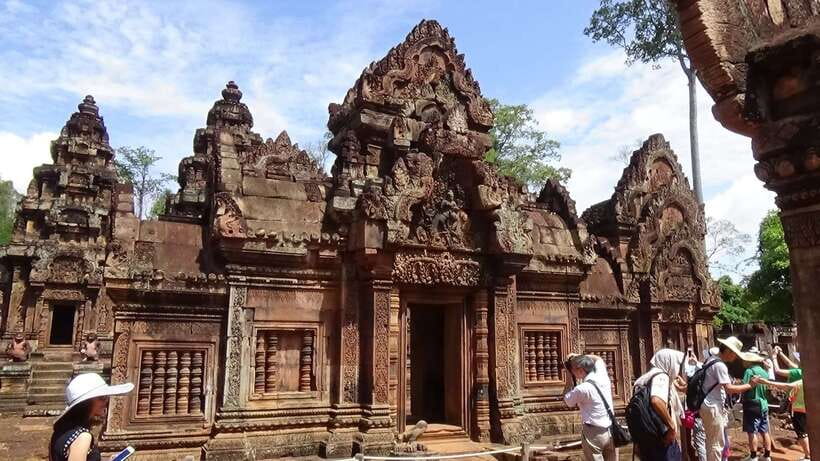
Banteay Srei is the stop I would most want to protect time for. It is smaller than the headline temples, but its pinkish sandstone walls carry unusually crisp reliefs of Hindu gods, mythic scenes, foliage, and ornamental details.
The scale matters. At a huge temple, you often look up and take in a tower or gallery as a single grand form. At Banteay Srei, I want to move slowly and look closely. The carved stone feels almost jewel-like in its precision, and the compact layout makes it easier to understand how the decoration fits together.
The temple was only accessible to visitors from the late 1990s, after the Khmer Rouge left the area. That recent history is important. This is not simply an old monument placed on a sightseeing route. Access, safety, conservation, and Cambodia’s difficult past all shape how you encounter it today.
Guides such as Bun, Pal, and Sak are especially helpful here because the details can blur together without context. A good guide can point out the figures, explain the stories behind the reliefs, and show old photographs on a tablet. Several guides also take photographs for the group, which is useful at a site where framing the carvings and people together can be tricky.
The drawback is distance. Banteay Srei sits away from the central Angkor cluster, so you spend time in the van getting there and back. That travel is part of the reason the tour lasts a full day, but the temple earns the extra road time.
Neak Pean, a small shrine surrounded by water
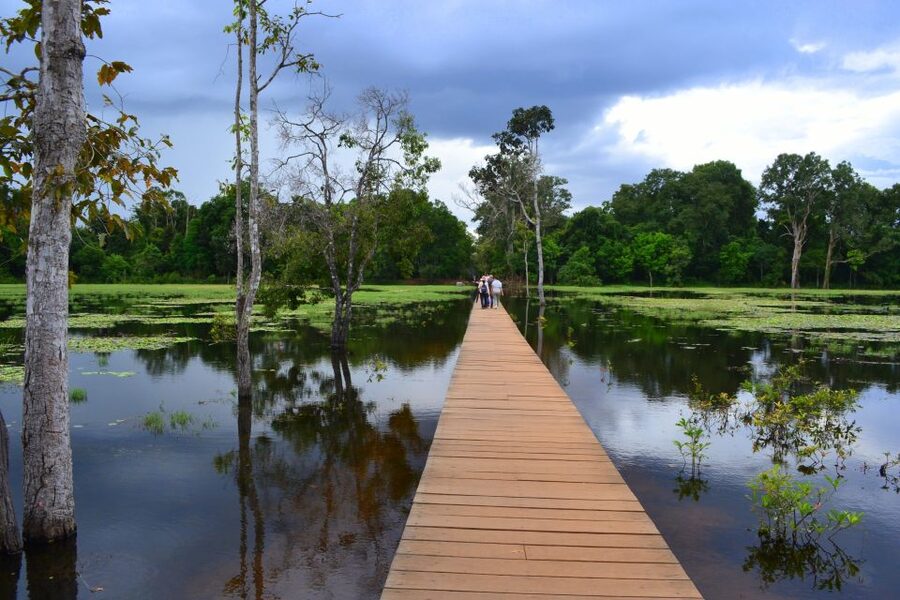
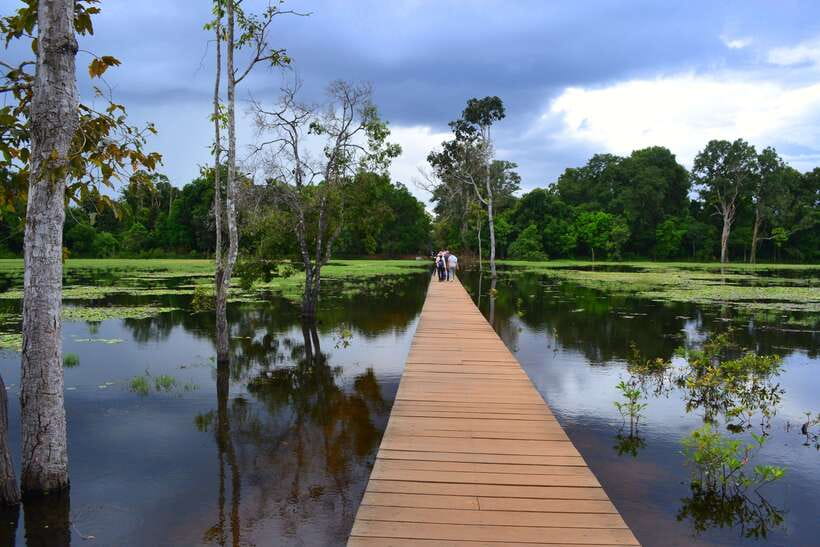
Neak Pean is an artificial island with a Buddhist temple on a circular island in Jayatataka Baray. The approach across the water gives the stop a different feel from the temple mountains and enclosed galleries elsewhere on the route.
I find Neak Pean most rewarding when you pay attention to the setting, not just the central structure. Water, causeways, and the island plan shape the experience. It is a compact visit, but it adds a strong Buddhist and hydraulic element to a day otherwise filled with royal and Hindu temple architecture.
The one limitation is that Neak Pean is not a vast complex. You will not spend hours exploring a maze of chambers. Its value comes from the unusual design and the pause it provides between larger sites. Your guide can explain why water matters here and help you see the plan as more than a pretty walk across a pond.
Bring insect repellent, especially if you are sensitive to insects near water. Sunglasses and a sun hat also help, since shaded cover is not guaranteed along the approach.
Same city, a different century:
- Athens: Acropolis & up to 5 Archaeological Sites Combo Pass
★ 4.2 · 13,904 reviews - Colosseum: Underground and Ancient Rome Tour
★ 4.7 · 12,691 reviews - Pompeii: Small Group Tour with an Archaeologist
★ 4.8 · 12,264 reviews - Lisbon: History, Stories and Lifestyle Walking Tour
★ 4.8 · 10,902 reviews
Preah Khan, where corridors meet tree roots
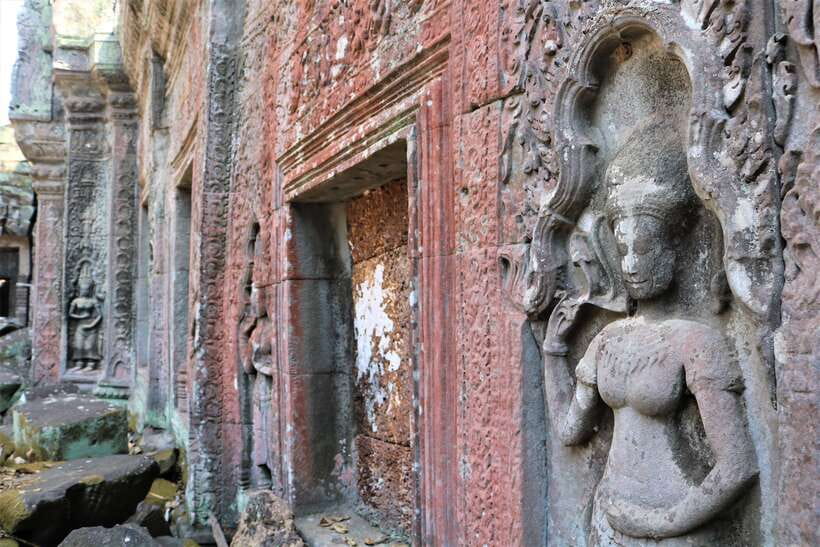
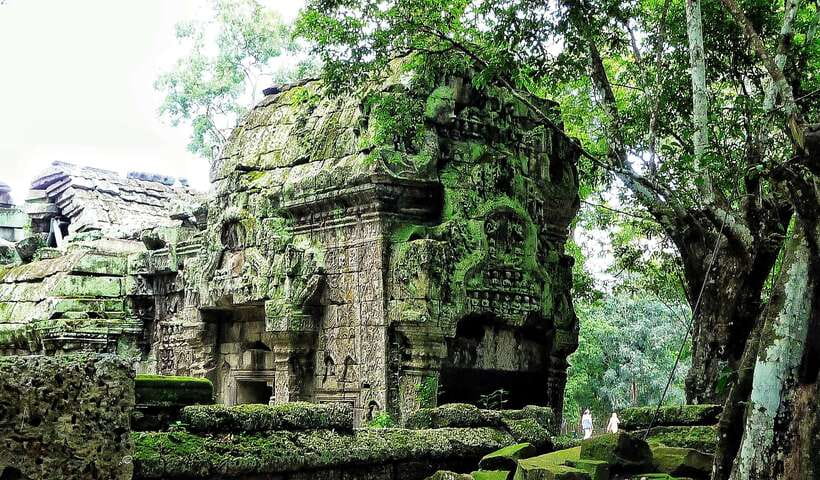
Preah Khan was commissioned by King Jayavarman VII in honor of his father. It is a ruined complex of stone structures, galleries, corridors, and tree growth, with a mood that feels more intimate than the monumental Angkor Wat.
This is the place where I would slow down. Preah Khan rewards looking through doorways, along long axes, and into half-collapsed corners. Tree roots and crumbling masonry create the atmosphere, but the site is not just a jungle backdrop. It has enough surviving structure to show the scale and planning of the original complex.
Restoration work by the World Monuments Fund has helped preserve parts of the temple, and some sections are in remarkably good condition. That also means you should pay attention to where you walk and follow your guide’s directions. Uneven stones, narrow passages, and broken surfaces make comfortable footwear important.
Preah Khan makes a good contrast with Angkor Wat. Angkor Wat can feel ordered, symmetrical, and ceremonial. Preah Khan feels more layered and personal, with the remains of a working religious and royal center revealed in fragments. If you like atmosphere and texture more than perfect symmetry, this may be your favorite stop.
Lunch, road time, and the practical side of the day
Lunch takes place at a local restaurant for about an hour. Food and drinks are not included in the stated $18 tour price, so carry enough money for the meal. One useful detail from the supplied information is that a restaurant near Banteay Srei may add a 2 percent charge for credit card or mobile payment, so cash can keep the bill simple.
The driving sections are not wasted time. Banteay Srei is farther from Siem Reap than the central temples, and the route covers several sites outside Angkor Thom. The van gives you a chance to rest, cool down, and listen to your guide without walking.
Drivers named in the supplied experiences include Mao, Naro, Syha, V, Keal, Mong, and Chan. The strongest practical pattern is consistent: careful driving, cold water, umbrellas when rain arrives, and cool towels when you return from a temple. Rainy-season flexibility is useful. One group chose to skip the final sunset because of weather and was taken back to the hotel.
The day is active but not a forced march. The listed stops generally allow about an hour at Preah Khan, Neak Pean, and Banteay Srei, with up to 90 minutes at Pre Rup. You still need to watch your energy, especially in hot months. A long day can feel easy in the morning and tiring by the final temple.
How the guides shape the experience
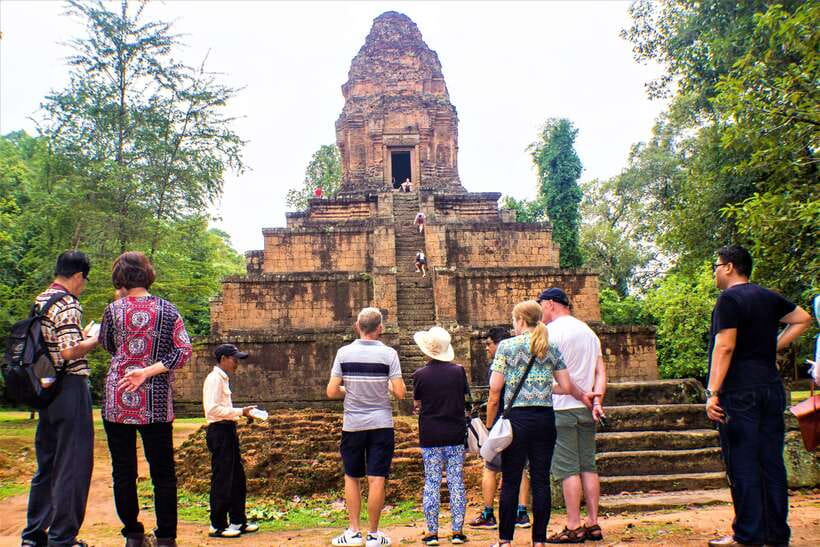
This tour depends heavily on the guide. The temples are old, the royal names are numerous, and Hindu and Buddhist symbols can be confusing when you see them without explanation.
Guides including Pal Saroun, Bun, Sakriya, Mr Nang, Sokpee, Sokee, Roem, and Chhay are praised in the supplied material for clear English, patience, historical explanation, and help with photos. Several use a tablet with images of the temples in earlier periods. That is useful at ruined sites because you can compare the stones in front of you with how the buildings may once have looked.
I especially value guides who explain both religion and recent Cambodian history. The tour can cover Hindu mythology, Buddhist ideas, Khmer kings, temple construction, restoration, and Cambodia’s wartime past. Some guides also share personal connections to Siem Reap and the surrounding area, giving the day a local voice rather than a string of memorized dates.
Guide assignments can change, so you should not book on the assumption that a particular person will lead your group. The overall guiding standard is the main strength, but the exact style will depend on who is assigned.
What the price really means
The advertised tour price is $18 per person. That is low for a full-day trip with hotel pickup, an air-conditioned vehicle, an English-speaking guide, bottled water, cool towels, and several temple visits.
But the real required cost includes a one-day Angkor Pass at $37 per person. That brings the basic total to $55 before lunch and drinks. If you already hold a valid Angkor Pass, the tour becomes especially good value, though the pass rules should be confirmed when booking.
For comparison, the value is not just transport. Banteay Srei and the outlying temples are spread across the Angkor area, and arranging separate transport, timing, and explanations would take effort. The small-group setup gives you a guide without the cost of a fully private tour.
The tradeoff is a fixed group schedule. You have more flexibility than on a large coach, but less than with a private car. Most people will appreciate the structure, especially on a first visit to the outer temples. If you want to linger for hours at one site, ask endless photography stops, or change the route completely, a private arrangement may suit you better.
Who should book this day
I would choose this tour if you have at least two days for Angkor and want to move beyond the most famous monuments. It is also a reasonable choice for a one-day temple visit if Banteay Srei and quieter outer sites appeal more than checking only the standard highlights.
It suits adults and children aged eight or older who can manage walking on uneven temple ground. It is not suitable for wheelchair users, and the no-shorts rule means you need clothing that meets temple standards. Outdoor clothing, a sun hat, sunglasses, and insect repellent belong in your day bag.
The tour is less suitable if you dislike early starts, heat, long drives, or a full schedule. The experience can run from about 8 am to 6 pm, depending on pickup location, traffic, group timing, and sunset conditions.
You can cancel up to 24 hours ahead for a full refund, and the reserve-now, pay-later option keeps payment flexible. Pickup and drop-off cover hotels in Siem Reap city, with the exact time confirmed before the tour.
Should you book the Banteay Srei and Grand Circuit tour?
I would book it for a second Angkor day, especially if Banteay Srei’s carvings, Preah Khan’s ruined corridors, and smaller crowds sound more appealing than another visit to the major temples.
The strongest reasons are the route’s variety, the low tour cost, and the practical care from the guide and driver. The main cautions are the extra $37 temple pass, the separate lunch cost, the long day, and the fact that sunset depends on weather.
If you want a well-organized introduction to the less visited side of Angkor, this is a smart choice. If you have only a few hours or need wheelchair access, choose something shorter and more flexible.
FAQ
How long does the tour last?
The experience lasts about nine hours. Pickup is generally around 8 am, with return to Siem Reap after the final temple and sunset stop.
What temples are included?
The stated route includes Pre Rup, Banteay Srei, Neak Pean, and Preah Khan. The exact order can vary, and the final sunset stop depends on weather and the day’s schedule.
Is hotel pickup included?
Yes. Pickup and drop-off are included for hotels in Siem Reap city. The exact pickup time depends on your hotel and is provided one day before the tour.
How much is the Angkor Pass?
The one-day Angkor Pass costs $37 per person and is paid separately on the day of the activity.
Is lunch included?
Lunch at a local restaurant is part of the schedule, but lunch and drinks are not listed among the included tour services. Budget separately for them.
Is transportation air-conditioned?
Yes. The tour uses an air-conditioned vehicle, with bottled water and cool towels provided during the day.
Is the tour conducted in English?
Yes. An English-speaking live guide leads the tour.
What should I bring?
Bring sunglasses, a sun hat, insect repellent, and suitable outdoor clothing. Wear comfortable footwear for walking on uneven temple surfaces.
Can I wear shorts?
No. Shorts are listed as not allowed, so wear clothing that meets the temple dress requirement.
Is the tour suitable for children and wheelchair users?
The tour is not suitable for children under eight or for wheelchair users. It includes walking at several temple sites and uneven historic surfaces.
Just added around the world
- 3 Hour Whiskey and History Tour★ 5.0 · 152 reviews
- Downtown Denver History & Highlights – Small Group Walking Tour★ 5.0 · 285 reviews
- Denver – Capitol Hill Guided Walking Ghost / History Tour★ 4.5 · 75 reviews
- Private Nightlife Tour in Denver: Culture, History, and Cocktails★ 5.0 · 48 reviews
- Tip Based: Capitol Hill History & Ghost Tour★ 5.0 · 34 reviews
- Delphi: Archaeological Site & Museum Ticket with Audio★ 3.5 · 24 reviews
- 1-Hour Thunderball WWII Adventure Jet Skiing in Darwin★ 5.0 · 70 reviews
- Bombing of Darwin World War II Tour with Harbour Cruise★ 4.5 · 219 reviews