
Review · INDIA
The Hipster Chandigarh Architecture History Tour
Chandigarh is best understood from the inside, and Rusty has an unusually personal connection to the city. He grew up in Le Corbusier’s public housing, studied in Pierre Jeanneret’s schools, and worked in buildings designed by Maxwell Fry. That gives this architecture and planning tour more weight than a standard sightseeing drive.
I like the access to places such as the Capitol Complex, Museum Maison Jeanneret, and Pierre Jeanneret’s public housing. I also like the human pace: Rusty allows time for photographs, adjusts food stops to your preferences, and uses humor without turning the city’s political and social story into a lecture. The main consideration is the packed schedule. Two days cover a lot, and architecture fans may want extra time at several stops.
Key things to know before booking
- Rusty’s local connection: He is a third-generation Chandigarh resident who spent much of his life in the city’s modernist buildings.
- Rare architectural access: The program includes guided visits to public housing, Maison Jeanneret, the Lake Club, and parts of Panjab University.
- A full two-day program: You visit major monuments, museums, markets, a lake, and working parts of the city rather than seeing only postcard sites.
- Transport and admission included: Pickup, drop-off, driving, parking, waiting time, entrance fees, and photography charges are covered.
- Good for mixed interests: Food stops, jokes, gentle explanations, and flexible pacing help families and first-time architecture visitors.
- Potentially large group: The maximum group size is 41, so ask about the expected size if close personal guidance matters to you.
Why Chandigarh needs more than a monument tour
Chandigarh was planned as a new city after the partition of India. Its fame comes from Le Corbusier and his collaborators, but the city makes more sense when you look beyond the famous concrete buildings.
You need to see how housing, markets, universities, government offices, recreation, water, shade, and movement fit together. That is where this experience earns its two-day length. Rusty links the grand civic buildings to ordinary city life, including the apartment blocks and commercial areas that many architecture tours skip.
I like that the focus is not only on Le Corbusier. Pierre Jeanneret, Maxwell Fry, Jane Drew, Indian architects, planners, and local residents all form part of the story. The result is less a parade of famous names and more an explanation of how a planned city works.
Rusty’s background also shapes the tone. He has worked as a journalist for 11 years and researched Chandigarh through reporting and architectural study. His style is described as funny, warm, and occasionally eccentric, but the humor stays politically neutral and suitable for families, students, couples, and official visitors.
More History Tours in India:
- Fontainhas Heritage Walk by Make It Happen
★ 5.0 · 2,834 reviews - The Great Indian Food Tour: Old Delhi Food and Heritage Walk
★ 5.0 · 1,698 reviews - Old Goa Heritage Walk by Make It Happen
★ 5.0 · 797 reviews
Day one: the big ideas in concrete
The first day begins at 9:00 am and concentrates on Chandigarh’s most important modernist buildings. Pickup is offered, and an air-conditioned vehicle covers the driving, parking, waiting, and drop-off costs.
Capitol Complex and the Open Hand
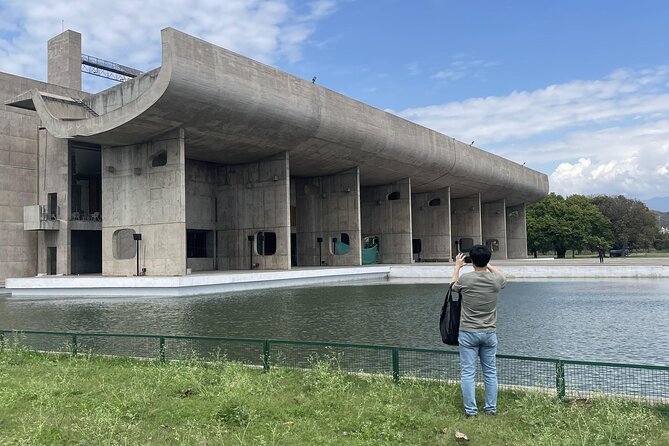
The Capitol Complex is the essential first stop. This UNESCO World Heritage site contains the Secretariat, Assembly Hall, and Open Hand Monument, all built around the civic life of the new city.
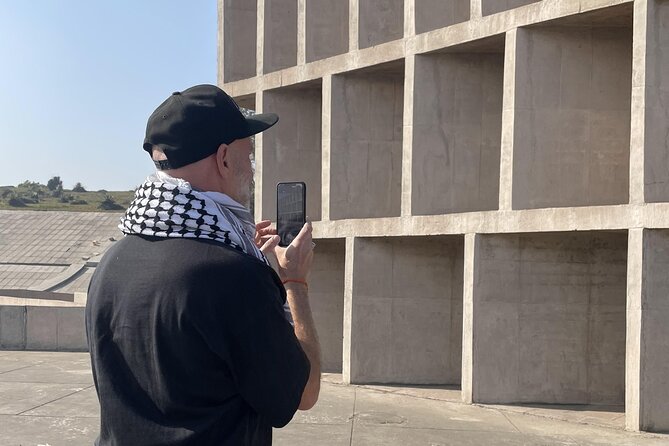
You can expect about an hour here, with admission included. The scale matters. Photographs show concrete shapes and strong shadows, but a guide helps you see how the buildings were meant to represent government, public duty, and a new civic identity.
The Open Hand Monument receives a separate visit later in the day. That may sound repetitive, but the two stops serve different purposes. At the Capitol Complex, you see it as part of the larger government setting. Later, you get closer to the symbol itself and hear the story of its meaning as a sign of peace, unity, giving, and receiving.
The Open Hand visit lasts about 25 minutes. On a windy day, you might see the structure rotate, which adds a small bit of movement to an otherwise solid concrete setting.
Le Corbusier Centre and the working architects’ building
The Le Corbusier Centre occupies the former architects’ building and takes about 50 minutes. It offers a more intimate counterpoint to the huge government complex.
This stop is useful because it shows the practical side of city building. You are not only looking at finished monuments. You are also learning about the people, drawings, decisions, and methods behind them.
The tour includes visual demonstrations connected with natural cooling and early sustainable design ideas. That makes the visit especially worthwhile if you are interested in climate-conscious architecture. You can consider how passive design worked before modern mechanical systems became the default answer.
Same city, a different century:
- Old Delhi Food, Heritage&Cultural Walk with Rickshaw ride to Masterji Kee Haveli
★ 5.0 · 742 reviews - Blue City Heritage Private Walking Tour With Pickup and Drop-Off
★ 5.0 · 441 reviews - Kolkata Heritage Tram Tour
★ 4.0 · 395 reviews - Private Heritage Walking Tour in Jaisalmer Fort and Old Bazaar
★ 5.0 · 306 reviews
Gandhi Bhawan at Panjab University
Gandhi Bhawan is one of Chandigarh’s most recognizable buildings. Designed by Pierre Jeanneret, it has a distinctive lotus-like roof that gives the structure a lighter, more symbolic character than the heavier civic buildings.
The private guided visit lasts about 30 minutes. It is a good reminder that Chandigarh’s architectural story does not end with Le Corbusier. Jeanneret helped shape the city’s educational and residential character, and this building shows a different approach to form and meaning.
Panjab University receives a longer visit of about 40 minutes. You get a chance to understand the campus as a planned setting rather than a single photo stop. Since the university is still part of daily life, this is one of the places where the original plan meets a functioning institution.
Chandigarh Architecture Museum
The Chandigarh Architecture Museum takes about an hour. Its raw concrete form and tubular stairway pay homage to Le Corbusier’s 1965 Zurich Pavilion.
Inside, the museum spreads across three levels and contains rare exhibits connected with the city’s development. This is one of the most useful stops for putting the buildings in order. After seeing the sites in person, you can connect the plans, models, documents, and historical material with what you have already observed.
If you are new to modern architecture, this museum may be more valuable than another outdoor monument. It gives you the vocabulary to understand structure, planning, proportion, and materials without requiring a specialist background.
Geometric Hill and the Tower of Shadows
Geometric Hill is a short 20-minute stop within the Capitol Complex area. Its earth mounds and concrete forms were designed as part of Le Corbusier’s larger sculptural plan for the civic center.
The Tower of Shadows takes about 15 minutes. It was designed as a demonstration building for studying the movement of the sun. Here, you can see how light and shade were treated as design tools rather than afterthoughts.
These are brief visits, so do not expect a long walk or a full lecture at each one. Their value comes from the connection between them. Together, the buildings show how Chandigarh used geometry, sun, shade, and mass to create a public setting.
Museum Maison Jeanneret
The first day ends with Museum Maison Jeanneret, the former home of Pierre Jeanneret. He lived there for 11 years, and the house now provides a close look at his residential design.
This is one of the most appealing stops for anyone who wants to see how the city’s architects lived, not just how they designed public buildings. The house gives the architectural story a domestic scale.
The visit lasts about 30 minutes. You may wish it were longer, especially if you enjoy furniture, interiors, and personal details. Still, it is an important change of pace after the monumental Capitol Complex.
Day two: daily life, water, memory, and public housing
The second day shifts from civic monuments to the city’s everyday structure. You see recreation, commerce, remembrance, housing, art, and private social spaces.
Sukhna Lake and the city’s cooling system
Sukhna Lake begins the day with a gentle 30-minute walk. The lake was man-made and connected to Chandigarh’s water and climate planning.
It was designed to refresh groundwater and help cool the northern sectors of the city. That makes it more than a pleasant place for a morning stroll. It shows how environmental planning was built into the city’s design from the beginning.
The walk is a welcome change after the concrete-heavy first day. If you are visiting during hot weather, the early timing should make this part more comfortable, though the tour still depends on good weather.
Sector 17 Market and the commercial city
Sector 17 Market is often overlooked by people focused only on the Capitol Complex. The one-hour walk looks at Corbusier’s commercial planning, including shaded, tree-lined pedestrian routes.
This is where you see the plan tested by real life. Shops, public movement, people watching, and everyday business give the city a different feel from its formal government buildings.
There is no admission charge here. You should see it as both an architectural stop and a chance to observe Chandigarh residents using the spaces the planners designed. It is also a natural point for a snack or drink, since frequent food stops are part of the experience and are paid for separately.
Chandigarh War Memorial
The Chandigarh War Memorial sits within Bougainvillea Garden in Sector 3. The visit lasts about 30 minutes and offers a quieter, more reflective pause.
Its design was conceived by Lieutenant General J. F. R. Jacob and combines a modest architectural setting with serious historical meaning. This stop widens the tour beyond Le Corbusier and Jeanneret. Chandigarh is not only a planned modernist city. It is also a place shaped by India’s military and political past.
Pierre Jeanneret’s public housing
The public housing visit is one of the rarest parts of the program. Access is subject to local conditions, but the aim is to walk through Pierre Jeanneret’s housing as it continues to function in its original setting.
This matters because housing reveals more about a city than a grand monument does. You can see the scale, layout, and practical choices intended for ordinary residents. Rusty’s own experience of living in Corbusier’s public social housing gives this part a personal connection that is difficult to reproduce with a guide who only studied the buildings from outside.
Because access can change, treat this as a valuable possibility rather than a guarantee. If it is available, it may become the most memorable hour of the tour.
Government Museum and Art Gallery
The Government Museum and Art Gallery takes about an hour and occupies a 1960s building designed by Le Corbusier.
Its collection includes objects from the pre-partition era in areas that are now part of Pakistan, along with one of the world’s largest collections of Greco-Buddhist art. This is a strong historical counterweight to the modern buildings.
You also get a clearer sense of how Chandigarh relates to the wider region. The city was created as a new capital, but it did not appear without a past. The museum connects modern planning with older art, culture, and the upheaval of partition.
Lake Club
The final stop is the Lake Club, a private yacht club designed by Le Corbusier shortly before his death. The guided visit lasts about 30 minutes.
This is an unusual closing stop because it shows a recreational and social side of the city’s design. It is easy to focus on government offices, university buildings, and housing, but clubs and leisure spaces also reveal how planners imagined urban life.
Access is described as insider access, so local conditions may matter. The club also helps bring the tour back to Sukhna Lake, linking the city’s water planning with recreation and social life.
What the $71.02 price includes
At $71.02 per person, the tour offers good value if you use the full two days. Pickup and drop-off, an air-conditioned vehicle, parking, driving, waiting time, entrance fees, and photography charges are included.
That removes several costs that can add up quickly during an architecture-focused visit. You are not paying separately at each major museum or monument, and you do not need to arrange transport between scattered sites.
Food and snack stops are not included. The stops are intended to be inexpensive, but you pay for your own choices. Gratuities are optional.
The group maximum is 41 people. That is a useful number to know before booking. Rusty’s personal style and flexible attention may feel strongest in a small group, while a larger group can make private access and questions less immediate.
Who will enjoy this most
I would choose this for architecture students, urban planners, photographers, journalists, design fans, and anyone curious about how a city is planned from the ground up. You do not need technical training, since Rusty explains the ideas with humor and practical examples.
It also suits families and couples who want more than a quick city drive. The food stops, gentle explanations, and variety of sites keep the subject from becoming too dry.
You should think twice if you want a relaxed schedule with only a few highlights. The program is full, and some stops last only 15 to 30 minutes. You may also prefer a private tour if you want long photo sessions or detailed discussion at every building.
The experience is designed for most people, and service animals are allowed. It is near public transportation, though the included vehicle makes moving between sites easier.
Booking and weather notes
Confirmation is provided at booking, and the listed start time is 9:00 am. Since the program requires good weather, a cancellation caused by poor conditions brings the choice of another date or a full refund.
For your own cancellation, a full refund requires cancellation at least six full days before the start time. Cancelling two to six full days ahead allows a 50 percent refund, while cancellations less than two full days ahead are not refunded. Local time controls the cutoffs.
Should you book the Hipster Chandigarh Architecture History Tour?
Book it if you want to understand why Chandigarh looks the way it does, not simply photograph its famous buildings. Rusty’s life story, journalism background, and local contacts add context to places that can otherwise seem severe or abstract.
The strongest reasons are the rare housing access, Maison Jeanneret, the Capitol Complex, and the chance to connect government buildings with markets, museums, water, housing, and leisure. The tradeoff is a busy two-day schedule and a possible group size of up to 41.
For a first visit to Chandigarh, this is a strong choice at $71.02, especially with transport and entry fees included. If you are an architecture specialist, book it for the access and local perspective, but leave room afterward to revisit the buildings that deserve more time.
FAQ
How long is the Chandigarh architecture tour?
The experience lasts approximately two days. Day one covers nine stops, and day two covers six stops.
What time does the tour start?
The tour starts at 9:00 am.
Is pickup included?
Yes. Pickup and drop-off charges are included, along with driving, parking, and waiting charges.
Are entrance fees included?
Yes. Entry tickets, admission fees, and photography tickets and fees are included wherever required.
Is food included?
No. The tour includes frequent inexpensive snack stops, but you pay for your own food and drinks.
How large can the group be?
The maximum group size is 41 people.
Are service animals allowed?
Yes. Service animals are allowed on the experience.
What happens if poor weather cancels the tour?
You will be offered a different date or a full refund if poor weather causes the experience to be canceled.
Just added around India
- Exploring Mylapore: A Cultural & Historical Walking Tour★ 5.0 · 42 reviews
- Chennai Heritage & Cultural Walk (2 Hours Guided Walking Tour)★ 3.5 · 32 reviews
- Georgetown heritage walking tour in Chennai about the founding of Chennai★ 5.0 · 144 reviews
- See Bangalore through my eyes (Cultural / Historical / Walking Tour)★ 5.0 · 60 reviews
- 2 days Private tour of Hampi world heritage site from Bangalore by car★ 5.0 · 75 reviews
- Discover Bangalore with Me (A Private Historical Walk Tour)★ 5.0 · 24 reviews
- Treasures of Mysuru – day tour★ 5.0 · 27 reviews
- World heritage Somnathpur sculptures and Talakadu temple mystery★ 5.0 · 79 reviews
India History Tours, compared.
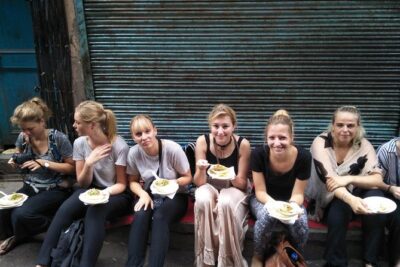
The Great Indian Food Tour: Old Delhi Food and Heritage Walk
Read our review →

Old Delhi Food, Heritage&Cultural Walk with Rickshaw ride to Masterji Kee Haveli
Read our review →
Blue City Heritage Private Walking Tour With Pickup and Drop-Off
Read our review →
Private Heritage Walking Tour in Jaisalmer Fort and Old Bazaar
Read our review →
Old Delhi Food-Spice Market-Temples Tour Soon Featured on NETFLIX
Read our review →Browse the lists this tour appears in