Review · ROME
Ancient Rome: Archeological area Largo Argentina
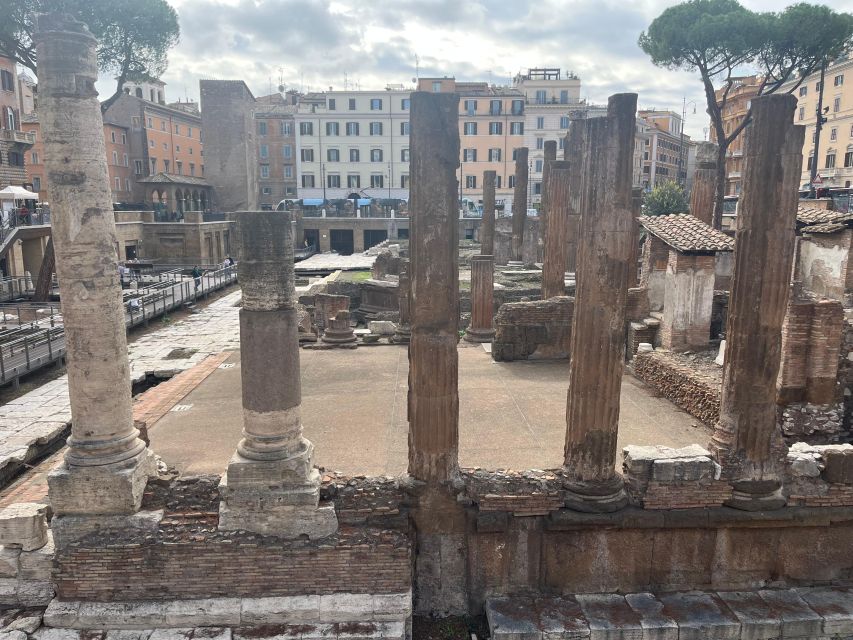
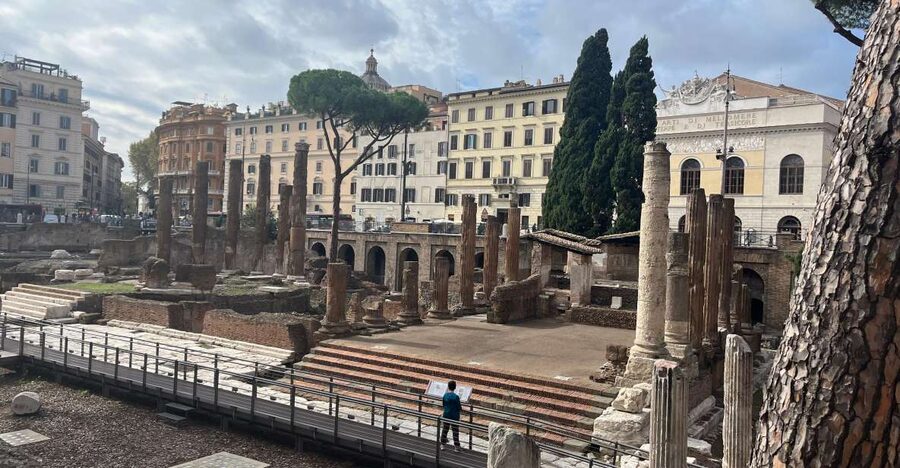
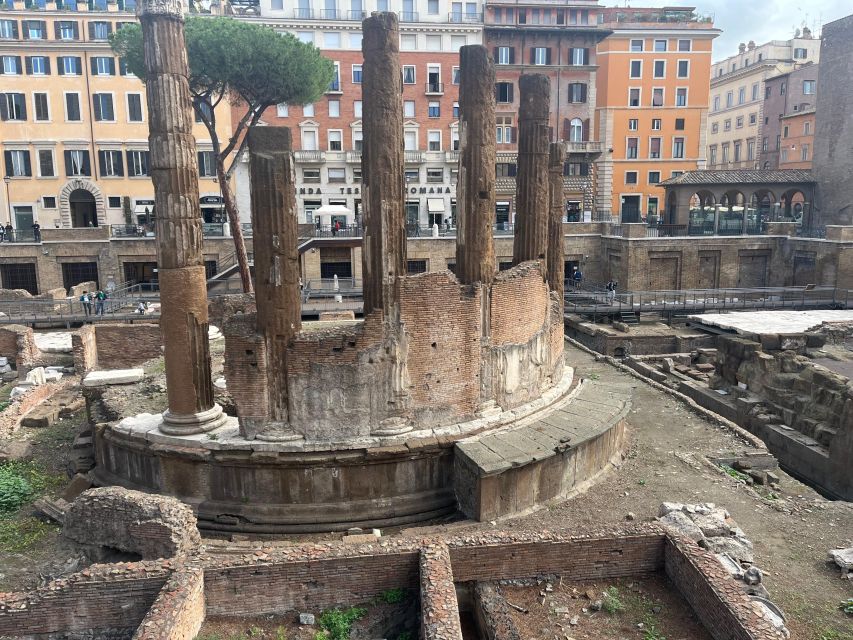
The most striking fact about Largo Argentina is also its darkest: this is where Julius Caesar was killed on the Ides of March in 44 BC. Beneath modern Rome, you’ll see the remains of four temples and the tuff foundations of the Curia of Pompey, the ancient meeting hall tied to that famous murder.
I like the clear multimedia introduction, which uses images to show how the ruins may have looked long ago. I also like the short, focused visit, since one hour gives you a useful look without taking over your day. The main drawback is that much of the site can be viewed from outside, so $23 may feel high if you want only a quick glimpse.
Key points to know before you go
- Caesar’s assassination site: See the remains of the Curia of Pompey, where ancient sources place his killing.
- Four temples in one archaeological area: The ruins date from the 4th to the 1st centuries BC.
- Multimedia film before the visit: Allow about 25 to 30 minutes at the Touristation office for a visual introduction.
- English audio guide: The visit is self-guided rather than led by a live guide.
- Short walk between locations: Ticket pickup is at Piazza d’Aracoeli 16, about six minutes from the excavation area.
- Ancient ruins in modern Rome: You are looking at an archaeological island surrounded by the working city.
Why Largo Argentina matters in Rome
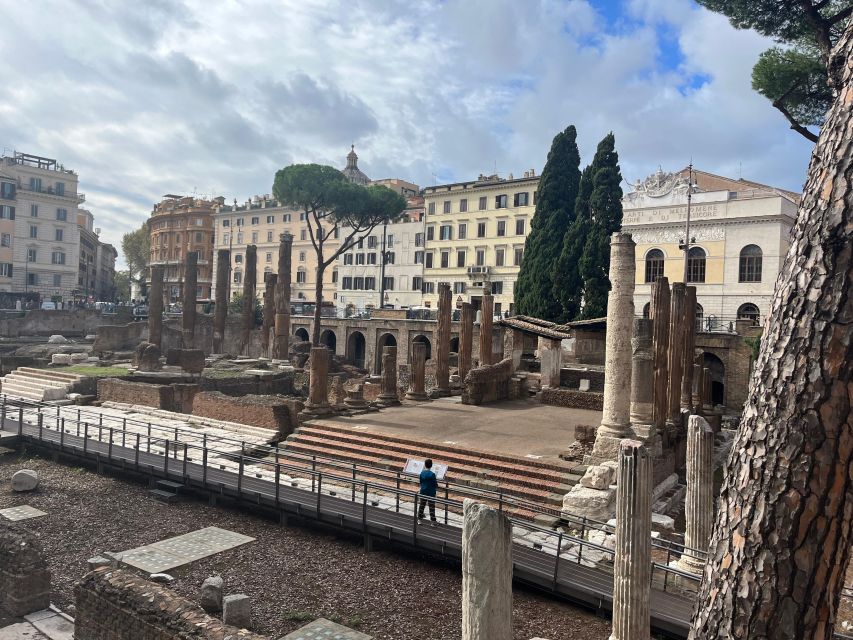
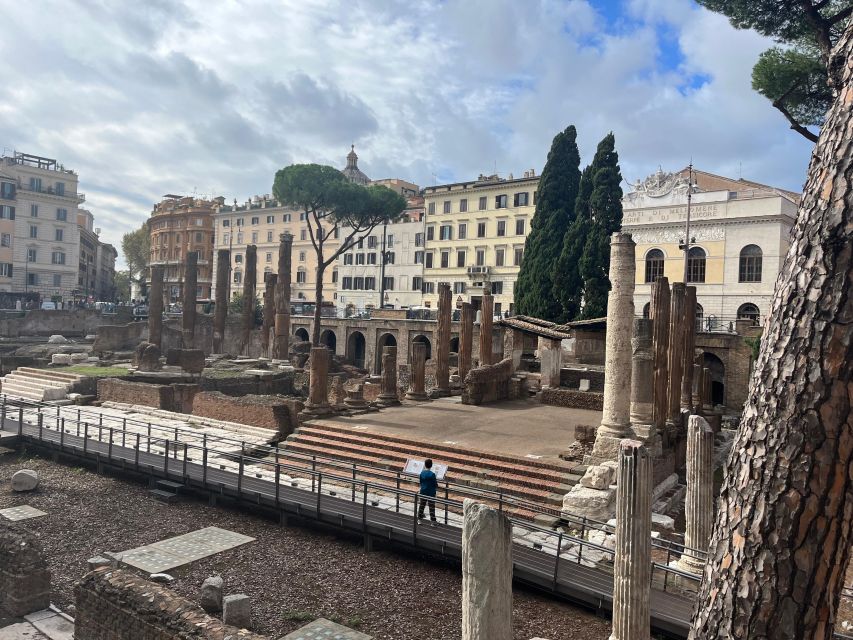
Largo di Torre Argentina is not simply a patch of broken stone. It is a record of Rome across more than two thousand years, with Republican temples, imperial changes, medieval structures, and modern streets all occupying the same small area.
The setting makes the visit unusual. You are not walking through a fully rebuilt monument or a quiet open-air park. You are looking down into an archaeological area surrounded by present-day Rome. Cars, buses, buildings, and daily city life remain close by, while the ruins preserve some of the oldest architecture in the city.
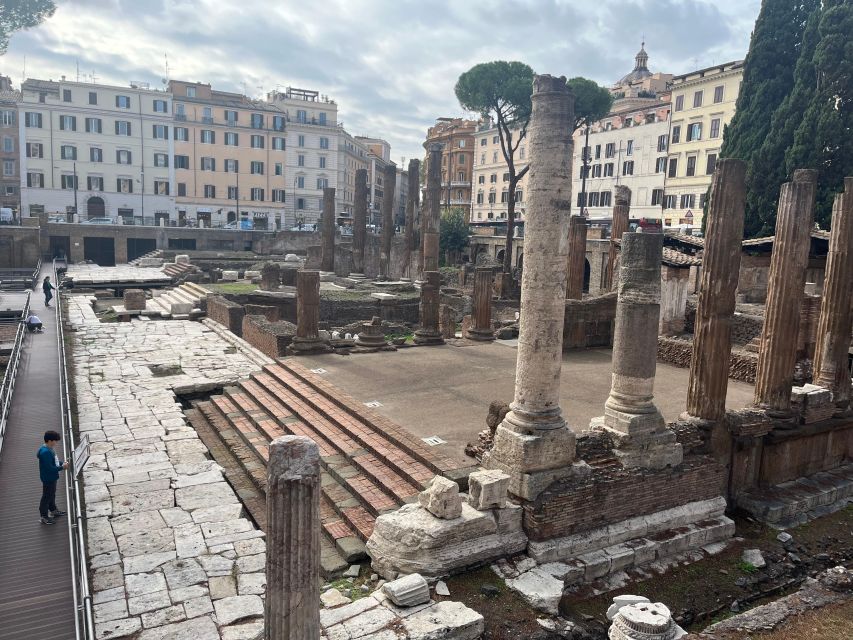
The site contains four temples built between the 4th and 1st centuries BC. Their exact original purposes are not always easy to read from the remains, but their age is clear. You can see layers of construction, stone foundations, raised platforms, and later changes that show how Rome kept adapting old sacred places.
For me, the value comes from the contrast. The area is not polished into a single historical moment. It shows Rome as a city that repeatedly built over, reused, and altered its own past.
More Ancient History Tours in Italy
- Colosseum: Underground and Ancient Rome Tour
★ 4.7 · 12,691 reviews - Colosseum & Ancient Rome with Arena Floor Option I Max 6 People
★ 5.0 · 3,306 reviews - Rome: Colosseum, Ancient Rome Tour or AudioGuided Tour
★ 4.4 · 2,879 reviews
Starting at Touristation Aracoeli
Your booked time refers to the meeting point, not necessarily the moment you enter Largo Argentina. Go first to TOURISTATION ARACOELI at Piazza d’Aracoeli 16 to redeem your voucher and receive assistance.
Look for the fountain and orange flags in front of the office entrance. This detail matters because the actual archaeological area is elsewhere, and arriving directly at the ruins could leave you wondering where to check in.
The walk from the office to Largo Argentina takes about six minutes. Build that into your schedule, especially if you have a restaurant booking, museum reservation, or train to catch afterward. The time at the office includes the multimedia presentation, so this is not just a quick ticket exchange.
You receive a paper city map and WiFi assistance at the meeting point. Those extras are modest, but the map can help you connect this site with nearby central Rome. The office also provides help if you have trouble using the app or locating the entrance.
No live guide is listed for the visit. Instead, you use an English audio guide through an app. That gives you control over the pace, but it also means you will not have a historian beside you to answer questions or point out small details.
The 25 to 30-minute multimedia introduction
The multimedia film is an important part of the experience. It lasts about 25 to 30 minutes and uses visual overlays to suggest how the temples and surrounding structures may have appeared in antiquity.
This is especially helpful at Largo Argentina because the ruins are fragmentary. A low wall or broken platform can be hard to picture on its own. Seeing a reconstruction before you reach the site gives you a basic mental image, making the stones easier to interpret.
I would treat this presentation as a short history lesson, not a full museum program. It is designed to introduce the site and the wider story of ancient Rome. If you already know Roman Republican history well, some of it may feel basic. If you are visiting Rome for the first time, it gives useful context before you face the remains.
The visual overlays are the strongest feature. They help bridge the gap between the low ruins in front of you and the larger buildings that once occupied this area. The film also makes the later walk more meaningful because you are not seeing disconnected stones without a plan.
One practical point: the listed inclusion says 30 minutes, while the experience has also been described as taking about 25 minutes. Plan on roughly half an hour rather than expecting a quick five-minute video.
Walking through the four ancient temples
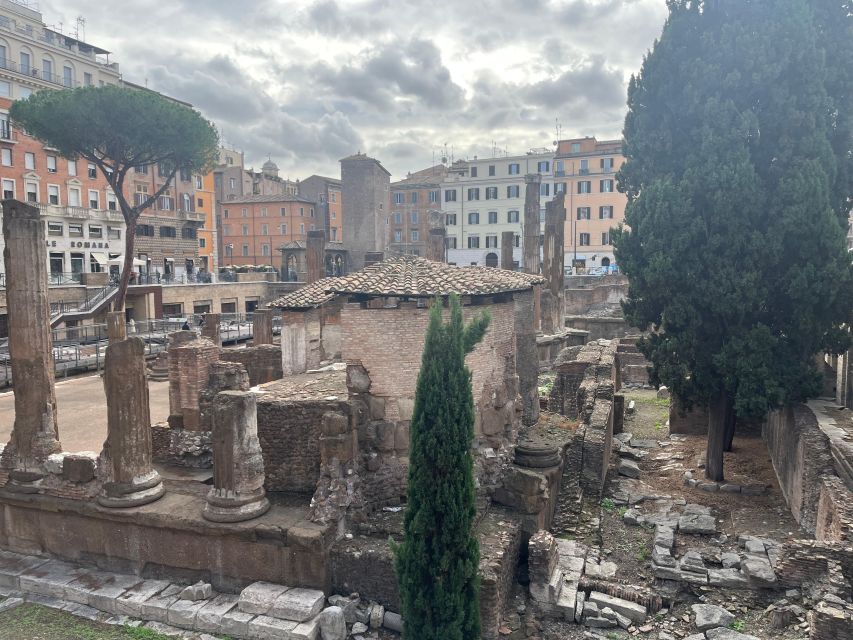
After the office presentation, you walk to the Largo Argentina excavation area. The site contains four temples dating from the 4th through the 1st centuries BC, making it one of the best places in central Rome to see very early Roman architecture gathered in one view.
The temples are not intact buildings. You will mainly see foundations, platforms, columns, and stone remains. That limitation is part of the challenge, but it is also why the film and audio guide matter. The ruins ask you to imagine scale and purpose rather than simply admire a complete facade.
Take time to compare the different levels and materials. The archaeological area preserves more than one period, and the remains reflect changes made during the imperial age. Later construction also appears in the area, including structures from the medieval period.
I like sites where the history is not reduced to one famous person. Caesar draws most people here, but the four temples are the older story. They show the religious and civic importance of this part of Rome before the imperial period became the main focus of popular history.
The area also works well for a short visit. You do not need half a day to understand its main features. In about an hour, including the film and the walk, you can connect the temples with the Republican city and the later layers that followed.
More Ancient History Tours in Rome
- Colosseum Underground & Ancient Rome Guided Tour
★ 4.5 · 2,590 reviews - Pantheon Elite Guided Tour – Rome’s Iconic Ancient Temple
★ 5.0 · 1,447 reviews - Ancient Rome: Colosseum Underground Group Tour
★ 4.5 · 1,059 reviews - Colosseum Express Guided Tour and Ancient Rome Admission Included
★ 4.0 · 1,008 reviews
The Curia of Pompey and Caesar’s final moments
The emotional center of the visit is the remains that protect the tuff base of the Curia of Pompey. Ancient sources identify this as the place where Julius Caesar was assassinated on March 15, 44 BC, the Ides of March.
The setting helps correct a common misunderstanding. Caesar was not killed in a grand imperial palace or at the Colosseum. The event took place in a political meeting hall connected with Pompey, his former rival and the famous Roman general.
The visible remains are not a preserved room with a clear floor plan and walls. You are seeing archaeological traces, including the tuff base. That can feel less dramatic than a complete monument, but it is the direct connection to the site described in ancient accounts.
Use the audio guide to slow down here. The value is not in a single spectacular object. It is in standing above the remains of a political space where the Roman Republic reached one of its most famous turning points.
The story also gives the whole visit a useful focus. The temples explain Rome’s religious past, while the Curia of Pompey connects the area to political conflict, power, and the end of Caesar’s life. You get both the long story of the site and one sharply defined moment.
Imperial and medieval layers beneath modern Rome
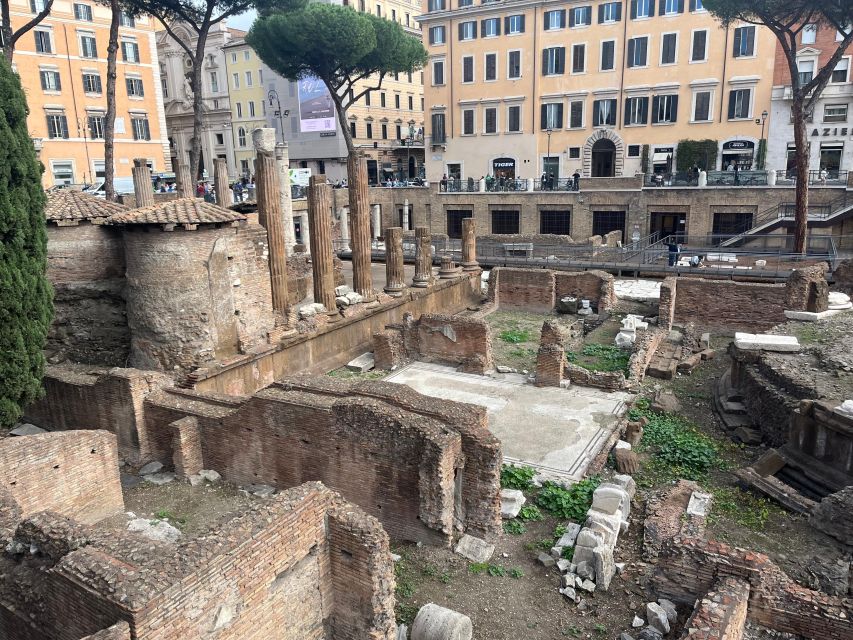
Largo Argentina continued to live after the Republican period. The area preserves changes from the imperial age, when the temples were altered or incorporated into later building programs.
Medieval structures also remain. This is one reason I would not treat the site as only a Caesar stop. Rome did not abandon the area after antiquity. Its buildings and foundations were used, covered, changed, and built around across many centuries.
That uninterrupted use is the central lesson here. You are looking at a place shaped by repeated occupation rather than a single archaeological snapshot. The ruins may seem low and incomplete, but they hold evidence of a long sequence of urban life.
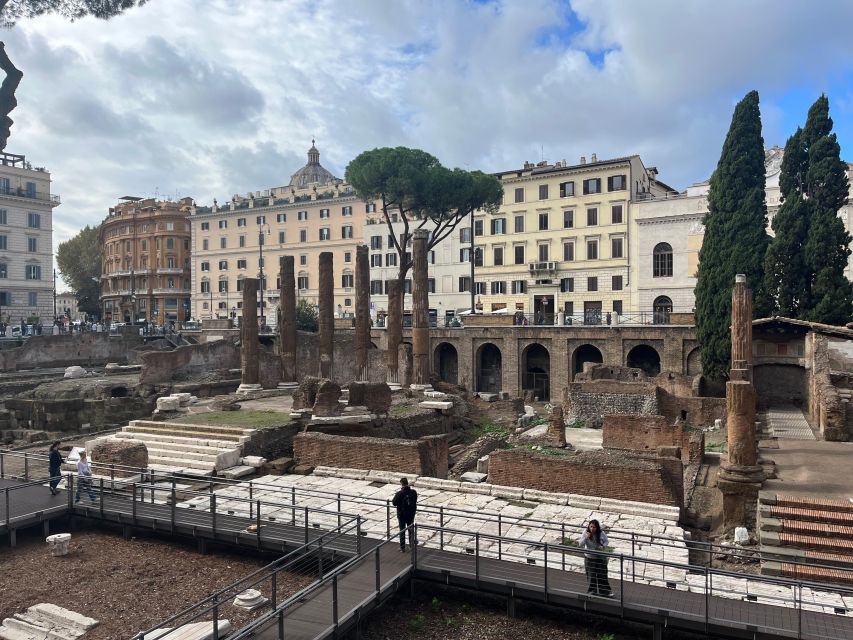
The modern setting makes this easier to grasp. Largo Argentina feels like an ancient island in the middle of a working city. The past is not separated from the present by a distant park or a countryside setting. It sits right beside traffic, sidewalks, and ordinary Roman movement.
Is the $23 price good value?
At $23 per person, this is reasonably priced if you value the introductory film, reserved entrance, audio guide, map, and help at the office. The multimedia presentation adds something you would not get from simply looking at the ruins from the street.
The price is harder to justify if your main goal is a quick photo or a view of Caesar’s assassination site. Much of Largo Argentina can be seen from outside, and the archaeological area is compact. One person who used the experience felt that buying a ticket directly at the gate would have been enough and that the skip-the-line benefit was not essential.
That is an important distinction. This is not a large attraction where avoiding a long queue saves hours. The reserved entry offers convenience, but the main reason to pay is the added interpretation, not a major time-saving advantage.
The small museum area below ground also affects the calculation. It adds another layer to the visit, but it is not a large museum complex. If you want a full archaeological museum, this experience will feel limited. If you want a compact introduction to a remarkable Roman site, the price is easier to accept.
I would book it for a first visit to Rome when you want a short, organized history stop. I would skip it if you prefer exploring from the street, reading independently, or spending your admission budget on larger museums and monuments.
Who will enjoy this one-hour visit?
This experience suits you if you like Roman history but do not want a long guided walk. The one-hour format fits neatly between visits to nearby sights, and the film gives you enough context to understand the ruins without requiring prior study.
It is also a good choice for visitors who enjoy visual explanations. Fragmentary ruins can be frustrating, and the reconstruction images help you picture the temples as buildings rather than piles of stone.
Families with older children may find the Caesar story and the multimedia presentation easier to follow than a long lecture. The visit is short, and the subject has a clear dramatic hook. Younger children who need open space or constant activity may find the archaeological remains less engaging.
History specialists may want more detail than the audio guide provides. Since no live guide is included, you cannot ask for a deeper discussion of Republican politics, temple design, or the medieval structures. The format is designed for a general introduction.
The experience is offered in English. Bring your passport, since it is listed as required. Pets, glass objects, luggage, large bags, alcohol, and drugs are not allowed.
Practical timing and booking advice
Choose your time based on when you can reach Piazza d’Aracoeli 16, not just when you want to see Largo Argentina. You must redeem the voucher at the Touristation office first.
Arrive with enough time to find the office, identify the fountain and orange flags, and settle in for the film. Afterward, allow about six minutes to walk to the excavation entrance.
The booking allows cancellation up to 24 hours before the scheduled time for a full refund. You can also reserve now and pay later, which helps if your Rome schedule is still changing.
There is no transport, food, or drink included. This is a local walking visit, not a transfer service or a full meal-and-sightseeing package. Plan your own route to the office and the archaeological area.
The audio guide is available in English through an app. Keep your phone ready, and remember that the experience depends on your own device use rather than a person leading the group from stop to stop.
Should you book Largo Argentina?
Book this experience if you want a short, well-organized introduction to an unusual Roman site, especially if Caesar’s assassination interests you. The film, English audio guide, and reserved entrance make the compact ruins easier to understand, and the four temples add far more than the famous murder story alone.
Skip it if you only want to see the area from outside or if you are counting on a major skip-the-line advantage. The excavation is small, and much of it is visible without paying.
For most first-time visitors with a spare hour, the strongest reason to book is interpretation. You are not paying only to look at stones. You are paying for a visual explanation of what once stood there and a clearer sense of how this ancient site fits into modern Rome.
FAQ
Where does the experience begin?
It begins at TOURISTATION ARACOELI, Piazza d’Aracoeli 16. Look for the fountain and orange flags in front of the office entrance.
Does the selected time refer to the archaeological site?
No. The selected time refers to your appointment at the Touristation Aracoeli office, where you redeem your voucher.
How long does the experience last?
The listed duration is one hour. The multimedia presentation takes about 25 to 30 minutes, followed by the visit to Largo Argentina.
Is a live guide included?
No. A live guided tour is not included. An English audio guide app is provided instead.
What can you see at Largo Argentina?
You can see four temples dating from the 4th to the 1st centuries BC, remains of the Curia of Pompey, imperial-era changes, and medieval structures.
Is this where Julius Caesar was killed?
Yes. The remains of the tuff base of the Curia of Pompey mark the place identified by ancient sources as the site of Caesar’s assassination on the Ides of March in 44 BC.
Is the multimedia film included?
Yes. A 30-minute ancient Rome multimedia video is included. Allow roughly 25 to 30 minutes for the presentation.
Is transport included?
No. Transport is not included. You walk from the Touristation office to the archaeological area, which takes about six minutes.
What should I bring?
Bring your passport. A paper city map and WiFi are included at the meeting point.
Can I cancel the booking?
Yes. You can cancel up to 24 hours in advance for a full refund. Reserve now and pay later is also available.
More Archaeological Site Tours in Rome
- Rome: Ostia Antica Archaeological Park Ticket & Audio App
★ 4.6 · 146 reviews - Rome Pantheon Semi-Private Guided Tour with an Archaeologist
★ 5.0 · 60 reviews - Rome: Private Colosseum Experience and Ancient Ruins Tour
★ 4.6 · 25 reviews - Pompeii: Entry Ticket and Guided Tour with an Archaeologist
★ 4.8 · 19,459 reviews
More Ancient Rome and Colosseum Tours
- Rome: Colosseum with Arena, Roman Forum and Palatine Guided Tour
★ 4.0 · 5,598 reviews - Colosseum with Arena, Roman Forum and Palatine Hill Guided Tour
★ 4.5 · 3,526 reviews - Rome: Colosseum Arena, Roman Forum & Palatine Hill Tour
★ 4.5 · 1,874 reviews - Colosseum, Roman Forum & Palatine Hill Guided Tour
★ 4.5 · 1,568 reviews
Just added around Rome
- Rome: Colosseum and Ancient Rome Guided Walking Tour★ 4.5 · 95 reviews
- Secrets of Rome: Historical True Crime Small Group Tour★ 4.9 · 85 reviews
- Rome: Rome at Night Evening Historical Walking Tour★ 4.9 · 24 reviews
- Rome Secrets: Dark History & Tasty Bites Tour★ 5.0 · 37 reviews
- Rome: Introduction to the Colosseum and Ancient City Tour★ 4.8 · 75 reviews
- Rome Pantheon Semi-Private Guided Tour with an Archaeologist★ 5.0 · 60 reviews
- Rome: Ostia Antica Archaeological Park Ticket & Audio App★ 4.6 · 146 reviews
- Rome: Private Colosseum Experience and Ancient Ruins Tour★ 4.6 · 25 reviews
Rome History Tours, compared.
Colosseum: Underground and Ancient Rome Tour
Read our review →
Rome: Colosseum with Arena, Roman Forum and Palatine Guided Tour
Read our review →
Colosseum with Arena, Roman Forum and Palatine Hill Guided Tour
Read our review →
Colosseum & Ancient Rome with Arena Floor Option I Max 6 People
Read our review →
Rome: Colosseum, Ancient Rome Tour or AudioGuided Tour
Read our review →
Colosseum Underground & Ancient Rome Guided Tour
Read our review →
Rome: Colosseum Arena, Roman Forum & Palatine Hill Tour
Read our review →