
Review · ROME
Rome Secrets: Dark History & Tasty Bites Tour
Rome’s darker side comes alive on this compact evening walk. You move from the Jewish Ghetto’s tales of Kabbalah and the Golem to skulls carved on a baroque church, secret passages, public executions, and the shadowy story of Aqua Tofana. It is Rome with the lights turned low.
I like the mix of real history and folklore, and I like that the stories come with food: Roman pizza early on, then ciambelline al vino and a glass of wine. The main drawback is pace. Two hours covers a lot of ground, so some stops are brief, and the experience suits curious walkers more than anyone seeking long visits inside monuments.
Key points to know before you book
- The Jewish Ghetto sets the mood: Begin at Portico d’Ottavia with stories of mysticism, Kabbalah, the number 7, and the Golem.
- Food is part of the tour: Roman pizza, one glass of beer, one glass of wine, and local sweets are included.
- The stories are the main attraction: Giordano Bruno, Giulia Tofana, Mastro Titta, ghosts, heretics, and secret escapes fill the route.
- You see lesser-known corners: Passetto del Biscione and Arco dei Banchi offer atmospheric streets and passageways away from Rome’s headline sights.
- Guides make a real difference: Simona, Daniele, Daniel, and Sylvia are among the guides praised for strong storytelling and enthusiasm.
- It is good value at $40: For two hours of guiding, several food and drink tastings, and a route through central Rome, the price is fair.
Rome after dark, beginning at Portico d’Ottavia
The meeting point is in front of the ruins of the Portico d’Ottavia, in the Jewish Ghetto. This is a useful place to begin because the setting does much of the work before the guide even starts talking. Ancient stone, narrow lanes, and the remains of imperial Rome create the right frame for stories that sit somewhere between documented history and old city lore.
Your guide introduces the Jewish Ghetto’s traditions of mysticism and Kabbalah, along with the strange importance of the number 7 in Roman stories. You also hear the legend of the Golem, a creature linked to Jewish folklore and the idea that knowledge and sacred words can give life to clay.
This opening is not a formal lesson in Jewish history, and you should not expect a museum-style presentation. Instead, the guide uses the neighborhood as a starting point for stories about belief, fear, and the way legends cling to old streets. Guides such as Simona, Daniele, Daniel, and Sylvia have been praised for making these stories easy to follow and personal rather than stiff.
The first food stop comes in the Jewish Ghetto area. You get Roman pizza, and the inclusions also list a glass of beer. The pizza gives the tour a practical lift, especially if you have come straight from sightseeing and need something more substantial than a quick snack.
More Dark History and Haunted Tours in Rome:
- Rome: Guided Bar Crawl with Drinks & Dark History
★ 4.9 · 444 reviews - Secrets of Rome: Historical True Crime Small Group Tour
★ 4.9 · 85 reviews - Normandy D-Day Sites & Cemetery Day Trip from Paris with Lunch
★ 5.0 · 6,877 reviews
Passetto del Biscione and Rome’s small sacred images
From the Ghetto, the walk turns toward the Passetto del Biscione. This is one of the route’s most appealing stops because it is not the sort of place most first-time visitors seek out on their own.
The passage is an old frescoed corridor with stories of secret meetings, forbidden love, and fast escapes. It is also connected with Rome’s Madonnelle, the small sacred images placed in corners, above doorways, and along streets. These images show how religious life in Rome has often appeared in ordinary public spaces rather than only inside grand churches.
You will want your camera here, but keep it ready rather than stopping for a long photo session. The tour is moving on a schedule, and this section is meant to be seen and explained rather than explored at length. The corridor’s appeal comes from its worn surfaces and enclosed atmosphere, not from a large landmark or a long list of things to inspect.
This is also where the tour shows its strength. Instead of simply ticking off major monuments, it draws attention to places that can seem insignificant until someone explains the story behind them. I like that approach. Rome can reward a slow glance at a side passage just as much as a visit to a celebrated piazza.
Campo de’ Fiori and the statue of Giordano Bruno
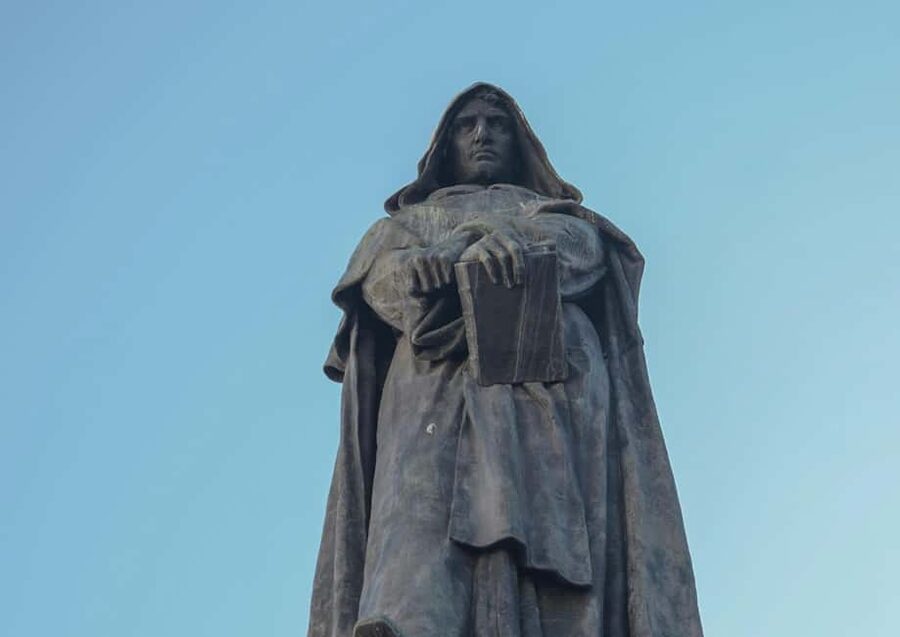
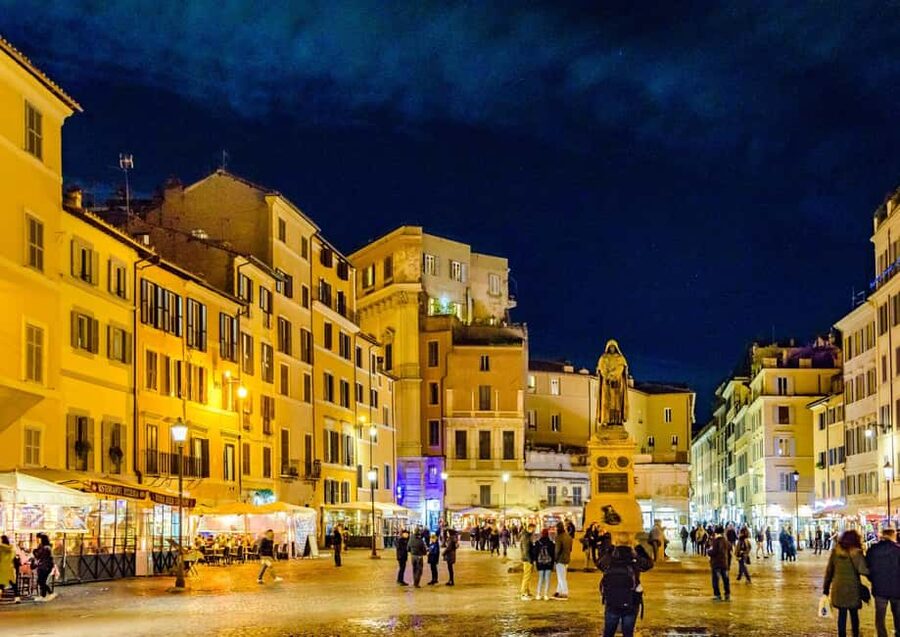
The route continues to Campo de’ Fiori, one of central Rome’s best-known squares. During the day, it is associated with market stalls and food stands. At night, its mood changes, and the statue of Giordano Bruno gives the square a serious edge.
Bruno was burned alive for heresy in 1600. His bronze figure faces across the square, and the statue has long carried the force of a warning and a challenge. The guide explains his story as part of Rome’s history of forbidden ideas, religious control, and the cost of speaking against accepted beliefs.
This is not presented as a simple good-versus-evil tale. Bruno’s story works because it raises questions about free thought and authority, while the square around him remains a normal part of modern Rome. That contrast is one of the evening’s best effects.
The Campo de’ Fiori stop is brief, listed at about 10 minutes. You get the main story and a sense of the place, but you will not have time for a full historical study of the square. If you want market history, food shopping, or a long look at the surrounding streets, return another day.
Santa Maria dell’Orazione e Morte and its carved skulls
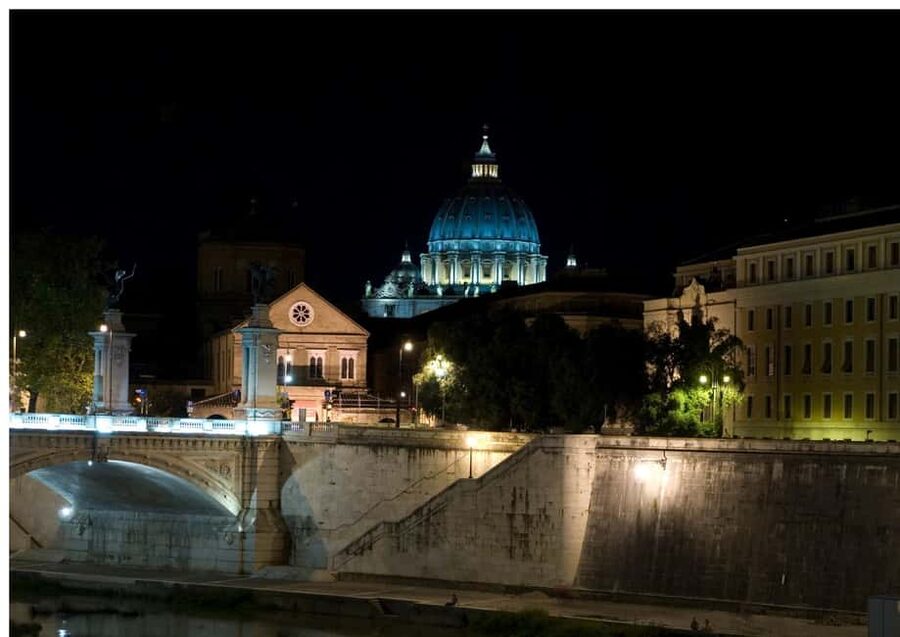
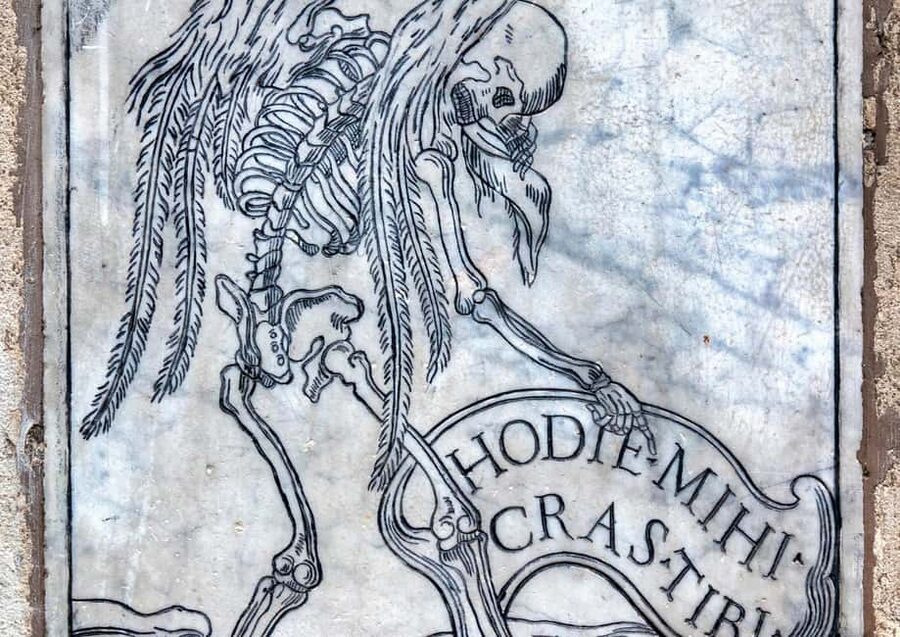
Next comes the Church of Santa Maria dell’Orazione e Morte, or Santa Maria of Prayer and Death. The church is known for its macabre decoration, including skulls, bones, and inscriptions about mortality. The façade itself features carved skulls, so the stop makes its point immediately.
The church was connected with the care and remembrance of nameless people recovered from the Tiber River. That detail gives the decoration a purpose beyond theatrical horror. The skulls are reminders of people who had no known family or public memorial, and the church’s role was tied to prayer for the dead.
The scheduled stop is described as a photo stop of about 10 minutes. That distinction matters. You should expect to view and photograph the church and hear its story, but you should not book this tour expecting a long interior visit or a full church art tour.
For me, this is one of the strongest visual moments of the walk. Rome is packed with grand churches, but this façade has a very different tone. It is not elegant in the usual Roman way. It is blunt, unsettling, and memorable.
More History Tours in Rome:
- Colosseum: Underground and Ancient Rome Tour
★ 4.7 · 12,691 reviews - Rome: Colosseum with Arena, Roman Forum and Palatine Guided Tour
★ 4.0 · 5,598 reviews - Colosseum with Arena, Roman Forum and Palatine Hill Guided Tour
★ 4.5 · 3,526 reviews - Colosseum & Ancient Rome with Arena Floor Option I Max 6 People
★ 5.0 · 3,306 reviews
Via Giulia and the story of Aqua Tofana
The walk then reaches Via Giulia, an elegant street with a darker tale attached to it. Here the guide tells the story of Giulia Tofana, the 17th-century poisoner associated with Aqua Tofana, a lethal substance reportedly sold to women who wanted to escape unhappy marriages.
This story needs careful handling. It is dramatic, but it is also a story about domestic power, desperation, and the limited choices available to women in an earlier age. The tour uses the tale to show the private crimes and quiet betrayals that can sit behind Rome’s polished façades.
Via Giulia itself is a good setting. Its smooth cobblestones and refined buildings feel far removed from the image of a murder story, which makes the contrast work. You are not walking into a crime museum. You are hearing about hidden acts in a street where the surface looks calm.
The guide’s delivery matters especially here. Daniele has been praised for adding archaeological background, charm, and humor, while Simona and Sylvia are also described as strong storytellers. If you like history presented through individual lives, this section will likely hold your attention better than a list of dates and architectural terms.
Arco dei Banchi and the city’s secret routes
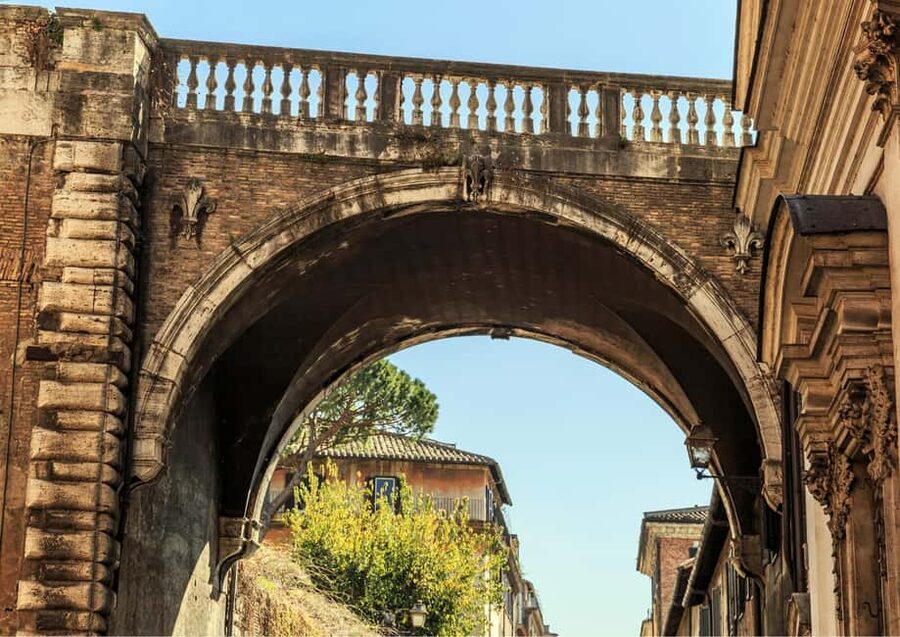
The route passes beneath the Arco dei Banchi, a passageway associated with bankers, spies, and priests moving between the Vatican and the center of Rome without being seen. It is another short stop, but it helps explain how the city’s streets once served practical and secret purposes.
Rome’s historic center can feel like an open-air stage, with grand streets built to display power. The Arco dei Banchi offers the opposite experience. It is a place of movement behind the scenes, where people could pass through without attracting attention.
The tour does not claim that every whispered tale is proven fact, and that is important. Stories about secret routes grow over time. A good guide helps you understand which parts are historical record and which belong to local legend. The best moments on this walk come from that balance between evidence and atmosphere.
Ciambelline al vino and a pause for something sweet
The second food stop balances the darker stories with a very Roman treat: ciambelline al vino, small ring-shaped biscuits made with wine, served with a glass of wine. One glass of beer and one glass of wine are listed among the inclusions, along with local sweets.
This is not a full dinner, so plan accordingly. The pizza and biscuits make the tour more than a lecture with a few sightseeing pauses, but you should still eat properly if you need a substantial evening meal. The food works best as part of the experience, giving you a taste of everyday Roman traditions while the guide continues with the city’s stranger tales.
Some recent bookings also describe gelato during the walk, but the clearly stated food details focus on Roman pizza, ciambelline al vino, wine, beer, and local sweets. Food arrangements can vary, so I would treat gelato as a possible extra rather than the core promise.
Ponte Sant’Angelo and the final story of Mastro Titta
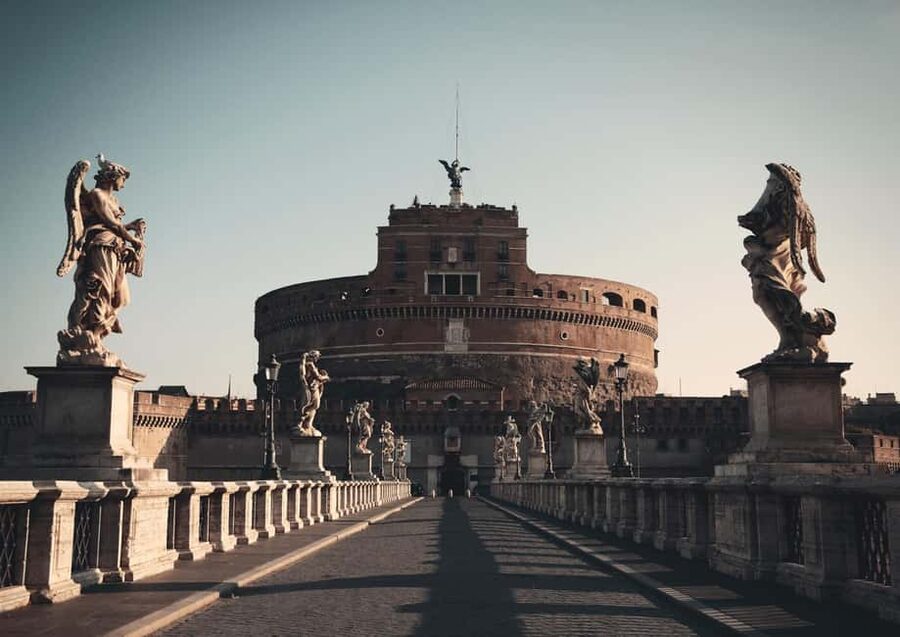
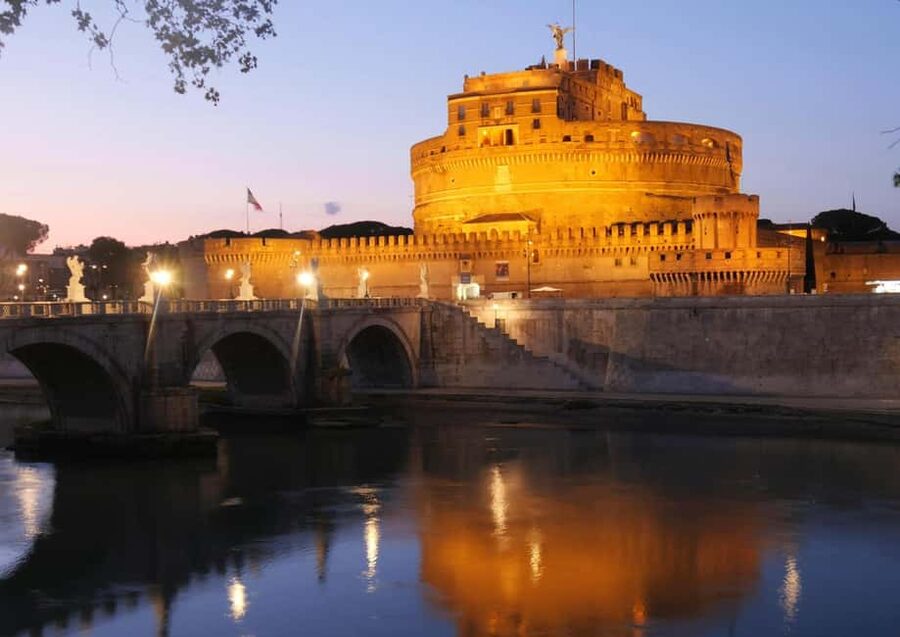
The tour finishes near Ponte Sant’Angelo, with a photo stop of about five minutes and the final story of Mastro Titta, Rome’s most famous executioner. His work was gruesome, but his place in Roman memory is more complicated than a simple villain portrait.
Mastro Titta carried out executions for the Papal States, and his name became linked with public punishment in Rome. The guide uses his story to close the evening on a note of power, fear, and spectacle. Reaching the area near the bridge after dark gives the ending a strong visual setting, especially with Castel Sant’Angelo nearby.
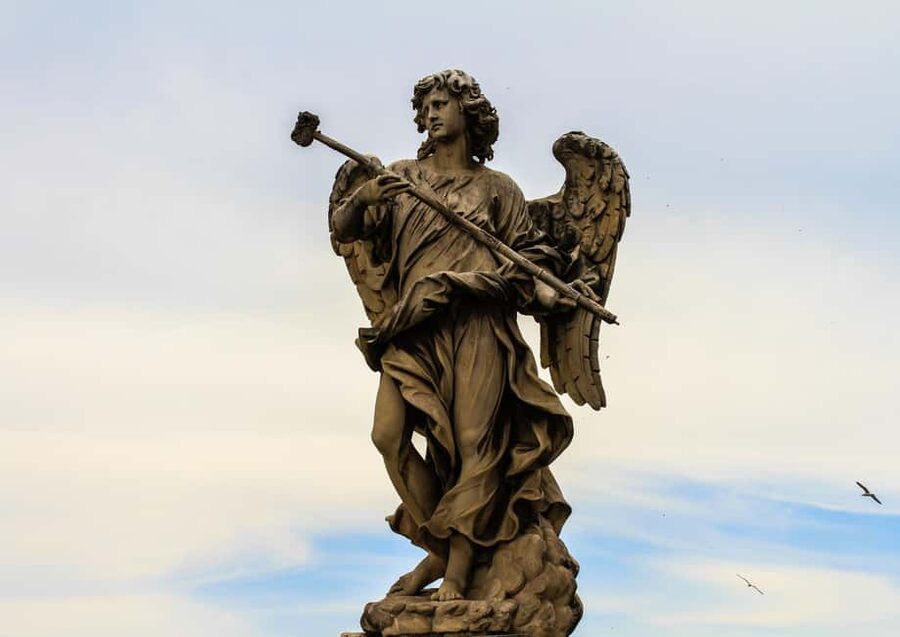
You do not get a long visit at Ponte Sant’Angelo. This is a short closing stop, not a guided tour of the castle or a detailed examination of the bridge’s statues. Still, it is an effective finish because the route has moved from ancient legend to religious authority, private crime, and public execution.
The official ending point is on Via del Banco di Santo Spirito. That makes the tour convenient if you want to continue around the central historic area, but the experience itself ends there.
What $40 gets you in two hours
At $40 per person, this is a fair deal if you value a strong guide and enjoy food woven into a walking route. You receive two hours of live guiding, Roman pizza, one beer, one wine, and local sweets. You also cover several central neighborhoods and see corners that are easy to miss without local direction.
The price is less attractive if you mainly want entry into major attractions. There is no stated admission to the church, Castel Sant’Angelo, or another paid monument. The value comes from interpretation, storytelling, tastings, and the route.
Private and small-group options are available. A small group should make it easier to hear the guide in narrow streets and ask questions. A private version may suit couples or families who want more control over the pace, though the standard two-hour format still limits how long you can linger at each stop.
The tour has a five-out-of-five rating from 37 reviews, with the strongest praise focused on the guides. That pattern is useful. The food is a welcome part of the package, but the guide is what makes or breaks the evening. Daniele is repeatedly singled out for enthusiasm, humor, archaeological background, and the ability to keep attention for the full two hours. Simona is praised for passion and warmth, while Sylvia is noted for blending history and folklore.
Who should book this Rome night walk?
I would choose this tour for a first or second evening in Rome if you want an easy introduction to the city’s central streets without repeating the Colosseum and Vatican circuit. It is also a good first-day activity because the route gives you history, food, and orientation at once.
You will get the most from it if you enjoy:
- Ghost stories that are tied to real places
- Lesser-known people and events
- Short walks between central Rome landmarks
- Roman snacks and wine
- Guides who tell stories with humor and personality
- A mix of documented history and local legend
I would hesitate if you dislike macabre subjects. Skulls, nameless dead, poisoning, heresy, and executions are not side notes here. They are the theme.
The walk may also feel rushed if you want long photo stops or time to study architecture. Several stops last around 10 minutes, and Ponte Sant’Angelo is listed at only five minutes. Wear comfortable shoes, arrive at the Portico d’Ottavia meeting point on time, and expect a steady two-hour walk through central streets.
The tour is offered in English, French, Spanish, and Portuguese. Free cancellation is available up to 24 hours before the experience, and you can reserve now and pay later, which helps if your Rome schedule is still shifting.
Should you book Rome Secrets?
Book it if you want Rome told through strange people, uneasy legends, and overlooked corners rather than only emperors and popes. The combination of Portico d’Ottavia, Passetto del Biscione, Campo de’ Fiori, Via Giulia, and Ponte Sant’Angelo gives you a strong sense of the old center, while the pizza, wine, beer, and biscuits keep the evening relaxed.
Skip it if you want extensive monument access, a full meal, or a slow architectural tour. For $40, though, the balance is persuasive: a lively guide, a carefully chosen two-hour route, several local tastings, and stories that may change the way you see Rome’s ordinary streets.
FAQ
Where does the Rome Secrets tour begin?
The tour begins in front of the ruins of the Portico d’Ottavia, in Rome’s Jewish Ghetto.
Where does the tour finish?
It finishes on Via del Banco di Santo Spirito, near Ponte Sant’Angelo.
How long does the tour last?
The walking tour lasts two hours.
What food and drinks are included?
The experience includes Roman pizza, one glass of beer, one glass of wine, and local sweets. The tour description specifically mentions ciambelline al vino biscuits.
Which languages are available?
Live guides are available in English, French, Spanish, and Portuguese.
Is the tour private or shared?
You can book a private option or join a small group.
Can I cancel the booking?
You can cancel up to 24 hours in advance for a full refund. The experience also offers a reserve-now, pay-later option.
Just added around Rome
- Rome: Colosseum and Ancient Rome Guided Walking Tour★ 4.5 · 95 reviews
- Secrets of Rome: Historical True Crime Small Group Tour★ 4.9 · 85 reviews
- Rome: Rome at Night Evening Historical Walking Tour★ 4.9 · 24 reviews
- Rome: Introduction to the Colosseum and Ancient City Tour★ 4.8 · 75 reviews
- Rome Pantheon Semi-Private Guided Tour with an Archaeologist★ 5.0 · 60 reviews
- Rome: Ostia Antica Archaeological Park Ticket & Audio App★ 4.6 · 146 reviews
- Rome: Food Tour of the Historic Center with Rooftop Spritz★ 4.7 · 43 reviews
- Rome: Guided Tour of Colosseum and Ancient Rome★ 4.9 · 74 reviews
Rome History Tours, compared.
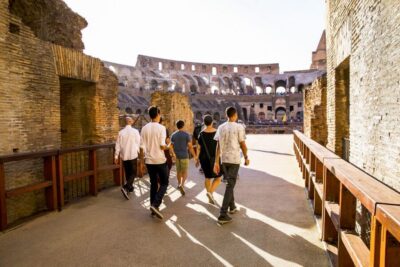
Colosseum: Underground and Ancient Rome Tour
Read our review →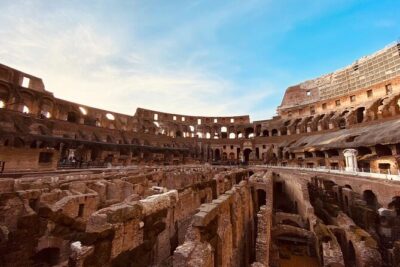
Rome: Colosseum with Arena, Roman Forum and Palatine Guided Tour
Read our review →
Colosseum with Arena, Roman Forum and Palatine Hill Guided Tour
Read our review →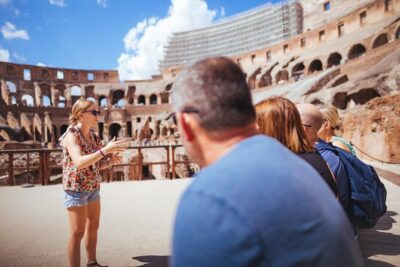
Colosseum & Ancient Rome with Arena Floor Option I Max 6 People
Read our review →
Rome: Colosseum, Ancient Rome Tour or AudioGuided Tour
Read our review →
Colosseum Underground & Ancient Rome Guided Tour
Read our review →
Rome: Colosseum Arena, Roman Forum & Palatine Hill Tour
Read our review →
Colosseum, Roman Forum & Palatine Hill Guided Tour
Read our review →Browse the lists this tour appears in