
Review · NAPLES
Pompeii and Herculaneum Private Walking Tour with an Archaeologist
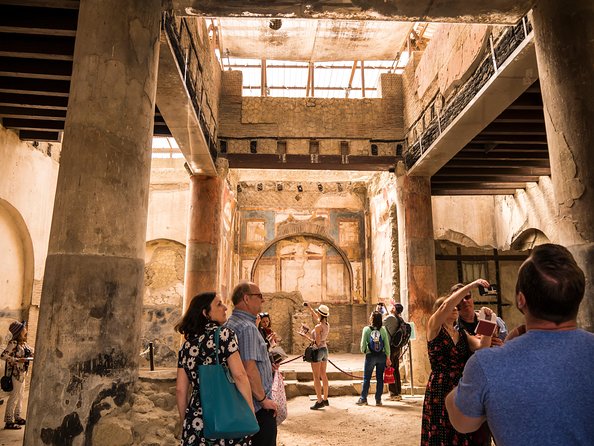
Herculaneum preserves Roman life in startling detail, while Pompeii gives you the scale of a whole city. This private walking tour covers both in about five and a half hours, with an archaeologist explaining the homes, baths, shops, public buildings, and human stories behind the ruins. The contrast between the two sites is the real prize.
I like the private format because you can ask questions and set the pace instead of following a large group. I also like the range of guides, including Mena, Vincenzo, Ivan, Sylvia, and Giancarlo, who have been praised for their archaeological training and ability to make the ruins understandable for both adults and children.
The main catch is cost and logistics. The fee is $597.36 per group, before admission tickets, food, or transportation, and you must arrange your own train or other transfer. The Herculaneum meeting point can also take some planning to find.
Key points to know before booking
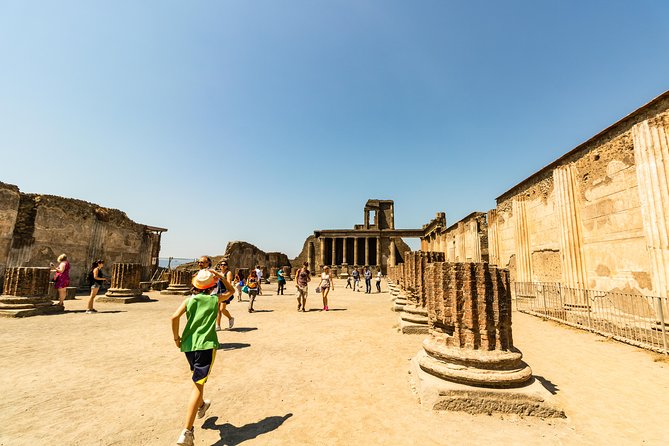
- Two ancient cities in one half-day: Start at Herculaneum, then continue through Pompeii, ending inside the Pompeii ruins.
- A private archaeologist guide: Your group has the guide to itself, with room for questions and changes in pace.
- Herculaneum is the more intimate stop: Expect remarkably preserved wood, frescoes, houses, baths, and carbonized objects.
- Pompeii supplies the grand scale: The route includes the forum, basilica, baths, theaters, large villas, and the famous Lupanar.
- Tickets and transport cost extra: Herculaneum admission is listed at €16 for adults and €2 for EU citizens aged 18 to 25. Pompeii tickets are also separate.
- Wear proper shoes: Uneven ancient streets make comfortable walking shoes essential. Flip-flops are specifically discouraged.
Why seeing Herculaneum before Pompeii works
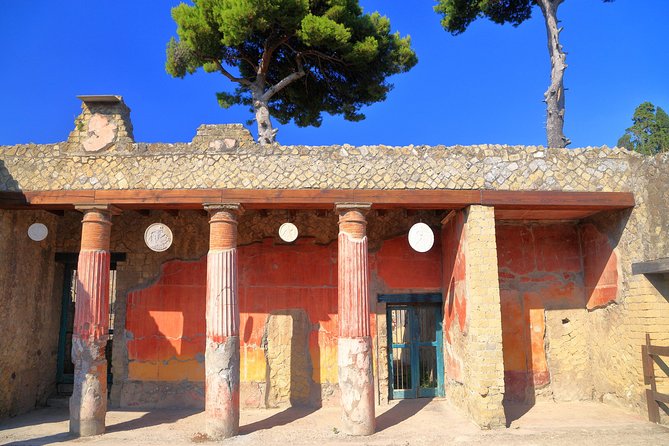
Herculaneum is a smaller site, and this route lets you begin with close-up details. The tour starts at the Herculaneum ticket office, reached by the Circumvesuviana train station at Corso Resina 1, about a ten-minute walk away. The train trip is listed as roughly 30 minutes, but the ticket and transport are not included.
You first spend about an hour exploring the archaeological park, then continue through selected houses and public buildings. That opening hour matters because Herculaneum can feel less like a vast excavation and more like a Roman neighborhood you can inspect room by room.
The House of the Deer is a good example. Its name comes from marble deer statues found in the peristyle, or columned garden. You can use this stop to understand how a wealthy house combined private rooms, garden space, decoration, and views toward the coast.
The terrace of Marcus Nonius Balbus shifts the focus from private life to civic identity. Balbus was a major benefactor who restored and built public structures. After his death, the city honored him with a funeral altar and a long inscription. An archaeologist can explain how one person’s generosity shaped the public face of Herculaneum.
More Ancient History Tours in Italy
- Herculaneum: Skip-the-Line Guided Tour with Archaeologist
★ 4.8 · 3,439 reviews - Herculaneum Small Group Tour and Ticket With an Archaeologist
★ 5.0 · 994 reviews - From Naples: Pompeii & Herculaneum with Archaeologist Guide
★ 4.8 · 665 reviews
Herculaneum’s public life, homes, and engineering
The College of the Augustales is linked to the cult of the emperor Augustus and may also have served as a local civic headquarters. It gives you a look at how religion, politics, and status overlapped in Roman towns.
Casa del Rilievo di Telefo is another strong stop. It may have belonged to Marcus Nonius Balbus and had private access to the nearby Suburban Baths. That detail is easy to miss without guidance, yet it says a great deal about comfort and privilege in the ancient city.
The House of the Wooden Partition is memorable for its carbonized wooden divider. Wood is not what most people expect to see at a site buried by volcanic material, so this is a useful reminder that Herculaneum preserves more than stone walls and painted plaster.
The House of the Skeleton has a darker story. Its name comes from human remains found in an upstairs room in 1831. The guide can place that discovery within the wider evidence of the eruption without turning the stop into a sensational display.
At the Central Baths, you see a public facility divided into separate men’s and women’s sections, each with its own entrance. These baths were built around the start of the first century AD and help you picture bathing as a regular part of Roman social life, not simply a luxury reserved for the very wealthy.
The House of the Black Salon is one of Herculaneum’s grander residences. Its monumental entrance still preserves carbonized doorposts and a lintel, a small but powerful reminder that the eruption caught buildings with their fittings still in place.
Casa Sannitica has a distinctive arrangement associated with the Samnites. Its atrium is bordered by a gallery with Ionic columns, and its rooms retain fresco decoration. Casa del Bel Cortile is unusual for a different reason: instead of a standard atrium, it has a courtyard with a stairway and stone balcony.
The House of the Grand Portal rounds out the Herculaneum portion with columns, frescoes, and charred wooden pieces. The route includes many ten-minute stops, so your guide’s ability to select the best details matters. A private tour is useful here because you can ask about architecture, decoration, religion, engineering, or daily habits instead of simply moving from one label to the next.
Moving from Ercolano to Pompeii
The schedule allows a quick lunch break if needed, but food is not included. You should plan this carefully because the day is long, and the tour involves considerable walking over uneven ground.
The transfer to Pompeii is not included either. The experience information describes a train transfer to Herculaneum, while the inclusions clearly state that all transportation is your responsibility. Confirm your preferred route and timing before the day begins, especially if you are traveling with children or a larger group.
At Pompeii, meet the guide at Porta Marina Superiore, the main entrance named in the tour details. The tour ends inside Pompeii at Via Villa dei Misteri, 2, so this is best viewed as a one-way sightseeing day rather than a round-trip excursion from Naples.
That arrangement can be useful if Pompeii is your final stop, but it requires planning if you need to return to Naples, catch a train, or meet a driver. One strong feature of the private format is that the guide may be able to help when transport plans go wrong. Several guide experiences, including those with Ivan and Sylvia, included help with unexpected train or direction problems. That is not a substitute for planning, but it is valuable support.
Pompeii’s main street and public center
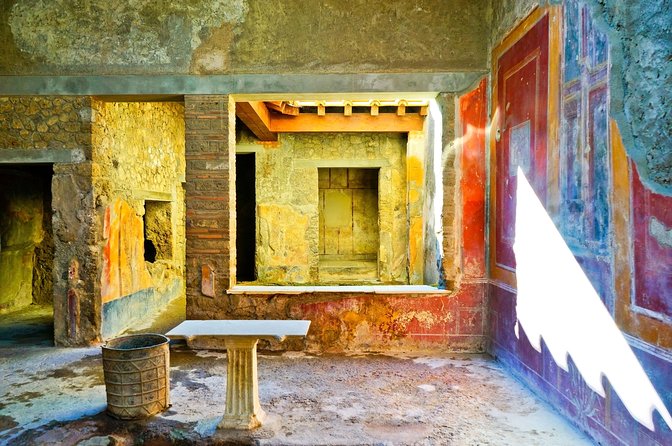
Pompeii changes the mood immediately. Herculaneum feels compact and intensely preserved. Pompeii spreads out as a full city, with long streets, public squares, theaters, baths, shops, and large private homes.
The route includes a walk along the main street before reaching the Forum. Ancient streets are uneven, and the exposed site offers little shelter in places, so sunglasses, sunscreen, water, and sturdy shoes are sensible choices.
The Forum was the city’s main public square. From here, you can begin to see how religious, political, commercial, and social activities were arranged around a central civic space. The Basilica, described as an open portico that sheltered merchants and other activities, adds another layer to the picture of business and law in the Roman city.
The Granaries of the Forum are especially useful for understanding the eruption’s human cost and the later work of archaeology. Here you can see marble tables, fountain pieces, and casts of victims, along with casts of a dog and a tree. This is one of the most emotionally difficult parts of the visit, and a good guide should give you context without reducing the people to curiosities.
More Ancient History Tours in Naples
- From Naples: Ruins of Pompeii
★ 4.3 · 204 reviews - Naples: Pompeii Archaeology Park Tour & Skip-the-Line Entry
★ 4.8 · 190 reviews - Pompeii: Private Tour with an Archaeologist
★ 4.9 · 168 reviews - Herculaneum Private Tour with an Archaeologist
★ 5.0 · 132 reviews
Pompeii’s homes reveal status and taste
The House of the Faun was one of Pompeii’s largest and most impressive private residences. Its size helps you understand how much space and wealth some Roman families controlled within the city.
The House of Menander is another major residence, known for its architecture, decoration, and contents. Together, these houses show that Pompeii was not made up of one uniform Roman lifestyle. Some residents lived in modest quarters, while elite families built homes designed to display education, taste, hospitality, and status.
The tour also visits the Stabian Baths, the oldest thermal complex in the city. These baths occupied a broad area near the Brothel lane, the Holconius crossroads, and Via Stabiana. Seeing them after the Central Baths at Herculaneum gives you a useful comparison between two Roman bathing complexes.
The Lupanar, Pompeii’s most famous brothel, is another brief stop. It is popular and can be crowded, so the private guide helps by explaining what you are seeing and placing it within Roman urban life. The visit is short, about fifteen minutes, but it is one of the stops many people specifically want to see.
Theaters and the end of the route
The Teatro Grande was Pompeii’s main theater and one of the day’s most important public entertainment sites. The route also includes a look at the smaller Teatro Piccolo. Together, they show how performance, music, and civic gatherings fitted into the city’s public life.
The Pompeii section includes many stops of ten to fifteen minutes. That pace keeps the tour moving, but it also means you will not have unlimited time in every building. If your group has a particular interest, such as frescoes, household religion, Roman plumbing, theaters, or the eruption itself, tell the guide early.
That is one of the strongest reasons to pay for a private tour. Mena has been praised for making both sites lively and welcoming, while Vincenzo has been singled out for clear explanations of Pompeii and Herculaneum. Ivan has been noted for taking a group away from the heaviest crowds and discussing engineering and culture. Sylvia has been praised for keeping adults and children engaged, and Giancarlo for patiently handling children’s questions.
Guide quality can vary in delivery style. One experience with Alessandra was described as informative but somewhat formulaic, with less explanation while walking between stops. The same account still found the private pace worthwhile. That is a fair warning: an archaeologist’s expertise is valuable, but presentation style is personal, and you should not assume every guide will teach in exactly the same way.
Is $597.36 good value?
The listed price is $597.36 for a group of up to 15 people. For one or two people, that is a serious expense. For a family or group that can share the cost, the calculation looks better, especially when compared with buying several separate private services.
Admission tickets are extra. Herculaneum is listed at €16 for adults and €2 for EU citizens aged 18 to 25. Pompeii admission is also not included, and neither are trains, other transportation, food, or drinks.
I see the value in three areas. First, you cover both major sites in one organized day. Second, an archaeologist can explain details that a map or audio guide may leave flat, such as the meaning of a private bath entrance, a carbonized doorframe, or a civic inscription. Third, you get flexibility for questions and pacing.
The value is weaker if you prefer a slow, independent visit or only have time for one site. Five and a half hours is enough for a strong overview, but not enough to see every corner of Pompeii. You are paying for interpretation and planning help, not for an exhaustive excavation tour.
Who should book this private walking tour?
I would choose this for a family, a group of friends, or anyone who wants the ancient sites explained in plain language. It is also a good fit if you care about architecture, Roman daily life, archaeology, or the technical side of the eruption.
Families may find the private setup especially useful. Giancarlo is praised for handling questions from children aged 11 to 14, and Sylvia’s approach worked well for mixed-age groups. You can stop to clarify a term or shorten a discussion when attention begins to fade.
I would hesitate if your budget is tight, if you dislike arranged pacing, or if you want a quiet full-day exploration of Pompeii alone. The amount of walking is substantial, and a moderate level of physical fitness is recommended. Service animals are allowed, and the sites are near public transportation, but the tour still involves ancient streets and uneven surfaces.
The experience is highly rated at 4.9 from 77 ratings, with 97 percent of participants recommending it. Those numbers point to strong satisfaction, but the practical details matter more: private access to an archaeologist, two major sites, separate ticket costs, and a one-way finish inside Pompeii.
My booking advice
Book this tour if you want context more than speed and can share the private price with a group. Ask for your guide’s name when confirming, and tell the company what your group wants to focus on. Guides such as Mena, Vincenzo, Ivan, Sylvia, and Giancarlo have received especially warm praise for expertise, patience, and personal attention.
Plan your own transport, buy or arrange both site tickets as needed, and allow time for a quick meal. Cancel at least 24 hours before the start time if your plans change, since later cancellations and changes are not accepted for a refund.
For many people, the archaeologist is the difference between seeing old stones and understanding a city. If that difference matters to you, this is a strong, carefully targeted way to visit Herculaneum and Pompeii in one day.
FAQ
How long does the Pompeii and Herculaneum tour last?
The scheduled duration is approximately five hours and 30 minutes. Some private visits may run longer depending on the group and the day, but the advertised tour length is five and a half hours.
Where does the tour begin?
The tour begins at Via dei Papiri Ercolanesi in Ercolano, with the meeting point at the Herculaneum ruins ticket office.
Where does the tour end?
The tour ends inside the Pompeii ruins at Via Villa dei Misteri, 2, in Pompeii.
Are admission tickets included?
No. Herculaneum and Pompeii admission tickets are separate. Herculaneum tickets are listed as €16 for adults and €2 for EU citizens aged 18 to 25.
Is transportation included?
No. Any transportation to the sites is not included. The Herculaneum route can be reached by train at Corso Resina 1, followed by a walk of about ten minutes.
Is the tour private?
Yes. Only your own group participates. The price covers up to 15 people per group.
What should I wear?
Wear comfortable walking shoes. Flip-flops are not recommended. Sunglasses and sunscreen are also suggested.
Is food included?
No. Food and drinks are not included. A quick lunch break may be possible during the transfer between sites if needed.
Can I cancel for a full refund?
Yes, if you cancel at least 24 hours before the experience starts. Cancellations or changes made less than 24 hours before the start time are not accepted for a refund.
More History Walking Tours in Naples
- Naples: Historic Center and Sansevero Chapel Walking Tour
★ 4.8 · 208 reviews - Naples Walking tour of the Historical Center
★ 5.0 · 75 reviews - Naples: Historic City Center Guided Walking Tour
★ 4.7 · 38 reviews
More History Walking Tours in Italy
- Naples Spanish Quarters Walking Tour Street Art, Folklore & Sweet
★ 5.0 · 797 reviews - Naples Walking Tour with Underground Roman Ruins Ticket
★ 4.5 · 510 reviews - Naples Panoramic Walking Tour: From the Hills to the Center
★ 5.0 · 298 reviews - Naples: City Walking Tour w/ Underground Roman Ruins Ticket
★ 4.6 · 284 reviews
Just added around Naples
- Naples: National Archaeological Museum Tour & Digital Guide★ 4.2 · 177 reviews
- Naples: City and Lapis Museum Tour with an Archaeologist★ 4.5 · 29 reviews
- Naples: Pompeii Archaeology Park Tour & Skip-the-Line Entry★ 4.8 · 190 reviews
- Naples: Historic City Center Guided Walking Tour★ 4.7 · 38 reviews
- Naples: Monuments and Historic District Self-Guided Tour★ 4.0 · 50 reviews
- Naples Archaeological Museum 2-Hour Guided Private Tour★ 5.0 · 51 reviews
- Naples: National Archaeological Museum audio guide★ 4.0 · 155 reviews
- Pompeii: Private Tour with an Archaeologist★ 4.9 · 168 reviews
Naples History Tours, compared.
Herculaneum: Skip-the-Line Guided Tour with Archaeologist
Read our review →
Herculaneum Small Group Tour and Ticket With an Archaeologist
Read our review →
Naples Spanish Quarters Walking Tour Street Art, Folklore & Sweet
Read our review →
From Naples: Pompeii & Herculaneum with Archaeologist Guide
Read our review →
Naples: Street Art & History Tour in the Spanish Quarters
Read our review →
Naples Walking Tour with Underground Roman Ruins Ticket
Read our review →
Naples Panoramic Walking Tour: From the Hills to the Center
Read our review →
Naples: City Walking Tour w/ Underground Roman Ruins Ticket
Read our review →Browse the lists this tour appears in