

Review · GUIDED
Best Two-Day Guided Tours to the Ancient Cairo ,Giza Pyramids , Sakkara and More
The best part of this two-day Cairo tour is its range. In one carefully packed visit, you see the Great Pyramids, enter the Red Pyramid, stand before Djoser’s Step Pyramid, and visit Old Cairo’s churches and synagogue. I like that hotel pickup and drop-off remove much of Cairo’s transport hassle, especially when you are moving between sites spread across the city.
I also like the small group limit of 15 people and the choice of guide language. Past experiences have specifically praised guides named Mohamed and Rafa, along with Islam, a driver who helped make the days feel safe and easy. The main drawback is clear: the $50 price does not include any entrance fees, so your final cost will be higher.
Key points to know before booking
- Giza is only the beginning: You also visit Saqqara, Dahshur, the Citadel, Coptic Cairo, and the Egyptian Museum.
- The Red Pyramid is part of the plan: You have the chance to enter it, while the Bent Pyramid is viewed from outside.
- Hotel transfers matter in Cairo: Pickup and drop-off are included for hotels in Cairo and Giza.
- The group stays fairly small: The maximum is 15 people, with an expert guide and air-conditioned vehicle.
- Entrance fees are extra: The advertised $50 covers guiding, transport, taxes, landing fees, and parking, but not site tickets.
- Spanish support may be available: Mohamed and Rafa were praised for Spanish-language guiding, though you should request your preferred language when booking.
Why two days works well in Cairo
Cairo’s ancient sights are not arranged in a tidy sightseeing line. Giza lies west of the city, Saqqara and Dahshur are farther south, and the Citadel, Old Cairo, and the Egyptian Museum sit in different parts of central Cairo. You can reach some sites by taxi or public transport, but arranging all of this yourself takes time and patience.
This tour gives you a guide, driver, and set route for two days. That has real value in Cairo, where a wrong turn can cost more time than you expect. You are picked up at your hotel and returned to Cairo or Giza at the end of each day, so you do not need to work out a new ride after a long morning among the pyramids.
The pace is active. Day one covers three major archaeological areas, while day two combines Islamic Cairo, Coptic Cairo, and the Egyptian Museum. You will see a great deal, but this is not a slow, reflective tour with long free periods at each stop.
More Ancient History Tours in the world:
- Pompeii: Entry Ticket and Guided Tour with an Archaeologist
★ 4.8 · 19,459 reviews - Athens: Acropolis & up to 5 Archaeological Sites Combo Pass
★ 4.2 · 13,904 reviews - Colosseum: Underground and Ancient Rome Tour
★ 4.7 · 12,691 reviews
Giza Pyramids and the Great Sphinx
Your first morning begins at the Giza Plateau, where the guide introduces you to the pyramids of Cheops, Chephren, and Mykerinus. These are the monuments most people picture when they think of Egypt, but the setting is easier to appreciate when someone explains how the royal burial complex worked.
The tour also includes the Great Sphinx and the Valley Temple. The Sphinx gives you a close look at one of Egypt’s most familiar statues, while the Valley Temple helps connect the monument to the wider funerary complex. Your guide is expected to explain burial customs and the role of the pharaohs, rather than simply point out the largest stones.
You have about three hours here, which is a useful amount of time for a first visit. It should allow room for the main sights and explanations without turning the morning into an all-day stop. Still, Giza can feel intense, and the heat or crowds may make those three hours seem shorter.
Entrance to the Giza sights is not included. This matters because the base price can look unusually low for a private-style sightseeing program with transport and guiding. Before booking, set aside additional money for each site and any optional areas you want to enter.
Saqqara and Djoser’s Step Pyramid
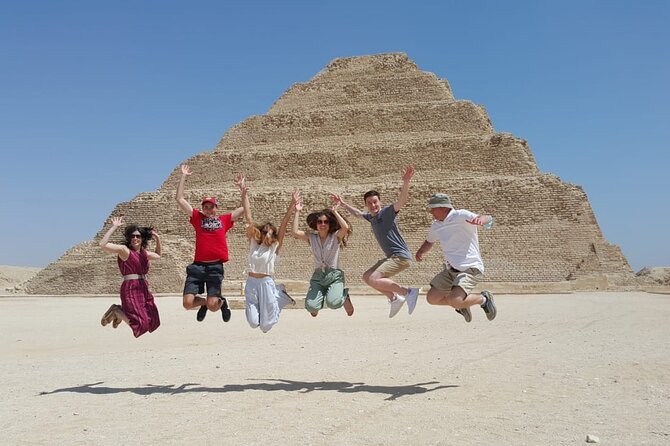
From Giza, you continue to Saqqara, one of the most important stops for understanding how pyramid building developed. The centerpiece is the Step Pyramid of King Djoser, built around 2630 BC and described as the world’s oldest major stone structure.
I consider this one of the tour’s best choices. Giza gives you the famous monuments, but Saqqara shows an earlier stage in the development of pyramid design. The Step Pyramid does not have the same instantly recognizable shape as the Great Pyramid, yet it offers a different and important view of ancient Egyptian construction.
The planned visit lasts about 90 minutes. That is enough for an introduction and a look at the principal monument, but you should not expect every corner of the large archaeological site. The guide helps you focus your time, which is useful when you have another pyramid area still ahead.
Admission is extra here as well. Ask for a clear breakdown of the tickets needed for your chosen stops, since the tour covers several separate sites over the two days.
Dahshur and the Red Pyramid entrance
The final archaeological stop on day one is Dahshur. Here, you have the chance to enter the Red Pyramid and see the Bent Pyramid from the outside. This gives the day a useful contrast: Giza offers the most famous pyramids, Saqqara offers the early Step Pyramid, and Dahshur presents two important experiments in pyramid design.
The Red Pyramid visit is a strong feature for anyone who wants more than exterior photographs. Entering a pyramid can involve tight passages and a physically demanding route, so consider your comfort before deciding to go inside. The supplied information confirms the chance to enter, but it does not give details about the interior route or any additional fee, so ask your guide on the day.
The Bent Pyramid is viewed rather than entered on this tour. It is known for its unusual change in angle, and your guide can help explain why its shape differs from the more familiar pyramids. You have about an hour at Dahshur, followed by a transfer back to your hotel in Cairo or Giza.
By the end of day one, you will have covered a lot of ground. I like the order because it places the major pyramid areas together, but anyone who prefers a relaxed pace may find the schedule full.
More Guided Tours in the world:
- History and Hauntings of Salem Guided Walking Tour
★ 5.0 · 14,564 reviews - Edinburgh: Edinburgh Castle Guided History Tour with Tickets
★ 4.8 · 9,933 reviews - Berlin: Third Reich & Cold War Guided Walking Tour
★ 4.9 · 8,378 reviews - Historic Charleston Guided Sightseeing Walking Tour
★ 5.0 · 6,216 reviews
The Citadel and Muhammad Ali Mosque
Day two starts with the Islamic and Coptic areas of Cairo. The first stop is Saladin’s Citadel, including the Muhammad Ali Mosque, often called the Alabaster Mosque. You also see Al Gowhara Palace, associated with Mamluk and Ottoman rule.
The Citadel offers a different experience from the open desert sites. Instead of focusing on royal tombs, you are looking at Cairo’s later Islamic center and its religious architecture. The mosque is the visual focus, while the Citadel gives your guide a chance to explain how power shifted through later periods of Egyptian history.
You have about an hour here. That makes the stop manageable, but it also means the visit is an overview. If you want long periods for quiet viewing or detailed architectural study, this tour may feel too quick. If you want a clear introduction before moving on, the timing makes sense.
The entrance ticket is not included. Since every major stop charges separately, you should treat the $50 as the cost of transport and guiding rather than the complete sightseeing bill.
Coptic Cairo, the Hanging Church, and Ben Ezra Synagogue
The tour then moves into Old Cairo, where you visit the Roman fortress area, the Hanging Church, St. Sergius, and the Ben Ezra Synagogue. This section gives the second day more variety than a simple museum-and-mosque route.
The Hanging Church, also called Al Mo’allaka Church, is one of the main Coptic landmarks in the area. St. Sergius is connected with the tradition that the Holy Family found shelter there. The Ben Ezra Synagogue adds a Jewish site to the route, making this a compact introduction to several religious communities within historic Cairo.
You have about an hour for Coptic Cairo. That is enough to see the principal buildings with a guide, but not enough to examine every detail at length. The value is in the connections between the sites. A good guide can help you understand why this small area matters and how its churches, fortress remains, and synagogue fit into Cairo’s past.
The tour description does not promise free time for shopping or wandering. That is useful if you prefer a focused program, but less ideal if you want to explore Old Cairo on your own.
The Egyptian Museum and five thousand years of objects
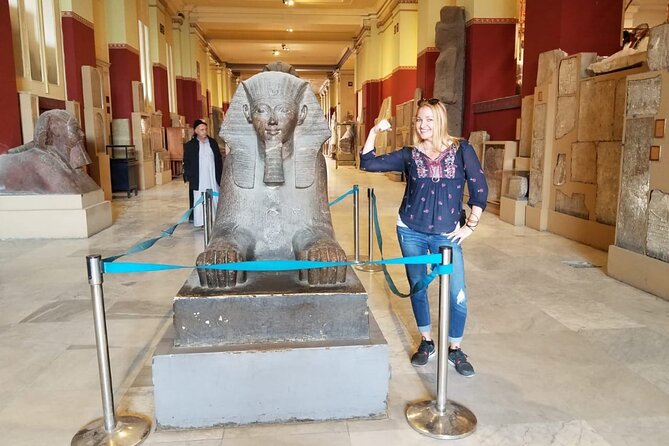
The last major stop is the Egyptian Museum in downtown Cairo, with about three hours planned inside. The collection covers pharaonic and Roman-era material and is described as holding 5,000 years of Egyptian art. You also have the chance to see Tutankhamun-related displays.
Three hours is a sensible amount of time for a first visit because the museum can be difficult to handle without a plan. A guide can point you toward major pieces and explain what you are seeing instead of leaving you to face room after room without context.
The museum is also where the tour’s two-day range pays off. After seeing pyramids and temples in their original settings, you can look at objects removed from tombs and archaeological sites. The connection between the monuments and the museum collection makes the ancient Egypt portion feel more complete.
The museum admission is extra. The supplied details do not specify which Tutankhamun displays are included in the standard ticket or whether any special rooms cost more, so confirm this with the operator before you go if that part is important to you.
Guides, drivers, and the small-group setup
The tour includes an expert guide, with a preferred language available to request. Spanish-language guiding received especially strong praise, and guides named Mohamed and Rafa were singled out for making the experience friendly and informative. Islam was also praised as the driver on one Spanish-language visit.
You should not assume that a particular guide will be assigned unless the provider confirms it. Still, these names give you useful information when you contact Hola Egipto. If you need Spanish or another language, state it clearly when booking.
The maximum group size is 15 people. That is not a private tour, but it is far more workable than a large coach group. You can usually hear the guide more easily, move through entrances with less fuss, and ask a question without holding up dozens of people.
Air-conditioned transport is included. In Cairo, this is more than a small comfort. You will be outside at several archaeological sites, then back in the vehicle for transfers between areas. Hotel pickup and drop-off also help you avoid negotiating separate rides after a tiring day.
What the $50 price really covers
At $50 per person, the tour is priced attractively for two days of transport and guiding. The included services are pickup and drop-off by air-conditioned vehicle, an expert guide, the planned two-day program, service, taxes, landing fees, and parking fees.
The important limit is that all sightseeing entrance fees are separate. You should not compare the $50 directly with a fully ticketed package. Instead, compare it with the cost of arranging a driver, guide, and transport for two days, then add the site admissions to get your real total.
Pickup from Heliopolis or Nasr City costs an additional $10 per person per day. The included pickup information specifically covers hotels in Cairo and Giza, so check your address before assuming the standard rate applies.
Group discounts may be available, although no exact discount is stated. Ask for the current total if you are booking with family or friends.
Who should book this Cairo tour?
I would choose this tour if you want the major ancient and religious sights in a short visit and do not want to manage Cairo transport yourself. It suits first-time visitors, people staying in Cairo or Giza hotels, and anyone who wants a guide to explain what they are seeing.
It is also a good fit if you want both famous sites and less obvious stops. Saqqara, Dahshur, the Citadel, and Coptic Cairo prevent the experience from becoming only a Great Pyramid photo stop.
I would think twice if you want a slow schedule, long museum hours, or several unplanned breaks. The route is packed, and the ticket costs can add up. Visitors with limited mobility should also ask the provider for more details, since the tour includes archaeological ground, religious sites, and the possibility of entering the Red Pyramid.
Booking is flexible in one useful way: you can cancel for a full refund up to 24 hours before the start time. The tour can also be moved or refunded if poor weather or an insufficient number of bookings causes cancellation.
Should you book it?
Book this two-day tour if efficient sightseeing, hotel transfers, and a guide-led introduction matter more to you than setting your own pace. The strongest features are the wide route, small group limit, air-conditioned vehicle, and chance to enter the Red Pyramid.
Before paying, confirm your pickup area, preferred guide language, expected entrance fees, and whether the Tutankhamun displays you want to see are covered by the museum ticket. If you accept the extra admissions and busy schedule, this is a practical way to cover Cairo’s biggest ancient and historic sights without taking on the city’s transport problems yourself.
FAQ
How long is the tour?
The experience lasts approximately two days. Day one includes Giza, Saqqara, and Dahshur. Day two includes the Citadel, Coptic Cairo, and the Egyptian Museum.
Is hotel pickup included?
Pickup and drop-off are included for hotels in Cairo and Giza. Heliopolis and Nasr City pickups cost an additional $10 per person per day.
Are entrance fees included?
No. Entrance fees for the sightseeing locations are paid separately.
How large is the group?
The tour has a maximum of 15 travelers.
Can I choose the guide language?
Yes. You can request your preferred language when booking. Spanish-language guides named Mohamed and Rafa have been used on this experience.
Is the Red Pyramid included?
Dahshur is included, and you have the chance to enter the Red Pyramid. The Bent Pyramid is viewed from outside. Entrance fees are not included.
Can I cancel for a refund?
You can cancel up to 24 hours before the experience starts for a full refund. Cancellations or changes made less than 24 hours before the start time are not accepted for a refund.
Just added around the world
- Scenic Train ride to historical cities of Morretes and Antonina★ 4.0 · 188 reviews
- 6-Day Cultural Tour to Machu Picchu★ 5.0 · 76 reviews
- Jewish Heritage of Curacao★ 4.5 · 68 reviews
- The Curacao’s Colorful History Walking Tour★ 5.0 · 55 reviews
- Discover Scuba Diving Amathounta’s Ancient Port★ 5.0 · 30 reviews
- Night Walking Tour of Medieval Cuenca★ 5.0 · 64 reviews
- Olous – Guided Snorkelling Excursion to Discover Olous Sunken Ancient City★ 4.5 · 31 reviews
- WWII – The Battle of Crete Day Tour★ 5.0 · 103 reviews
Guided, compared.
Pompeii: Entry Ticket and Guided Tour with an Archaeologist
Read our review →
History and Hauntings of Salem Guided Walking Tour
Read our review →
Edinburgh: Edinburgh Castle Guided History Tour with Tickets
Read our review →
Berlin: Third Reich & Cold War Guided Walking Tour
Read our review →
Historic Charleston Guided Sightseeing Walking Tour
Read our review →
Ghent: 50-Minute Medieval Center Guided Boat Trip
Read our review →
Rome: Colosseum with Arena, Roman Forum and Palatine Guided Tour
Read our review →
Venice: St. Mark’s Basilica Guided Tour & VR History Intro
Read our review →Browse the lists this tour appears in