
Review · FRANCE
Full day Australian Battlefields Tour
The most powerful part of this day is the way it connects famous battle sites with the ordinary Australians who fought there. You move from the polished memorial at Villers-Bretonneux to shell craters, lost villages, cemetery walls, and the fields where so many men disappeared.
I like the private format, which lets Brigitte De Cuyper adjust the pace and answer family-history questions. I also like the balance between formal memorials and raw battlefield ground, especially the Sir John Monash Centre, where letters, diaries, and life-size images tell the story in soldiers’ own voices.
The main drawback is the pace. Eight hours covers a lot of ground, and several stops last only 10 or 20 minutes. Lunch is not included, and rain or cold weather can make the open-air memorials much harder work.
Key points
- A strongly Australian focus: Villers-Bretonneux, Pozières, the 1st Australian Division Memorial, and the Sir John Monash Centre anchor the day.
- A local guide with personal preparation: Brigitte De Cuyper researches family connections before the tour when details are provided.
- A private, flexible experience: Only your group takes part, and past arrangements have included extra cemetery visits or changes to the route.
- The Sir John Monash Centre is the indoor highlight: Allow its full one-hour visit for films, letters, interactive displays, and personal stories.
- The Somme’s major sites fit into one long day: Lochnagar Crater, Thiepval, Ulster Tower, and Beaumont-Hamel add British, Irish, Newfoundland, and German-front context.
- Good for serious history travelers: The day is moving and sometimes sad, not a light sightseeing outing.
From Amiens Cathedral to the Australian front
Your day begins at 9:00 am in Amiens, with pickup available. Some arrangements have included collection at accommodation or Amiens train station, which is useful if you are making a day trip from Paris. The exact pickup point should be confirmed carefully, since one past booking suffered from a hotel change that was not passed on to the guide.
Amiens Cathedral gives the morning a wider setting before the tour turns toward the war. This huge Gothic building is celebrating its 800th birthday this year and is described as the largest Gothic cathedral in the world. During the drive, Brigitte explains Amiens from the Middle Ages to the present, along with the local economy, culture, and rolling countryside around the Somme.
That introduction matters. The battlefield is not an isolated museum zone. It is part of a living region of French villages, farms, churches, roads, and ordinary daily life. The drive helps you understand how the war changed places that had existed for centuries.
Brigitte grew up in this part of the Somme, and that local connection shapes the day. Her explanations are not limited to troop movements and dates. She also describes the French experience of the war and the way the battlefields remain part of local memory.
More Battlefield and Military History Tours in France:
- Normandy Battlefields Tour – American Sites (A3)
★ 5.0 · 876 reviews - Normandy Battlefields D-Day Private Trip with VIP Services from Paris
★ 5.0 · 240 reviews - Full-Day Canadian Battlefields & sites Normandy Tour from Bayeux
★ 5.0 · 191 reviews
Villers-Bretonneux and the Australian story
The first major stop is Villers-Bretonneux Military Cemetery and the Australian Memorial. Here you begin with Australia’s role on the Western Front, including the Allied counterattack of April 1918.
This is an important place to start because Villers-Bretonneux is central to the Australian story in France. You have time to pay your respects at the graves of the Diggers before walking the short distance to the Sir John Monash Centre.
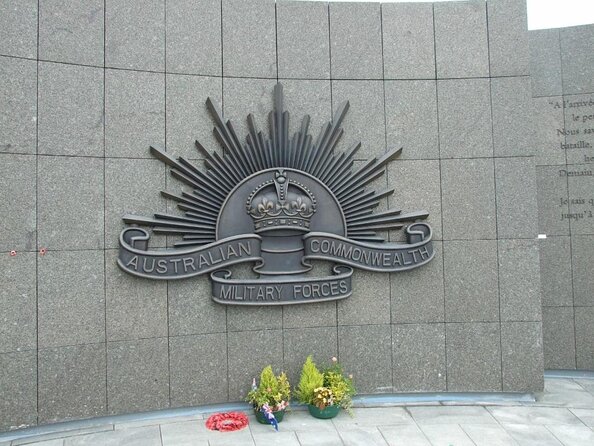
The Australian National Memorial sits at the heart of the Commonwealth War Graves cemetery. It was inaugurated on July 22, 1922, and its walls carry the names of 10,729 Australian servicemen. On Anzac Day, thousands gather here at dawn.
The memorial is formal and carefully maintained, while the cemetery gives the names a human scale. Take your time with the inscriptions. The guide’s explanation of the April 1918 fighting helps you understand why this ground mattered, but the quiet rows of graves can be more affecting than any military summary.
You have about 20 minutes at the cemetery and memorial area before the museum visit. That is enough for an introduction and a respectful pause, but it is not a long independent exploration. If you want to study every name or photograph individual graves, you may feel pressed.
One hour inside the Sir John Monash Centre
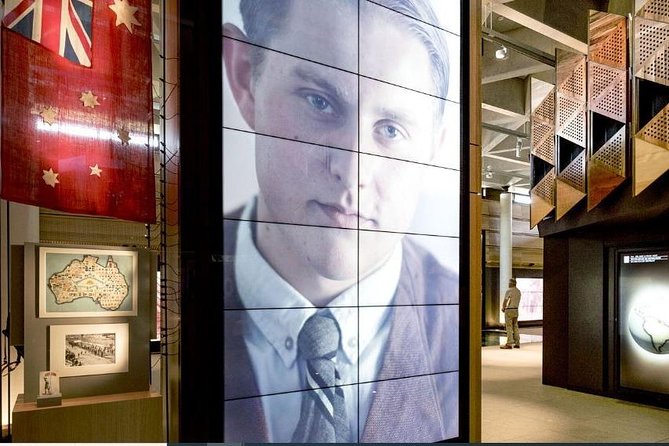
The Sir John Monash Centre is the day’s key indoor experience. Its purpose is to tell Australia’s Western Front story through the voices of those who served.
The displays use interactive media, letters, diaries, and life-size images. Instead of treating the war as a list of battles, the centre follows ordinary Australians through the places where they fought and died. That makes the material easier to connect with, especially if you arrive with a family story or a particular soldier in mind.
The planned visit lasts one hour. I would protect that hour rather than hurry through it. One past visitor described being able to spend all day there, and that is a useful warning for history enthusiasts: the centre can absorb more time than the schedule allows.
The visit also gives you a break from the weather. Much of the rest of the day happens outdoors, so this hour provides both context and shelter. The centre is included in the tour price, while the outdoor memorial stops do not require separate admission fees.
If the centre is closed on your date, the day can still continue with relevant battlefield stops, but it will lose the tour’s most concentrated Australian museum experience. It is worth checking current opening arrangements before booking if this stop is your main reason for choosing the tour.
Chipilly and the Somme Valley
The route then follows the Somme Valley to Chipilly. The brief stop here is centered on the 58th British Division Memorial, a stone monument showing a soldier comforting a wounded horse.
The sculpture pays tribute not only to the men of the division but also to the thousands of horses that died during the war. It is one of the more unusual memorials on the route, and its quiet subject makes a useful change from the large national monuments.
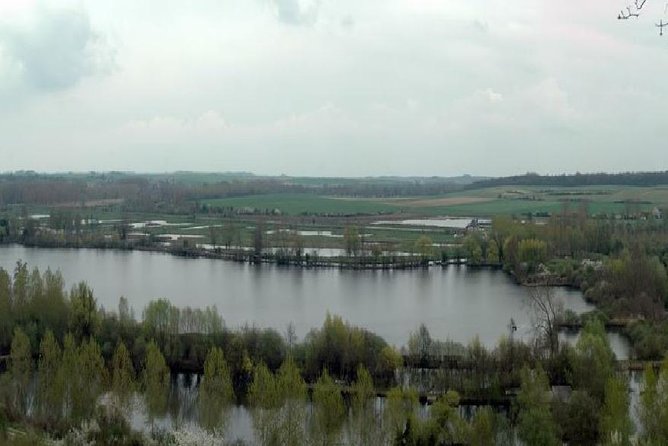
At the Camp Cesar viewpoint, you get a broad view over the Somme Valley. The stop lasts about 10 minutes, so think of it as an orientation point rather than a long walk. Brigitte uses the view to explain the opening of the 1916 Battle of the Somme, why the offensive was planned, and which nations took part.
The short stop works well because the countryside helps you picture the scale of the campaign. Still, keep your expectations realistic. You will not have time here for an extended ramble or a detailed look at every battlefield feature.
More Full-Day Trips in France:
- Normandy American D-Day Beaches Full Day Tour from Bayeux
★ 5.0 · 2,103 reviews - From Paris: Normandy D-Day Landing Beaches Full-Day Tour
★ 4.8 · 698 reviews - From Bayeux: American D-Day Sites in Normandy Full-Day Tour
★ 4.9 · 503 reviews - From Nice: Provence and its Medieval Villages Full-Day Tour
★ 4.8 · 352 reviews
Albert, lunch, and the golden Virgin
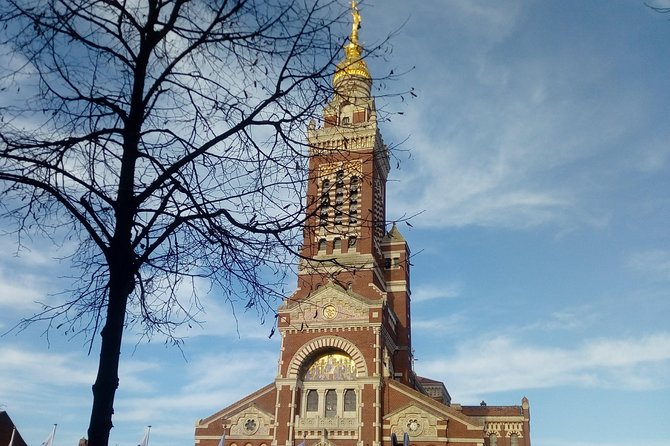
The town of Albert brings a different kind of war story. The Basilica Notre Dame de Brebières is built in a Neo-Byzantine style and is one of Picardy’s notable buildings.
The basilica was destroyed during the Great War and rebuilt in the same form by Edmond Duthoit, son of the original architect. Its dome is covered in gold sheets and topped by a statue of the Virgin Mary holding the infant Jesus. Brigitte explains the wartime story attached to the statue, adding a local and religious layer to the military narrative.
Lunch follows at Le Hygge Restaurant Brasserie. You have about one hour, but lunch is not included in the $253.97 price, so budget separately for your meal and drinks. The stop is practical as well as pleasant. After several memorials and cemetery visits, a proper break helps you handle the long afternoon.
The restaurant stop also gives the day a more normal rhythm. This is not eight straight hours of standing among graves. You get time to eat, talk, and process what you have seen before returning to the battlefield.
Lochnagar Crater and the violence of 1916
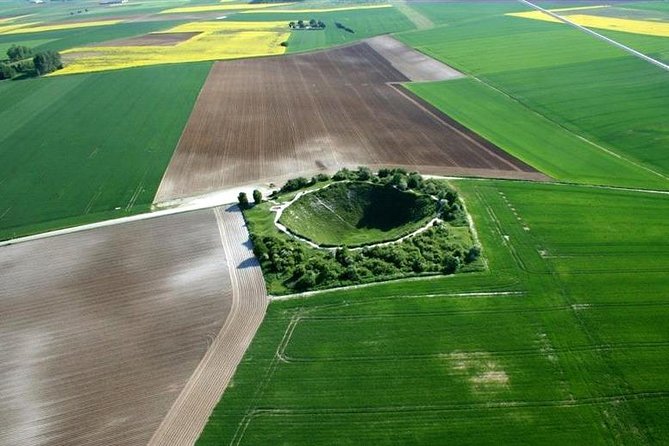
Lochnagar Crater is one of the most striking physical reminders of the Battle of the Somme. A large mine was placed under the German front line and detonated on the first day of the battle. It was one of 19 mines used to support the British infantry advance.
The crater is about 70 feet deep and 330 feet wide. Those numbers are useful, but the shape of the ground explains the force of the explosion better than words can. You are looking at a scar made by a single blast, not a reconstructed exhibit.
The stop lasts around 20 minutes and admission is free. You may find the ground uneven, and weather can affect comfort, so sturdy footwear and a coat are sensible. This is also one of the places where the scale of the war can feel less abstract. A crater this large makes it clear how radically the earth itself was altered.
Pozières, Australian sacrifice, and the tank memorial
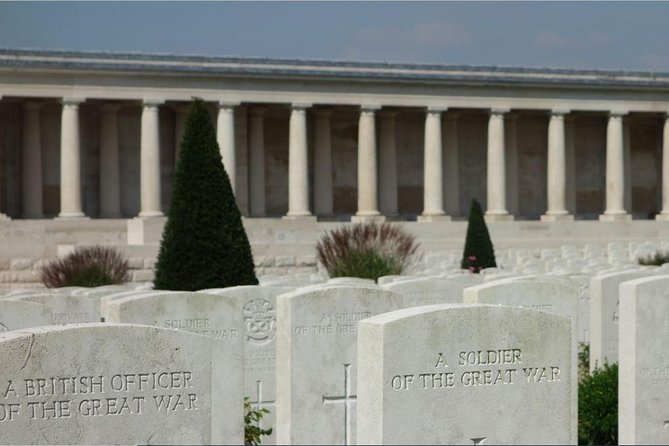
At the 1st Australian Division Memorial, Brigitte explains the fighting at Pozières between July 23 and September 3, 1916. Almost 7,000 men died there, and the site is one of the most important Australian stops on the route.
The nearby Windmill site was made an Australian memorial in the 1930s at the suggestion of official war historian Charles Bean. It commemorates 23,000 casualties, including men who died in the surrounding countryside. The ruined windmill site and the open fields give the place a stark quality.
Across from it, the Tank Memorial opens another subject: the arrival of tanks on the Western Front and the changing nature of modern warfare. This is a useful contrast with the earlier cemetery stops. You move from individual names and family grief to machines, tactics, and the industrial scale of battle.
The listed route also includes Mouquet Farm. As with several short battlefield points, the value comes mainly from Brigitte’s explanation and the way she places each location within the wider fighting. Do not expect every stop to have a large building or a formal visitor center.
Thiepval and the problem of the missing
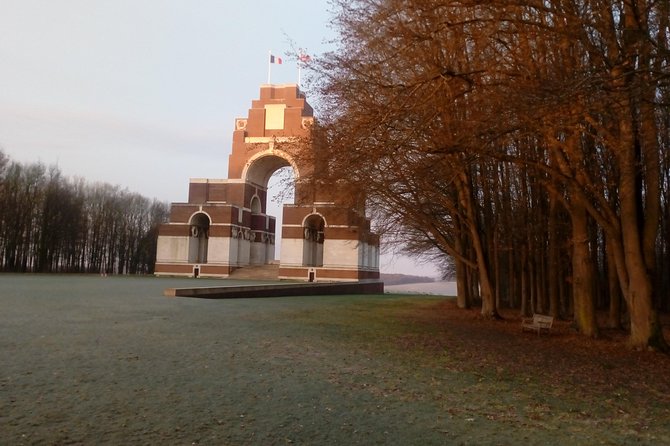
The Memorial to the Missing at Thiepval is one of the largest and most imposing British war memorials in the world. Its walls carry the names of more than 72,000 soldiers who were missing or whose bodies were never identified.
This stop lasts about 45 minutes, longer than most of the smaller memorial visits. That extra time is welcome. The monument dominates the surrounding fields, and its size reflects the number of families who never received a known grave.
Here Brigitte explains military tactics and the meaning of missing during the First World War. That word can sound administrative until you consider what it meant at home. A family might know that a son or brother had gone into battle, but have no confirmed place to mourn him.
Thiepval is not specifically Australian, yet it belongs on this tour because it gives you the wider Commonwealth setting. The Australian experience makes more sense when you also understand the British command structure, the scale of the offensive, and the enormous number of men lost without identified remains.
Ulster Tower and Newfoundland Memorial Park
The Ulster Tower is Northern Ireland’s national war memorial. It commemorates the men of the 36th Division and others from Ulster who served in the First World War. It opened in 1921 and was among the early memorials built on the Western Front.
From the hill, you can still see traces of the Somme front lines in the opposite field, along with the remains of a German machine-gun post. These features help connect the memorial to the battlefield rather than leaving it as a standalone monument.
The final main stop is Newfoundland Memorial Park at Beaumont-Hamel. It is the largest battlefield site in the Somme and honors Newfoundlanders who served during the war.
For Newfoundland, the Battle of the Somme began with staggering losses on July 1, 1916. The land was purchased in 1921 by the women of Newfoundland and their government, and the park became a symbol of sacrifice and island identity.
Ending here gives the tour a wider emotional frame. You began with a strong Australian focus, but the day closes by showing how the Somme affected different parts of the Commonwealth. The shared battlefield connects Australia, Britain, Ireland, Newfoundland, France, and Germany, while each memorial preserves its own memory.
What the $253.97 price buys you
At $253.97 per person, this is not a budget sightseeing day. It is a private eight-hour tour, though, so the comparison is not with a large coach excursion. You are paying for dedicated transport and guiding, pickup, all listed fees and taxes, and a route that would be difficult to cover efficiently without a car.
The value rises if you have a family connection. Brigitte asks about relatives before the tour and has researched soldiers for several families. In some cases, she has added a cemetery connected with a guest’s ancestor or adjusted the route to include a particular place.
That preparation is a major reason to share names, units, dates, and burial information when you book. It does not guarantee a personal discovery, but it gives the guide something specific to work with.
The cost is harder to justify if you only want a quick general introduction to the Somme. Several stops are brief, lunch costs extra, and the day is aimed at people who want detailed explanation rather than a relaxed countryside drive.
Who should book this Somme day?
I would choose this tour if you are Australian, have a relative who served in France, or want the Australian part of the Western Front explained carefully. It also suits couples, families, and small groups who prefer a private guide over a fixed group schedule.
The day requires moderate physical fitness. You will be getting in and out of transport, walking around cemeteries and memorial grounds, and spending time outside in changing weather. Service animals are allowed.
It is not the best fit if you want a slow day with long café stops or extensive time at each individual site. The route is packed. The emotional tone is also serious, with many cemeteries, missing names, and accounts of heavy losses.
Communication in English is strong, and Brigitte is described as an effective storyteller who welcomes questions. Her local background is especially useful when you want more than battle dates. She can connect the military events to the villages, churches, farms, and people of the Somme.
Should you book the Australian Battlefields Tour?
Book it if you want a focused Australian and Commonwealth view of the Somme and value a private guide who can prepare around your family history. The Sir John Monash Centre, Villers-Bretonneux, Pozières, and the personal research offered by Brigitte make this more than a standard battlefield drive.
Before booking, accept that it is a full day, bring suitable clothing and shoes, and set aside money for lunch. Confirm the pickup location carefully, especially if your hotel changes.
If you prefer a shorter or less emotional outing, this may feel too packed and solemn. For an Australian pilgrimage, a family-history visit, or a serious first look at the Somme, it offers strong value and a thoughtful route through the places that matter most.
FAQ
How long is the Australian Battlefields Tour?
The tour lasts approximately eight hours, beginning at 9:00 am.
Where does the tour take place?
The tour is based in Amiens and visits battlefields and memorials across the Somme region, including Villers-Bretonneux, Pozières, Thiepval, and Beaumont-Hamel.
Is hotel pickup available?
Pickup is offered. The stated pickup information says the guide will wear a guide badge. Confirm your exact pickup point, particularly if your accommodation changes.
Is this a private tour?
Yes. Only your group takes part in the activity.
Is the tour offered in English?
Yes. The tour is offered in English.
Is lunch included?
No. Lunch at Le Hygge Restaurant Brasserie is not included in the tour price.
Is admission to the Sir John Monash Centre included?
Yes. Admission to the Sir John Monash Centre is included. The listed outdoor memorial and battlefield stops do not require separate admission fees.
What level of fitness is required?
A moderate level of physical fitness is recommended. The tour includes walking around cemeteries, memorials, and outdoor battlefield sites.
Can I cancel the tour for a refund?
You can cancel up to 24 hours before the experience starts for a full refund. Cancellations or changes made less than 24 hours before the start time are not accepted for a refund.
Just added around France
- Medieval Carcassonne: Interactive Ghost Story & City Game★ 3.5 · 33 reviews
- Carcassonne During World War 2★ 5.0 · 127 reviews
- Carcassonne ‘s Medieval Walls: A Self-Guided Tour★ 4.5 · 43 reviews
- Small Group Guided D-Day Tour and Mémorial de Caen Museum★ 5.0 · 237 reviews
- Normandy: Private tour D-Day landing beaches American sector★ 5.0 · 62 reviews
- Mémorial de Caen Museum Admission and Guided Tour of D-Day Sites★ 4.5 · 275 reviews
- Private Day Tour including Normandy Landing Beaches & Battlefields from Caen★ 5.0 · 53 reviews
- Private Bordeaux History Tour with a glass of Bordeaux wine.★ 5.0 · 28 reviews
France History Tours, compared.

Normandy D-Day Sites & Cemetery Day Trip from Paris with Lunch
Read our review →
Paris: Louvre Museum Entry with History of Mona Lisa
Read our review →
Normandy D-Day Small-Group Day Trip with Omaha Beach, Cemetery & Cider Tasting
Read our review →
Normandy D-Day Beaches and American Cemetery Day Trip from Paris
Read our review →
Normandy American D-Day Beaches Full Day Tour from Bayeux
Read our review →
Normandy American D-Day Experience – Group tour from Bayeux
Read our review →
Normandy Beaches Half-Day Afternoon Trip from Bayeux (A2)
Read our review →
Omaha Beach D-Day Experience – Afternoon group tour from Bayeux
Read our review →Browse the lists this tour appears in