Review · NAPLES
Pompeii and Herculaneum led by an Archaeologist with private transport
The most striking part of this day is seeing how differently Vesuvius destroyed two nearby Roman towns. Pompeii was buried under falling ash, while Herculaneum was hit by superheated volcanic material. With an archaeologist such as Daniela, Ivan, or Alfredo leading the way, those differences become much easier to understand.
I like the private Mercedes transport, especially if you are staying outside Naples or arriving by cruise ship. I also like the chance to see both sites with one guide, rather than trying to connect the dots yourself. The main drawback is simple: seven hours is a long, active day, and both sites involve uneven ground and plenty of walking.
- Two major Roman sites in one day: Compare Pompeii’s broad streets and public buildings with Herculaneum’s smaller, better-preserved homes.
- An archaeologist at your side: Guides including Daniela, Ivan, Alfredo, Benedetto, and John Carlos have been praised for detailed explanations and patient pacing.
- Private transport from a wide area: Pickup is offered from accommodations, ports, train stations, and airports in Naples, Salerno, Sorrento, and the Amalfi Coast.
- A Mercedes minivan with a professional driver: Drivers such as Luigi, Luca, Giovanni, and Fulvio can make the long transfer between sites easier.
- A flexible lunch break: You can stop for lunch between the ruins, or skip it to spend more time inside the archaeological parks.
- A full day on ancient stone: Comfortable shoes, water, sunscreen, and sunglasses are not optional extras in summer.
Why Seeing Both Cities Changes the Story
Many people visit Pompeii and leave with a picture of one Roman city frozen by disaster. Seeing Herculaneum too gives you a more complete view.
Pompeii was covered by pumice and ash during the eruption of Mount Vesuvius. Herculaneum suffered a different fate, with hot volcanic material and landslides preserving some wooden doors, partitions, and household details in remarkable condition. Your guide can point out these contrasts as you move from one site to the other.
I find this comparison more useful than visiting either place alone. Pompeii gives you scale. Herculaneum gives you detail. One feels like a city you can walk through for hours, while the other offers a closer look at domestic life and building decoration.
The day is sold as roughly seven hours. That sounds manageable until you add hotel pickup, transfers, lunch, and walking through two large archaeological parks. You should expect a serious sightseeing day, not a casual outing.
Private Pickup Makes a Wide-Area Tour Practical
Pickup is available from a hotel or other accommodation, cruise port, train station, or airport in Naples, Salerno, Sorrento, and the Amalfi Coast. That reach is one of the strongest reasons to consider this experience.
If you are staying in Sorrento or along the Amalfi Coast, arranging both archaeological sites on your own can mean juggling trains, local transport, walking routes, and entry times. A private vehicle removes much of that work. It also means you return to the same driver instead of finding your way back after a hot day among the ruins.
The vehicle is described as a private, air-conditioned Mercedes car or minivan with a professional driver. Drivers named in the feedback include Luigi, Luca, Giovanni, Raphaelle, and Fulvio. One driver recommended a local winery for lunch, while another adjusted the schedule for a cruise passenger whose ship arrived later than planned.
That kind of flexibility matters, but you should still provide your exact pickup point and timing when booking. Cruise passengers should allow a sensible margin before the ship’s departure. The tour can adjust some schedules, but road traffic and site conditions are outside the company’s control.
More Ancient History Tours in Italy
- Herculaneum: Skip-the-Line Guided Tour with Archaeologist
★ 4.8 · 3,439 reviews - Herculaneum Small Group Tour and Ticket With an Archaeologist
★ 5.0 · 994 reviews - From Naples: Pompeii & Herculaneum with Archaeologist Guide
★ 4.8 · 665 reviews
Herculaneum: Small Scale, Remarkable Preservation
The day begins with pickup and a meeting with your archaeologist at Herculaneum’s ticket office. The planned visit covers about an hour in the supplied schedule, although the full list of stops suggests that the pace can be brisk.
Herculaneum is smaller than Pompeii, but it rewards close attention. The preserved houses often give you a sharper sense of rooms, decoration, and private life. Your guide’s job here is not just to name buildings, but to explain what their layout says about Roman society.
House of the Deer and the Terrace of M. Nonius Balbus
The House of the Deer takes its name from marble deer statues found around its peristyle. It introduces you to the kind of private residence where sculpture, gardens, and outdoor space helped signal status.
Nearby, the terrace of M. Nonius Balbus honors one of the city’s major benefactors. His funeral altar carries a long inscription describing the honors given to him. This is a useful stop for understanding how wealthy public figures shaped city life through building projects and civic gifts.
College of the Augustales and the Central Baths
The College of the Augustales was linked to the cult of Emperor Augustus and may also have served as a local civic headquarters. It helps you see that Herculaneum was not simply a collection of private homes. It had organized religious, political, and social institutions.
The Central Thermae, or public baths, were built around the beginning of the first century AD. Separate entrances served men and women, a detail that gives the ruins a practical human scale. Your guide can help you read the remaining rooms as part of a functioning daily routine rather than as empty stone chambers.
More Ancient History Tours in Naples
- From Naples: Ruins of Pompeii
★ 4.3 · 204 reviews - Naples: Pompeii Archaeology Park Tour & Skip-the-Line Entry
★ 4.8 · 190 reviews - Pompeii: Private Tour with an Archaeologist
★ 4.9 · 168 reviews - Herculaneum Private Tour with an Archaeologist
★ 5.0 · 132 reviews
The Telephus Relief House and House of the Skeleton
The Casa del Rilievo di Telefo is unusual because it appears to have had private access to the adjoining Suburban Baths. It may have belonged to Marcus Nonius Balbus, the same prominent figure linked to the terrace.
The House of the Skeleton probably formed from three smaller buildings. Its name comes from human remains found in an upper room in 1831. This is a sobering stop, and a reminder that the site is not only about beautiful frescoes and elegant courtyards.
Black Salon, Wooden Partition, and Samnite House
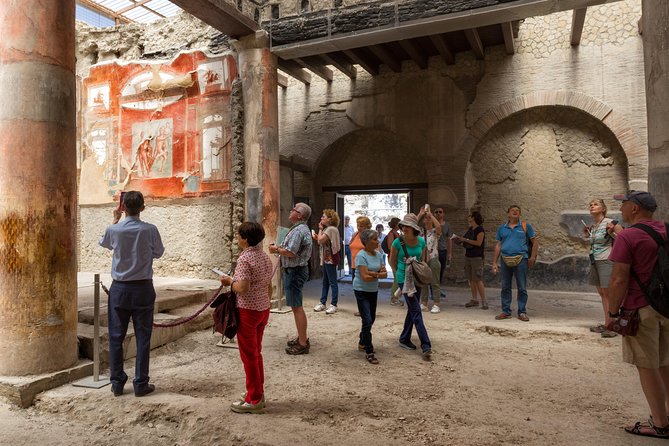
The House of the Black Salon has a grand entrance, with carbonized remains of its doorposts and lintel. The dark decorative room and surviving wooden elements show how much can remain when a disaster preserves materials instead of simply destroying them.
At the House of the Wooden Partition, the surviving partition is the star. Wood rarely survives in ancient sites, so this detail is especially valuable. It gives you a rare look at how Romans divided rooms and managed privacy inside a home.
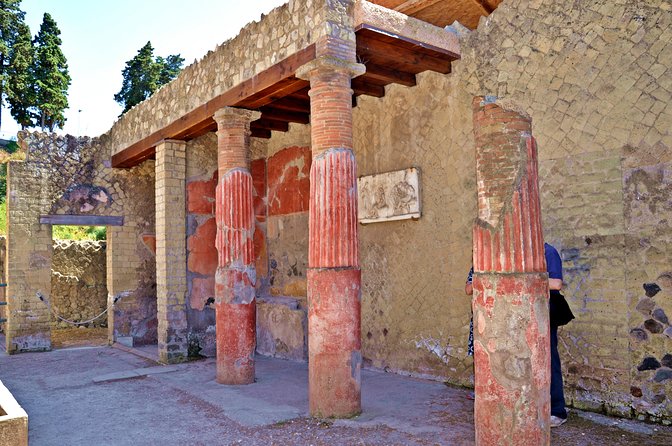
Casa Sannitica has an atrium surrounded by a gallery with Ionic columns. Its frescoes and layout reflect an older Samnite tradition, linking the town’s Roman life with the people and customs that came before full Roman control.
Bel Cortile and the Grand Portal
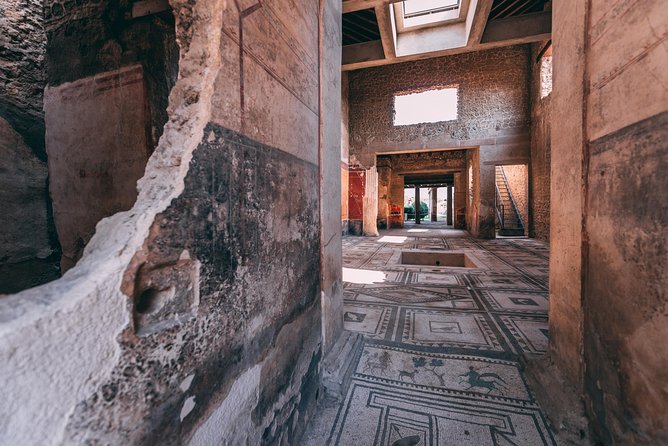
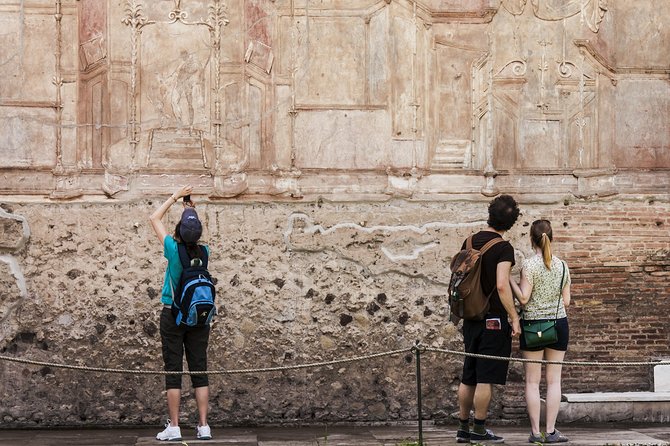
Casa del Bel Cortile replaces the usual atrium arrangement with a courtyard, stairway, and stone balcony. It is one of the more original domestic layouts at Herculaneum and makes a good comparison with the more familiar atrium houses.
The House of the Grand Portal brings together many features found across the site: columns, frescoes, rooms, and carbonized wooden parts. You may find the stop less about one famous object and more about seeing how the pieces of a wealthy Roman home fit together.
The supplied schedule assigns about ten to fifteen minutes to many of these stops. That is enough for a guided introduction, but not enough for slow photography or extended independent study at every house. Tell your guide if a particular room interests you most. Private touring gives you a better chance to adjust the pace than a large group outing.
Pompeii: Streets, Public Buildings, and Famous Houses
After Herculaneum, you have time for lunch on your own before continuing to Pompeii. The lunch stop is optional. Skipping it may let you see more of Herculaneum before larger groups arrive, while taking the break gives your feet and attention a needed rest.
The precise order can vary. The supplied plan places Herculaneum first, while one account describes Pompeii before lunch and Herculaneum afterward. Ask for the final sequence when your pickup is confirmed. Either way, the value comes from seeing both sites with the same archaeological context.
Pompeii is much larger and more spread out. The visit focuses on several major landmarks rather than attempting every street and building.
The Lupanar and Forum
The Lupanar is Pompeii’s best-known brothel. Its small rooms and painted imagery are often memorable, but your guide can give the site a broader social context and explain how commercial sex fit into the city’s public life.
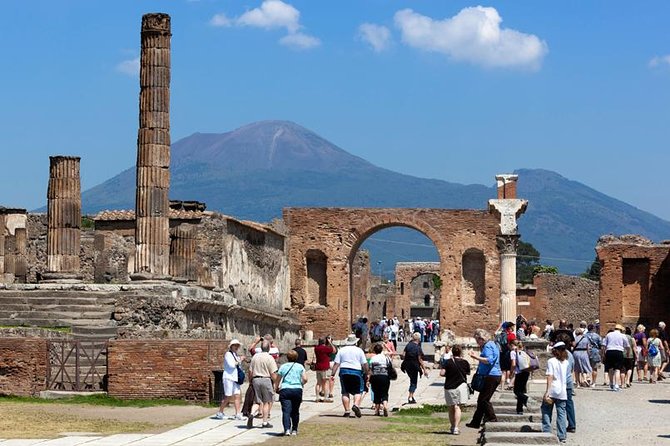
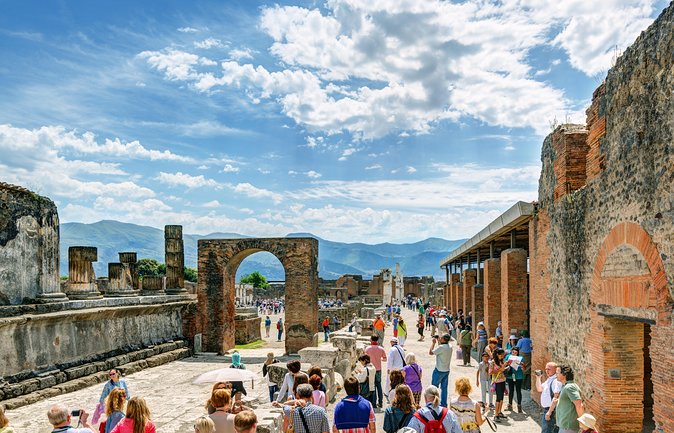
The Forum was Pompeii’s main square, framed by important civic and religious buildings. This is where the city’s public identity comes into focus. You can picture commerce, official business, ceremonies, and daily movement all converging in one open space.
You will also walk along one of Pompeii’s main streets. The streets are among the most useful parts of the visit because they show the practical structure of the city. Look at the relationship between houses, shops, public buildings, and crossroads as your guide explains how residents moved around town.
Granaries and the Basilica
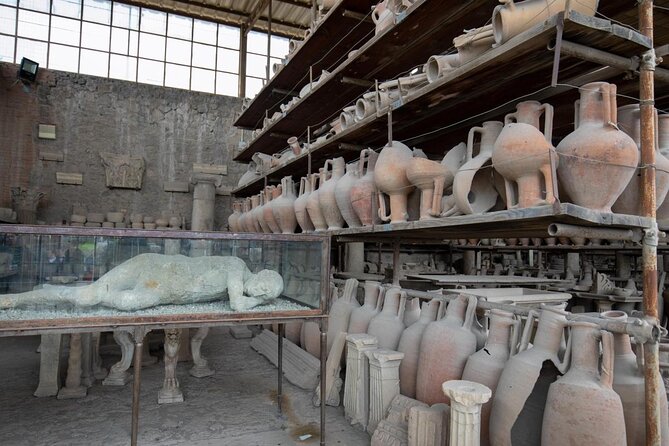
The Forum Granaries hold marble tables, fountain basins, and casts of victims, including a dog and a tree. The casts can be difficult to see, but they make the eruption personal. These are not abstract archaeological remains. They are traces of people and animals caught in a sudden disaster.
The Basilica was an open portico used for merchants and other civic activity. It was not a Christian church in the later sense of the word. Your archaeologist can help distinguish Roman civic architecture from later religious use of the term.
Stabian Baths and the House of Menander
The Stabian Baths occupy a broad area between several streets and represent Pompeii’s oldest major thermal complex. The scale of the baths shows how central public washing, exercise, and social contact were to Roman urban life.
The House of Menander is one of Pompeii’s grandest private residences. Its architecture, decoration, and contents make it a strong counterpoint to the more modest homes you may pass along the way. This is one of the places where a guide’s explanation helps you understand wealth through floor plans, artwork, and the arrangement of rooms.
House of the Faun and the Theaters
The House of the Faun was one of Pompeii’s largest private residences. Its size alone gives you a sense of the economic gap between elite families and ordinary residents.
The Teatro Grande was Pompeii’s main theater. The visit also includes a look at the smaller Teatro Piccolo, which served a different performance setting. The theaters add another piece to the city’s daily life, showing that Pompeii was not only a place of business and domestic activity but also of public entertainment.
What an Archaeologist Adds to the Visit
The guide is the heart of this experience. Names associated with the tours include Daniela, Ivan, Alfredo, Mena, Benedetto, Giacoma, and John Carlos. One guide, Benedetto, is described as holding a doctorate in archaeology. Another, Ivan, has worked at both sites for more than two decades.
The practical benefit is not simply more facts. A good guide helps you decide what deserves your attention. At Pompeii, that may mean understanding the street plan before entering a house. At Herculaneum, it may mean noticing a carbonized doorframe or a wooden partition that you would otherwise walk past.
Several guides are also described as patient with mobility limits and willing to adjust the pace. That does not make the sites easy. Ancient paving is uneven, the walking is substantial, and summer heat can be tough. Most people can participate, but you should be honest about your walking needs when arranging the tour.
Is the $666.75 Price Worth It?
At $666.75 per person, this is an expensive excursion. The price needs to be judged against what is included: private pickup and drop-off, private transportation, a professional driver, guidance for the full tour, and admission to Pompeii and Herculaneum as described in the inclusions.
The value improves for a couple, family, or small private group that would otherwise pay separately for transport, site entry, and a specialist guide. It also makes more sense if you are staying beyond Naples or need to return to a cruise ship on a tight schedule.
The value is weaker if you are comfortable using public transportation, prefer to spend a full day at one site, or want lots of unstructured time for photography. The seven-hour format is efficient, not leisurely.
One detail deserves checking before payment: the practical notes list Herculaneum entry at 16 euros for adults and 2 euros for European Union citizens aged 18 to 25, while the inclusions state that Herculaneum and Pompeii entry tickets are included. Confirm the exact ticket arrangement and any age-based pricing with Askos Tours.
Practical Advice for a Better Day
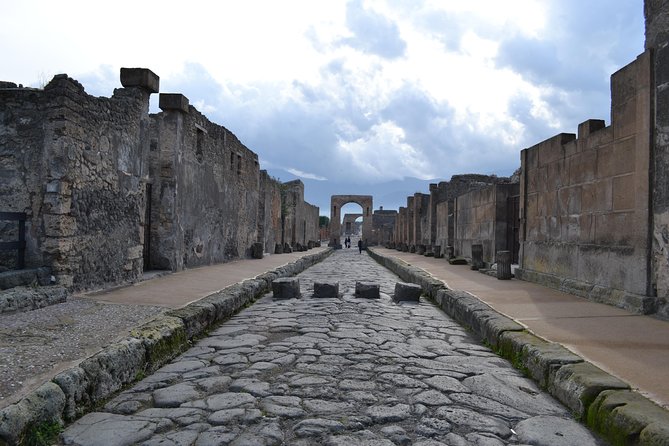
Wear supportive walking shoes. The warning against flip-flops in summer is sensible, since the ancient streets are hard underfoot and surfaces can be uneven.
Carry water, sunscreen, and sunglasses. Bring a small snack if you may skip lunch, though meals and personal expenses are not included. The tour allows a lunch stop between the sites, but you are not required to stop.
Private touring does not mean you avoid every crowd. Pompeii is a major attraction, and some buildings may be busy. The private format does let your guide steer you toward the main sights and adjust the pace when possible.
The tour is offered in English, and service animals are allowed. Most people can take part, but the walking distance and hot stone surfaces deserve serious thought for anyone with mobility limits.
Free cancellation is available up to 24 hours before the start time. Changes or cancellations made within 24 hours are not accepted for a refund.
Who Should Book This Experience?
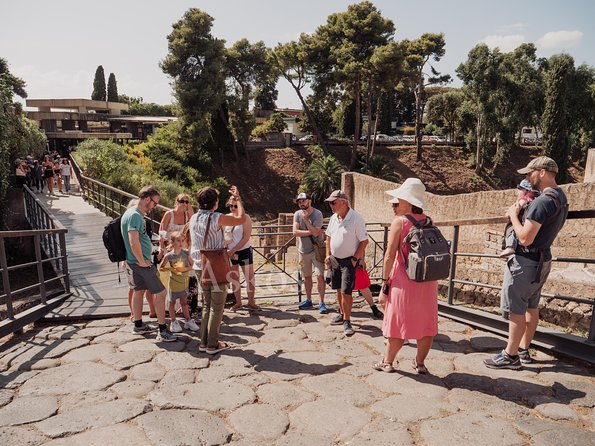
I would choose this tour if you want both archaeological sites in one day and care about understanding what you are seeing. It suits first-time visitors who want a clear route, families who need private transport, cruise passengers, and anyone staying in Sorrento, Salerno, or the Amalfi Coast.
I would think twice if you dislike guided sightseeing, need long breaks, or want to examine every building in detail. Pompeii alone can fill a day, and the combination of two sites is demanding.
For the right traveler, the strongest feature is the pairing of expert guidance and private transport. You get the broad city view at Pompeii, the close household details at Herculaneum, and an explanation of why the eruption affected each place so differently. If that sounds more useful than simply ticking two ruins off a list, this is a sound, though costly, choice.
FAQ
How long does the tour last?
The experience lasts approximately seven hours, including transportation, guided sightseeing, and time for a lunch stop if you choose to take one.
Where can pickup take place?
Pickup is offered from your accommodation, cruise port, train station, or airport in Naples, Salerno, Sorrento, and the Amalfi Coast.
Is transportation private?
Yes. Transportation is provided by private minivan or Mercedes vehicle with a professional driver, and only your group participates in the activity.
Are Pompeii and Herculaneum admission tickets included?
The inclusions state that Herculaneum entry tickets and Pompeii Express tickets are included. The practical information separately lists Herculaneum prices, so confirm the precise ticket arrangement when booking.
Is lunch included?
No. Lunch and personal expenses are not included. A lunch stop is offered between Herculaneum and Pompeii, but you may choose not to stop.
Is the tour offered in English?
Yes. The experience is offered in English.
Can cruise passengers book this tour?
Yes. Pickup is available at the cruise port, and the schedule may be adjusted when a ship arrives later than usual. Allow enough time to return before departure.
What should I wear?
Wear comfortable walking shoes. In summer, bring water, sunscreen, and sunglasses, and avoid flip-flops.
Can people with mobility limitations participate?
Most people can participate, and guides may be able to adjust the pace. The sites require substantial walking on ancient surfaces, so discuss your needs when booking.
What is the cancellation policy?
You can cancel up to 24 hours before the experience start time for a full refund. Cancellations or changes made less than 24 hours in advance are not accepted.
More Archaeological Site Tours in Naples
- Naples Walking Tour with Underground Roman Ruins Ticket
★ 4.5 · 510 reviews - Naples: City Walking Tour w/ Underground Roman Ruins Ticket
★ 4.6 · 284 reviews - Naples: National Archaeological Museum Tour & Digital Guide
★ 4.2 · 177 reviews - Naples: National Archaeological Museum audio guide
★ 4.0 · 155 reviews
More Private History Tours in Italy
- Pompeii and Herculaneum Private Walking Tour with an Archaeologist
★ 5.0 · 77 reviews - Naples Archaeological Museum 2-Hour Guided Private Tour
★ 5.0 · 51 reviews - Pompeii: Exclusive Tour with Archaeologist and Entry Tickets
★ 4.9 · 634 reviews - Ancient Ostia Antica Semi-Private Day Trip from Rome by Train with Guide
★ 4.5 · 579 reviews
Just added around Naples
- Naples: National Archaeological Museum Tour & Digital Guide★ 4.2 · 177 reviews
- Naples: City and Lapis Museum Tour with an Archaeologist★ 4.5 · 29 reviews
- Naples: Pompeii Archaeology Park Tour & Skip-the-Line Entry★ 4.8 · 190 reviews
- Naples: Historic City Center Guided Walking Tour★ 4.7 · 38 reviews
- Naples: Monuments and Historic District Self-Guided Tour★ 4.0 · 50 reviews
- Naples Archaeological Museum 2-Hour Guided Private Tour★ 5.0 · 51 reviews
- Naples: National Archaeological Museum audio guide★ 4.0 · 155 reviews
- Pompeii and Herculaneum Private Walking Tour with an Archaeologist★ 5.0 · 77 reviews
Naples History Tours, compared.
Herculaneum: Skip-the-Line Guided Tour with Archaeologist
Read our review →
Herculaneum Small Group Tour and Ticket With an Archaeologist
Read our review →
Naples Spanish Quarters Walking Tour Street Art, Folklore & Sweet
Read our review →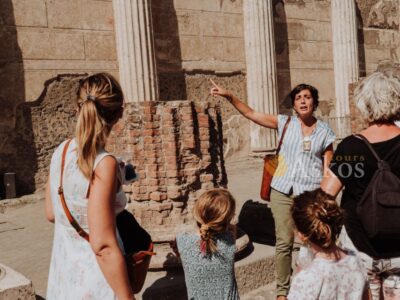
From Naples: Pompeii & Herculaneum with Archaeologist Guide
Read our review →
Naples: Street Art & History Tour in the Spanish Quarters
Read our review →
Naples Walking Tour with Underground Roman Ruins Ticket
Read our review →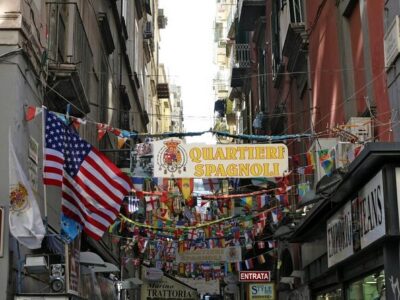
Naples Panoramic Walking Tour: From the Hills to the Center
Read our review →