
Review · RIO DE JANEIRO
Rio: Tijuca Forest Small Group Hike to Caves and Waterfalls
Rio’s Tijuca Forest is not just a patch of trees beside the city. This 6.2-kilometer route leads you past a 19th-century chapel, coffee-farm ruins, a suspension bridge, and Brazil’s largest gneiss cave, then ends with a cool shower beneath Baronesa Cascade. I like the way the tour connects nature with Brazil’s complicated past, rather than treating the forest as scenery alone. I also like the small groups and hotel pickup from much of Rio’s South Zone.
The main caution is the climb. The route gains about 448 meters and includes rough, sometimes steep ground. Some people find it fairly easy, while others finish ready for a nap in the van. Wildlife sightings are never guaranteed, and popular stops can have other people around.
Key points to know before you book

- A 6.2-kilometer rainforest circuit: Expect roughly 2.5 to 3 hours of walking, plus stops and transport.
- The waterfall shower is the payoff: Baronesa Cascade offers a refreshing place to cool off near the end.
- History is built into the trail: Coffee plantations, an old slave cemetery, a chapel, and former estate buildings help explain how Tijuca changed.
- The guides make a real difference: Vini, Riccardo, Tito, Renata, Pietro, and others are praised for combining forest facts with Rio and Brazilian history.
- Hotel pickup is limited by area: Service covers designated hotels and hostels in neighborhoods including Copacabana, Ipanema, Leblon, Leme, Flamengo, Santa Teresa, Gloria, Catete, Urca, and Botafogo.
- Bring your own supplies: Food, water, snacks, sunscreen, insect repellent, sturdy sports shoes, and a small daypack are not provided.
Why Tijuca Forest is worth your morning
Tijuca National Park gives you a rare change of pace in Rio. You can leave the beaches and traffic behind, then reach thick rainforest, steep rock, running water, and shaded trails without spending a full day travelling far from the city.
The forest also has an unusual story. Much of this area was once used for coffee cultivation. After the plantations damaged the slopes and water sources, the land was replanted during the 19th century. Today, Tijuca is often described as the world’s largest replanted urban forest, and this route lets you see evidence of both periods.
That past is what makes the walk more interesting than a simple nature outing. You are not only looking at trees. You are following old paths, passing remains of former estates, and learning how Rio’s water supply, hills, plantations, and urban growth are connected.
The tour lasts about six hours from pickup to drop-off, though the actual walk takes around 2.5 to 3 hours. The route covers 6.2 kilometers, or about 3.8 miles, with 448 meters of elevation gain. Most of the trail is shaded, which helps in Rio’s heat, but shade does not remove the effort of climbing.
More Small-Group History Tours in Brazil:
- Pompeii: Small Group Tour with an Archaeologist
★ 4.8 · 12,264 reviews - London Small Group Tour of Historical Pubs
★ 5.0 · 10,422 reviews - Pompeii Small Group Tour with an Archaeologist
★ 5.0 · 6,593 reviews
Taunay Waterfall and the first forest views
The day begins with pickup from a designated hotel or hostel. The long list of pickup points covers much of the South Zone, but you should confirm your exact address. If your hotel is outside the service area, you will be given a nearby meeting point instead.
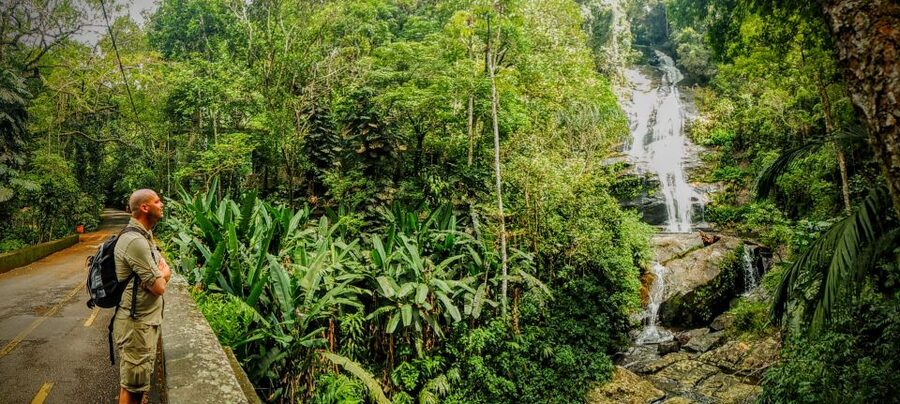
The first major stop is Cascatinha Taunay, the park’s largest waterfall. The stop is short, around 15 minutes, so think of it as an introduction rather than a long swimming break. It gives you an early look at the water and rock formations that shape the park.
A guide usually sets the tone here by explaining the forest’s history and geography. Guides such as Vini, Riccardo, Tito, Renata, Pietro, and Luiza have been singled out for making these explanations lively and easy to follow. Luiza’s background in botany, in particular, is useful if you want more detail about the ecosystem and plant life.
The route then continues into Tijuca National Park proper. You will walk along trails first made in the 19th century, with the guide pointing out plants, geology, and signs of earlier human use. This is a good reason to choose a guided hike instead of simply following a marked path on your own. The guide gives each stop a place in the larger story.
Mayrink Chapel and the old plantation route
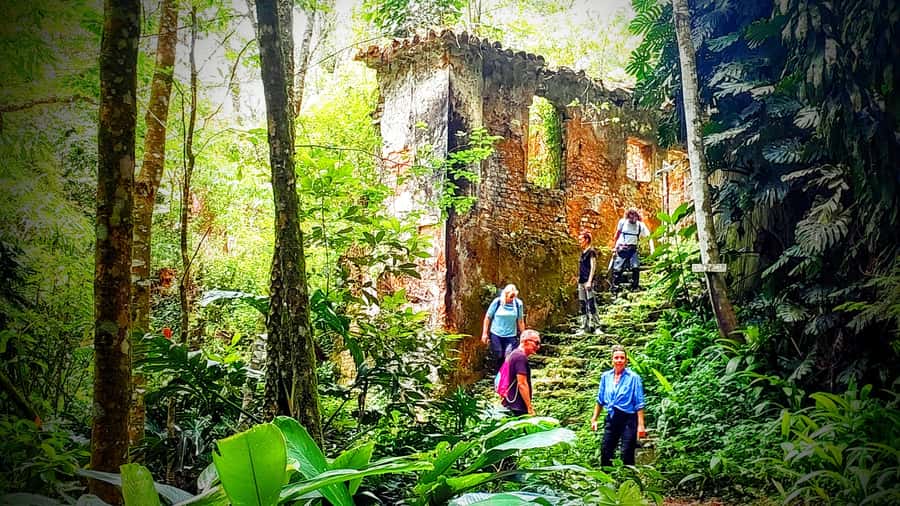
Capela Mayrink is a small chapel dating from 1850. The stop is brief, about five minutes, but it adds a human scale to the forest. Its presence makes clear that Tijuca was once a managed agricultural area, not untouched rainforest.
From here, the route settles into a proper forest walk. You will climb and descend on uneven ground, with pauses at points of interest. The walk is not technical, but roots, rocks, damp surfaces, and changes in slope require steady footing.
The old coffee plantations are an important part of the tour’s story. The forest that surrounds you is the result of replanting and long-term recovery. Your guide may connect this process to Brazil’s economic past, the use of enslaved labor, and Rio’s need to protect its water sources.
That wider context is one of the strongest features of the outing. Tito has been praised for explaining the history of both Brazil and Rio, while Riccardo and Renata are often noted for making the information accessible without turning the walk into a classroom lecture.
Suspension bridge, eucalyptus grove, and forgotten remains
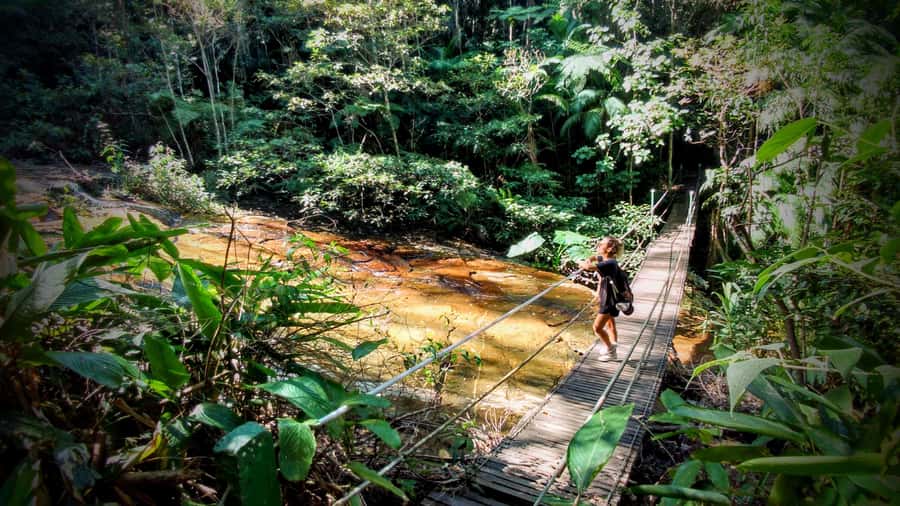
Cova da Onça includes a suspension bridge and another short section of trail. The bridge adds a small bit of adventure, but it is not the main challenge of the day. The bigger test is the repeated uphill and downhill walking.
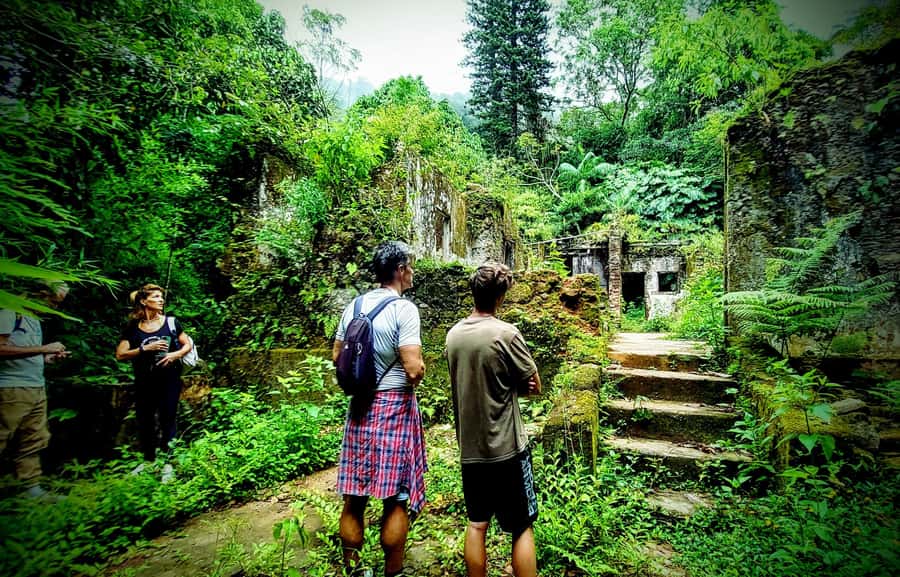
The Eucalyptus Forest brings another layer of history. An old slave cemetery is located in this area, a quiet reminder that the plantations depended on forced labor. This can be a sobering stop, and it gives the route more substance than a series of waterfalls and photo points.
There are also old structures and remnants connected with the former coffee-farm estates. At one point, you pass the former residence of Barão d’Escragnolle, once one of the park’s managers. The building is now associated with Esquilos restaurant, so you see how the forest’s old administrative and plantation sites have been reused.
A small fountain called the Wallace Fountain also appears along the circuit. It was a gift from English philanthropist Richard Wallace to Brazil and was made in France in 1870. Its figures represent goodness, charity, sobriety, and simplicity. It is an easy detail to miss without a guide.
More Walking and Hiking Trips in Brazil:
- Antalya: Hiking in Termessos Ancient City
★ 5.0 · 152 reviews - Nepal Discovery Tour: Heritage Sites & Scenic Hill Easy Hike
★ 5.0 · 121 reviews - PRIVATE LeMorne Mountain Picturesque Hike-UNESCO Recognised
★ 4.9 · 51 reviews - Private Pre-Pyrenees Medieval Village Hike from Barcelona
★ 5.0 · 39 reviews
Morcego’s Grotto, Brazil’s largest gneiss cave
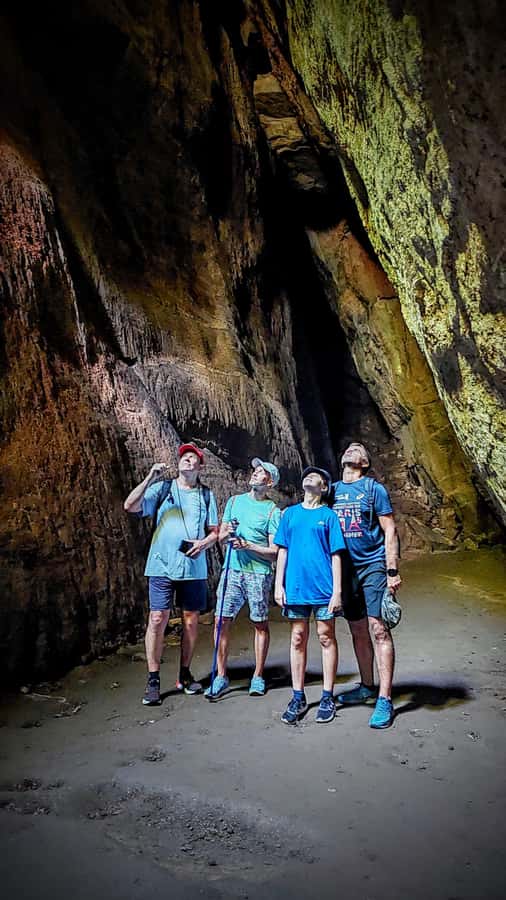
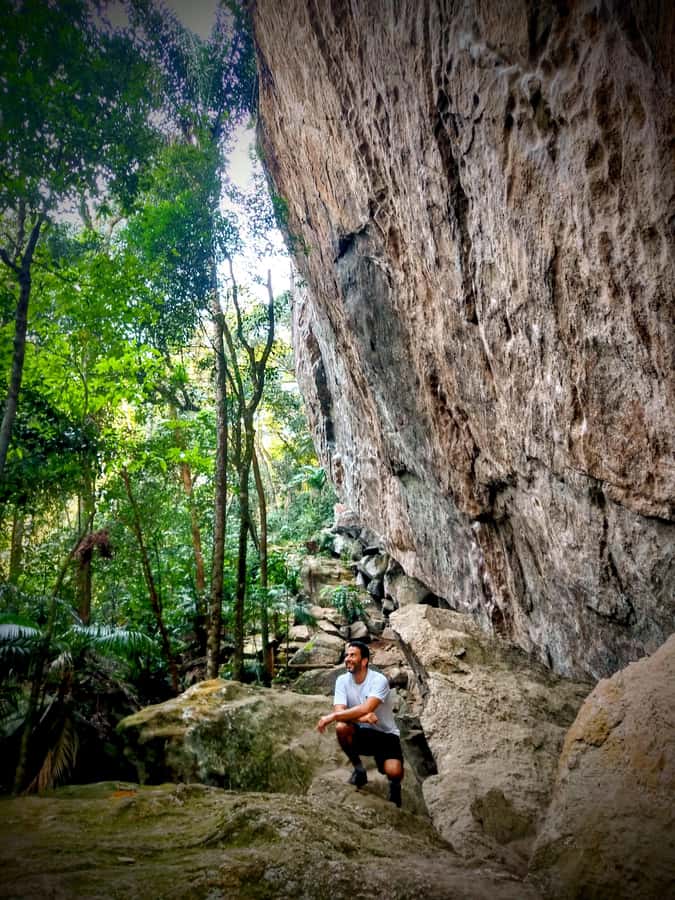
The Bat Cave, or Morcego’s Grotto, is one of the route’s most unusual stops. It is described as the largest gneiss cave in Brazil, and you reach it on foot as part of the forest circuit.
Expect a short visit rather than a long underground expedition. The cave is a natural feature, not a polished tourist attraction. You may see bats, but you may also see none. On some visits, the bats are resting, and the right thing is to leave them undisturbed.
The cave is also a useful geology lesson. Gneiss is a hard metamorphic rock, and the cave helps show how Rio’s hills were shaped over long periods. If you enjoy physical places that carry a story, this stop is more rewarding than simply taking another waterfall photograph.
The route includes a secret stop and additional photo points, though the exact details are not specified. That means the guide may adapt the walk to conditions, group pace, or what is worth seeing that day.
Baronesa Cascade and the welcome waterfall shower
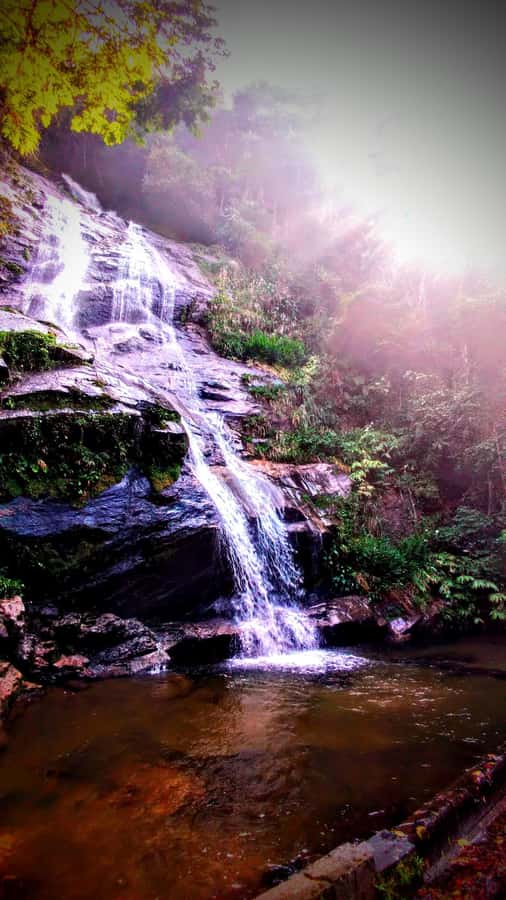
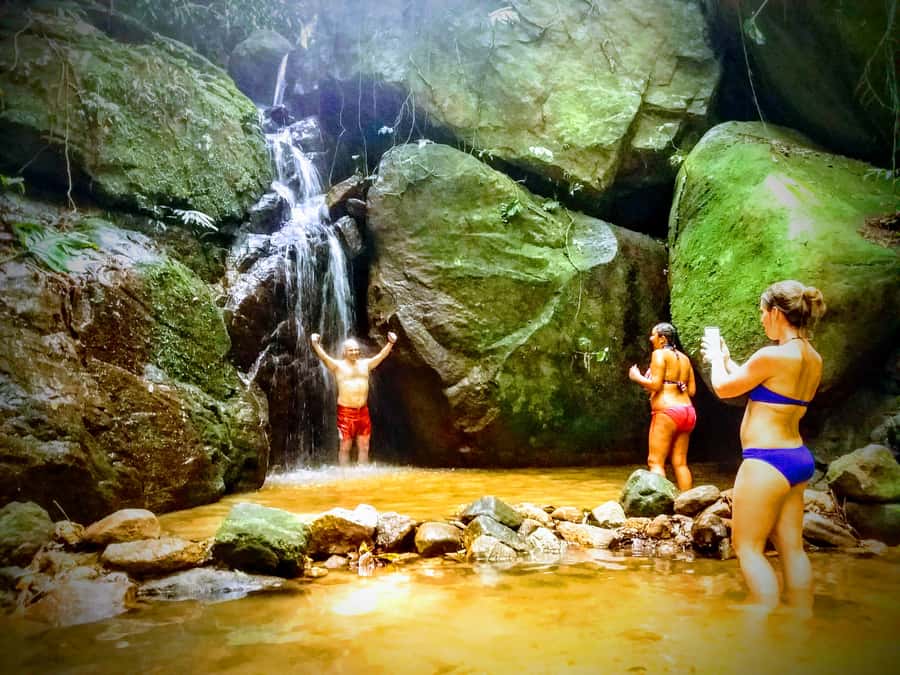
Baronesa Cascade is the route’s main cooling stop. After the climb and the uneven trail, the chance to stand beneath the falling water is a simple but memorable pleasure.
Bring a change of clothes or wear quick-drying sportswear if you want to get properly wet. The supplied information confirms a waterfall shower, but it does not promise a large swimming pool or a long bathing period. Treat it as a refreshing break, not a beach substitute.
The waterfall comes relatively late in the walk, which makes its position work well. You have already seen the chapel, ruins, bridge, cemetery, cave, and older forest paths. The water gives you a physical reward at the point when your legs may need one.
Conditions can vary with weather. Rain may make trails wetter and more slippery, while a dry period can reduce the force of smaller cascades. One guide has carried ponchos for rainy conditions, but you should still bring suitable clothing and shoes.
Palmira viewpoint and the ride back
After Baronesa Cascade, the trail turns back toward the starting point. The return includes Mirante da Palmira and another viewpoint, where you may get wider views through or above the trees.
The route is not built around one grand panorama. Its appeal comes from the mix of forest, water, rock, history, and small discoveries. If your ideal hike requires a sweeping city view every few minutes, this may feel restrained. If you enjoy a trail that reveals details gradually, it works well.
The final transfer returns you to your designated hotel or drop-off point. The transport is short enough that most people accept a compact van, though taller passengers may find the seating cramped. One useful improvement would be clearer vehicle information before pickup, such as the vehicle model or license plate.
How hard is the 6.2-kilometer hike?
The operator labels the walk moderate, and that is the safest way to approach it. You need good fitness for roughly three hours on rainforest terrain, with a 448-meter climb. You do not need to be an advanced hiker, but you should be comfortable with sustained uphill walking.
The route can feel easy to one person and demanding to another. Several people have described it as manageable, while at least one person found a steep section harder than expected. The group pace and the guide’s attention matter here. Tito, Gustavo, and others have been praised for keeping a steady pace and helping people through the tougher sections.
Wear sports shoes with a secure grip. Bare feet are not allowed, and sandals are a poor choice for rough or wet ground. Keep your daypack light. Large luggage is not permitted, and there is no reason to carry anything beyond water, snacks, sun protection, insect repellent, and a dry layer.
The forest is often cooler and shadier than the city, but you still need water. Food and drinks are not included, so pack enough for the hike. Heart conditions and wheelchair use are listed as reasons this activity is unsuitable.
Wildlife, plants, and realistic expectations
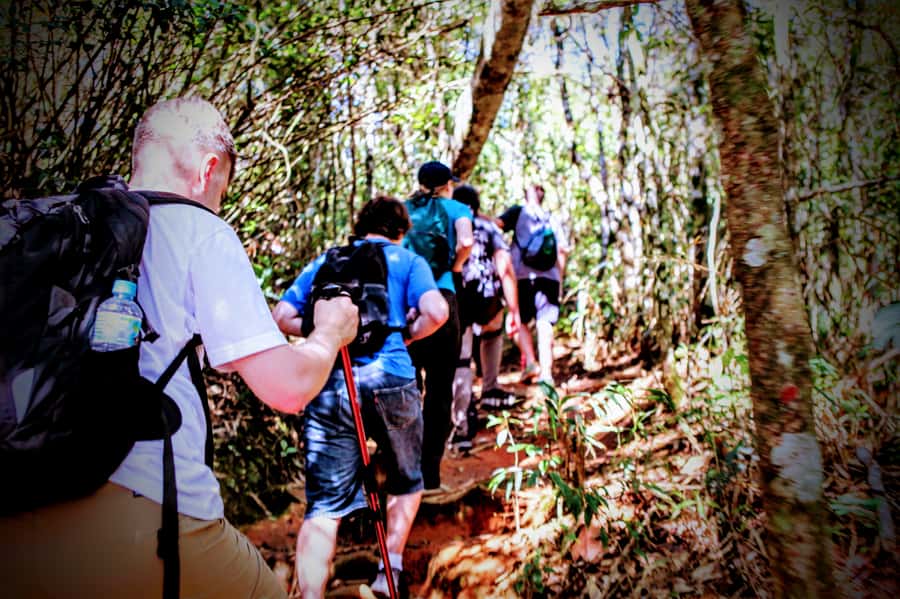
Tijuca is a rainforest, but this is not a wildlife-spotting safari. You might see capuchin monkeys, coatis, sloths, or other animals, but you might also see none. Sightings depend on timing, weather, noise, and luck.
Some people have spotted a sloth from the vehicle, while others have seen coatis and capuchin monkeys on the trail. Many walks focus more on plants, trees, rock, and forest ecology. That is not a weakness, but you should book this for the whole forest experience rather than for a guaranteed animal encounter.
The guides are a major part of the nature side of the tour. They can explain what you are seeing and help you notice details that would be easy to pass by. Luiza brings botanical training, while other guides have strong backgrounds in local wildlife, geography, and Brazilian history.
Small groups, language, and the $69 price
At $69 per person, the tour offers good value if you want transport, a bilingual guide, insurance, and a structured route through several parts of Tijuca. A private car, park orientation, and three hours of guided walking would cost more if arranged separately.
Small groups are especially useful here. A guide can adjust the pace, answer questions, and stop when someone needs a breather. The advertised format allows private or small-group bookings, and groups may be as small as a handful of people.
English and Portuguese are available. The strongest value comes from the guide commentary. If you only want to walk beneath trees, you could seek out a simpler park visit. If you want to understand the old plantations, replanting project, cave geology, and relationship between Rio and the forest, the guide adds real worth.
Free cancellation up to 24 hours before the start and reserve-now, pay-later booking make the activity easier to fit around changing plans. Pickup and drop-off are included only from designated South Zone locations, and outlying transport is not included.
Who should book this Tijuca Forest walk?
I would choose this tour if you want active time in nature but do not want to organize transport, routes, and park history yourself. It suits visitors who enjoy a moderate workout, shaded forest, waterfalls, caves, old structures, and a guide who talks about Brazil beyond the usual postcard sights.
It is also a good choice for a first visit to Tijuca. The circuit covers several distinct features in one half-day and gives you a clearer sense of the park’s scale and past.
I would think twice if you dislike steep climbs, wet trails, compact vehicle transfers, or uncertain wildlife sightings. It is not suitable for wheelchair users or people with heart problems, and the elevation gain should not be treated as a minor footnote.
Should you book it?
Book this Tijuca Forest hike if you want a well-organized introduction to Rio’s rainforest with plenty of context. The combination of Morcego’s Grotto, Mayrink Chapel, old plantation traces, waterfalls, and a bilingual guide gives you far more than a short walk to a single viewpoint.
The best reason to go is the guide-led interpretation. Vini, Riccardo, Tito, Renata, Pietro, Gustavo, and Luiza are among the guides associated with especially strong experiences, though your assigned guide can vary. Pack water, snacks, repellent, proper shoes, and a willingness to climb. If you do, $69 is a fair price for an active, informative half-day away from Rio’s beaches.
FAQ
How long does the Tijuca Forest tour last?
The full activity lasts about six hours, including hotel transport, stops, and the hike. The walking portion takes approximately 2.5 to 3 hours.
How far is the hike?
The route is 6.2 kilometers, or about 3.8 miles, with approximately 448 meters, or 1,469 feet, of elevation gain.
Is the hike difficult?
It is rated moderate and requires good fitness for rough rainforest terrain, uphill sections, and downhill walking. Some people find it fairly easy, but others may find the steep sections demanding.
Is hotel pickup included?
Pickup and drop-off are included from designated hotels and hostels in parts of Rio’s South Zone, including Copacabana, Ipanema, Leblon, Leme, Flamengo, Santa Teresa, Gloria, Catete, Urca, and Botafogo. If your address is not covered, a nearby meeting point may be offered.
What languages does the guide speak?
The tour is available with a live guide in English or Portuguese.
Does the tour include food and water?
No. You need to bring your own food, snacks, water, and other drinks.
Can I swim under the waterfall?
The tour includes a waterfall shower at Baronesa Cascade. You can cool off beneath the water, but the supplied information does not promise a swimming area or a set bathing time.
What should I bring?
Bring water, food or snacks, sunscreen, insect repellent, sports shoes, sportswear, and a small daypack. Large bags, luggage, pets, alcohol, drugs, and bare feet are not allowed.
Just added around Brazil
- Scenic Train ride to historical cities of Morretes and Antonina★ 4.0 · 188 reviews
- Germanic Route – Cultural and historical in Ilhota, Blumenau and Pomerode★ 4.5 · 67 reviews
- Rio: Historical Walking Tour★ 4.7 · 32 reviews
- Rio: Olympic Boulevard, Museum of Tomorrow & History Tour★ 4.1 · 47 reviews
- Rio de Janeiro: Historical Downtown and Lapa Walking Tour★ 4.4 · 32 reviews
- Salvador Historic Walking Tour – Pelourinho★ 4.8 · 62 reviews
- From Foz do Iguazu: Triple Frontier Landmark Ticket★ 4.4 · 136 reviews
- Florianópolis: Historical Center, Beach & Nature Tour★ 3.3 · 25 reviews
Rio de Janeiro History Tours, compared.

Rio de Janeiro: Historic Rio and Santa Teresa Half-Day Tour
Read our review →
Rio de Janeiro: Little Africa Heritage Walking Tour
Read our review →
Ancient Rio and Santa Teresa Tour with Hotel pick-up and drop-off
Read our review →
Rio: Olympic Boulevard, Museum of Tomorrow & History Tour
Read our review →
Rio de Janeiro: Historical Downtown and Lapa Walking Tour
Read our review →
Browse the lists this tour appears in