
Review · GERMANY
Lübeck: Hanseatic League History Walking Tour
Lübeck’s story comes alive in its brick streets, old harbor, and narrow lanes, where merchant power shaped Northern Europe for centuries. This private walk traces the Hanseatic League from the Holsten Gate to the Hospital of the Holy Spirit, linking grand landmarks with tucked-away courtyards.
I like the small private-group format, which lets your guide adjust the pace and follow your interests. I also like the tidy 90-minute route: you see major sights such as St. Mary’s Church and the Rathausmarkt without giving up half a day. The main consideration is price. At $259 for up to six people, it makes the most sense for a full group, not a solo visitor.
Key points at a glance
- Start at the Holsten Gate: Begin beside Lübeck’s famous brick fortification and learn why this city controlled key routes into the Baltic trade.
- Follow the old commercial spine: Walk past the salt storehouses and Trave Harbour, then continue along Große Petersgrube, one of Lübeck’s oldest streets.
- See the model for Baltic churches: St. Mary’s Church helps explain how Lübeck’s architecture influenced other Hanseatic cities.
- Connect trade with daily life: Buddenbrook House and the Schiffergesellschaft guild hall show the city beyond ships and cargo.
- Look into traditional courtyards: The route ends at the Hospital of the Holy Spirit, with a chance to see one or two quiet backyards.
- Choose a guide-led pace: English and German tours are available, and guides such as Bernd, Karin, and Chris have been praised for clear explanations and flexibility.
Why Lübeck is the right place to learn about the Hanseatic League
The Hanseatic League was not a single kingdom or tightly managed company. It grew from links between North German merchants who wanted safer, more reliable trade connections, then developed into a confederation of cities.
At its height, the network included about 300 maritime and inland cities across Northern Europe, stretching from Riga to Bruges. That scale can sound abstract in a museum display. In Lübeck, you can connect it to real streets, churches, warehouses, guild halls, and waterways.
The city’s location helped make it powerful. Lübeck sits on the Trave River, with access toward the Baltic Sea. Its merchants could move goods between inland markets and ports, while the city’s walls, institutions, and trading partnerships supported that commercial life.
I find this route useful because it does not treat the Hanseatic League as a list of dates. You move through places that explain how the system worked. The harbor points to shipping, the salt storehouses point to valuable cargo, the guild halls point to professional networks, and the churches point to the money and influence generated by trade.
More History Walking Tours in Germany
- Berlin: Third Reich & Cold War Guided Walking Tour
★ 4.9 · 8,378 reviews - Munich: Third Reich & WWII Walking Tour
★ 4.6 · 6,181 reviews - Berlin’s Best: 2 Hour Walking Tour Third Reich and the Cold War
★ 5.0 · 5,486 reviews
Starting beneath the Holsten Gate
Meet your guide at the Holsten Gate, Lübeck’s best-known entrance and a fitting start for a city-history walk. The gate was one of four fortification gates at this wall passage alone, a reminder that Lübeck was once a defended commercial center rather than simply a pretty old town.
The gate gives you an immediate sense of the city’s traditional brick architecture. Its heavy form also sets up a useful question for the tour: what did Lübeck need protection from, and why was this city worth defending?
This is an easy meeting point to identify, but you should still arrive with a little time to spare. The tour does not include transfers, and you are expected to meet the guide there rather than at a hotel or transport stop.
From the gate, the route moves toward the salt storehouses and the Trave Harbour. These early stops help explain the practical side of Hanseatic commerce. Salt was an important trading product, and the harbor was the working link between Lübeck and the wider Baltic network.
You will not spend the entire 90 minutes in one grand square. The appeal is the change in setting: fortifications give way to warehouses, then to streets and religious buildings. That variety keeps the walk moving.
From salt storehouses to the Trave Harbour
The Trave Harbour brings the League’s purpose into focus. Merchant associations needed dependable sea connections, and Lübeck’s position made it a natural meeting point for goods, ships, and people.
At the harbor, your guide can place the city in its wider Northern European setting. The Hanseatic network linked ports and inland towns, so Lübeck’s importance was not limited to its own waterfront. Its influence reached along trading routes toward cities such as Riga and Bruges.
This part of the walk is especially useful if you prefer seeing history in its working setting. A church can show wealth and artistic ambition, but a harbor shows why the wealth existed in the first place.
The route is still a walking tour, not a harbor cruise, so you should expect explanation rather than a boat ride. Food and drinks are also not included. If you want a coffee or snack, plan to do that before or after the tour rather than expecting a scheduled stop.
Große Petersgrube and Lübeck’s brick streets
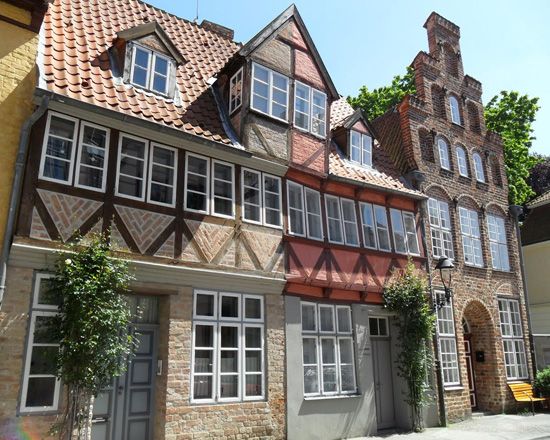
The walk continues along Große Petersgrube, one of Lübeck’s oldest streets. Here the tone changes from large civic landmarks to close-up views of traditional buildings.
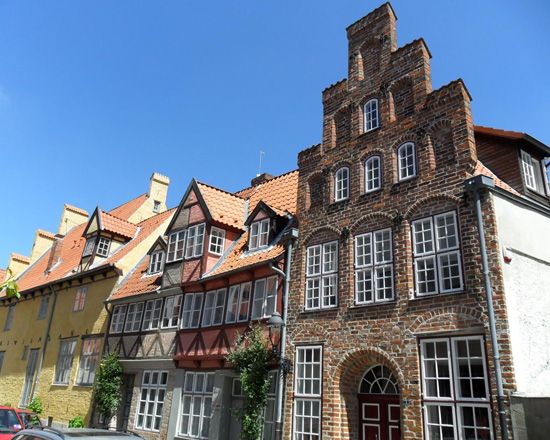
Look for the old brick construction and stepped gables. These shapes are part of the visual language of North German trading towns, and they make Lübeck feel distinct from cities built mainly in stone or plaster.
This is one of the places where a guide adds real value. You can walk past an old facade on your own and admire its shape. A guide can connect the building style to the city’s trade, social structure, and place within the Baltic world.
The street also shows why comfortable shoes matter. The tour covers historic streets and narrow lanes over 90 minutes. The distance is described by one guide as a good balance of time and walking, but this is still an active city walk rather than a seated talk.
You will have time to look up at the buildings, but the schedule is compact. If photography is your main goal, you may need to choose a few key spots instead of stopping at every facade.
Same city, a different century:
- Leipzig: City History Canal Sightseeing Tour on a Motorboat
★ 4.7 · 7,671 reviews - Third Reich Berlin: Hitler and WWII Walking Tour
★ 5.0 · 3,301 reviews - Leipzig: 1.5-Hour Historical Walking Tour in German
★ 4.7 · 2,217 reviews - Nuremberg: Medieval Dungeons Guided Tour
★ 4.8 · 2,214 reviews
St. Mary’s Church and Lübeck’s architectural influence
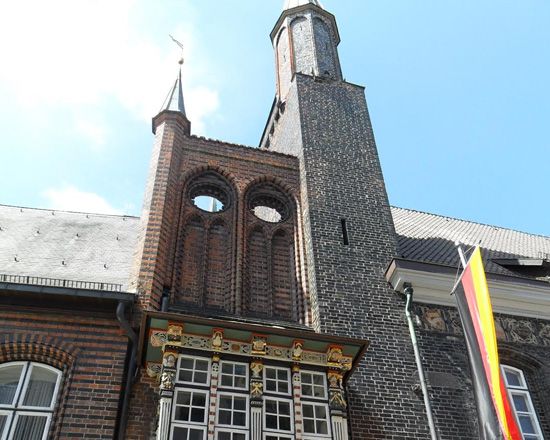
St. Mary’s Church is one of the major landmarks on the route. It was used as a model for numerous churches in Hanseatic cities around the Baltic region, giving it importance beyond Lübeck itself.
That makes this stop more than a quick photo opportunity. The church helps show how Lübeck exported cultural influence along with goods and business practices. A successful trading city did not only send ships outward. Its building ideas, religious institutions, and civic habits also traveled.
You can expect your guide to explain the church’s place in the Hanseatic world rather than simply point out its exterior. The supplied tour details do not promise entry inside, so you should think of this as a guided city stop, not a guaranteed interior visit.
St. Mary’s also gives the itinerary a useful contrast. The harbor and storehouses explain commerce, while the church shows how commerce shaped public and religious life. The route keeps returning to that relationship between money, power, and the city’s appearance.
Rathausmarkt and the civic center
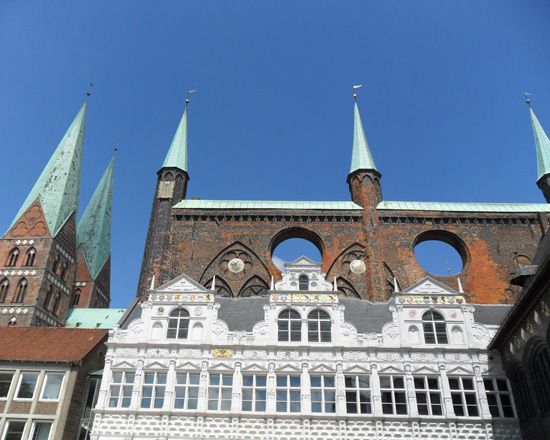
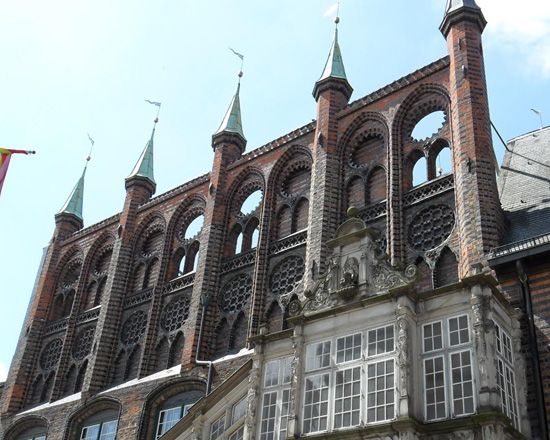
The Rathausmarkt square brings you into Lübeck’s civic heart. The City Hall is among the key sights named for the tour, and the square helps explain how merchant wealth became civic authority.
The Hanseatic League was built through trade, but its cities still needed rules, councils, public buildings, and local institutions. A stop around the Rathausmarkt gives your guide a natural place to discuss how a commercial city governed itself.
I appreciate this sort of context because it keeps the tour from becoming a parade of facades. Lübeck’s old town is attractive, but the useful question is always what each place tells you about city life.
The 90-minute length means the guide must keep the story moving. You will receive a focused introduction to Lübeck and the Hanseatic League, not a full course in every period of the city’s past. If you want detailed coverage of the Reformation, World War II, or modern Lübeck, you would need a different tour or extra time in the city.
Buddenbrook House and the world of Lübeck’s merchants
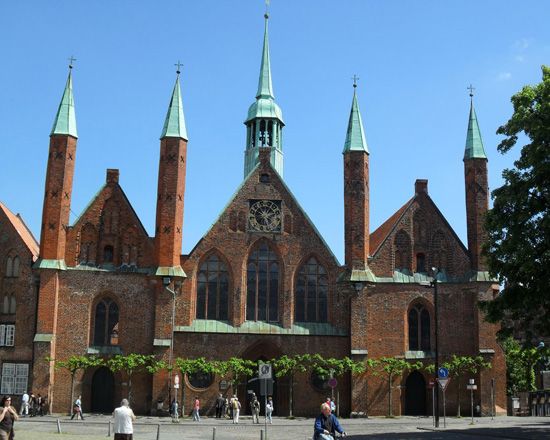
The route passes Buddenbrook House, associated with the Mann family. This stop adds a literary and domestic layer to the tour.
The Hanseatic story is often told through ships, merchants, and city councils. Buddenbrook House points toward the families who lived within that commercial society and the cultural memory it later produced.
It is a helpful reminder that historic Lübeck was not only a collection of public buildings. People worked, built families, formed social ties, and created reputations within these streets.
The tour does not include a museum visit or admission, so you should not expect an extended examination of the Mann family inside the house. Instead, the building works as part of the walking route, linking Lübeck’s mercantile past with its literary identity.
The Schiffergesellschaft guild hall
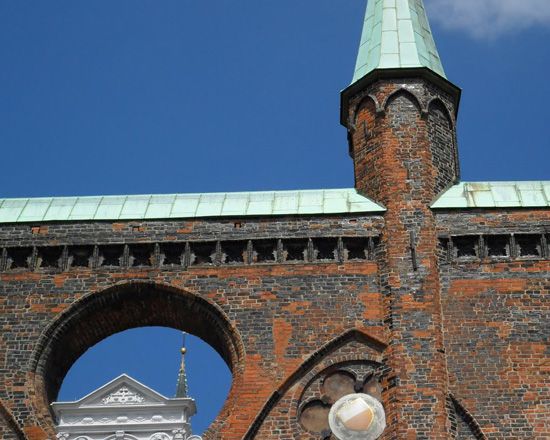
One of the most evocative stops is the Schiffergesellschaft guild hall, where sailors of the Hanseatic League used to stop. The building connects the large idea of a trading network with the people who worked on the ships.
Guild halls mattered because trade relied on relationships, rules, and mutual support. The Hanseatic League may have linked hundreds of cities, but its daily operation depended on smaller groups of merchants and sailors meeting, negotiating, and maintaining trust.
This stop should appeal to you if you enjoy social history more than a simple list of dates. It helps put human faces on the League’s commercial system, even if the tour cannot cover every part of guild life in detail.
As with the other buildings, the stated itinerary does not promise entry. You should expect to see the hall and hear about its role, with the main experience taking place on the streets.
Ending at the Hospital of the Holy Spirit
The tour finishes at the Hospital of the Holy Spirit, described as one of Lübeck’s oldest social institutions. This is an interesting ending because it broadens the story beyond trade and architecture.
A medieval or early modern city needed places to care for vulnerable people. The hospital shows how Lübeck’s civic life included social institutions as well as markets, churches, defenses, and guilds.
The final stop may also include a look into one or two traditional backyards. These quieter spaces are a fine counterpoint to the Holsten Gate and Rathausmarkt. They offer a closer look at the city’s lived-in side, where the old town feels less like a postcard and more like a network of small domestic spaces.
The courtyards are one of the route’s more appealing details. If you specifically enjoy old lanes and tucked-away architecture, tell your guide early. Bernd, in particular, has been praised for responding to requests to see courtyards, and Karin has been noted for offering ideas about what to do after the official walk ends.
How the guides shape the experience
This is a private group tour with live guiding in English or German. The group can include up to six people, which is a strong size for a conversation-based walk.
The guide names associated with recent departures include Bernd, Karin, and Chris. Bernd has been described as energetic, entertaining, and able to adjust the route to requests. Karin has been praised for explaining the city clearly and sharing useful ideas for independent sightseeing afterward. Chris has also received strong marks for teaching visitors about Lübeck.
No guide can guarantee the same personality or exact emphasis on every departure. Still, the format gives you a good chance to ask questions, request more courtyards, or slow down briefly at a particular building.
The short length makes a clear guide especially important. In 90 minutes, you cover major landmarks, a harbor area, an old street, a church, a literary building, a guild hall, and a hospital. You need someone who can give enough context without turning every stop into a lecture.
Is $259 good value for a private group?
The price is $259 per group of up to six. If six people join, that works out to about $43 per person. For two people, it is about $129.50 each, and for one person the full private-group price is a major expense for a 90-minute walk.
That makes the tour a better value for families, friends, or a small business group traveling together. A company group has already used the walk as part of a meeting, and the format can work well when you want one shared introduction to the city rather than separate tickets or individual audio guides.
The value comes from the private setting and guide attention, not from included extras. Transfers, food, and drinks are not included. There is no stated museum admission, cruise, or meal.
If you are traveling alone and mainly want a basic orientation, the price may be hard to justify. If six people want a focused introduction, the per-person cost becomes more reasonable, especially since you can ask questions and shape the emphasis.
You can cancel up to 24 hours before the tour for a full refund, and you can reserve now and pay later. Those terms help if your route through northern Germany is still changing, but they do not alter the basic value calculation.
Who should book this Lübeck walk?
I would recommend it most to first-time visitors who want a clear introduction to Lübeck’s old town and Hanseatic role. It also suits anyone who likes architecture, urban history, merchant stories, and short walks that connect several kinds of places.
Families and mixed-age groups may appreciate the 90-minute format. You see a lot without committing to a long day, and a private guide can adjust explanations to the group.
It is also a sensible choice for a business gathering or a small group with limited free time. The route gives everyone a shared sense of place, and the ending at the Hospital of the Holy Spirit leaves you positioned to continue exploring.
I would hesitate if you want extensive interior visits, a food component, or a very long examination of Lübeck’s past. This is a compact overview, with the main focus on streets, exteriors, public spaces, and guided storytelling.
Should you book it?
Book this walk if you have up to six people, want a private guide, and would like Lübeck’s Hanseatic story explained through the places where it happened. The best parts are the route’s variety, the old brick streets, the harbor connection, and the chance to ask for details such as courtyards.
Think twice if you are alone, watching every euro, or planning to spend most of your time inside museums. For a small group that wants a strong first look at Lübeck in 90 minutes, the price can make sense. The high 4.9 rating from 57 bookings also points to a consistently well-received experience, with guide clarity, flexibility, and the amount covered in a short time receiving the strongest praise.
FAQ
Where does the Lübeck Hanseatic League walking tour begin?
The tour begins at the Holsten Gate in Lübeck.
Where does the tour end?
The route ends at the Hospital of the Holy Spirit.
How long is the tour?
The walking tour lasts 90 minutes.
How many people can join the private group?
The price covers a private group of up to six people.
What languages are available?
The live tour is available in English and German.
What sights are included on the route?
The route includes the Holsten Gate, Trave Harbour, the salt storehouses, Große Petersgrube, St. Mary’s Church, Rathausmarkt and the City Hall, Buddenbrook House, the Schiffergesellschaft guild hall, and the Hospital of the Holy Spirit.
Are food and drinks included?
No. Food and drinks are not included.
Are transfers included?
No. Transfers are not included, so you should make your own way to the Holsten Gate.
Can I cancel the tour for a full refund?
Yes. You can cancel up to 24 hours in advance for a full refund.
Just added around Germany
- Berlin Food & Cultural Tour: Must-Try German & Berliner Classics★ 5.0 · 51 reviews
- Berlin Half-Day World War II Walking Tour★ 4.5 · 48 reviews
- Berlin Cold War & World War II Third Reich Walking Tour★ 4.5 · 30 reviews
- Small-Group Historical Bike Tour in Berlin★ 4.5 · 103 reviews
- Historic center of Berlin – Tour in Italian★ 5.0 · 143 reviews
- Private Taxi Tour City East & West History and Architecture 3-4h★ 5.0 · 42 reviews
- Berlin Wall and Cold War Bike Tour in Small Groups★ 5.0 · 114 reviews
- Private Tour: Jewish Heritage Walking Tour of Berlin★ 5.0 · 29 reviews
Germany History Tours, compared.

Berlin: Third Reich & Cold War Guided Walking Tour
Read our review →
Leipzig: City History Canal Sightseeing Tour on a Motorboat
Read our review →
Berlin’s Best: 2 Hour Walking Tour Third Reich and the Cold War
Read our review →
Third Reich Berlin: Hitler and WWII Walking Tour
Read our review →
Leipzig: 1.5-Hour Historical Walking Tour in German
Read our review →
Berlin: Third Reich, Hitler, and WWII Walking Tour
Read our review →Browse the lists this tour appears in