Review · ATHENS
Small-Group Women History in Ancient Greece Walking Tour
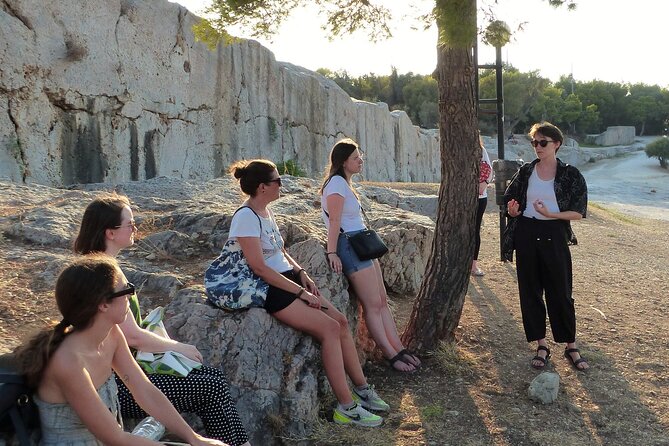
Ancient Athens is often told through male philosophers, generals, and lawmakers. This walking tour changes the angle. With guide Maelle, you follow the stories of women who lived within strict limits, along with those who pushed against them, from Athena and Penelope to Aspasia, Sappho, and Agnodice. The result is a more human picture of the ancient city.
I like two things right away. The subject is unusually focused, so it adds something new if you have already seen the Acropolis or taken a standard Athens walk. I also like the route itself: nine stops connect myths and real lives to actual places, ending on Philopappos Hill with a view toward the Acropolis.
The main drawback is practical. This is a walking tour with several uphill sections, and it is not recommended if you have mobility issues. You also see the Ancient Agora from outside rather than entering it, so this is about interpretation and storytelling, not archaeological-site admission.
Key points to know before booking

- Women take center stage: Learn about marriage, education, work, politics, slavery, courtesans, festivals, and mythology.
- Maelle leads the walk: Her warm, inclusive style and clear preparation are praised throughout the supplied feedback.
- A small group helps: The maximum is 12 people, giving you a better chance to ask questions.
- The route crosses central Athens: Begin at Monastiraki and finish on Philopappos Hill after passing Hadrian’s Library, the Agora, Areopagus, and Pnyx.
- No site admissions are included: The historic locations provide the setting, but the Ancient Agora is viewed from outside.
- The finish is scenic: Philopappos Hill gives you a strong Acropolis view and easy access back toward central Athens.
Why this women’s history walk adds something new
A conventional ancient Athens tour can leave you with temples, battles, male citizens, and the birth of democracy. Those subjects matter, but they do not tell you how most women lived. This walk asks different questions: Who could receive an education? What did marriage mean? Who could enter public spaces? What happened to women who worked outside the home?
That change in focus is the tour’s main strength. You are not simply hearing a list of famous women. You are also learning about women whose names were never recorded, including wives, female slaves, courtesans, and women whose lives were shaped by laws made by men.
The stories include mythological figures such as Athena, Penelope, and Pandora. They also reach into the lives of Sappho, Aspasia, and Agnodice, women associated with poetry, public influence, philosophy, and medicine. Myth and documented history are placed side by side, giving you a useful way to compare the ideals ancient Greeks created with the lives women actually had.
I especially like that the tour does not pretend ancient society was fair. One supplied comment describes women’s situation as a bad deal, which is blunt but fitting. The value is in seeing both the restrictions and the ways women found room to act within them.
More Ancient History Tours in Athens
- Athens: Acropolis & up to 5 Archaeological Sites Combo Pass
★ 4.2 · 13,904 reviews - Athens: Ancient Greek Theater Performance
★ 4.7 · 2,481 reviews - Historical Delphi One Day Tour with Arachova Stop & Expert Guide
★ 4.5 · 1,247 reviews
Monastiraki begins the story in modern Athens

The meeting point is Pl. Monastirakiou 2, on Monastiraki Square. This is a practical place to start because it is central and close to public transportation. You meet Maelle there before setting out on foot.
The opening stop lasts about 10 minutes. It is not a major sightseeing visit in itself, but it gives the group a clear starting point and lets Maelle frame the walk. You begin in one of Athens’s best-known public spaces, then move into questions about who was allowed to take part in public life in ancient times.
For a first Athens activity, this starting point works well. It is easy to reach and places you close to several other sights. If you are joining after a morning at the Acropolis, allow enough time to cross the center and find the square.
Hadrian’s Library and the question of education
At Hadrian’s Library, you spend about 10 minutes learning about the education of girls and women in ancient Athens. The location adds a useful contrast. A library naturally brings up books, learning, and access to ideas, but education was not equally available to everyone.
This stop helps you avoid a common mistake: assuming that the ancient world had one single experience for all women. Life differed by city, class, legal status, and family position. The tour compares different kinds of women rather than treating them as one group.
The stop is also short, so expect a focused explanation rather than a full lesson on ancient education. If you enjoy asking questions, the small group should make it easier to pause briefly and ask Maelle for clarification.
Marriage, Eros, and two different Greek societies
The Holy Church of the All-Great Taxiarchs and the Virgin Mary Gregorousa provides the setting for a 15-minute discussion of marriage in ancient Athens and Sparta. You also hear about Eros, the passionate form of love.
This is one of the more useful parts of the walk because marriage is often reduced to a simple social arrangement. Here, you consider what marriage meant in two different Greek societies and how ideas about love fit, or failed to fit, into that arrangement.
The Athens and Sparta comparison helps keep the subject from becoming too general. Ancient Greece was not a single country with one standard set of customs. The route makes that clear while keeping the focus on women’s choices and limits.
Do not expect to enter the church as part of the experience. The stop is a street-based talk, with the surrounding location serving as a marker on the route.
More Ancient History Tours in Greece
- From Athens: Ancient Corinth Day Trip with Canal & VR Guide
★ 4.6 · 1,073 reviews - Acropolis, Parthenon & Athens Old City Heritage Walking Tour
★ 4.5 · 876 reviews - Private Biblical Tour Ancient Corinth & Isthmus Canal from Athens
★ 5.0 · 762 reviews - Athens: Ancient Corinth & Nafplio Full Day Trip with Swim
★ 4.8 · 531 reviews
Athena and the realities of married life
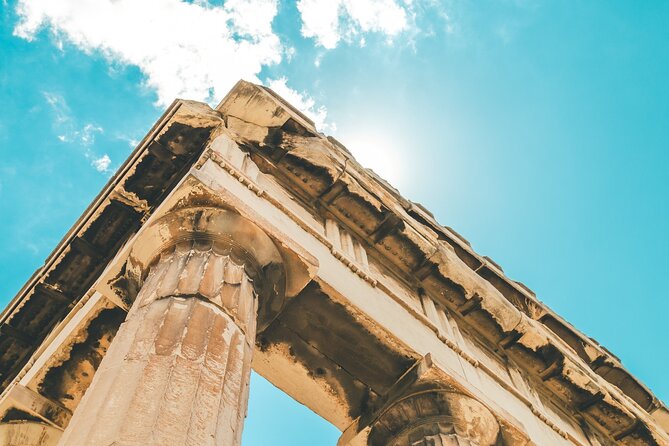
At the Gate of Athena Archegetis, the tour spends around 15 minutes on married life in ancient Athens and Sparta. This is also where Athena’s myths come into sharper focus.
Athena is a compelling figure for this subject. She is a powerful goddess, a symbol of wisdom and warfare, and one of the central figures in Athens. Yet the women who lived in the city did not share her freedom or authority. That contrast lets you see how mythological female power could exist beside real restrictions on women.
The stop should appeal to you if you like mythology but want more than familiar stories. Athena, Penelope, and Pandora are not treated as isolated characters. Their stories become clues to ancient ideas about loyalty, danger, intelligence, marriage, and women’s place in society.
Dioskouron and a festival for women
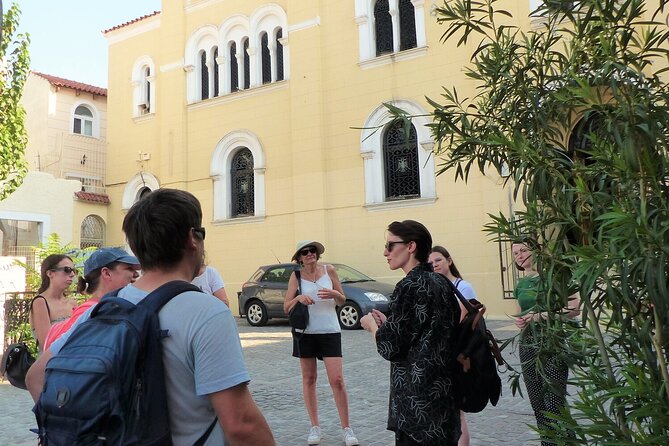
At Dioskouron, a roughly 10-minute stop introduces a mysterious ancient festival dedicated exclusively to women. This is one of the route’s more unusual details.
A festival reserved for women raises questions about community and independence. Even in a society that limited women’s public role, women could have their own religious activities, rituals, and shared spaces. The exact meaning of such events can be difficult to grasp from a standard monument visit, which is why this stop adds depth to the walk.
The presentation appears designed to give you a story to think about rather than a pile of dates. That suits the subject. You are moving through ordinary streets while considering ceremonies that once gave women a distinct role within the city.
The Agora from the outside

The Ancient Agora is the longest stop so far, at about 15 minutes. You look toward the marketplace and center of public life while learning about women in public spaces, female slaves, and courtesans.
This is a strong example of the tour’s method. The Agora was central to public life, but women did not have the same access to it as male citizens. Hearing that wives could be barred from the market and excluded from voting makes the famous democratic city look less open than its modern reputation suggests.
You also consider women whose lives did not fit the ideal of a citizen wife. Female slaves and courtesans occupied different social and legal positions, and their experiences should not be folded into one broad story about women. The stop gives you a clearer sense of how status shaped daily life.
The limitation is important: you do not enter the archaeological site. If you want to walk among the Agora ruins, you need a separate admission and more time. If you want context before visiting, the outside view works well.
Areopagus and the cost of challenging the rules
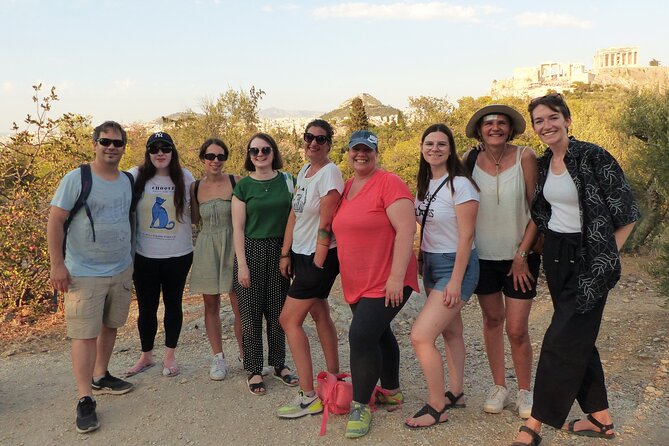
At Areopagus, Maelle discusses the place where serious offenders were tried in ancient times. The stop lasts about 10 minutes and turns toward a woman who risked a death sentence in order to change women’s rights.
This is the kind of story that gives the tour its emotional force. You are not just hearing that women had few rights. You are considering what it meant for someone to challenge that system when the consequences could be extreme.
Areopagus is also a memorable setting, with its strong connection to ancient law and judgment. The stones can be uneven, so take care as you walk. The route’s physical setting supports the subject without requiring an archaeological-site visit.
Pnyx and the limits of Athenian democracy
The Pnyx is perhaps the clearest place to discuss the limits of Athenian democracy. This is where democracy began, but only male citizens could vote. The stop lasts about 15 minutes and introduces a woman who influenced Athenian politics during the Golden Age.
That contrast is the heart of the visit. Athens created a political system that remains hugely important, but its rights were narrow. Women were excluded from voting, and most residents of the city were not full citizens either.
The discussion of Aspasia is especially useful here. She is remembered as a philosopher and as the companion of Pericles, the leading Athenian statesman. Her story complicates the simple idea that women had no influence at all. Formal political power and informal influence were not the same thing.
The Pnyx also adds a little uphill walking. You should be comfortable on foot and ready for uneven ground. The reward is a place where the political themes feel tied to the actual terrain of Athens.
Philopappos Hill ends with the best view
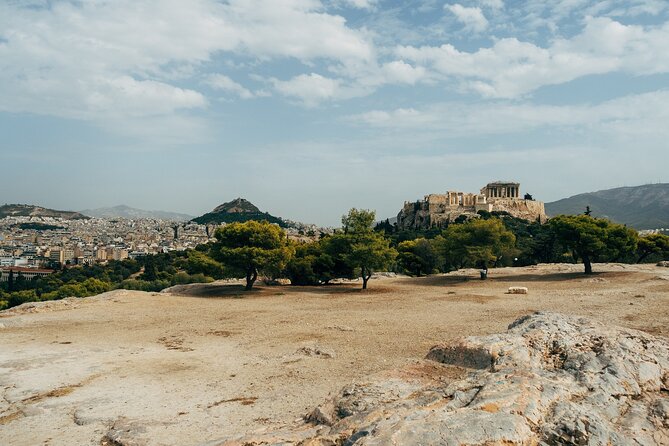
The final stop is Philopappos Hill, also known as the Hill of the Muses. After about 10 minutes here, the tour ends with a view toward the Acropolis.
This is a smart finish. The walk has dealt with limits, exclusion, and lost voices, then gives you a broad view of the city that produced those ideas. The hill has trees and a calmer feel than the central streets, making it a pleasant place to pause before heading back.
The endpoint is listed as Philopappos Hill, with access back toward the center on foot and to the metro if needed. The exact address supplied for the endpoint includes a street reference, so I would rely on the booking confirmation and the guide’s directions on the day.
How the two hours are used
The listed stop times add up to about two hours, and the tour is described as approximately two hours overall. That means the walk keeps moving. You will hear compact explanations at each location rather than spending long periods at one site.
This pace is a good fit if you have limited time in Athens or want a focused activity between larger museum and monument visits. It is less suitable if you prefer to linger, take many photographs, or explore each location independently.
The maximum group size is 12 people. That is small enough to make questions practical and should feel more personal than a large city walk. The supplied feedback repeatedly highlights Maelle’s kindness, humor, preparation, and ability to answer questions. One family specifically found the subject a good match for a 15-year-old interested in women’s rights.
Is $44.71 a fair price?
At $44.71 per person, the price is reasonable if you want a guided interpretation rather than entrance tickets. You are paying for a two-hour route, a small group, and a subject that is rarely covered in standard Athens sightseeing.
The value is strongest if you have already seen the major monuments or plan to see them separately. This walk does not replace the Acropolis, the Ancient Agora, or a museum visit. Instead, it helps you understand the society behind those places.
Every stop has free admission because the tour remains outside the archaeological sites. That keeps the cost clear, but it also means you should not book this expecting entry to the Agora or other monuments.
Who should book this Athens walk?
I would choose this tour if you enjoy social history, mythology, women’s studies, ancient politics, or tours that question the usual version of the past. It is also a smart first-day activity because it introduces central Athens and gives you themes to watch for during later sightseeing.
Families with older children and teenagers may find the subject more engaging than a long sequence of dates and architectural terms. The 15-year-old mentioned in the supplied feedback is a good example of the right audience, though interest matters more than age.
I would think twice if you have mobility issues, dislike hills, or want extensive time inside archaeological sites. Good weather is required, and poor weather can lead to a new date or a full refund. You can cancel for a full refund up to 24 hours before the start time, but later cancellations are not refunded.
Should you book it?
Book this walking tour if you want Athens told through people who are often left at the edge of the story. Maelle’s focus on women’s education, marriage, work, mythology, law, and political influence gives the route a clear purpose.
Skip it if your priority is entering ruins or covering every major monument. For everyone else, especially those who have already seen the Acropolis, this is a thoughtful way to add another layer to Athens for $44.71.
FAQ
How long is the Small-Group Women History in Ancient Greece Walking Tour?
The tour lasts approximately two hours.
Where does the tour begin?
It begins at Pl. Monastirakiou 2, Athina 105 55, Greece, in Monastiraki Square.
Where does the tour end?
It ends at Philopappos Hill, which is within walking distance of central Athens and has access to the metro if needed.
How large is the tour group?
The maximum group size is 12 travelers.
Does the tour enter the Ancient Agora?
No. The Ancient Agora is viewed from outside, and there is no entrance to the archaeological site as part of this tour.
Is the tour suitable for people with mobility issues?
It is not recommended for travelers with mobility issues. The route includes walking and reaches Philopappos Hill.
Is the tour available in poor weather?
The experience requires good weather. If it is canceled because of poor weather, you can receive a different date or a full refund.
Are service animals allowed?
Yes, service animals are allowed.
Can I cancel for a full refund?
Yes. You must cancel at least 24 hours before the experience start time for a full refund. Cancellations or changes made less than 24 hours before the start time are not accepted for a refund.
More History Walking Tours in Greece
- Private Athens: Historical Walking Tour Including the Changing of the Guard
★ 5.0 · 27 reviews - Corfu: History and Culture Walking Tour
★ 4.9 · 55 reviews - Small-group Corfu Town Historical Walking Tour
★ 5.0 · 39 reviews - Olympia’s Ancient Site and Museum Private Walking Tour
★ 4.7 · 31 reviews
More History Walking Tours in Athens
- Athens: History of Rebellion Walking Tour
★ 5.0 · 110 reviews - Ancient Athens for Kids 4-Hour Private Walking Tour
★ 5.0 · 66 reviews - Private Athens Walk: Ruins, Markets & Local Stories
★ 5.0 · 41 reviews - Athens:Acropolis – Historical Center Walking Tour in Spanish
★ 5.0 · 32 reviews
Just added around Athens
- The original Christian tour on Paul’s footsteps in Athens and ancient Corinth★ 4.5 · 25 reviews
- Ancient Athens tour: Acropolis, Parthenon and Acropolis Museum★ 5.0 · 256 reviews
- Ancient Athens Segway Tour with Agora and Kerameikos★ 5.0 · 94 reviews
- Ancient Sparta & Mystras Private Day Tour from Athens★ 5.0 · 52 reviews
- Athens National Archaeological Museum E-Ticket with Audio Guide★ 3.0 · 57 reviews
- Biblical Corinth Taste Faith & History with wine & Oil Tasting★ 5.0 · 28 reviews
- Ancient Corinth, Sanctuary of Hera, Blue Lake & Canal from Athens★ 5.0 · 26 reviews
- Half Day Historical Athens City Private Taxi Service Tour★ 5.0 · 79 reviews
Athens History Tours, compared.
Athens: Acropolis & up to 5 Archaeological Sites Combo Pass
Read our review →

Historical Delphi One Day Tour with Arachova Stop & Expert Guide
Read our review →
From Athens: Ancient Corinth Day Trip with Canal & VR Guide
Read our review →
Historic Athens: Small Group Electric Bike Tour
Read our review →
Acropolis, Parthenon & Athens Old City Heritage Walking Tour
Read our review →
Private Biblical Tour Ancient Corinth & Isthmus Canal from Athens
Read our review →