
Review · BERLIN
Charité Hospital Walking Tour: Exploring Berlin’s Medical History
Berlin’s Charité hospital is more than a handsome old medical campus. It is a place where major discoveries, painful ethical failures, wartime courage, and Cold War escape attempts all meet on the same short walk. This tour brings those stories together without asking you to spend half a day inside a museum.
I like the small group of up to 15 people, which gives the guide room to explain difficult subjects and answer questions. I also like the clear two-hour route, especially the way it links famous doctors such as Robert Koch and Rudolf Virchow with the less familiar story of life at Charité during the Third Reich and East German period.
The main limitation is that you do not go inside buildings where medical or university work is taking place. You are paying for the guide’s explanation and the outdoor sites, not for access to hospital wards, lecture rooms, or working clinical facilities.
Key points to know before you book
- Robert Koch’s monument opens the story: Learn how Charité began in the 18th century and hear about Koch’s work on tuberculosis, anthrax, and cholera.
- Six stops keep the pace brisk: Each stop lasts about 20 minutes, making this a useful choice for a short Berlin visit.
- The subject matter goes beyond famous doctors: The route covers medical breakthroughs, social medicine, Nazi-era abuses, wartime aid, socialism, and attempted escapes to West Berlin.
- The Tieranatomisches Theater is a highlight: This surviving 18th-century academic building shows how animal disease was studied before modern medical science.
- The tour ends near Berlin Central Station: The finish by the Humboldthafen canal is about a 10-minute walk from the station.
- The price is $30.12 per person: That is fair if you value a strong guide and focused context, though it is less compelling if you want interior access.
Why Charité makes such an unusual Berlin walk
Many Berlin walks focus on kings, war, walls, or the Nazi period. This one uses medicine as the thread, then follows that thread into politics and daily life. You begin with the founding of Berlin’s oldest hospital and finish beside a canal where East Berliners tried to swim to the West.
That shift is what gives the route its shape. At first, you are looking at monuments and old academic buildings. By the end, you are considering what happens when doctors work under dictatorship, war, or a socialist state.
The subject is serious, but the format keeps it manageable. The walk lasts about two hours, with six stops of roughly 20 minutes each. I find that length useful in Berlin, where a longer specialist tour can crowd out other plans. You get a concentrated look at Charité without making the hospital the only thing on your schedule.
The tour is offered in English and uses a mobile ticket. The group can include no more than 15 people, a sensible limit for a route built around stories and discussion rather than simply following a flag through a crowd.
More History Walking Tours in Berlin
- Berlin: Third Reich & Cold War Guided Walking Tour
★ 4.9 · 8,378 reviews - Berlin’s Best: 2 Hour Walking Tour Third Reich and the Cold War
★ 5.0 · 5,486 reviews - Third Reich Berlin: Hitler and WWII Walking Tour
★ 5.0 · 3,301 reviews
Starting with Robert Koch at Robert-Koch-Platz
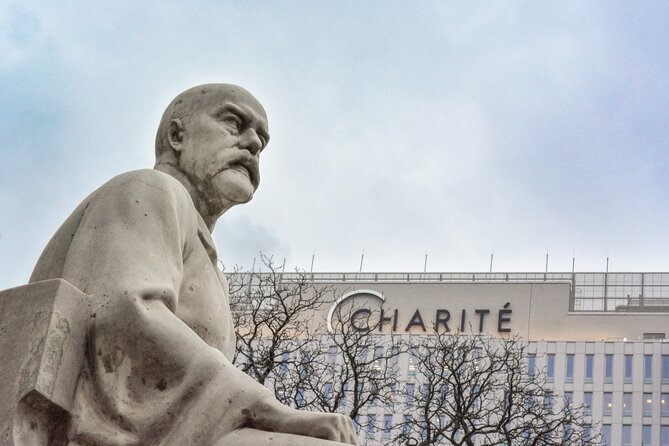
The tour begins at Robert-Koch-Platz, where the Robert Koch monument gives the guide a natural opening. You learn why Charité was established in the 18th century and how its role developed as Berlin’s oldest hospital.
Robert Koch is a useful figure for explaining both the promise and the complications of medical progress. He identified the causes of tuberculosis, anthrax, and cholera, work that changed how doctors understood infectious disease. The stop also covers his part in what is described as the first pharmaceutical scandal in medical history.
That last point matters. The tour does not present medicine as a simple march from ignorance to success. Scientific breakthroughs can save lives, but powerful doctors and new treatments can also bring money, prestige, and bad judgment. In about 20 minutes, you get that larger idea without needing a prior background in medicine.
The monument itself is an outdoor stop with no admission charge. You should arrive ready to listen rather than expecting a museum visit.
The Tieranatomisches Theater and medicine before modern science
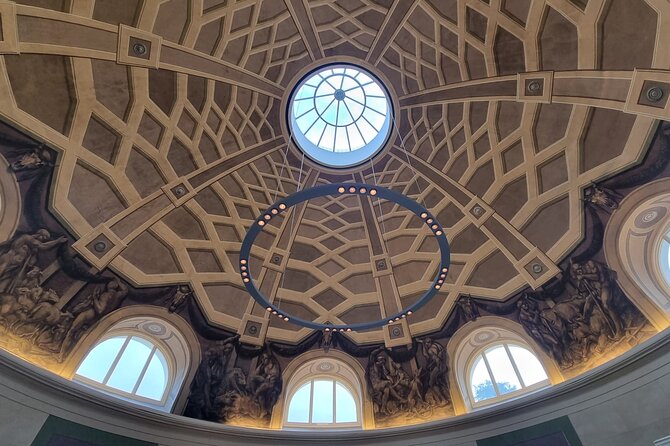
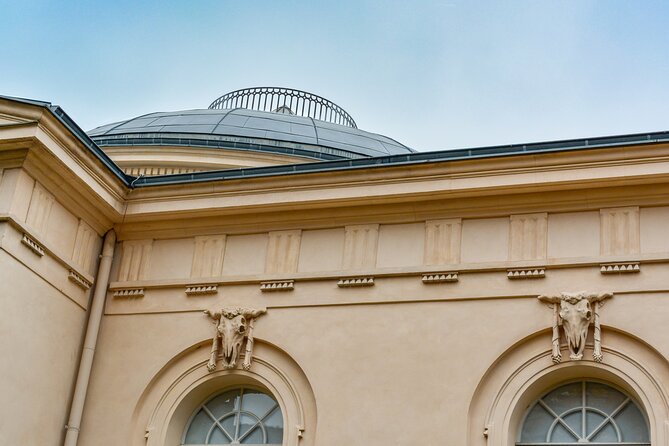
The second stop is the Tieranatomisches Theater, an 18th-century neoclassical building described as the oldest surviving academic building in Berlin. Its original connection to veterinary study gives the tour a practical way to explain how people approached disease before modern science.
This is one of the most distinctive points on the route. Human medical history can sometimes feel abstract, but animal disease made early doctors confront anatomy, infection, and treatment in direct ways. The building also helps you picture a period when observation and tradition often mattered more than tested scientific methods.
You will hear how diseases were treated before the rise of modern medical practice. That does not mean the tour turns into a technical lecture. The value comes from seeing a physical academic building while the guide explains what medical study looked like before the breakthroughs associated with Koch and others.
The stop is free, like the rest of the listed outdoor points. Keep your expectations clear: you see and discuss the building, but this experience does not promise entry into every site on the route.
Rudolf Virchow and the idea that society affects health
At the monument to Rudolf Virchow, the focus moves from laboratory science to the wider causes of illness. Virchow is presented as the father of modern pathology and the founder of social medicine.
That makes this stop especially useful for anyone who wants more than a parade of famous names. Pathology asks what disease does inside the body. Social medicine asks how housing, work, poverty, public policy, and living conditions affect health. The two ideas fit together, and the guide uses Virchow to show why medicine cannot always be separated from society.
I like this part of the walk because it gives the route a human scale. You are not simply memorizing discoveries. You are thinking about who gets sick, why illness spreads, and how a hospital fits into a city.
The monument is another short outdoor stop, lasting about 20 minutes. If your interest is mainly architecture, this may feel less visually dramatic than the red-brick campus later in the walk. Its value is in the explanation.
More History Walking Tours in Germany
- Berlin: Third Reich, Hitler, and WWII Walking Tour
★ 4.9 · 1,757 reviews - Berlin: History of the Third Reich Guided Walking Tour
★ 4.7 · 791 reviews - Berlin Historical Highlights Walking Tour
★ 4.9 · 657 reviews - Berlin Private Complete History All Day Walking Tour
★ 5.0 · 474 reviews
Albrecht von Graefe and Berlin’s early scientific monuments
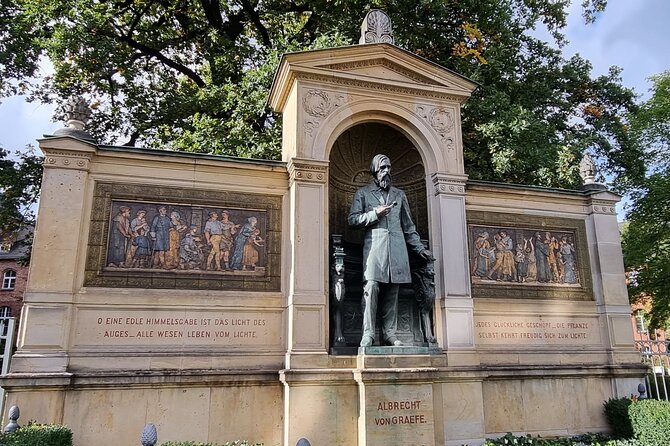
The fourth stop centers on Albrecht von Graefe, a pioneering ophthalmologist. You see the first monument in Berlin dedicated to a scientist and hear how von Graefe changed the field of eye medicine.
This section broadens the story again. Koch represents infectious disease, Virchow represents pathology and social medicine, and von Graefe brings in specialized surgery and eye care. Together, these figures show how medical work split into different fields as doctors gained better tools and more precise knowledge.
The monument also tells you something about Berlin’s public memory. Building a monument to a scientist signals that medical research had become important to the city’s identity. You are looking at a statue, but the guide helps you read it as evidence of changing attitudes toward science.
As with the other stops, there is no admission fee. The route keeps moving, so you should wear comfortable shoes and expect to spend the entire tour outdoors unless the guide indicates otherwise. The provided information describes a weather-dependent activity, so rain or poor conditions can affect the schedule.
Charité Campus Mitte and the hardest moral questions
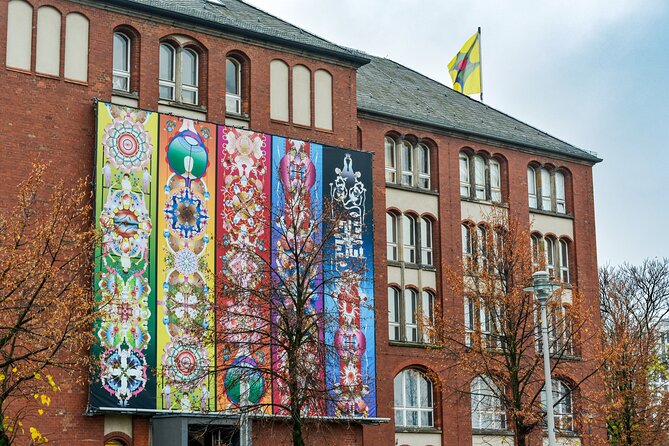
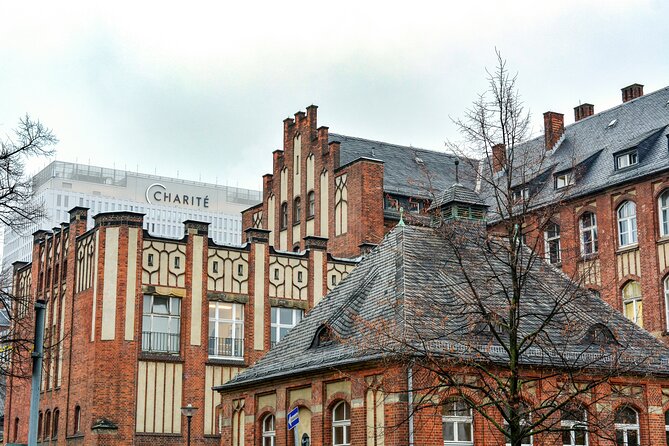
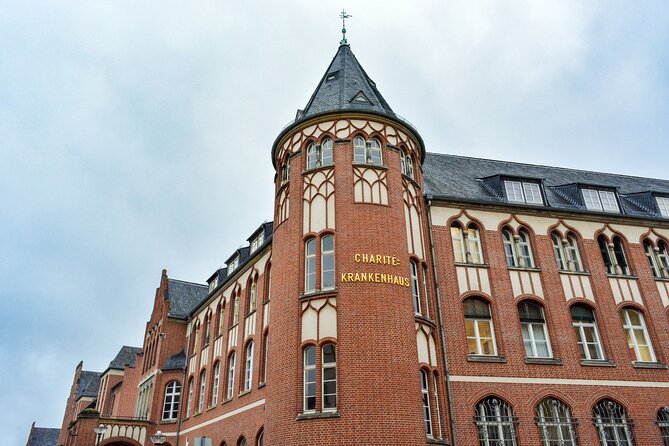
The Charité Campus Mitte is likely the visual center of the walk. You see its neogothic red-brick buildings and learn what happened at the hospital during the Third Reich.
This is where the tour becomes most morally demanding. Some doctors abused medicine, while others continued helping people indiscriminately until the final days of the Second World War. That contrast prevents an easy story about doctors as either heroes or villains.
For you, the value lies in connecting institutional history with individual choices. A hospital is not automatically humane simply because its purpose is to heal. People working inside it still make decisions, and those decisions can protect patients or exploit them.
The tour does not include visits to buildings where clinical or university operations continue. That limits what you can see firsthand, but it also keeps the walk respectful of a working hospital. You are examining the campus from the outside and using the guide’s context to understand what happened there.
This stop may be the reason to choose the tour if you have already seen Berlin’s major war memorials and want a different way to consider the period. It may be the wrong choice if you prefer a light sightseeing walk.
The canal, East Berlin, and attempted escapes
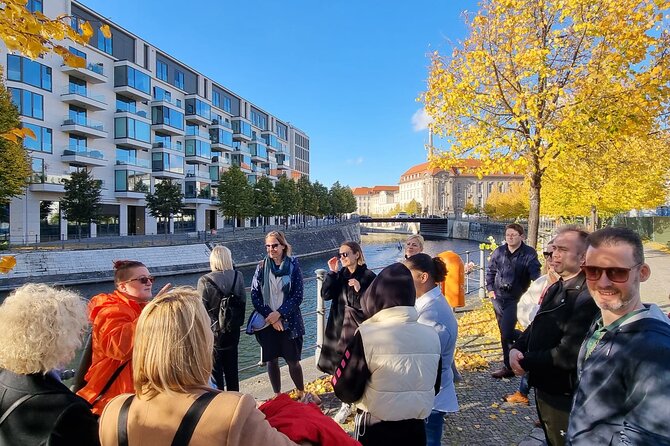
The final stop is near the Humboldthafen canal, by Design Offices Berlin Humboldthafen. Here, the story moves into the socialist era and the years after the Berlin Wall fell.
You hear about several East Berliners who tried to swim across the city canal to reach the West. The location gives this part of the tour a strong sense of place. You are not only hearing about the division of Berlin in general. You are standing beside the water connected to individual escape attempts just outside the Charité campus.
The guide also explains hospital life during socialism and after reunification. This adds an important layer to the route. Charité was not frozen in the 18th or 19th century. Its doctors and patients lived through changing political systems, and the institution carried those changes into the modern era.
The tour ends on Alexanderufer, beside the Humboldthafen canal. From there, Berlin Central Station is about a 10-minute walk away, which makes the finish convenient if you have a train to catch or want to continue exploring around the station.
What $30.12 buys you
At $30.12 per person, this is not a bargain-priced stroll, but the price can make sense if you care about interpretation. All listed fees and taxes are included, and the guide is included. The sites themselves do not charge admission, so most of what you pay goes toward the guided experience rather than tickets.
That distinction is important. If you are happy to walk around Charité alone and read basic information online, you can spend less. You will not get the same connected account of Koch, Virchow, von Graefe, wartime medicine, socialist hospital life, and Cold War escape attempts.
I see the tour as good value for a visitor who wants a specialist subject explained clearly in a short time. It is less good value for someone expecting interior access or a large medical museum. The experience does not include entry to buildings where clinical or university work takes place.
A small group also helps justify the cost. With a maximum of 15 people, the guide can keep the group together and explain sensitive material without the noise and distance common on a large city tour. One published comment described the leader as a strong storyteller who connected medical history with current issues. That is exactly the skill this route needs.
Who should book this walk?
I would choose this tour if you have an interest in science, medicine, ethics, public health, or Berlin’s political past. It is also a good fit if you have only a morning or afternoon free and want a focused experience rather than another broad city overview.
You do not need medical training. The route is built around stories and places, and the guide supplies the context. Still, you should be comfortable with difficult subjects, including medical abuse under the Third Reich and dangerous escape attempts during the division of Berlin.
The walk may suit solo visitors particularly well because the small group offers structure without the social pressure of a large organized outing. It also works for anyone staying near Berlin Central Station, since the ending is close by.
I would skip it if your main goal is to enter historic hospital buildings, see medical instruments, or tour active hospital facilities. You should also think twice if poor weather is likely, since the activity requires suitable conditions.
Booking is flexible up to 24 hours before the start time, with a full refund available if you cancel by then. Changes or cancellations made less than 24 hours before the start are not accepted for a refund, and a weather cancellation brings the choice of another date or a full refund.
My verdict on the Charité medical history tour
Book this walk if you want Berlin history told through doctors, patients, institutions, and moral choices. The route is short, the group is limited, and the final canal stop gives the experience a memorable political edge.
The strongest reason to go is the guide’s storytelling. The monuments and buildings matter, but the connections between them matter more. You move from infectious disease to social medicine, from scientific progress to abuse, and from a working hospital to Cold War escape stories.
Just remember what you are buying: a two-hour outdoor walking tour with guided interpretation, not a behind-the-scenes hospital visit. At $30.12, it earns its price when you want context, clear pacing, and a subject that feels different from Berlin’s usual sightseeing circuit.
FAQ
How long does the Charité Hospital Walking Tour last?
The tour lasts approximately two hours.
What language is the tour offered in?
The tour is offered in English.
Where does the tour begin?
The tour begins at Robert-Koch-Platz, 10115 Berlin, Germany.
Where does the tour end?
The tour ends on Alexanderufer, by the Humboldthafen canal. Berlin Central Station is about a 10-minute walk away.
How many people can join the tour?
The tour has a maximum group size of 15 people.
Are entrance fees included?
All listed fees and taxes are included. The tour does not include entry to buildings where clinical or university operations take place.
Can I cancel for a full refund?
Yes. You can cancel at least 24 hours before the start time for a full refund. Cancellations or changes made less than 24 hours before the start time are not accepted for a refund.
Just added around Berlin
- Berlin Food & Cultural Tour: Must-Try German & Berliner Classics★ 5.0 · 51 reviews
- Berlin Half-Day World War II Walking Tour★ 4.5 · 48 reviews
- Small-Group Historical Bike Tour in Berlin★ 4.5 · 103 reviews
- Historic center of Berlin – Tour in Italian★ 5.0 · 143 reviews
- Berlin Cold War & World War II Third Reich Walking Tour★ 4.5 · 30 reviews
- Berlin Wall and Cold War Bike Tour in Small Groups★ 5.0 · 114 reviews
- Private Tour: Jewish Heritage Walking Tour of Berlin★ 5.0 · 29 reviews
- Private Taxi Tour City East & West History and Architecture 3-4h★ 5.0 · 42 reviews
Berlin History Tours, compared.

Berlin: Third Reich & Cold War Guided Walking Tour
Read our review →
Berlin’s Best: 2 Hour Walking Tour Third Reich and the Cold War
Read our review →
Third Reich Berlin: Hitler and WWII Walking Tour
Read our review →
Berlin: Third Reich, Hitler, and WWII Walking Tour
Read our review →
Berlin: 3-Hour World Heritage Cruise to Potsdam
Read our review →
Cold War, Berlin Wall, Spies and the East Side Gallery
Read our review →
Berlin: History of the Third Reich Guided Walking Tour
Read our review →
Browse the lists this tour appears in