
Review · BERLIN
Explore The Berlin Wall: Cold War Berlin and Behind the Berlin Wall
Berlin’s Wall is easier to understand when you see its pieces in the right order. This three-hour tour links the Berlin Wall Memorial, Checkpoint Charlie, Potsdamer Platz, a surviving watchtower, and a small Wall section beside the Topography of Terror. Together, they show both the machinery of division and the city’s startling return to one whole place.
I like the way the tour gets beyond the famous checkpoint and takes you to less obvious remains. I also like the human focus: escape tunnels, failed attempts, family stories, and the daily reality of living beside a fortified border. The main drawback is that three hours goes quickly, and the tour involves a fair amount of walking, with public transport used between some sites.
Key points to know before booking
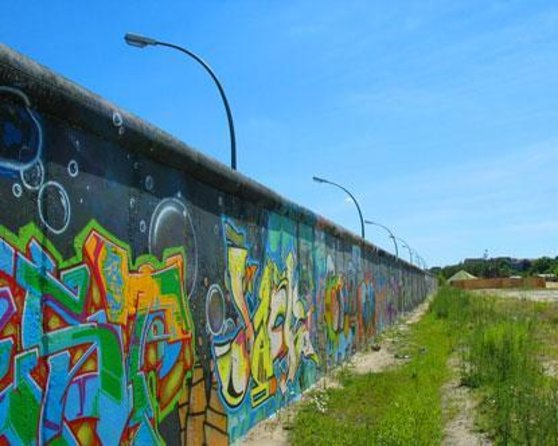
- The Berlin Wall Memorial is the main event: You see the only preserved complete cross-section of the Wall and Death Strip.
- Escape stories give the history a human scale: Guides explain how people tried to reach West Berlin, and why some attempts failed.
- The route covers more than Checkpoint Charlie: You also visit Potsdamer Platz, a rare GDR watchtower, and a Wall fragment beside the Topography of Terror.
- Guides bring strong subject knowledge: Ciaran, Eugen, Paul, Steve, and Aurel are among the guides praised for clear explanations and personal connections.
- It is good value at $32.67: You get about three hours of guiding across several important sites, though food and drinks are not included.
- Plan for weather and walking: The tour runs outdoors for much of its time, and winter conditions can be cold, snowy, or icy.
Why this route helps you understand Berlin’s divided past
A remaining piece of concrete can feel strangely flat when you encounter it by chance. The Wall’s meaning comes from knowing what stood behind it, who guarded it, who tried to cross it, and how Berlin changed after 1989.
That is the useful role of this tour. It does not leave you at one famous photo stop. Instead, it connects several sites across central Berlin, showing how the border changed from a working barrier into a scar in the city, and then into a memory woven into modern streets.
You will hear about the political split between East and West Berlin, but the focus is not only on presidents and treaties. The guides explain the conditions of ordinary life, the risks of escape, and the ways people tested the border. That human scale makes the subject easier to follow, especially if Cold War politics are not already familiar to you.
The route is especially helpful for a first visit. You do not need to spend half a day hunting for disconnected Wall remains. A guide gives each site a reason to matter, then shows you how it fits with the next stop.
More Cold War and Communism Tours in Berlin:
- Berlin: Third Reich & Cold War Guided Walking Tour
★ 4.9 · 8,378 reviews - Berlin’s Best: 2 Hour Walking Tour Third Reich and the Cold War
★ 5.0 · 5,486 reviews - Cold War, Berlin Wall, Spies and the East Side Gallery
★ 5.0 · 1,024 reviews
Starting at the Berlin Wall Memorial
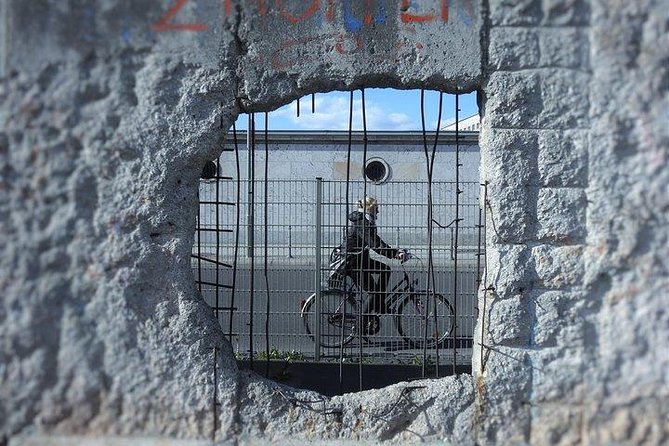
The tour begins at Birchys Berlin Tours on Ebertstraße 24 at 10:00 a.m. From there, the main stop is the Berlin Wall Memorial, where you spend about 1 hour and 20 minutes.
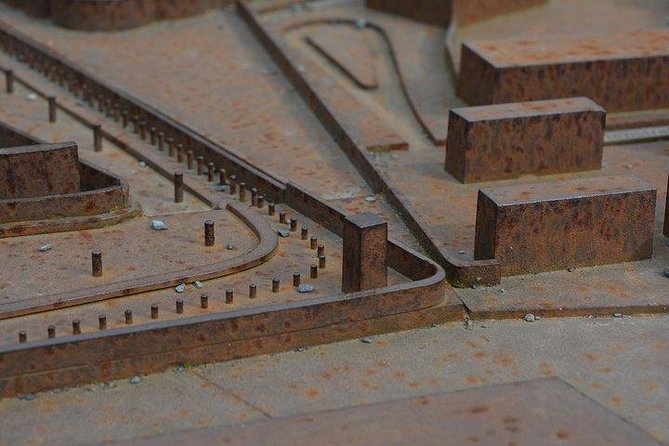
This is the strongest part of the route. The memorial stretches for more than a kilometer and preserves one of the most complete surviving sections of the former border system. You can see the Wall not as a single slab of concrete, but as a layered security zone with the space once called the Death Strip.
That distinction matters. Many modern sections show only a painted outer wall. Here, the memorial helps you picture the wider barrier system, the open ground between defenses, and the severe danger faced by anyone trying to cross. It is also connected with tragic deaths and remarkable escapes, so the site carries both political and personal weight.
I would give this stop your closest attention. It has the space needed to explain how the border worked, and it gives the rest of the tour a firm foundation. If you only have time to study one Berlin Wall site, this is the one I would prioritize.
The memorial is free to enter, but that does not mean the visit is simple or self-explanatory. The guide’s role is to point out what has survived, what has disappeared, and where the stories took place. You may find the stop more powerful than a museum visit because you are standing in the actual former border zone.
Checkpoint Charlie and the drama of 1961
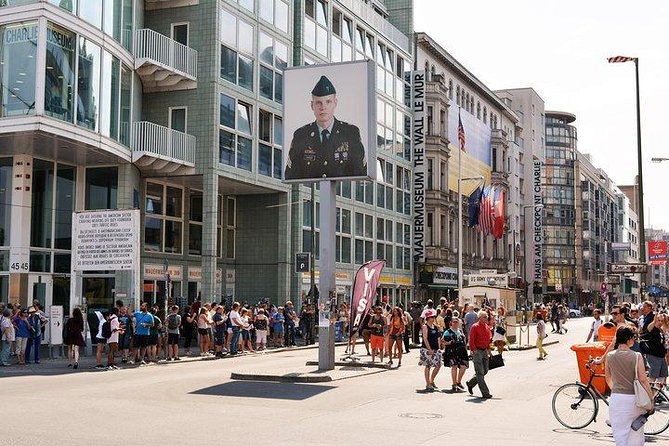
The tour then moves to Checkpoint Charlie for about 15 minutes. This is the most famous crossing point in Berlin, and it is also the place most likely to feel crowded and theatrical compared with the memorial.
Checkpoint Charlie became a symbol of the Cold War. In autumn 1961, American and Soviet forces faced one another here during a serious confrontation. The site also saw escape attempts, some successful and many unsuccessful, which gives the checkpoint more substance than its familiar sign and guardhouse-style display might suggest.
The short stop works best when the guide supplies the context. On its own, Checkpoint Charlie can feel like a quick photo opportunity. With an explanation of the military standoff and the attempts to get through the border, you can read the location as a place of real danger rather than only a city landmark.
Do not expect a long museum visit here. Fifteen minutes is enough for orientation and explanation, not for a full treatment of the Cold War. That is fine, because this tour uses Checkpoint Charlie as one chapter in a wider story.
The Wall beside the Topography of Terror
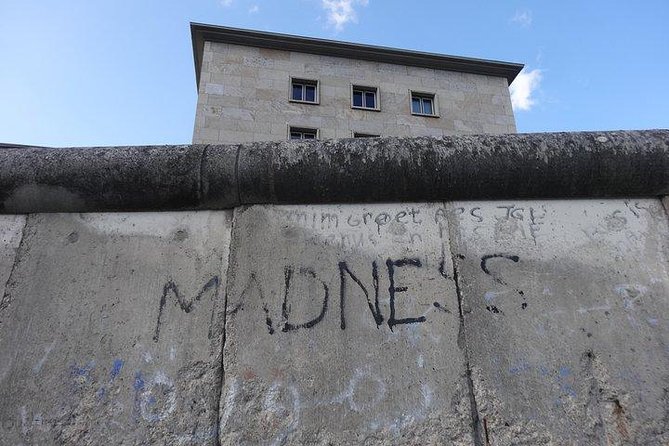
The next stop takes about 10 minutes at the Topography of Terror. A surviving Wall section on Niederkirchnerstrasse sits beside the former Luftwaffe headquarters, a building later used during the East German period as the House of Ministries.
This is a compact but loaded location. The Wall fragment is not isolated from Berlin’s earlier twentieth-century history. Nearby buildings connect the Nazi period, the divided city, and the government of East Germany. The setting makes clear that Berlin’s political layers overlap in the same few streets.
The stop also links to one of the more remarkable escapes into West Berlin. That detail gives the concrete fragment a story and helps explain why even a short section can matter. You are not simply looking at what remains. You are hearing how people used the city’s buildings, streets, and gaps in the border system to attempt the impossible.
Because the stop lasts only about 10 minutes, listen closely. This is a quick piece of the route, but it adds useful context that you would likely miss if you visited the Wall only at Checkpoint Charlie.
More History Tours in Berlin:
- Third Reich Berlin: Hitler and WWII Walking Tour
★ 5.0 · 3,301 reviews - Berlin: Third Reich, Hitler, and WWII Walking Tour
★ 4.9 · 1,757 reviews - Berlin: 3-Hour World Heritage Cruise to Potsdam
★ 4.5 · 1,569 reviews - Berlin: History of the Third Reich Guided Walking Tour
★ 4.7 · 791 reviews
A rare GDR watchtower
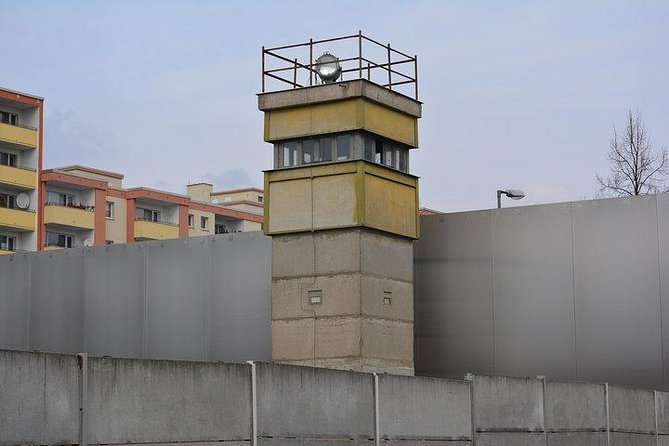
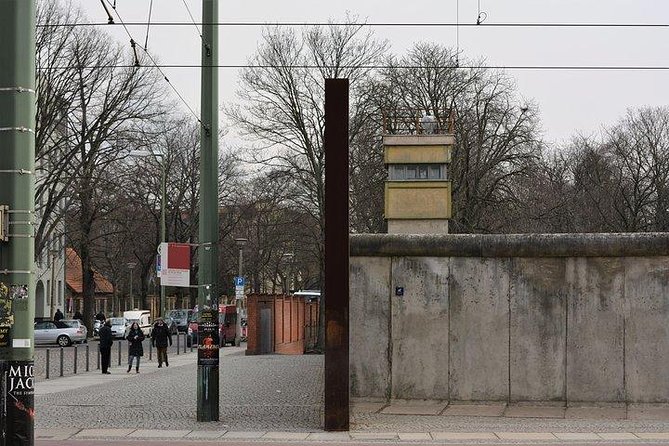
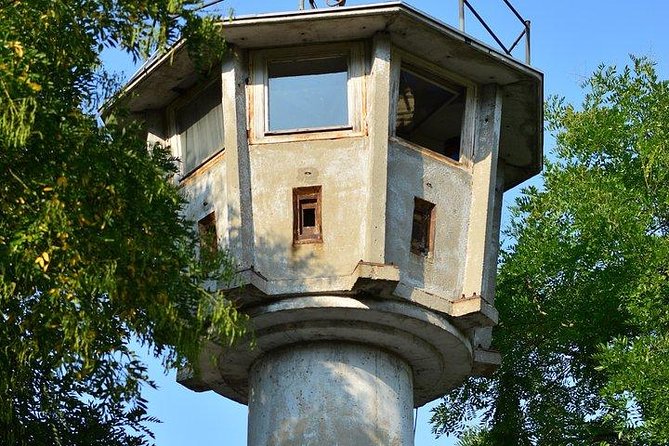
The GDR watchtower takes roughly 15 minutes and is the only stop where admission is included. It is described as the last surviving BT-variant watchtower that once helped surround West Berlin, preserved through a private initiative.
The chance to possibly ascend the tower gives this stop a different feel from the Wall fragments. A watchtower helps you think about surveillance and control from the guard’s position, not only from the viewpoint of someone trying to cross. That shift is valuable because the border was a system of observation as much as a physical obstacle.
Access to the tower may depend on conditions at the time of the visit, so you should treat the ascent as a possibility rather than a guarantee. Even without going up, the structure is a rare surviving part of the border apparatus.
This is also one of the tour’s less obvious stops. If you toured the city alone, you might pass through central Berlin without realizing such a remnant survived. The brief visit adds variety to the day and keeps the route from becoming a series of identical Wall panels.
Potsdamer Platz and the city rebuilt
At Potsdamer Platz, you spend about 10 minutes looking at one of Berlin’s clearest examples of change after reunification. During the divided years, this area was a desolate section of land within and along the former Death Strip. Today, it is a high-rise business and entertainment quarter.
The contrast is the point. Berlin’s redevelopment can make the border seem invisible, but this location shows how dramatically the city changed. Streets that once marked a dangerous edge are now part of an active central district.
I find this a useful final stop because it prevents the tour from ending only in loss. The Wall was dismantled, the border disappeared, and the city rebuilt across the former divide. Potsdamer Platz does not erase what happened, but it shows how completely the physical city has changed.
Ten minutes is enough to see the contrast and hear the explanation. It is not enough for a detailed architectural tour of the square, so keep your expectations focused on the Wall’s former path and Berlin’s reunification.
How the guides shape the experience
The quality of this tour depends heavily on the guide. The experience is designed around explanation, not just transport between monuments, and the named guides bring different strengths.
Ciaran is praised for linking the Wall to the wider Cold War and for making the subject approachable for families. He has also used older photographs to compare the Wall’s appearance in the early 1980s with the same places today. That sort of visual comparison can be especially helpful for teenagers and anyone who struggles to picture a vanished border.
Eugen is described as patient, friendly, and careful with questions. His explanations focus on the reality of life on both sides of Berlin, not simply the date the Wall went up or came down. Paul is praised for making Berlin’s complicated history easier to follow, while Steve brings a public historian’s approach and connects several strands of the Cold War.
Aurel has a personal connection to the subject, which adds another human angle to the political background. Guide assignments can change, so you should not book on the assumption that one particular person will lead your departure. Still, the repeated praise for clear delivery and detailed answers points to the tour’s central strength: the guide makes difficult history understandable while keeping the walk moving.
The small-group format helps. The supplied information gives two different maximum group sizes, 15 and 21, so confirm the current limit when booking. Either way, this is intended to be a relatively contained group rather than a huge crowd, and smaller numbers make it easier to ask questions and hear explanations outdoors.
Walking, public transport, and practical comfort
The experience lasts about three hours and begins at 10:00 a.m. It returns to the meeting point at the end. Guides have used the subway and tram during the route, so you should be ready for a mix of walking and city transport rather than a coach sightseeing trip.
That arrangement is useful because the Wall sites are spread through central Berlin. It also gives you a better feel for how the former border cuts through an ordinary modern city. The tradeoff is that you need comfortable shoes and enough energy for a morning on foot.
Bring water and a snack. Bottled water and snacks are not included, and the three-hour schedule does not include a dedicated meal stop. Dress for the forecast, too. Much of the experience takes place outdoors, and cold weather can be a serious factor. A past winter departure took place in snow and ice, yet the route still went ahead, which tells you to prepare rather than assume poor weather will make the tour comfortable.
The tour is offered in English and uses a mobile ticket. A paper voucher is also accepted. Service animals are allowed, and most people can participate, but anyone with mobility concerns should ask the provider about the walking and public transport sections before booking.
Is $32.67 good value?
At $32.67 per person, I consider this a fair price for a guided three-hour introduction to Berlin’s Wall and Cold War sites. The admission costs are low because most stops are free, but the value is in the route, the interpretation, and the time saved finding the scattered remains.
You are paying for a guide who can explain why the Death Strip mattered, connect the 1961 confrontation at Checkpoint Charlie to the larger Cold War, and tell you what happened at less obvious Wall sites. That is much more useful than paying to enter a single display and leaving without a clear sense of the city’s former division.
The price is strongest for first-time visitors and history fans who want structure. If you already know Berlin well and prefer to read plaques at your own pace, you may find the guided format less necessary. You will also want to account for any public transport costs if they are not covered separately, since the supplied details do not state that transport tickets are included.
Who should book this Berlin Wall tour?
I would recommend it to anyone with a serious interest in twentieth-century European history, especially people who want more than a quick photograph at Checkpoint Charlie. It is also a good choice for families with older children and teenagers because escape stories, old photographs, and real locations make the subject easier to grasp.
It suits first-time Berlin visitors particularly well. The route covers several major points in one morning, then returns you to the starting point with a clearer map of the city’s divided past. You can spend the afternoon visiting museums or revisiting the memorial on your own.
Armchair historians should enjoy the detail, but you do not need a degree in Cold War politics. The guides are used to answering questions and explaining complicated differences between East and West Berlin in plain language.
I would hesitate only if you want a slow, self-guided museum experience, dislike walking in poor weather, or have limited time and need a tightly timed attraction with guaranteed indoor seating. This is an outdoor history walk, and its best moments come from standing in places where the border once shaped daily life.
Should you book it?
Book this tour if you want the Berlin Wall explained as a human and political story, not just a collection of concrete fragments. The Berlin Wall Memorial is the essential stop, while the watchtower, escape accounts, Checkpoint Charlie confrontation, and rebuilt Potsdamer Platz give the morning a strong range.
At $32.67, the tour offers good value for a focused three-hour route with an English-speaking guide and a small-group feel. Bring water, wear good shoes, prepare for the weather, and confirm the current group limit and transport arrangements before departure. If those details suit you, this is a sensible way to get your bearings in Cold War Berlin.
FAQ
How much does the Berlin Wall tour cost?
The price is $32.67 per person.
How long does the tour last?
The tour lasts approximately three hours.
Where does the tour start and finish?
It starts at Birchys Berlin Tours, Ebertstraße 24, 10117 Berlin, Germany, at 10:00 a.m. The activity ends back at the meeting point.
Which sites are included?
The route includes the Berlin Wall Memorial, Checkpoint Charlie, the Wall section beside the Topography of Terror, a GDR watchtower, and Potsdamer Platz.
Is admission included?
Admission to the GDR watchtower is included. The other listed stops have no admission charge.
What happens if I need to cancel?
You can cancel up to 24 hours before the start time for a full refund. Cancellations or changes made less than 24 hours before the start time are not accepted for a refund.
Just added around Berlin
- Berlin Food & Cultural Tour: Must-Try German & Berliner Classics★ 5.0 · 51 reviews
- Berlin Half-Day World War II Walking Tour★ 4.5 · 48 reviews
- Small-Group Historical Bike Tour in Berlin★ 4.5 · 103 reviews
- Historic center of Berlin – Tour in Italian★ 5.0 · 143 reviews
- Berlin Cold War & World War II Third Reich Walking Tour★ 4.5 · 30 reviews
- Private Taxi Tour City East & West History and Architecture 3-4h★ 5.0 · 42 reviews
- Berlin Wall and Cold War Bike Tour in Small Groups★ 5.0 · 114 reviews
- Private Tour: Jewish Heritage Walking Tour of Berlin★ 5.0 · 29 reviews
Berlin History Tours, compared.

Berlin: Third Reich & Cold War Guided Walking Tour
Read our review →
Berlin’s Best: 2 Hour Walking Tour Third Reich and the Cold War
Read our review →
Third Reich Berlin: Hitler and WWII Walking Tour
Read our review →
Berlin: Third Reich, Hitler, and WWII Walking Tour
Read our review →
Berlin: 3-Hour World Heritage Cruise to Potsdam
Read our review →
Cold War, Berlin Wall, Spies and the East Side Gallery
Read our review →
Berlin: History of the Third Reich Guided Walking Tour
Read our review →
Browse the lists this tour appears in