
Review · BERLIN
Explore Berlin History and Highlights Sightseeing Walking Tour
Berlin’s story is written across a surprisingly compact stretch of central streets. In one morning, this tour takes you from the Brandenburg Gate and the Reichstag to the Holocaust Memorial, Hitler’s bunker site, Checkpoint Charlie, and Museum Island. It is a brisk walk through Prussian grandeur, Nazi terror, Cold War division, and reunification.
I like the small maximum group of 15, which gives you a better chance to ask questions than on a large city tour. I also like the guide-led storytelling, especially the way guides such as Aurel, Cairan, Rhys, Eugen, and Steve have connected buildings to the people and events behind them. The main drawback is simple: this is a serious 3.5-hour walking tour, so it is not a good fit if you have trouble walking that far.
- A full historical arc: Follow Berlin from Prussian capital to Nazi headquarters, divided Cold War city, and modern Germany.
- Eleven major stops: See the Brandenburg Gate, Reichstag, Holocaust Memorial, Checkpoint Charlie, Gendarmenmarkt, Bebelplatz, and Museum Island.
- A small group format: The tour accepts no more than 15 people, with some departures becoming even more personal.
- English commentary throughout: Guides explain the sites as you walk, with time for questions and discussion.
- A useful first-day orientation: Finish near Museum Island with a better sense of where central Berlin’s main sights fit together.
- Good value at $32.58: You pay for a guided city walk, not museum admission, transport, or entry to buildings.
Why this walk makes sense for a first look at Berlin
Berlin can feel scattered at first. Its major sights are spread across several historic districts, and the city’s past is too complicated to understand from photographs alone. This walk gives you a basic map of central Berlin while connecting the landmarks into one story.
The route begins at 10:00 a.m. beside the Brandenburg Gate and ends on Museum Island. That direction matters. You begin with the symbols of modern Germany, then move through the places tied to dictatorship and war before finishing among Berlin’s grand cultural buildings.
I see this as a strong first tour if you have only a few days in the city. You will not go inside every major attraction, but you will learn which places deserve a longer visit later. The guide fills in the links that are easy to miss when you move from one monument to the next on your own.
The tour is offered in English and uses an expert guide rather than an audio recording. Past guides named in feedback include Aurel, Cairan, Rhys, Eugen, Steve, Paul, Aaron, Arron, and Kieran. The precise guide depends on the date, but the repeated praise centers on clear explanations, an easy manner, patience with questions, and strong command of Berlin’s history.
Brandenburg Gate and the Reichstag: Berlin’s public face
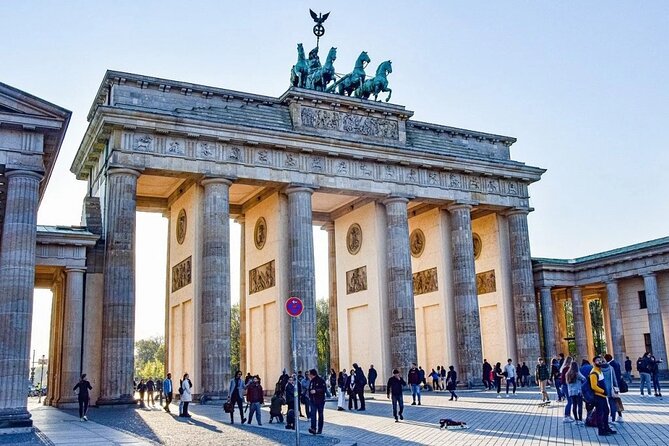
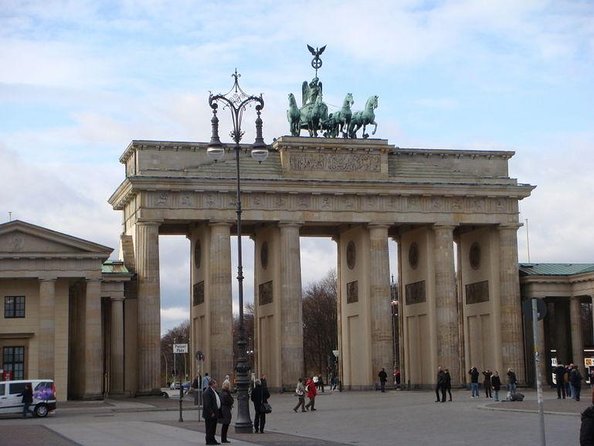
The Brandenburg Gate is an ideal starting point. It is one of Berlin’s most recognizable landmarks, but its importance goes far beyond its appearance. Your guide explains how the gate witnessed major changes in Berlin and Germany, giving you a useful introduction before the tour moves into more difficult subjects.
You get about 20 minutes here. That is enough time for an explanation and photographs, though it is not a long, quiet stop. For the best chance of a less crowded picture, arrive before 10:00 a.m. or later in the day. The meeting point is at Wurst 🙂 am Brandenburger Tor, at Ebertstraße and Scheidemannstraße, so check the exact corner before setting out.
The nearby Reichstag Building receives another 20 minutes. This is the German parliament building, with a past that reaches from the Imperial period through the Reichstag fire and the final Soviet assault on Berlin in the Second World War.
The tour does not include entry inside the Reichstag. That is important if you are expecting a dome visit or an indoor parliament tour. Instead, you learn how the building’s role changed across several political eras while viewing it from outside.
More History Walking Tours in Berlin
- Berlin: Third Reich & Cold War Guided Walking Tour
★ 4.9 · 8,378 reviews - Berlin’s Best: 2 Hour Walking Tour Third Reich and the Cold War
★ 5.0 · 5,486 reviews - Third Reich Berlin: Hitler and WWII Walking Tour
★ 5.0 · 3,301 reviews
The Holocaust Memorial and the former Führerbunker site
The Holocaust Memorial is one of the tour’s most serious stops. Its field of concrete blocks is large, central, and intentionally open to interpretation. Your guide discusses the memorial’s construction and the crimes it commemorates, helping you approach the site with some historical context rather than treating it as just an unusual photo setting.
You have about 15 minutes here. That is enough for an introduction and a short walk among the blocks, but you should not expect a full museum visit. The Information Centre is not listed as part of the tour, and the pace remains that of a city walk.
The next stop is the former Führerbunker site, now a car park. The plain setting is part of the lesson. There is no grand ruin to photograph and no preserved bunker interior to enter. Your guide explains where the bunker lay beneath the former New Reich Chancellery gardens and how Hitler’s final days ended there.
This stop works best when the guide supplies the missing details. On your own, you might pass the car park without realizing its importance. You receive about 15 minutes here, enough to discuss the site without turning it into a spectacle.
Luftwaffe headquarters and the Topography of Terror
The Bundesministerium der Finanzen is now Germany’s Finance Ministry, but the building once served as the headquarters of the Luftwaffe. The tour uses this stop to show how buildings survive political change. You hear about its construction, its Nazi-era role, and its Cold War connection.
Again, the emphasis is on the outside setting and the explanation. No admission is included, and the stop lasts about 15 minutes. This is one of the useful features of the route: you see a working government building and learn how its meaning shifted over time.
The Topography of Terror follows with a 20-minute stop. The site once held the headquarters of the SS, Gestapo, and SD. It now serves as a place of documentation and remembrance. Your guide covers both the Nazi period and the later effort to memorialize what happened there.
If you want to study the exhibitions in detail, you will need to return on your own. The walking tour gives you the site’s role and purpose, but it cannot replace time inside a documentation centre. I would mark this location for a separate visit if modern German history is a major interest.
Checkpoint Charlie and the reality of divided Berlin
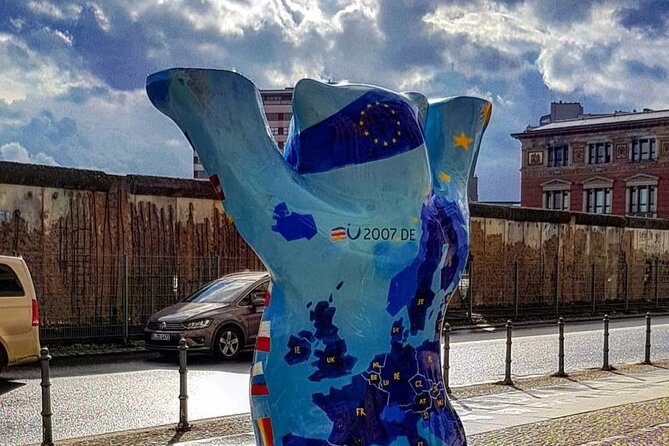
Checkpoint Charlie is one of Berlin’s best-known Cold War locations. It is also a place where expectations need managing. The tour gives you about 20 minutes to understand the checkpoint’s role and the wider story of Cold War Berlin.
You should think of this as a historical stop, not a preserved border crossing. The guide explains what made the checkpoint important and places it within the division of the city. That context is valuable because the present-day setting can feel more commercial and crowded than the history suggests.
The guide-led format helps here. A photograph of the guardhouse tells you very little by itself. A good explanation connects the location to the political tension between East and West and to the larger pattern of a city split by ideology.
More History Walking Tours in Germany
- Berlin: Third Reich, Hitler, and WWII Walking Tour
★ 4.9 · 1,757 reviews - Berlin: History of the Third Reich Guided Walking Tour
★ 4.7 · 791 reviews - Berlin Historical Highlights Walking Tour
★ 4.9 · 657 reviews - Berlin Private Complete History All Day Walking Tour
★ 5.0 · 474 reviews
Gendarmenmarkt and Bebelplatz: Prussian Berlin and Nazi crime
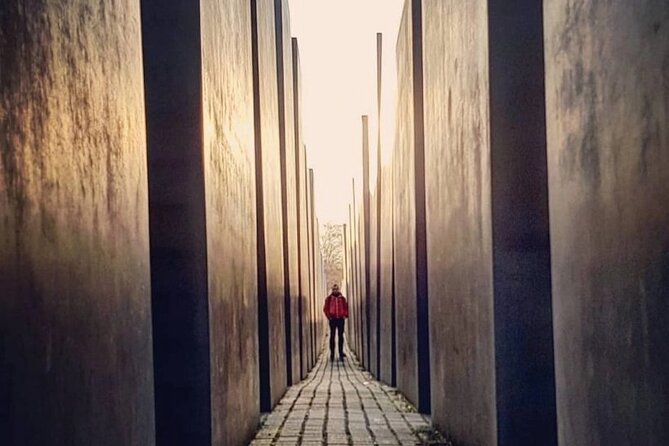
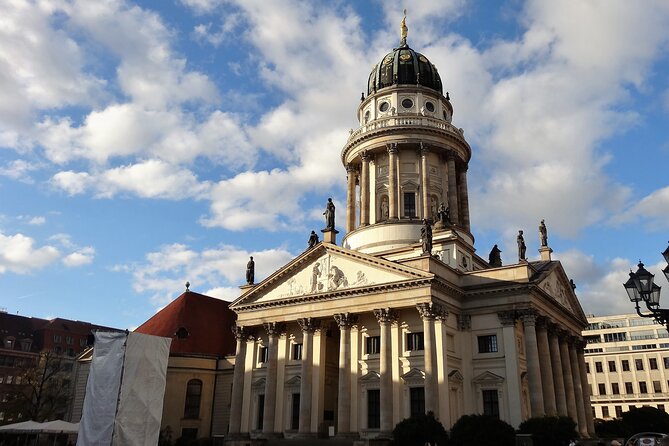
Gendarmenmarkt changes the mood. After the stark memorial sites and Cold War checkpoint, you reach one of central Berlin’s most impressive squares, surrounded by 18th and 19th-century architecture.
The stop lasts about 15 minutes. Your guide explains how the square was founded and developed, rather than asking you to admire the buildings without context. This is a good example of the tour’s broad time span. Berlin’s identity is not only about the 20th century. The city’s Prussian and imperial foundations help explain the grand avenues and formal squares you see later.
Bebelplatz is another 15-minute stop, with an important contrast between architectural beauty and political violence. The square is surrounded by buildings linked to Frederick the Great’s Prussian capital, but it is also remembered for the Nazi book burning of 1933.
Your guide discusses why the buildings were built and explains the memorial to the book burning. The stop is short, so you get the key facts and a chance to see the memorial, but not a long period for quiet reflection. Still, it is a worthwhile pause because the site shows how a beautiful public square can carry a painful memory.
Unter den Linden and the route toward Museum Island
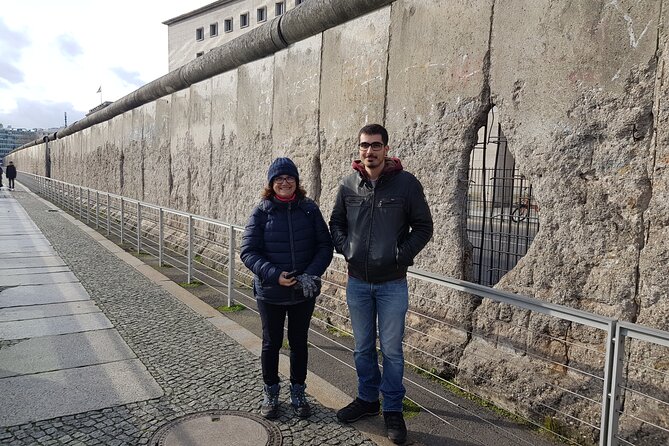
Unter den Linden provides the connecting street for the final part of the walk. You visit the eastern end of the boulevard and hear about Humboldt University, the Memorial to the Victims of War and Tyranny, and the German History Museum.
This section helps you read Berlin’s architecture as you walk. The buildings are not isolated sights. They belong to a historic central district shaped by monarchy, war, division, education, and national memory.
The stop lasts about 20 minutes, though the route itself includes walking between locations. Wear comfortable shoes and expect a steady morning on foot. The tour description clearly identifies this as a walking experience, and one unhappy booking resulted from a participant not realizing how much walking was involved.
That is the main practical warning I would give. Most people can take part, and service animals are allowed, but the tour is not designed around vehicle transfers or frequent seated breaks. If you need an easier pace, contact the provider before booking rather than assuming the route can be shortened.
Museum Island and the view toward Alexanderplatz
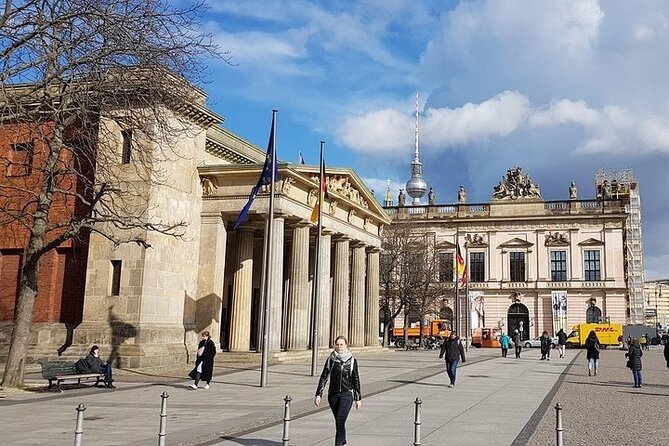
The final stop is Museum Island, where the route reaches medieval Berlin, the former City Palace, Berlin Cathedral, and the group of five major museums. You spend about 20 minutes here, looking across from the eastern side toward Alexanderplatz and discussing its role as the centre of postwar East Berlin.
This ending gives the tour a useful final chapter. You begin at a symbol of reunited Germany and finish near landmarks that show Berlin’s medieval, royal, cultural, and East German past. You also finish in an area where you can continue sightseeing on your own.
The tour does not include museum admission. That keeps the price low, but it means you should plan another visit if you want to enter the Pergamon Museum, Bode Museum, Neues Museum, Altes Museum, or Alte Nationalgalerie. The five institutions are mentioned as part of Museum Island, but this experience is an outdoor orientation rather than a museum tour.
What $32.58 buys you
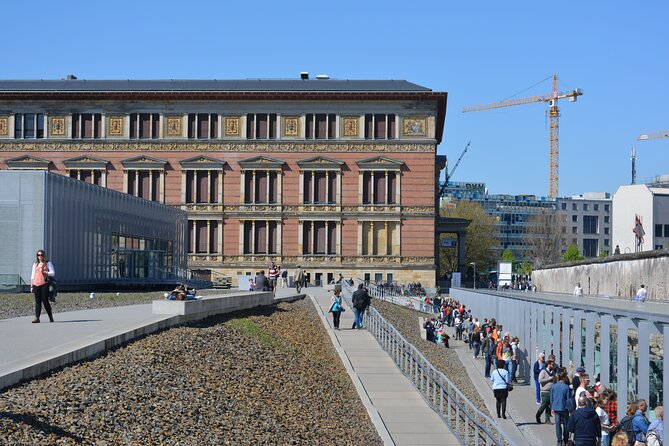
At $32.58 per person, this is a reasonable price for a 3.5-hour guided walk through central Berlin. You are paying for the guide’s preparation, historical interpretation, and route planning. All stops are free to visit from outside, so the value depends on how much you want explanation rather than entry tickets.
I would not book this tour mainly to save on admission fees. There are no museum or building entrances included. I would book it because Berlin’s history is layered, and a guide can help you understand why a finance ministry, a car park, a memorial, and a grand square all belong in the same story.
The small group limit improves the value. Fifteen people is still a group, but it is more manageable than a large crowd. Some departures have been much smaller, including groups of three and private-feeling departures when no one else signed up. That can make it easier to ask about family history, architecture, East and West Berlin, or any other subject that catches your attention.
Past comments also highlight useful touches such as guides showing photographs on an iPad, using personal family images connected to East Berlin, and suggesting places to visit after the walk. These details depend on the individual guide, so I would treat them as possible benefits rather than guaranteed features.
How the pace and guide affect the experience
The itinerary gives each stop between 15 and 20 minutes, with walking time between them. That means the tour is packed with information. One past participant wisely advised bringing snacks, since there is a lot to take in over the morning.
I like this pace for a first orientation. You see many important places without spending your entire day in one district. The tradeoff is that you may want more time at the Holocaust Memorial, Topography of Terror, or Museum Island than the schedule allows.
The strongest element is the guide. Aurel was praised for explaining architecture, reconstruction, and the reasons buildings changed over time. Cairan was noted for connecting local events to wider German and world history, while Rhys was described as friendly, funny, and easy to follow. Eugen, Steve, Paul, and Aaron were also singled out for clear, engaging explanations and a relaxed approach.
That range of names suggests a team rather than one fixed personality. Your experience will depend partly on who leads the departure. Still, the pattern is encouraging: guides are expected to explain, answer questions, and keep the history human rather than simply reciting dates.
Who should book this Berlin walking tour
I would recommend it to first-time visitors who want a clear introduction before exploring museums and neighbourhoods alone. It also suits families with older children, provided everyone is comfortable walking for several hours and listening to serious historical material.
History fans will appreciate the route’s range. You move from Prussia to the Nazi period, from the Second World War to the Cold War, and then toward reunification and modern Berlin. Architecture fans also get plenty to notice, especially around the Reichstag, Gendarmenmarkt, Bebelplatz, Unter den Linden, and Museum Island.
It is less suitable for anyone who wants extensive time inside museums, a relaxed café-based tour, or a short route with frequent transport breaks. It is also not the right choice if a member of your group cannot manage a long walk. The booking information says most people can participate, but that should not be confused with a low-mobility format.
The tour is near public transportation, which helps you reach the start and continue from the end. Confirmation arrives when you book, and free cancellation is available up to 24 hours before the 10:00 a.m. start time. Changes or cancellations inside that window are not refundable.
Should you book it?
Book this tour if you want to get your bearings fast while learning how Berlin’s major sights fit together. The price is fair, the route is full, and the small group limit gives the guide room to respond to questions.
Skip it if you dislike long walks or want to spend serious time inside the museums and memorial centres. For most first visits, though, this is a useful way to meet Berlin’s difficult past with a capable English-speaking guide, then return to the places that deserve a closer look.
FAQ
How long does the Berlin history walking tour last?
The tour lasts approximately 3 hours and 30 minutes.
What time does the tour start?
It starts at 10:00 a.m.
Where does the tour begin?
The meeting point is Wurst 🙂 am Brandenburger Tor, at Ebertstraße and Scheidemannstraße, 10117 Berlin, Germany.
Where does the tour end?
The tour ends on Museum Island in Berlin.
What language is the tour offered in?
The tour is offered in English.
How many people can join the tour?
The maximum group size is 15 people.
Are entrance tickets included?
No entrance tickets are included. The experience is a walking tour with an expert guide, and the listed stops are visited from outside.
Just added around Berlin
- Berlin Food & Cultural Tour: Must-Try German & Berliner Classics★ 5.0 · 51 reviews
- Berlin Half-Day World War II Walking Tour★ 4.5 · 48 reviews
- Small-Group Historical Bike Tour in Berlin★ 4.5 · 103 reviews
- Historic center of Berlin – Tour in Italian★ 5.0 · 143 reviews
- Berlin Cold War & World War II Third Reich Walking Tour★ 4.5 · 30 reviews
- Private Taxi Tour City East & West History and Architecture 3-4h★ 5.0 · 42 reviews
- Berlin Wall and Cold War Bike Tour in Small Groups★ 5.0 · 114 reviews
- Private Tour: Jewish Heritage Walking Tour of Berlin★ 5.0 · 29 reviews
Berlin History Tours, compared.

Berlin: Third Reich & Cold War Guided Walking Tour
Read our review →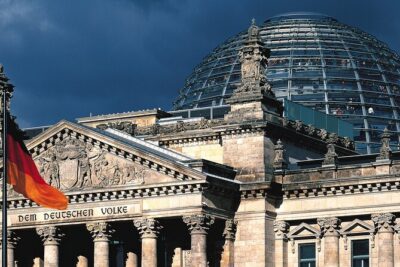
Berlin’s Best: 2 Hour Walking Tour Third Reich and the Cold War
Read our review →
Third Reich Berlin: Hitler and WWII Walking Tour
Read our review →
Berlin: Third Reich, Hitler, and WWII Walking Tour
Read our review →
Berlin: 3-Hour World Heritage Cruise to Potsdam
Read our review →
Cold War, Berlin Wall, Spies and the East Side Gallery
Read our review →
Berlin: History of the Third Reich Guided Walking Tour
Read our review →
Browse the lists this tour appears in