
Review · ITALY
Brescia the Unexpected: History, Local Stories & a drink
Brescia rewards the curious, and this tour shows you why. In three hours, you move from the hilltop Castello di Brescia to Roman ruins, painted churches, grand civic squares, and the rough-edged Carmine district. The city’s layers come one after another, often within a few steps of each other.
I especially like the castle panorama and the stop at the Chiesa del Santissimo Corpo di Cristo, with its remarkable painted ceiling. I also like the final drink, since it introduces you to the pirlo, Brescia’s local aperitif, rather than ending with a hurried goodbye.
The main consideration is the amount of walking. The route covers eight stops and includes the climb through the castle walls, so wear sensible shoes. The Biblioteca Queriniana and bishop’s palace are also unavailable on Saturday afternoons, Sundays, and Mondays.
Key points to know before booking
- Castle views begin the tour: You start at Brescia’s highest point, with a wide look over the city and northern mountains.
- The route covers many eras: Roman temples, medieval towers, Renaissance buildings, Fascist-era architecture, and modern city life all appear within three hours.
- Davide and Chiara lead the experience: Their approach combines dates and buildings with local stories, language details, and anecdotes about Brescia.
- The final drink is part of the price: Adults receive an alcoholic drink, while anyone under 18 receives a nonalcoholic option.
- Small groups keep the walk personal: The maximum group size is 12 people.
- The tour is best for first-time visitors: It gives you a strong city orientation and ideas for places to return to later.
Why Brescia makes such a good walking tour
Brescia is often passed over for better-known northern Italian cities. That is precisely why this walk can be useful. You get major Roman and medieval sights without a route built around only one famous monument.
The tour also explains how the city fits together. A castle on the hill, a Roman forum below, church interiors, political squares, and a working-class district are not treated as separate attractions. Your guide connects them through the struggles, ambitions, and changing tastes that shaped Brescia.
Davide Borghi and Chiara of Umbrella Tours guide the experience. The strongest feedback centers on their friendly style, clear communication, and ability to turn local history into a conversation rather than a lecture. Davide, in particular, is described as a lively storyteller who shares both major events and small details about language, culture, and city life.
The tour is offered in English and takes about three hours. Since the group is capped at 12, you should have a better chance to ask questions than on a large coach excursion. All the listed sights are included in the walking route without separate admission charges, and the included drink adds real value at the end.
More History Tours in Italy:
- Pompeii: Entry Ticket and Guided Tour with an Archaeologist
★ 4.8 · 19,459 reviews - Colosseum: Underground and Ancient Rome Tour
★ 4.7 · 12,691 reviews - Pompeii: Small Group Tour with an Archaeologist
★ 4.8 · 12,264 reviews
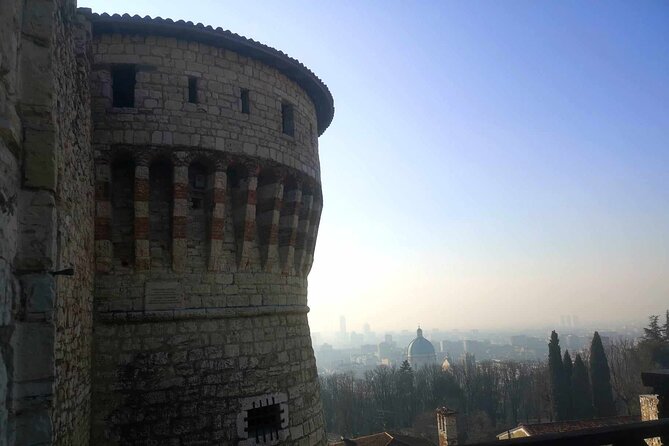
Starting above the city at Castello di Brescia
The meeting point is at Via del Castello, 13, on the hill above central Brescia. The first stop is the city’s castle, whose construction began in the eighth century.
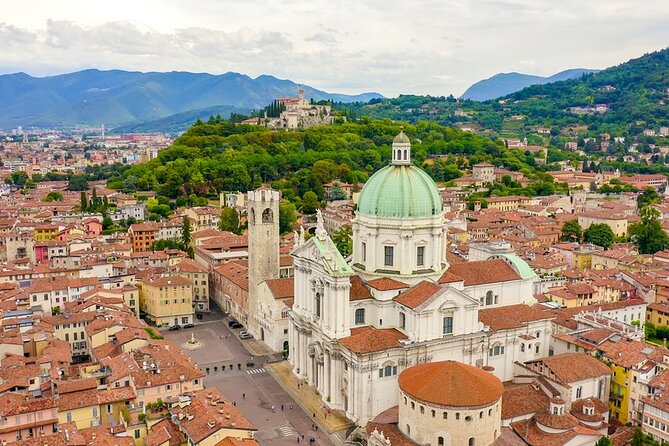
This is a smart place to start. From the hill, you can see the city center below and the mountains around it. The view gives you a quick sense of Brescia’s position and helps you understand the route before you descend into the streets.
You walk through and into the old walls to reach the highest viewpoint. The castle portion lasts about 25 minutes, so this is a panorama stop rather than a long castle tour. The climb and uneven historic surfaces may require a little care, especially if your mobility is limited.
One useful feature is the orientation. You begin with the whole city in view, then spend the rest of the tour identifying the buildings and districts you have just seen from above.
The painted ceiling of Santissimo Corpo di Cristo
The Chiesa del Santissimo Corpo di Cristo is one of the tour’s most memorable indoor stops. It is sometimes called Brescia’s Sistine Chapel, a bold comparison that points to the church’s painted ceiling.
You spend about 20 minutes inside, looking upward at the decoration and learning how the church fits into Brescia’s religious and artistic story. This stop breaks up the outdoor walking and gives the route a strong visual change.
The church is also a good example of why a local guide helps. From the street, a small church can be easy to overlook. Inside, the ceiling changes your sense of the building completely. If you like art but do not want to spend hours in a museum, this is one of the most efficient parts of the tour.
Roman Brescia at the Capitolium and Forum
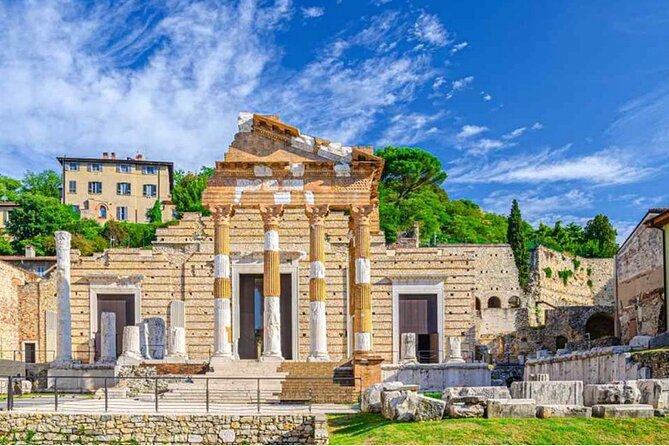
At the Tempio Capitolino and Piazza del Foro, the city’s Roman past comes into clear view. You are not simply hearing that Brescia was important in antiquity. You are standing among remains of the Roman city in the middle of the modern one.
The stop lasts around 20 minutes. That is enough time for your guide to explain what you are seeing and how the ancient forum relates to the streets around it. The appeal comes from the contrast: ordinary city life continues nearby while the Roman temple preserves a much older chapter.
This stop suits anyone who enjoys seeing history in place rather than only in a display case. It also helps explain why Brescia deserves more attention from visitors interested in northern Italy’s Roman sites.
Same city, a different century:
- Pompeii Small Group Tour with an Archaeologist
★ 5.0 · 6,593 reviews - Rome: Colosseum with Arena, Roman Forum and Palatine Guided Tour
★ 4.0 · 5,598 reviews - Venice: St. Mark’s Basilica Guided Tour & VR History Intro
★ 3.9 · 4,880 reviews - Colosseum with Arena, Roman Forum and Palatine Hill Guided Tour
★ 4.5 · 3,526 reviews
A quiet stop at the Queriniana Library
The Biblioteca Queriniana and the bishop’s palace offer a different kind of experience. Dating from the 17th century, this area is described as a public place that many people miss.
You spend about 20 minutes here, learning about the library and its setting. It is a useful pause after the Roman ruins because it shifts the focus from ancient civic power to scholarship, religion, and the institutions that shaped later Brescia.
There is an important scheduling catch. This stop is not available on Saturday afternoons, Sundays, or Mondays. The tour still operates on those days, but you should expect the route to adjust and the guide to explain the area from outside or replace the visit with other context.
If this library is a priority for you, choose a different day. If your schedule is fixed, the rest of the route still offers plenty of architectural and historical variety.
Three eras around Piazza Paolo VI
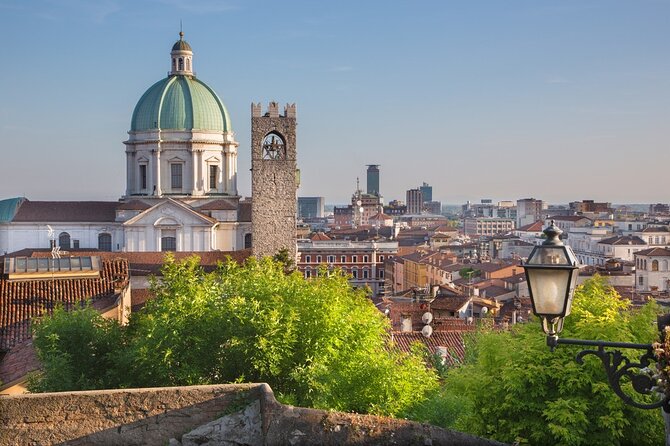
Piazza Paolo VI is one of the most attractive parts of the walk. Here you see the Old and New Domes, the medieval Tower of Pegol, and the square that once reflected the rivalries of Brescia’s noble families.
The 20-minute stop brings architecture and politics together. Your guide explains how powerful families competed and how those struggles affected the city. The square becomes more than a pretty place for photographs. It becomes evidence of the arguments and alliances that shaped public life.
The nearby contrast between the two domes is especially useful for understanding how Brescia changed over time. You get different periods in one compact setting, without needing a long transfer between sights.
Renaissance power at Piazza della Loggia
Piazza della Loggia is Brescia’s civic heart. The Loggia, built as the city’s major political building from the late 14th century onward, gives the square its grand Venetian appearance.
The tour spends about 20 minutes here. Your guide covers the many public events connected with the square and explains why it has remained such an important gathering place.
I like this stop because it shows how Italian squares work. They are not just open spaces between buildings. They are stages for government, celebrations, protest, and daily life. The Loggia’s elegant appearance can make the area seem calm, but its long civic role gives it more weight.
This is also one of the places where the guide’s local storytelling matters. The architectural facts are worth knowing, but the stories about political life and public events help the square stay in your memory.
Rationalist architecture at Piazza della Vittoria
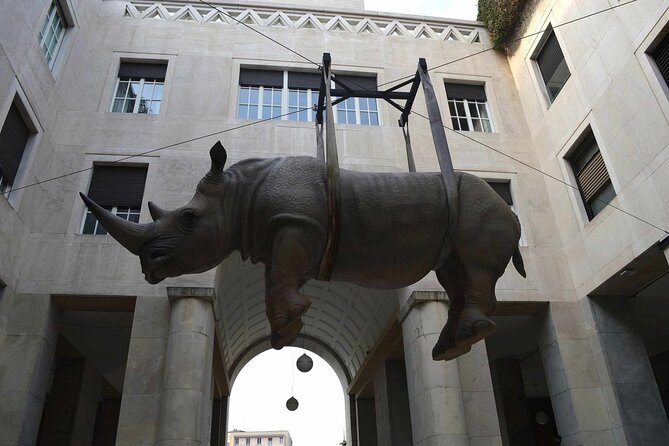
Piazza della Vittoria offers a sharp change in mood and style. The square is a major example of Rationalist architecture, designed by Marcello Piacentini to glorify Mussolini’s regime.
The tour does not treat the square as a simple architectural curiosity. It addresses the politics behind its design and the tragic consequences of that period. At the same time, you can consider the square’s scale and visual power on their own terms.
The stop takes around 20 minutes. It is a useful reminder that beautiful architecture can carry uncomfortable political messages. Brescia’s past is not presented as a polished sequence of victories. The city’s difficult chapters are part of the explanation too.
If you prefer tours that avoid politics, take note. If you want an honest account of how public spaces reflect power, this section adds substance.
Into the Carmine district on Via San Faustino
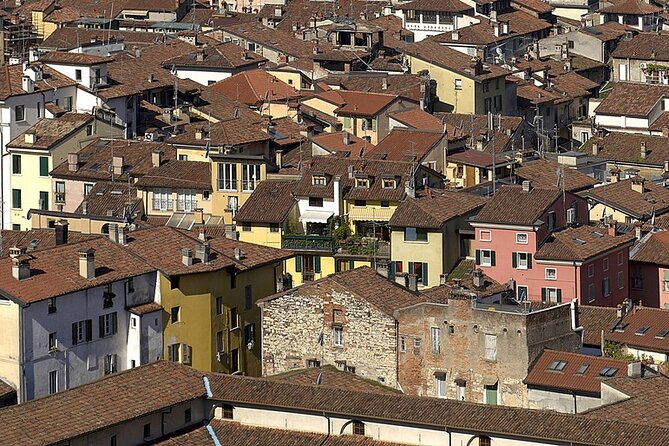
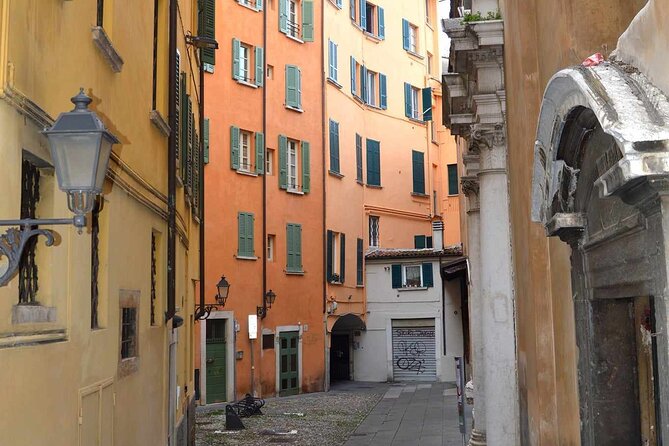
The longest stop is the walk along Via San Faustino and through the Carmine district, lasting about 35 minutes. This is where the tour moves furthest from the postcard version of Brescia.
Carmine was once considered a rougher area. It still carries a rebellious, creative, and proudly independent character. The narrow lanes are linked with labor struggles, worker rights, and anti-establishment movements that grew from the neighborhood.
This part of the route gives you a better sense of local identity. Historic churches and formal squares can explain what a city built, but districts like Carmine help explain how people lived, argued, organized, and pushed back.
The area also makes the tour feel less like a checklist of monuments. You are walking through an ordinary part of the city with its own social memory. Your guide’s stories about the Bresciani, the people of Brescia, are especially useful here.
Because this is a walking tour, the pace and surface conditions matter. One participant described a group with different mobility levels, and Davide adjusted the pace so no one was left behind. Still, you should be ready for a fair amount of walking over historic streets and through lanes.
The final drink and Brescia’s pirlo
The included drink comes after the walking portion. Adults over 18 receive an alcoholic beverage, while anyone under 18 receives a nonalcoholic drink.
The local specialty to look for is the pirlo, a cocktail associated with Brescia. The drink is served at an old bar in the city center, and the stop may come with small snacks. That makes the ending feel connected to local life rather than added as a generic refreshment.
I like this part for two reasons. First, it gives you a chance to sit down after the route. Second, it gives your guide room to explain a local drink and point you toward restaurants and cafés for your next meal.
The drink is not a full meal, so plan lunch or dinner separately. It can, however, be enough to take the edge off after the walk and help you decide where to eat next.
Price, group size, and practical value
At $102.12 per person, this is not the cheapest way to walk around Brescia. The value depends on how much structure and interpretation you want.
You are paying for roughly three hours with an English-speaking guide, a route that covers eight distinct stops, and a drink at the end. The sights themselves have no separate admission charge on the tour, so the main value comes from the route, the explanations, and the local stories.
For a first visit, I think the price is easier to justify. You get an overview of the castle, churches, Roman remains, medieval and Renaissance squares, Fascist-era architecture, and Carmine in one organized outing. You also learn what deserves a longer return visit.
The small maximum of 12 people helps. It should be easier to hear and ask questions than on a large city tour. The experience is also suitable for solo visitors, couples, families, and small groups, provided everyone can manage the walking.
The tour is often booked about 42 days ahead, so I would not leave it until the last day of a short Brescia stay. Free cancellation is available up to 24 hours before the start time. Service animals are allowed, public transportation is nearby, and most people can participate, though the route’s walking and castle climb deserve consideration.
Who should book Brescia the Unexpected
I would choose this tour if you are new to Brescia and want a broad introduction before exploring on your own. It is also a good match if you enjoy local stories, political history, architecture, and places that are easy to miss without a guide.
It suits solo visitors particularly well because the guide provides company and orientation without requiring a private booking. Families can also use the route as a way to turn a city walk into a series of clear stops, though younger children may find three hours of history tiring.
You may want another option if you dislike walking, need a fully step-free route, or care most about spending long periods inside museums. The library visit has day restrictions, and several stops are brief by design.
Should you book this tour?
Book it if you want Brescia explained as a living city rather than reduced to a list of monuments. Davide and Chiara bring together Roman remains, painted church art, medieval politics, modern architecture, Carmine’s social story, and the local pirlo in a compact route.
Choose a weekday other than Monday if the Biblioteca Queriniana matters to you. Wear comfortable shoes, arrive ready for the castle climb, and leave time after the tour for a meal recommended by your guide. For a first look at Brescia, this is a well-balanced introduction with enough local character to make you want to keep exploring.
FAQ
How long does the Brescia tour last?
The tour lasts approximately three hours.
Where does the tour begin?
The meeting point is Via del Castello, 13, 25121 Brescia, Italy.
Where does the tour finish?
The activity ends at a different location from the starting point. The exact end details are provided with the booking information.
What language is the tour offered in?
The guided tour is offered in English.
How many people can join the tour?
The maximum group size is 12 people.
Is a drink included?
Yes. Each participant over 18 receives an alcoholic drink. Participants under 18 receive an alcohol-free drink.
What is the pirlo mentioned in the tour?
A pirlo is a cocktail associated with Brescia. The final drink takes place at a local old bar in the city center.
Is the Biblioteca Queriniana visit available every day?
No. The library and bishop’s palace are not available on Saturday afternoons, Sundays, or Mondays.
Can I cancel the booking for a full refund?
Yes, if you cancel at least 24 hours before the experience start time. Cancellations made less than 24 hours ahead are not refunded, and changes made within that period are not accepted.
Just added around Italy
- Guided Cultural Tour of the Godfather Film in Messina★ 5.0 · 31 reviews
- Guided tour of the Riace Bronzes and the Archaeological Museum of Reggio Calabria★ 5.0 · 44 reviews
- SU NURAXI BARUMINI Unesco World Heritage Site★ 5.0 · 129 reviews
- Bolognese Cooking Class with Margherita in the Historic Center★ 5.0 · 26 reviews
- Tower and Power, Virtual tour in Medieval Bologna★ 4.5 · 54 reviews
- Bologna historical art walking tour with hidden gems and tastings★ 5.0 · 108 reviews
- Best of Bologna in one day : Food, architecture, art and history★ 5.0 · 27 reviews
- Private or semi-private tour of the historic center of Bologna★ 5.0 · 34 reviews
Italy History Tours, compared.
Pompeii: Entry Ticket and Guided Tour with an Archaeologist
Read our review →
Colosseum: Underground and Ancient Rome Tour
Read our review →
Pompeii: Small Group Tour with an Archaeologist
Read our review →Pompeii Small Group Tour with an Archaeologist
Read our review →
Rome: Colosseum with Arena, Roman Forum and Palatine Guided Tour
Read our review →
Venice: St. Mark’s Basilica Guided Tour & VR History Intro
Read our review →
Colosseum with Arena, Roman Forum and Palatine Hill Guided Tour
Read our review →
Herculaneum: Skip-the-Line Guided Tour with Archaeologist
Read our review →Browse the lists this tour appears in